
In this part of the series, I will follow the Lake Erie shoreline west from the Buffalo-area to Downtown Cleveland, Ohio, and in the next part of the series I will pick up the journey in West Cleveland and continue going around the entire lakeshore.
So far I have looked in-depth at cities and places all around the shores of Lake Superior, Lake Michigan, Lake Huron, and Lake Ontario, paying particular attention to lighthouses; railroad and streetcar history; waterfalls, wetlands and dunes; interstates and highways; golf courses, airports and race tracks; major corporate players; mines and mining; labor relations; and many other things.
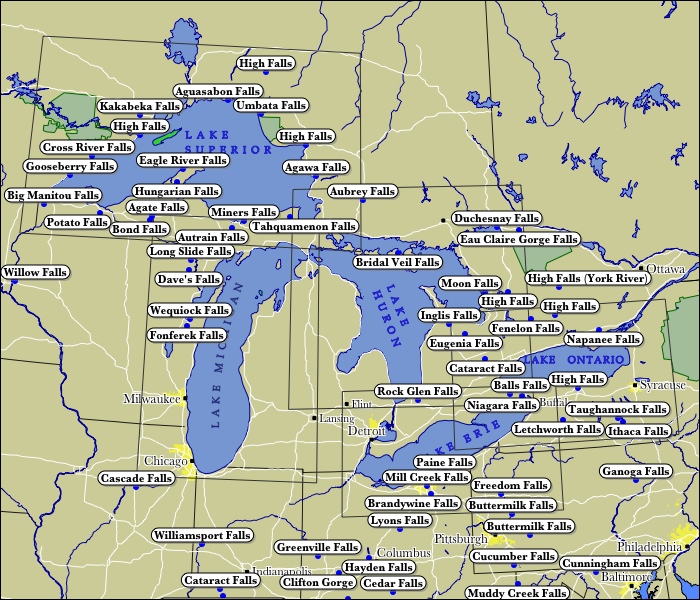
As a way of focusing my research, I will specifically follow the location of lighthouses and waterfalls around Lake Erie as I have been doing in this series as this particular focus has yielded a great deal of information as to what I believe happened here and our hidden history.
I believe there was a highly-sophisticated and highly-controlled hydrological and electrical system throughout the Great Lakes Region that was an integral part of the Earth’s original free energy grid system, and as we go through the information available to find along the way, I will continue to show you exactly why I think the Great Lakes were formed from tremendous amounts of water from the outflow of the waterfalls and the interconnected hydrological system when the original energy grid was destroyed and as quickly as possible, was replaced by nonrenewable energy resources that exist in limited supplies.
I believe the destruction of this energy grid was a worldwide event, and that the surface of the Earth was subsequently destroyed around its key infrastructure, which besides waterfalls, included components like lighthouses, rail infrastructure, canals, and what we know of as “forts,” and turned the landscape we see today into lakes, dunes, deserts, swamps, bogs, or causing the land to shear off and/or become submerged.
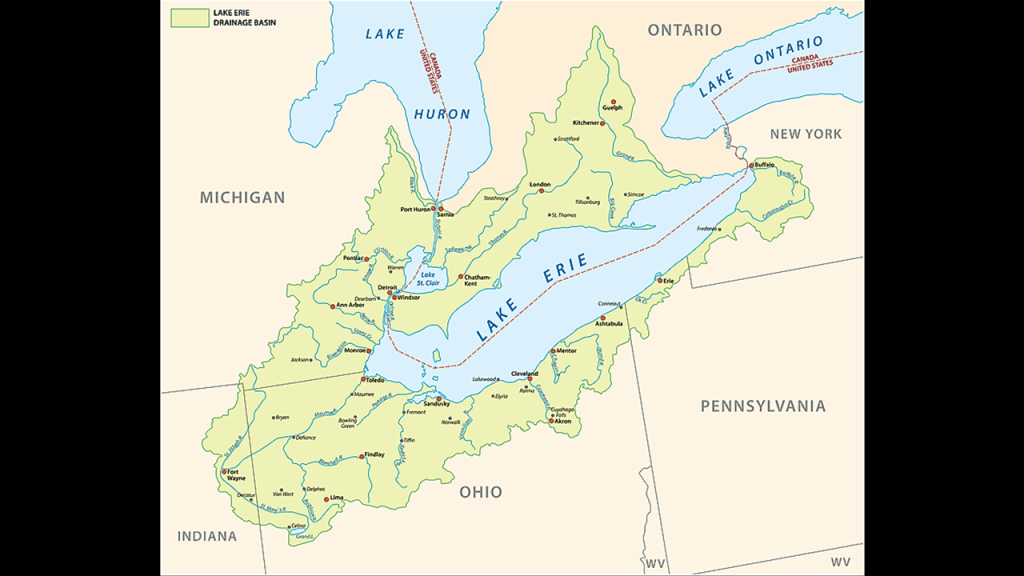
I have finally arrived at Lake Erie, the last of the five Great Lakes of North America for me to take a look at.
Like Lake Ontario, Lake Huron and Lake Superior, Lake Erie is located on the International Boundary between Canada and the United States.
The Canadian Province of Ontario occupies most of its northern-shore, along witht the States of Michigan on the northwestern- and Ohio on the western-shore; Ohio and Pennsylvaniaon the southern-shore, and New York on the southern and southeastern-shore.
Lake Erie is the fourth-largest Great Lake by surface volume, but the shallowest and smallest by volume of the five lakes.
Lake Erie has an average depth of 63-feet, or 19-meters, and is divided into three basins.
The Western Basin, and Lake St. Clair in the Detroit-Windsor area connected to Lake Erie by the Detroit River, are quite shallow, with depths , throughout ranging from 0- to -10-meters, or 33-feet.
The Central Basin is somewhat deeper, with depths ranging from 0- to 25-meters, or 0 – 82-feet.
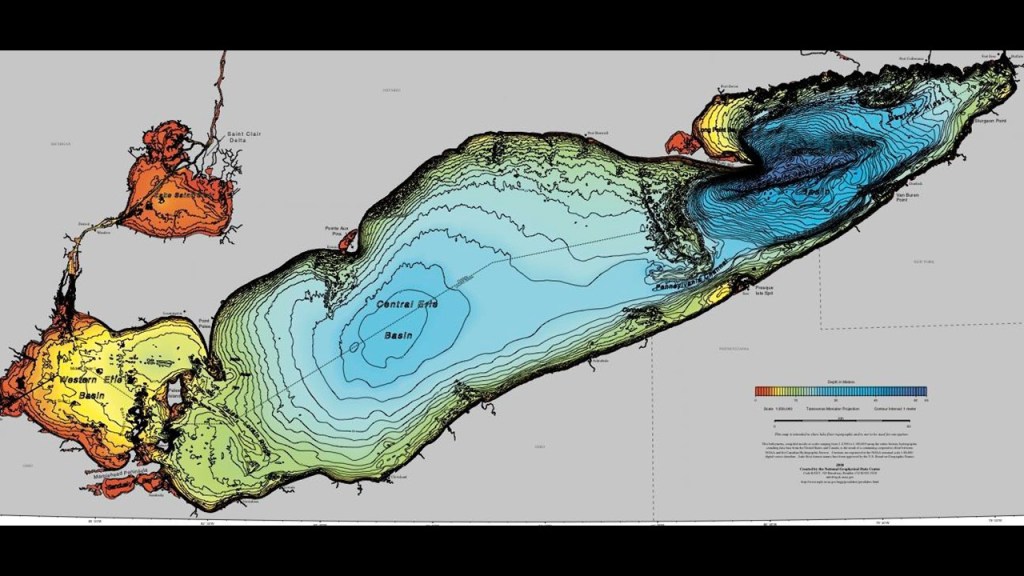
The Eastern Basin is the deepest, with depths ranging from 0- to 64-meters, or 0- to 210-feet, where the deepest point of Lake Eriemarked by an “X” circled in red, making it the only Great Lake whose deepest point is above sea-level.
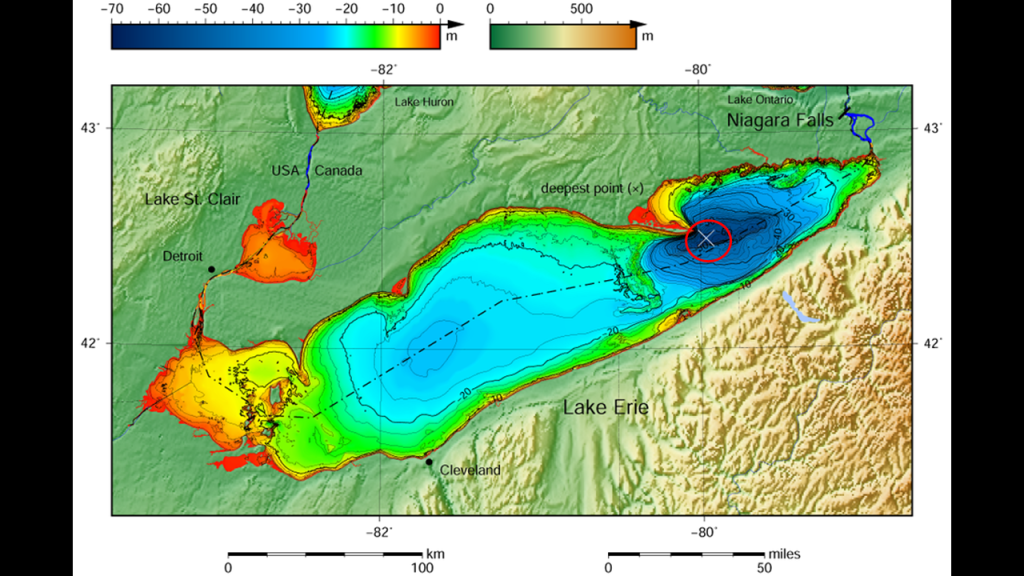
The depth contrast of the shallow western-end and the deep eastern-end causes water to pile-up when strong winds push the lake-water east or west.
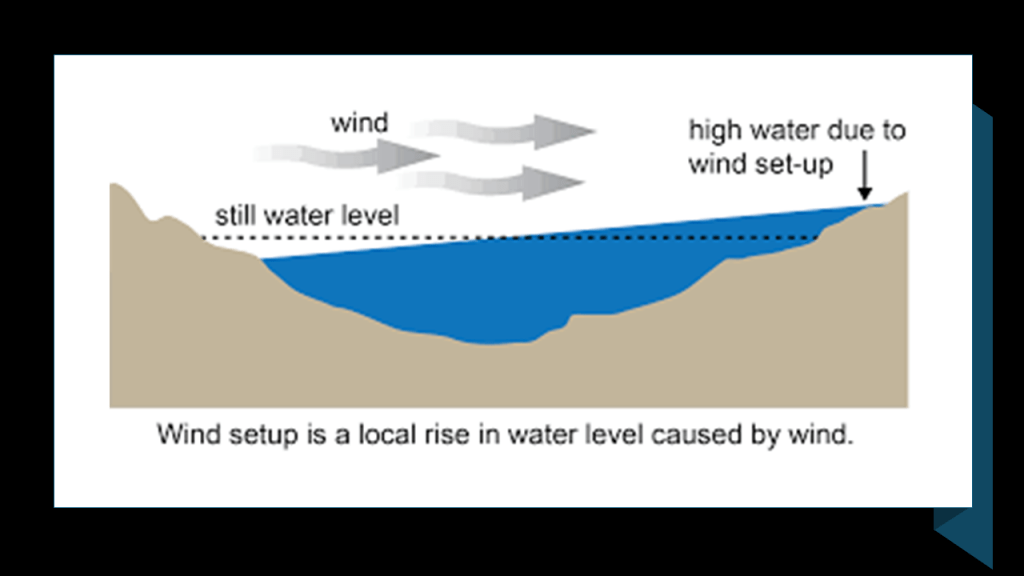
This results in a phenomenon known as a “seiche,” which happens strong winds push the lake water east or west, causing the water to pile up, or drain, and which Lake Erie is more prone to than the other Great Lakes.
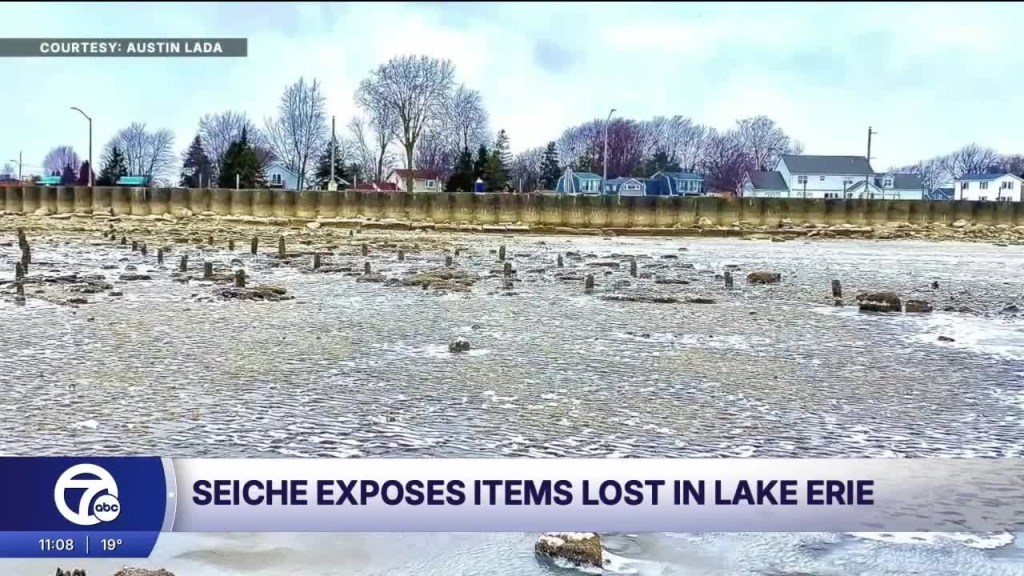
A “seiche” is the name for a standing wave in an enclosed, or partially-enclosed, body of water.
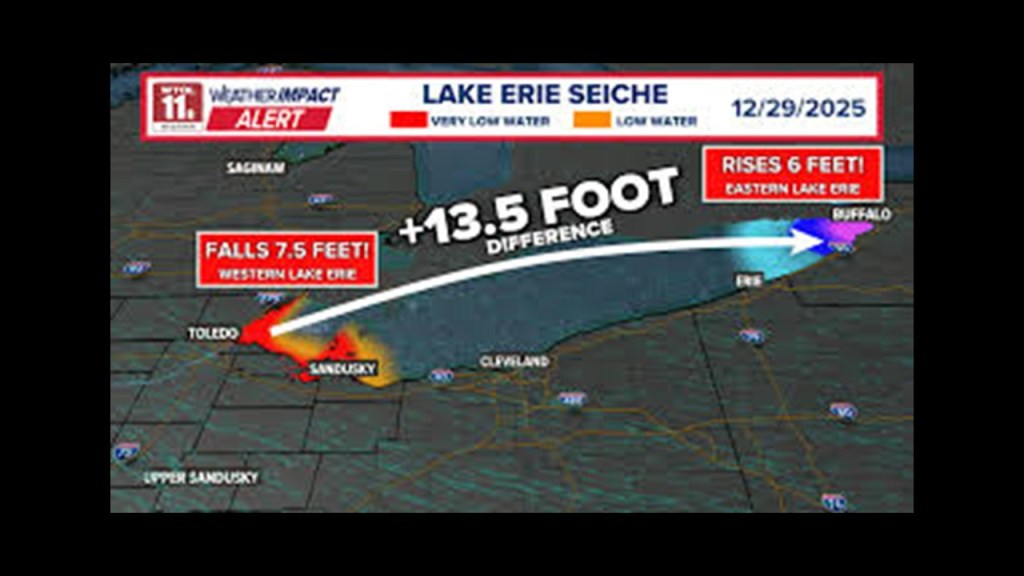
The seiches of Lake Erie are known to drain water out of one end of the lake and cause extreme flooding at the other end.
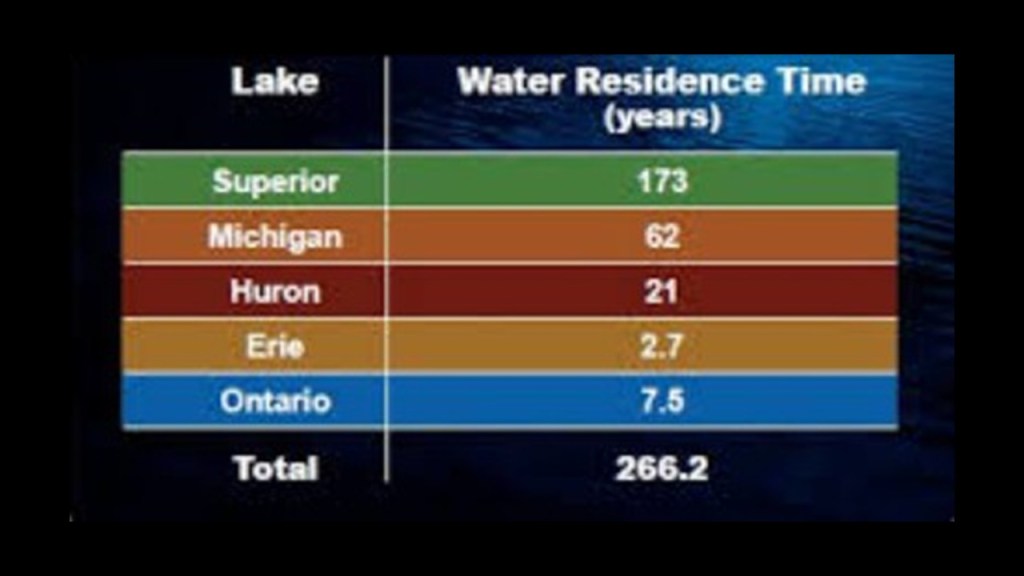
Lake Erie also has the shortest average water residence time of the Great Lakes at 2.7-years, meaning the average time that water spends in a particular lake.
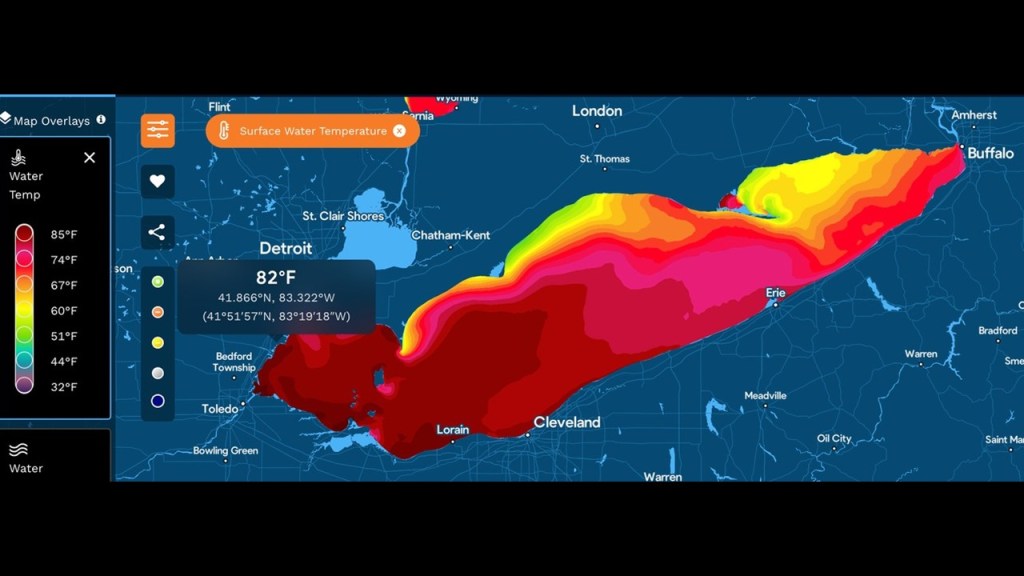
Lake Erie is also the warmest of the Great Lakes because it is the shallowest, and frequently reaches peak water temperatures in the 70 to 80-degree Fahrenheit-range, or upper 20-degree-Celsius-range, in the summer months of July and August, and more during heat waves.
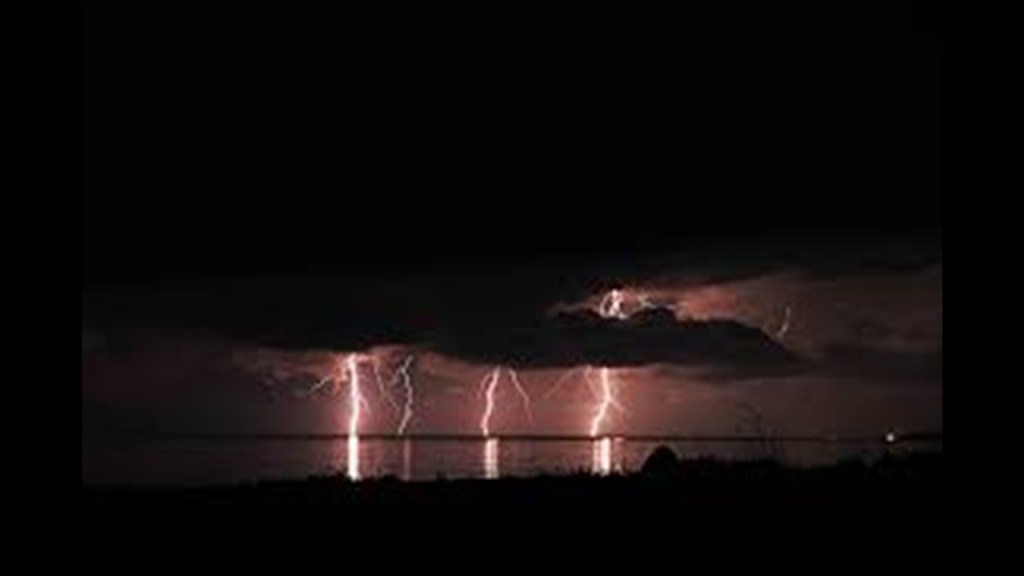
The Lake Erie Region is known as the “Thunderstorm Capital of Canada” as well, with impressive displays of lightning.
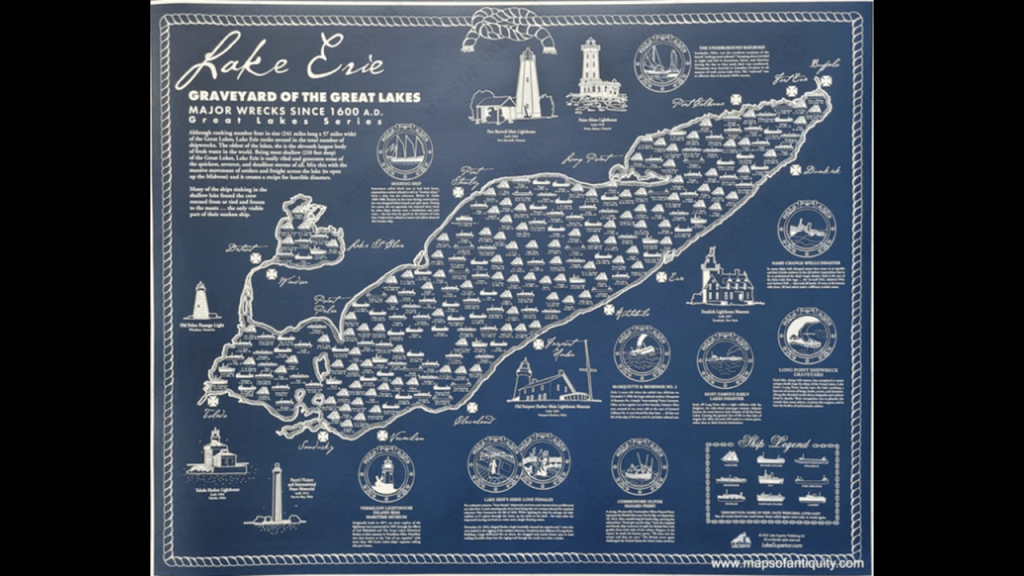
The relatively shallow waters found throughout the Great Lakes are notorious for shipwrecks, with an estimated somewhere between 6,000 to 10,000 ships and somewhere around 30,000 lives lost.
The reasons we are given for the high number of shipwrecks consist of things like severe weather, heavy cargo and navigational challenges.
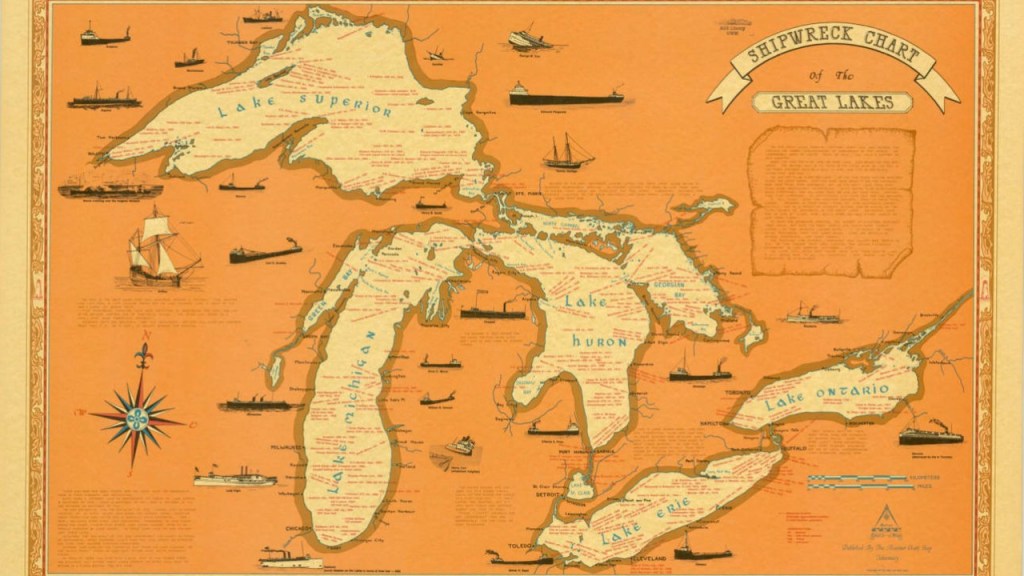
Lake Erie has one of the highest concentrations of shipwrecks anywhere on Earth, with an estimated 2,000 sunken vessels and only 400 of those have been discovered.
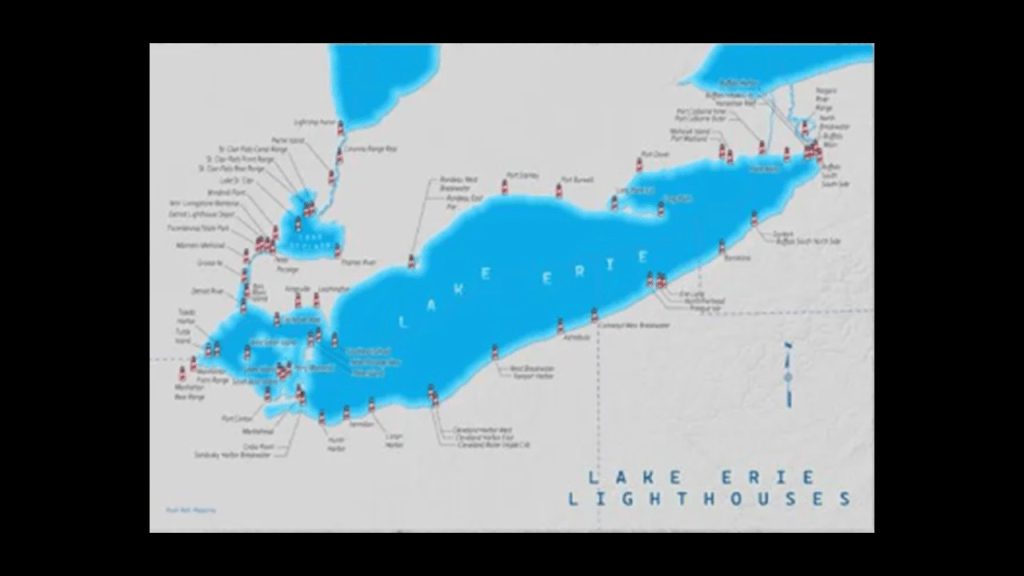
There are over 50 lighthouses around the shores of Lake Erie, most of which I will be including in this journey.
I already looked at the lighthouses shown here that go up the Detroit River, Lake St. Clair, and St. Clair River to the southern tip of Lake Huron in Part 3 of the series on the Michigan-side of Lake Huron.
While all of the Great Lakes have lighthouses, it is interesting to note that one of Michigan’s nicknames is “The Lighthouse State,” as it has more lighthouses than any other state.
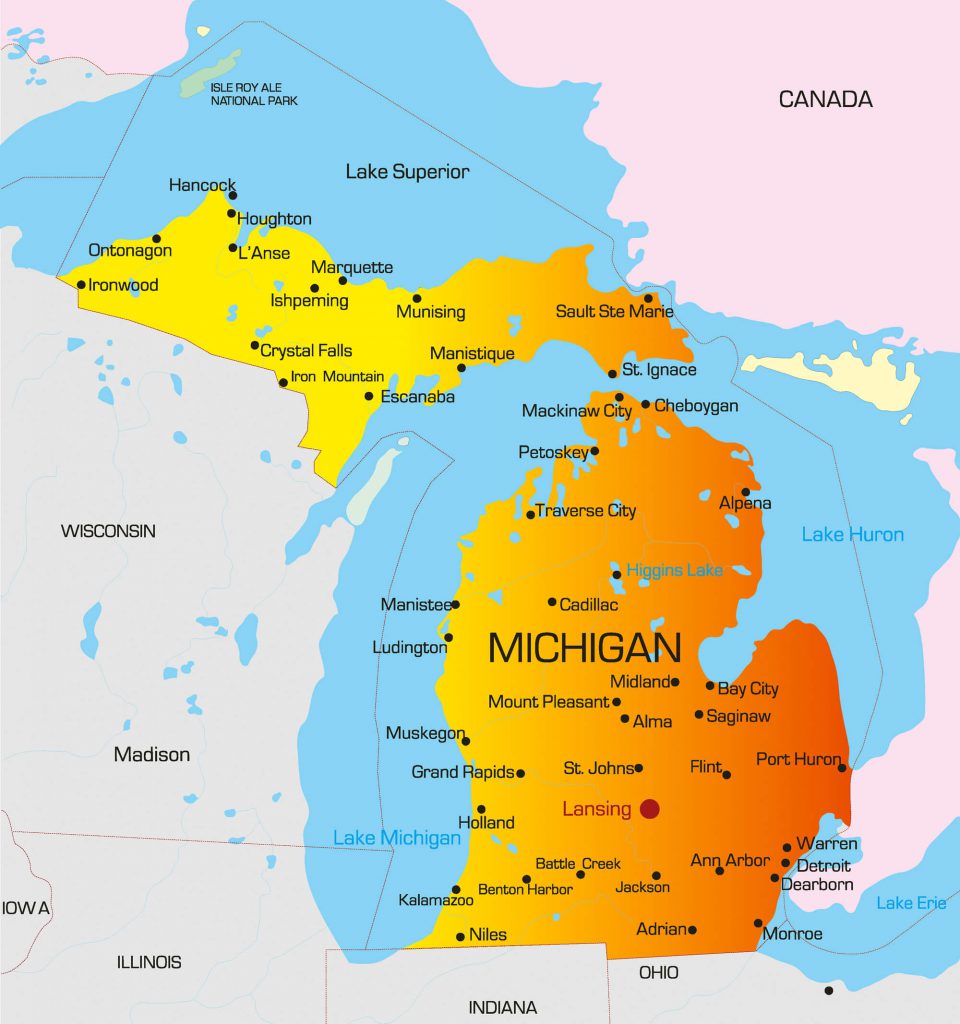
The State of Michigan is surrounded by four-out-of-the-five Great Lakes.
Generally-speaking, Lake Superior is on the northern-side of Michigan, bordering the state’s Upper Peninsula; Lake Michigan is on the western-side; Lake Huron on the eastern-side; and Lake Erie on the southeastern-side.
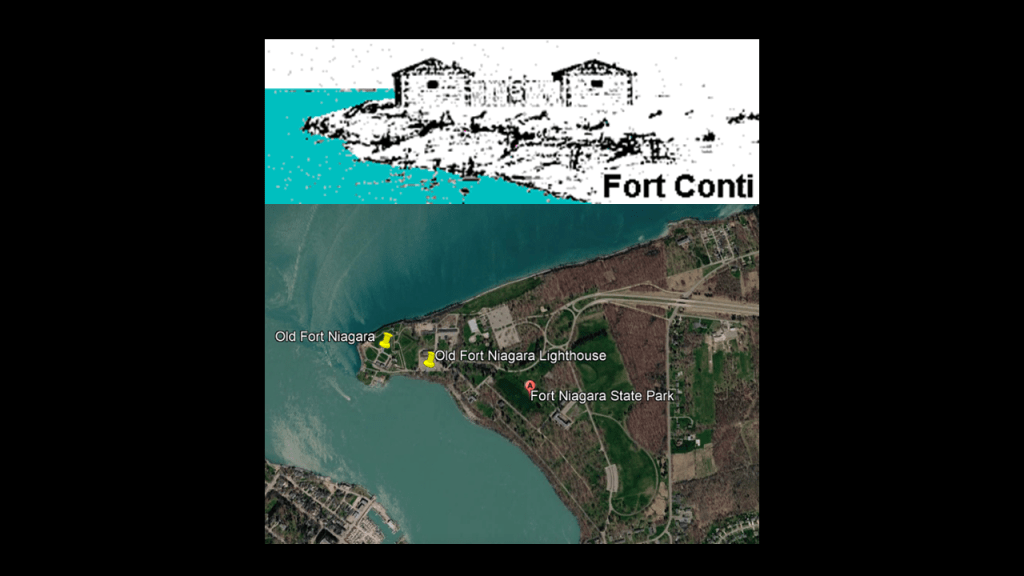
In our historical narrative, we are told Europeans started entering the Niagara River-area between Lake Ontario and Lake Erie in the 17th-century, with Frenchman Robert de la Salle given the credit for building Fort Conti at the mouth of the Niagara River in 1679, as a base for exploring for the Northwest Passage to Japan and China to extend France’s trade.
The location we are given for Fort Conti is Old Fort Niagara where the Niagara River meets Lake Ontario.
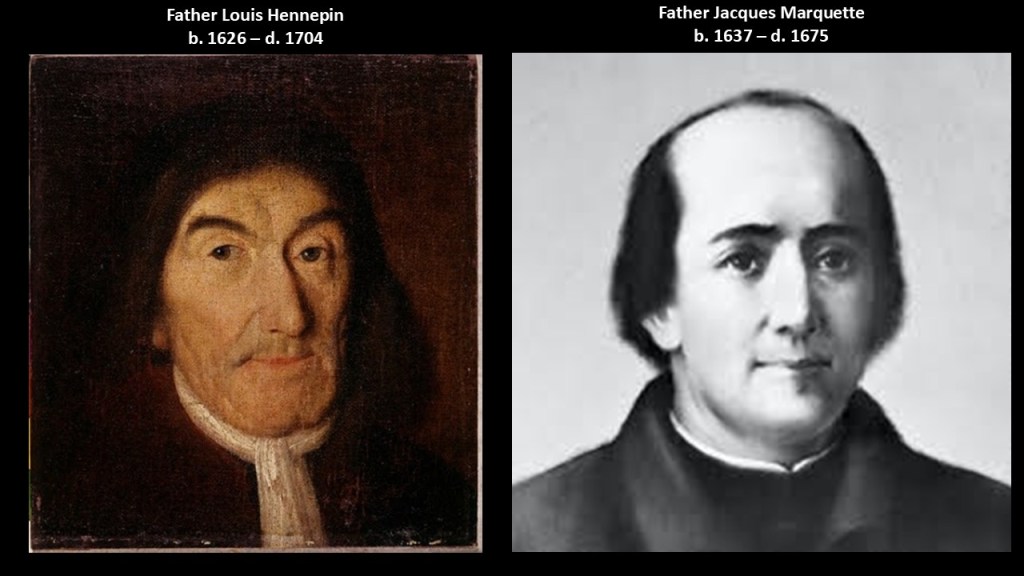
Robert de la Salle was accompanied by Belgian priest, missionary, and explorer of the North American interior, Franciscan Father Louis Hennepin, said to have been the first European to see the Niagara Falls.
Father Hennepin was a contemporary of the French Jesuit Father Jacques Marquette, who explored all over Lake Superior, Lake Michigan and Green Bay in our historical narrative.
While the Franciscans were members of related-religious orders said to have been founded by the highly-venerated and gentle St. Francis of Assisi in 1209, the Patron Saint of Animals, the Environment and Italy…

…I think the Franciscans played a similar role as the Jesuits with regards to what took place here in subverting the indigenous peoples and real history of the Americas.
The Franciscans were called the vanguard of missionary activity in the New World, but I definitely think they were also an active part of the cover-up and subversion of the original advanced civilization and its people here and in other parts of the world.
Let’s find out what a close look around Lake Erie tells us about this civilization that is missing from our collective awareness and our history books.
The first place I am going to look at on Lake Erie is Buffalo, New York’s second-largest city, and the county seat of Erie County.
Buffalo serves as a major gateway for travel and commerce across the Canadian border, forming part of the bi-national Buffalo-Niagara Region and Buffalo-Niagara Falls metropolitan area.
Niagara Falls, just to the north of Buffalo, is at the International Boundary between the United States and Canada, with the city of Niagara Falls in New York on one side, and the city of Niagara Falls in Ontario on the other.
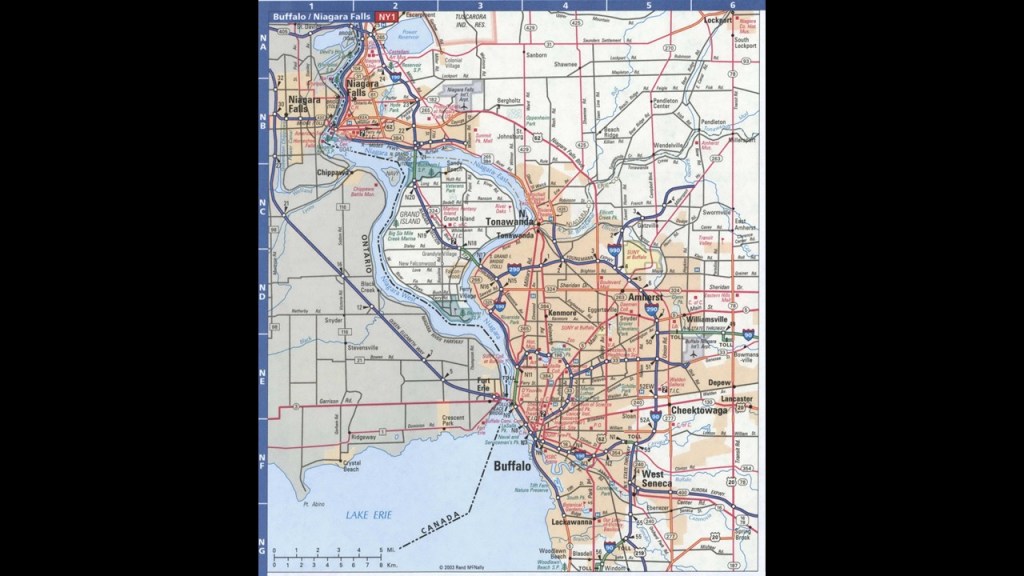
Grand Island is situated in-between the Niagara Falls-area and the Buffalo-area.
It is the largest Island in the Niagara River in New York, and I looked at Grand Island in-depth in Part 5 of this series.
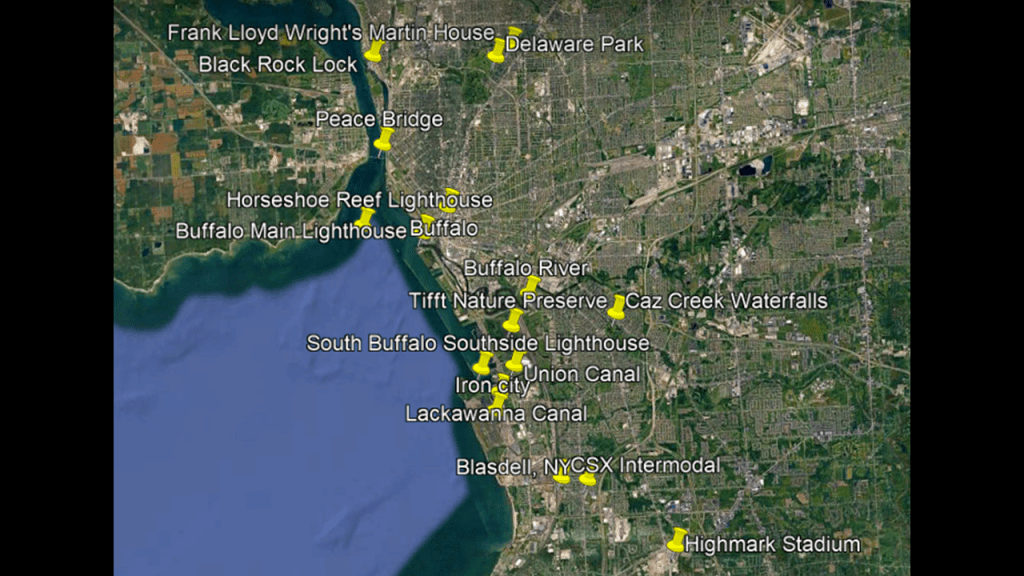
These are some of the places I am going to be looking at in the Buffalo-area, including places like the Black Rock Lock; the Peace Bridge; Delaware Park and the Martin House attributed to Frank Lloyd Wright, the Buffalo River; the three lighthouses in Buffalo; some of the canals in Buffalo; the Caz Creek Waterfalls, the Tifft Nature Preserve; Highmark Stadium; and a few other places as well.
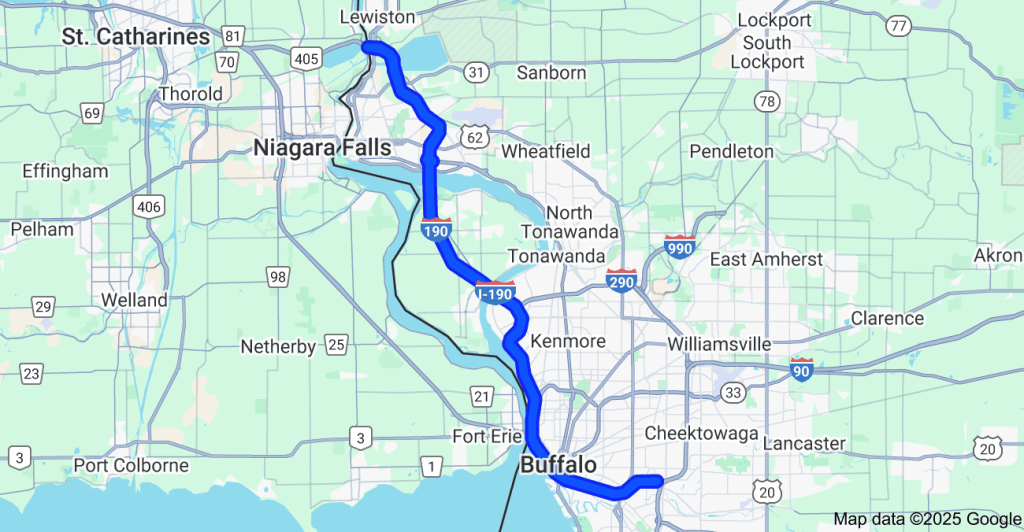
Interstate-190 connects Interstate-90 in Buffalo with the International Border at Lewiston, where it crosses the Lewiston-Queenston Bridge and from there becomes Ontario Highway 405.
Interesting to note that parts of Interstate 190 were built along the Rights-of-Way of the Lehigh Valley Railroad and the Erie Canal.
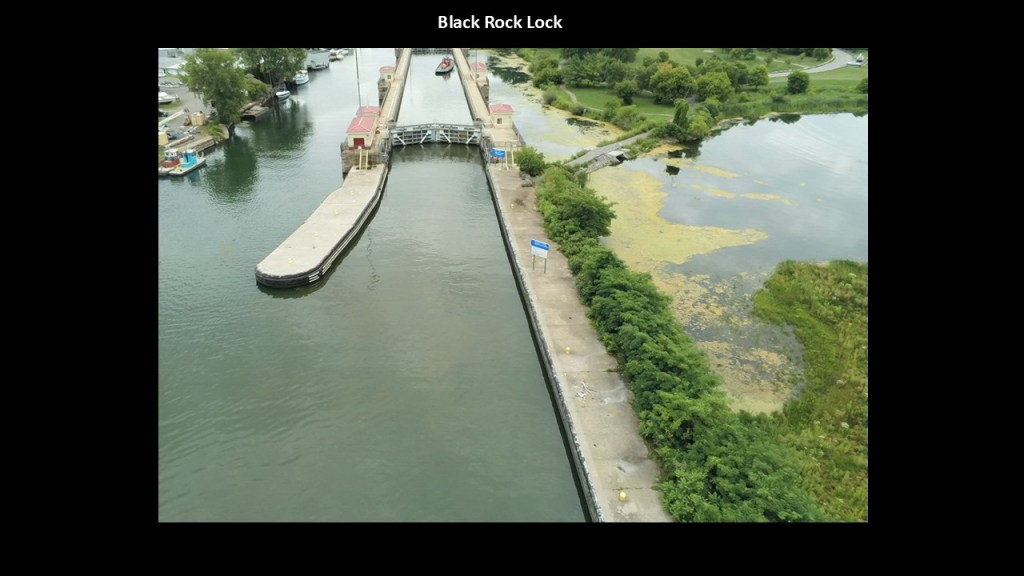
Heading north out of Buffalo, Interstate-190 follows the eastern edge of the Black Rock Channel.
The Black Rock Channel is 3.5-miles, or 5.6-kilometers, -long, and extends from Buffalo Harbor to the Black Rock Lock.
The Black Rock Lock allows vessels to bypass rapids on the Niagara River at the outlet of Lake Erie.
We are told it was the first lock was constructed by the U. S. Army Corps of Engineers in 1833 for the Erie Canal, and that it was enlarged in 1913.
The Tonawanda Channel, in the Niagara River on the eastern-side of Grand Island, is dredged and maintained to allow boat traffic to enter the canal system from the Niagara River or vice versa, and is the western terminus of the modern Erie Canal, as well as connecting the cities of Tonawanda and North Tonawanda in New York.

The Erie Canal in New York State runs for 351-miles, or 565-kilometers, between Lake Erie at Buffalo to the Hudson River near Albany.
It was said to have been constructed starting on July 4th of 1817 and first opened on October 26th of 1825.
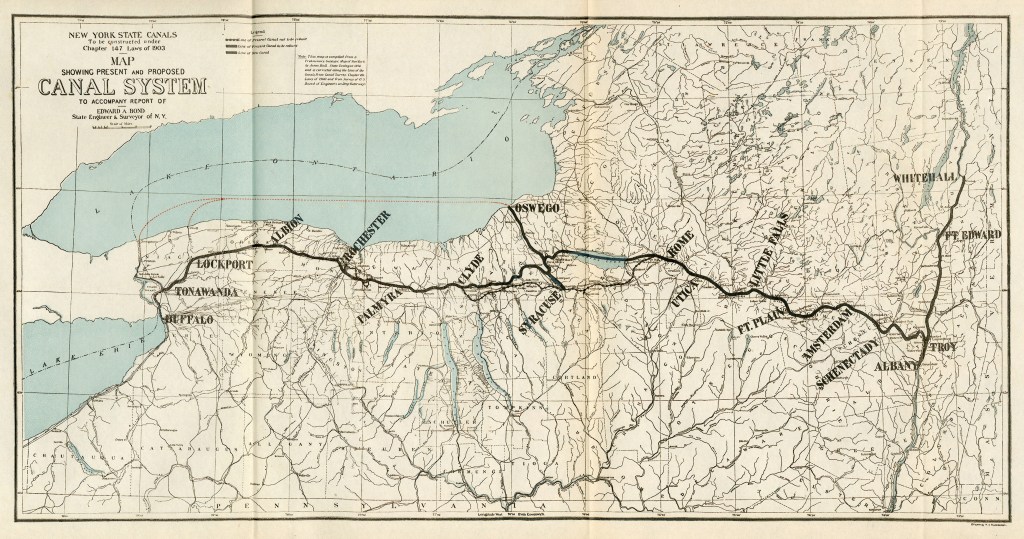
In our historical narrative, the opening of the Erie Canal made it the first navigable waterway connecting the Atlantic region to the Great Lakes, and accelerated the settlement of the Great Lakes region, the westward expansion of the United States as it greatly reduced the cost of transporting people and goods across the Appalachian mountains.
According to what we have been told, the Erie Canal was built during the American Canal Age.
We are told the American Canal Age was between 1790 and 1855, and started in Pennsylvania, where the first legislation surveying canals was first passed in 1762.
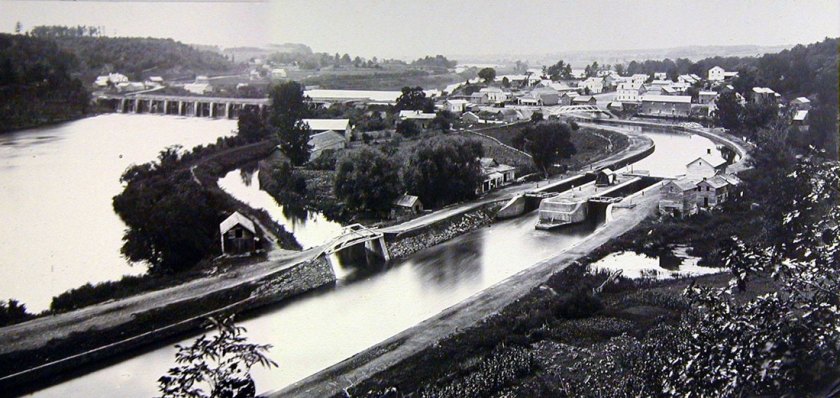
We are told that the “Main Line of Public Works” was passed by the Pennsylvania Legislature in 1826, and that it funded the construction of various transportation systems, including canal, road, and railroad.
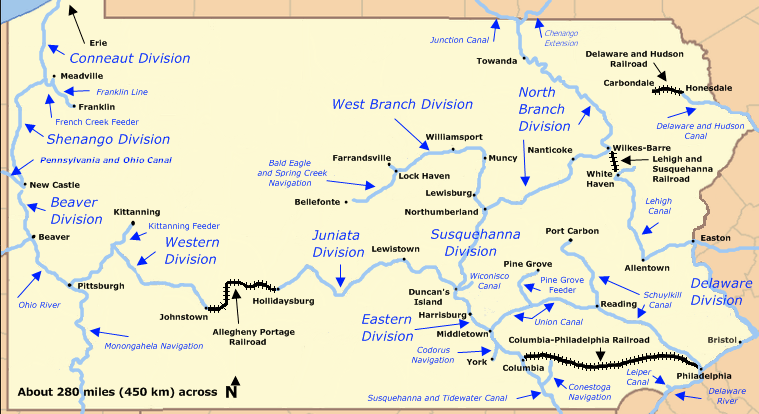
We are told the lower section of the Lehigh Canal was built between Easton, Pennsylvania and Mauch Chunk, now known as Jim Thorpe, Pennsylvania, with construction said to have been started in 1818, and completed in 1838.
This map also has a caption at the bottom that says this was the original Lehigh Valley Railroad line as well, which was said to have opened in 1855.
This would be connected to the same Lehigh Valley Railway that I mentioned that parts of Interstate-190 were built along the Rights-of-Way for, along with the Erie Canal.
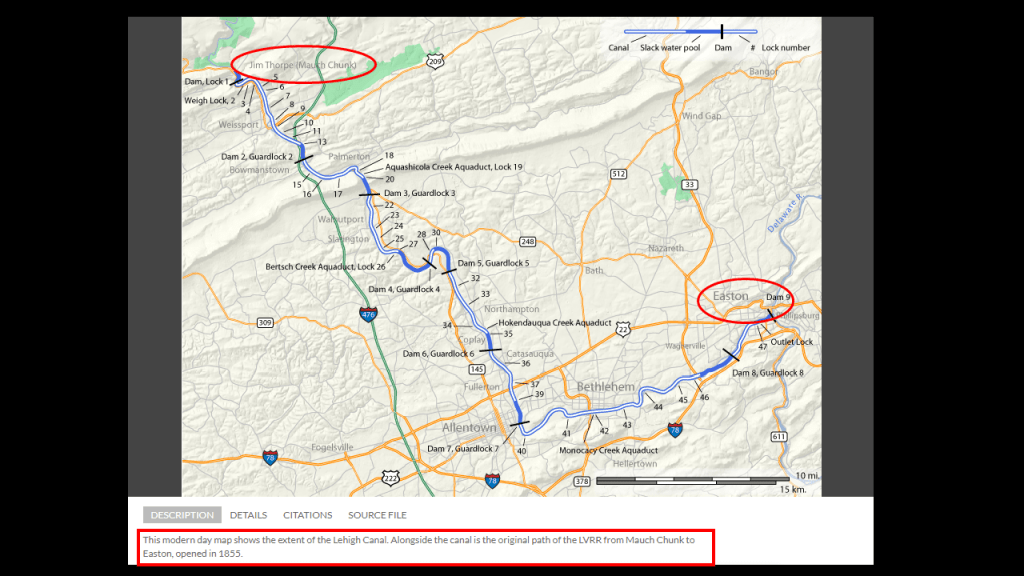
The Lehigh Gorge is part of the historic Lehigh Valley Railway, and what’s left is operates as a Scenic Railway, and today otherwise its abandoned railroad tracks are a recreational rail-trail.
It is one of many places I know of off the top of my head featuring the co-location of S-shaped river bends, railroads, canals, gorges, and waterfalls.
The Lehigh Gorge is described as a “steep-walled gorge carved by a river, thick vegetation, rock-outcroppings, and waterfalls characterize the state park.”
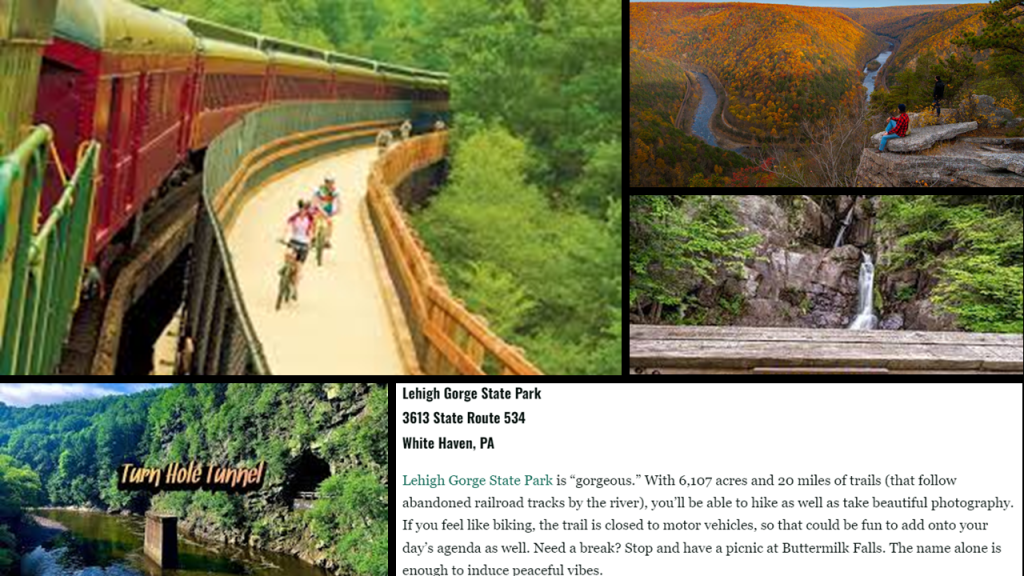
The Lehigh Gorge Trail follows more than 20-miles, or 32-kilometers of the Delaware and Lehigh Trail, part of the larger Delaware and Lehigh National Heritage Corridor.
The Delaware and Lehigh National Heritage Corridor preserves the historic pathway that carried coal and iron ore from Wilkes-Barre to Philadelphia.
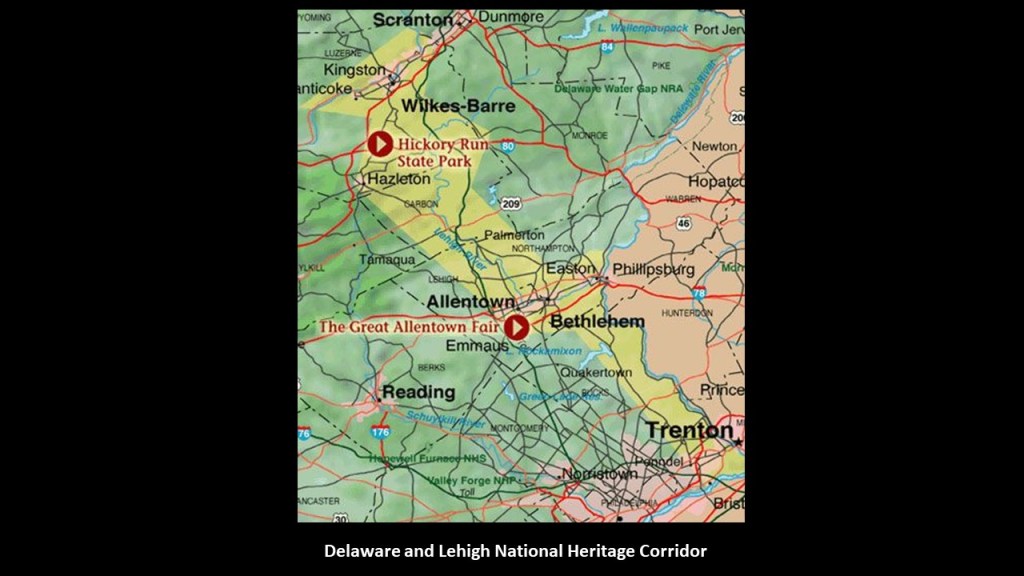
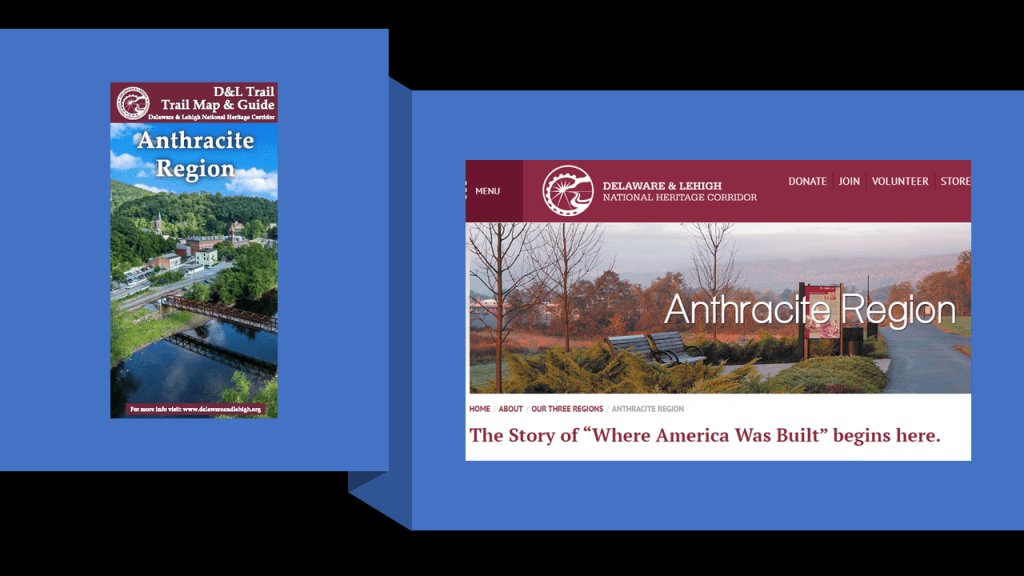
The Delaware and Lehigh National Heritage Corridor was also known as the “Anthracite Region” where the story of “where America was built” began.
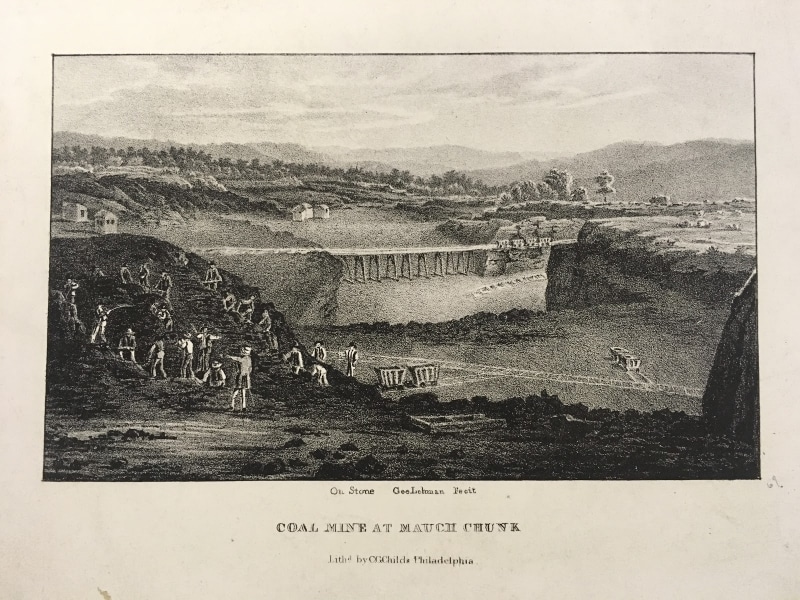
Anthracite coal is the purest form of coal.
We are told that the demand for anthracite coal increased in the 1820s and 1830s as coal-power replaced water power, and with the growth of the iron industry in Pennsylvania.
In Part 5 of this series on the New York-side of Lake Ontario, I found the Black Diamond Trail, a rail-trail found at Taughannock Falls State Park that was once part of the Lehigh Valley Railroad route whose Black Diamond Express once ran between Buffalo and New York City.
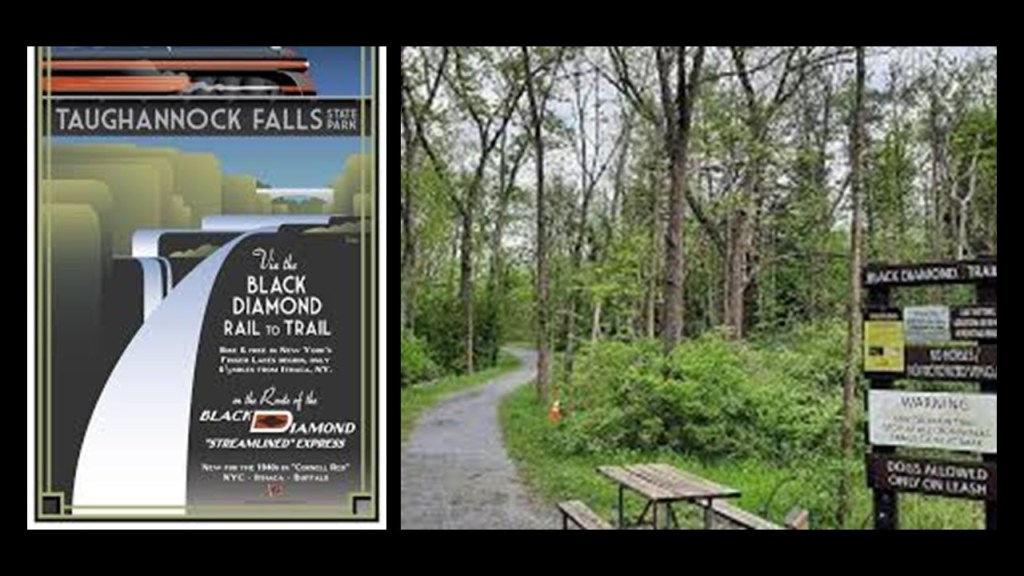
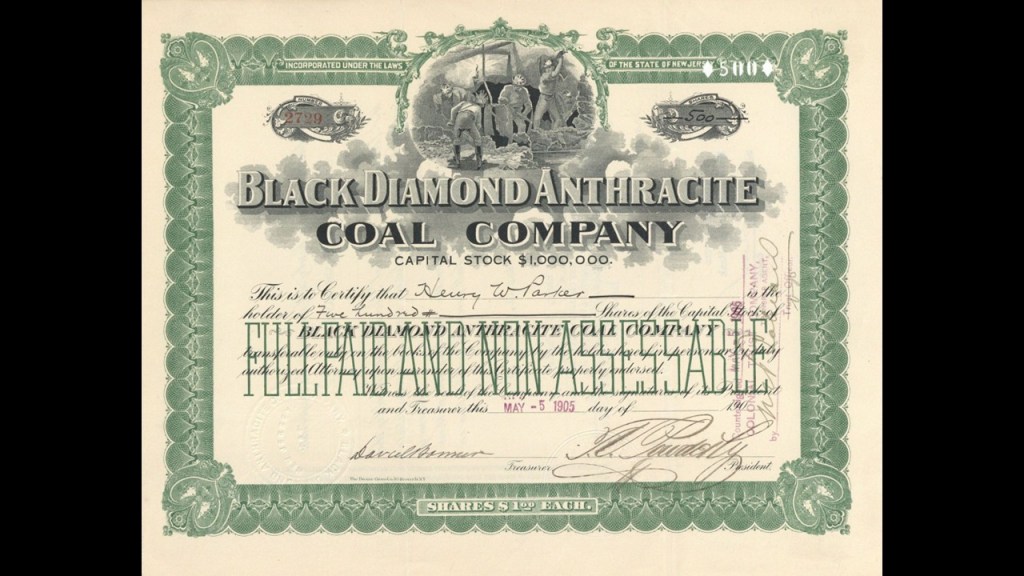
The term “Black Diamond” was a nickname for anthracite coal, which was a high-quality, dense, and hard coal, and a key energy source during the time we know of in our history as the Industrial Revolution.
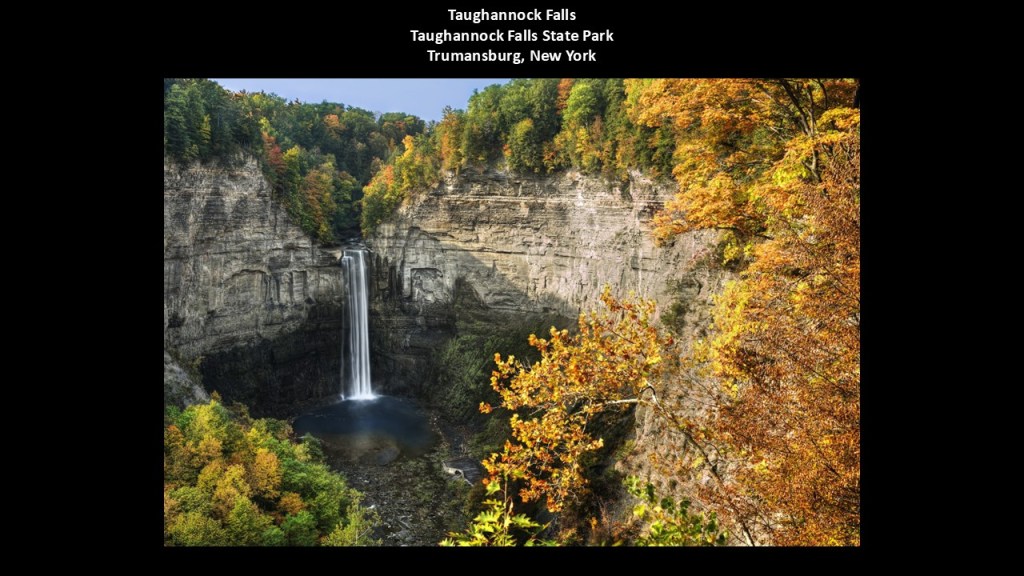
Taughannock Falls, at 215-feet, or 66-meters, -tall, is the tallest, single-drop waterfall in the United States.
I have long suspected that waterfalls are infrastructure of some kind, and not created by natural forces over a vast periods of geological time as we have always been taught, and this journey around all of the Great Lakes has brought forward many connections to waterfalls, railroads and canals that have deliberately been obscured so that we would not know about them.
Back in Buffalo,we find the International Railway Bridge and the Peace Bridge connecting Buffalo and Fort Erie, Ontario.
First, the International Railway Bridge.
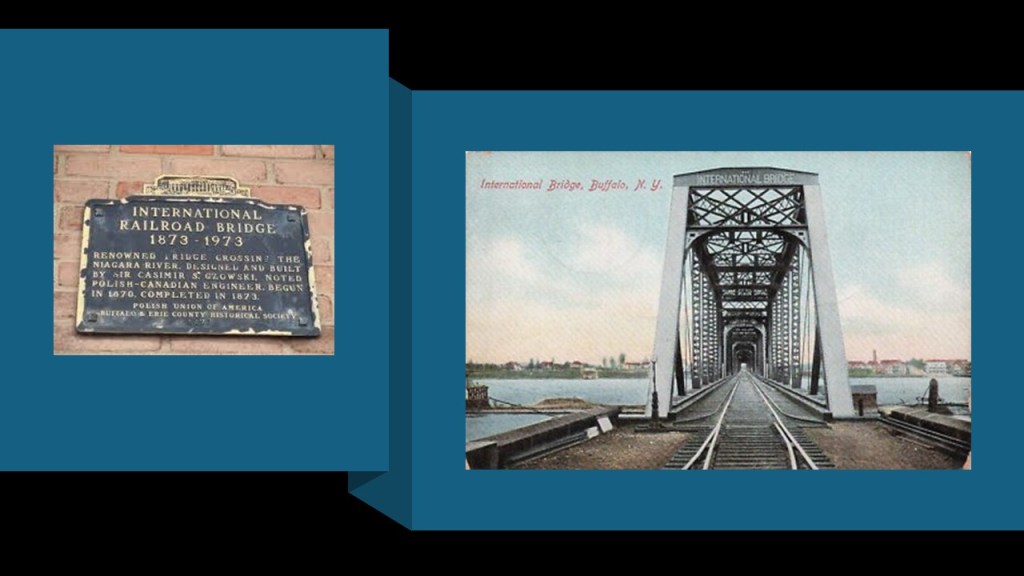
A steel-truss swing bridge, it is said to be oldest bridge at this location.
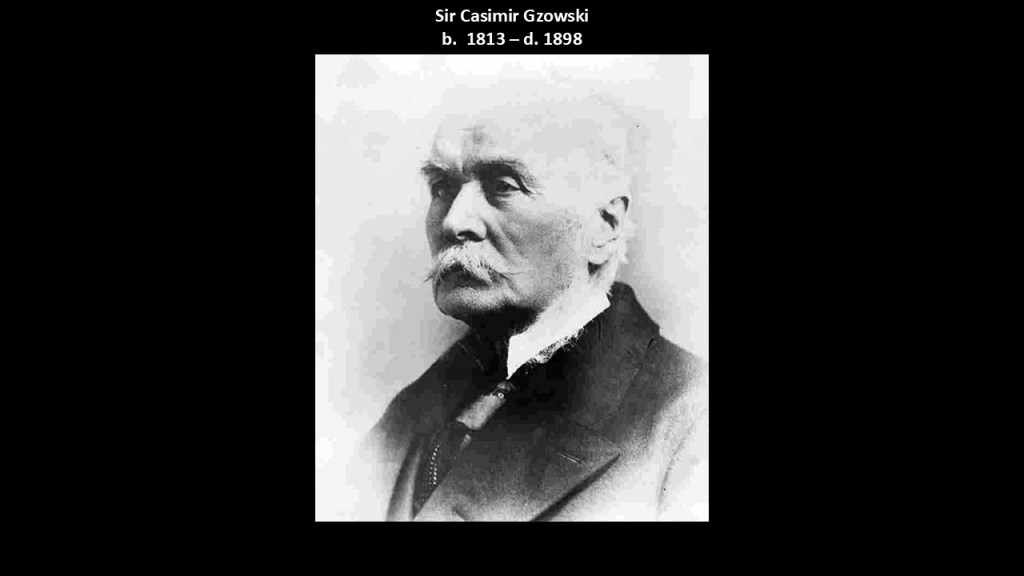
We are told it was originally been constructed between 1870 and 1873 for the International Bridge Company to provide an American link to connect the Grand Trunk Railway of Canada with American lines and designed and built by Sir Casimir Gzowski, and we are told that it was later strengthened in 1901.
It was a crucial trade link in the 19th-century and is still in use for freight traffic by the Canadian National and Canadian Pacific Railways today.
Sir Casimir Gzowski was a Polish-born Canadian civil engineer and political figure known for his work on a wide variety of Canadian Railways in our historical narrative, including, but not limited to, the New York and Erie Railway; the Atlantic and St. Lawrence Railway; and sections of the Grand Trunk Railway.
He was knighted by Queen Victoria in 1897.
On the American mainland, Canadian rail traffic is received by the Black Rock Railyard.
The railyard is surrounded by old residential neighborhoods and some abandoned industrial facilities.
Most of the rail-bed in the yard has been ripped up.
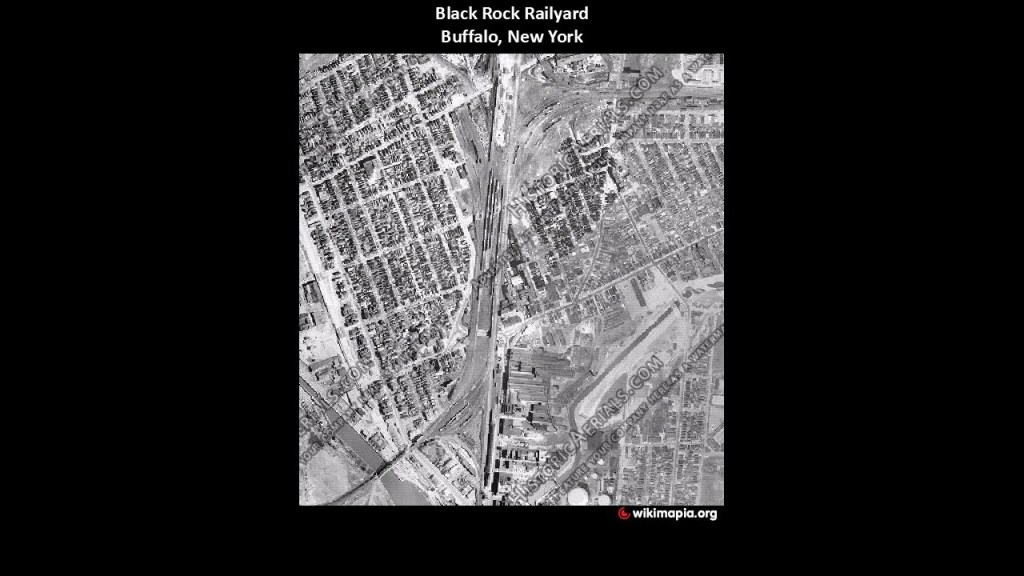
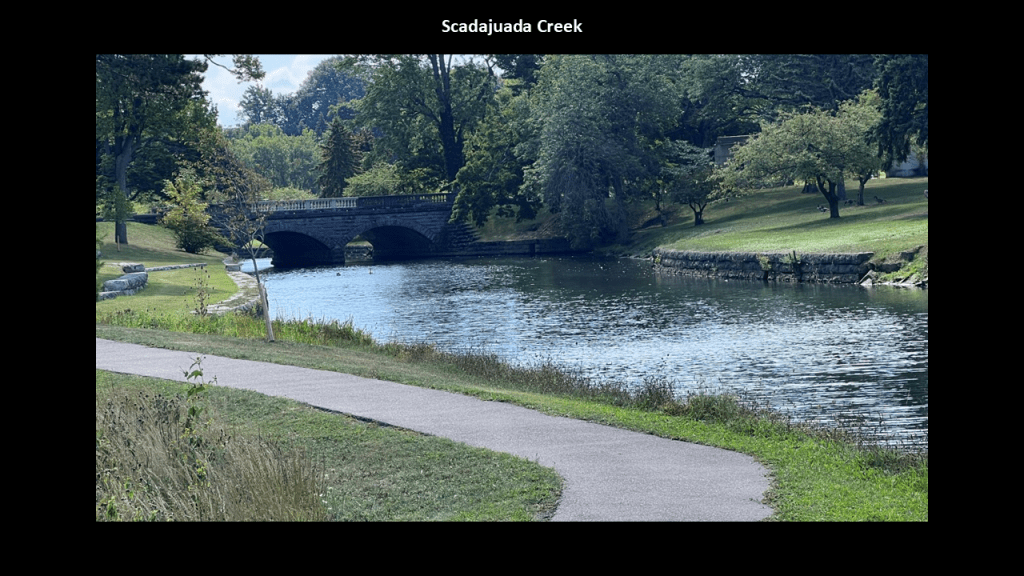
Interstate-190 is to the south of the railyard, as well as Scajaquada Creek, which I am certain is a covered-up canal and which empties into the Niagara River through the Black Rock Channel.
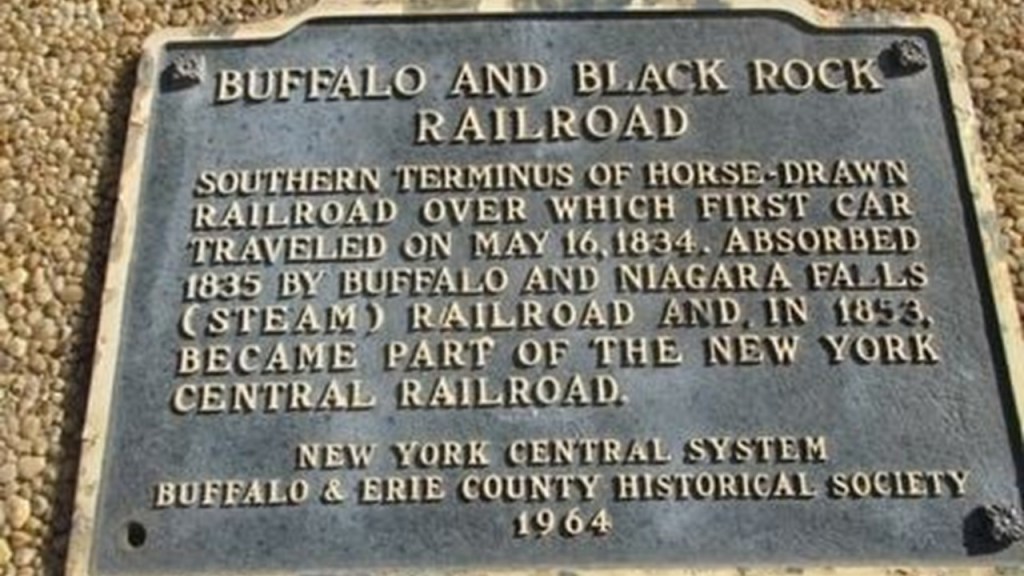
We are told the Railyard was built as the northern terminus of the Buffalo and Black Rock Railroad, a horse-powered line from downtown Buffalo.
Just to be clear, I believe all rail infrastructure everywhere was a pre-existing part of the destroyed free-energy grid system, and that it was brought back on-line initially by horse- and mule-power until other technology was developed for power.
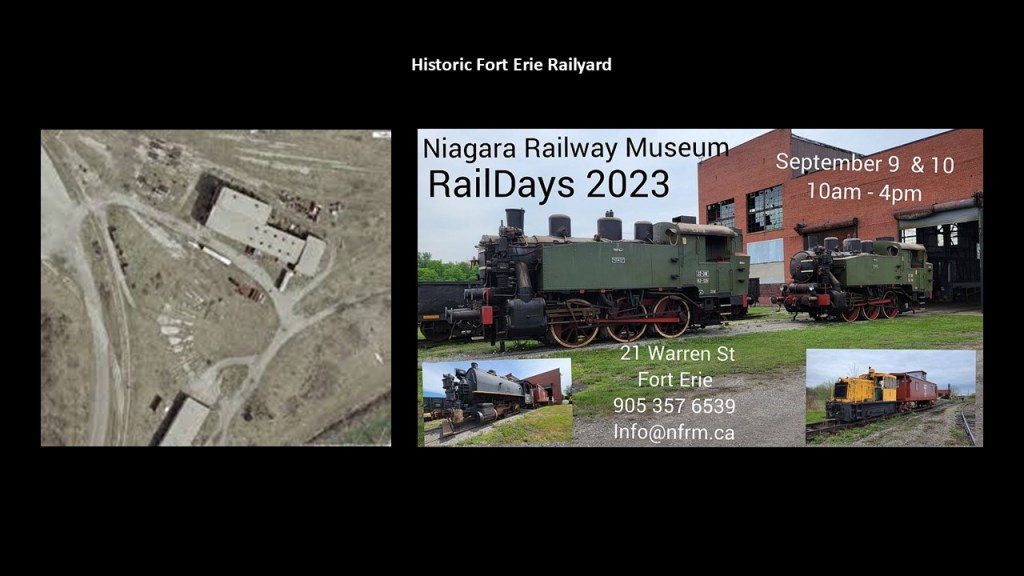
The former CN Railyard in Fort Erie for interchange on the other side of the International Railroad Bridge was closed, and was turned into the Niagara Railway Museum.
Everything thing else that was once there, including the Roundhouse, was removed.
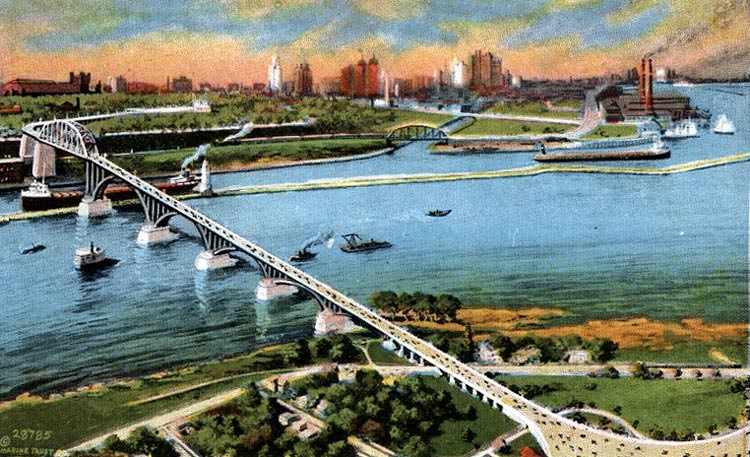
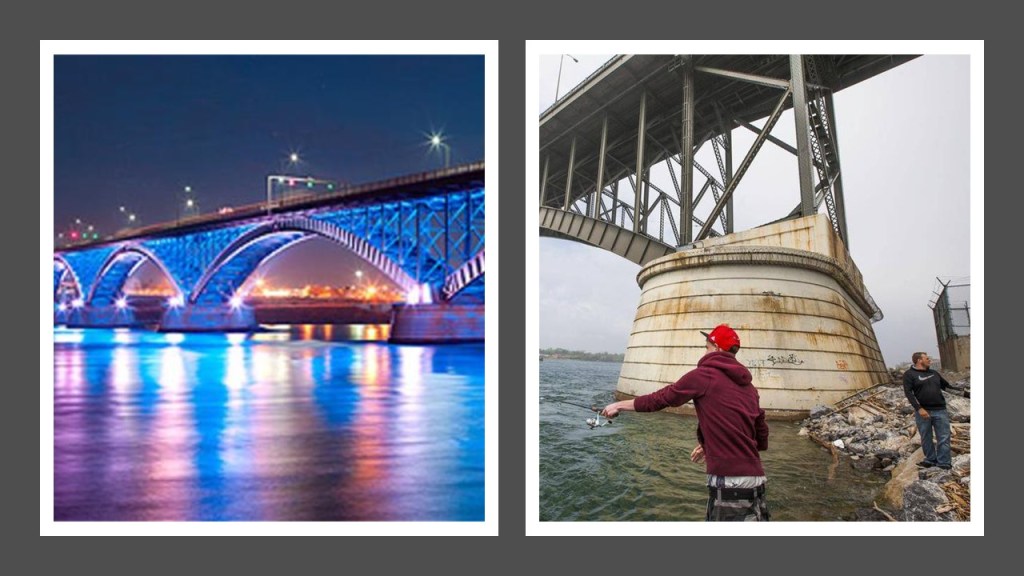
With regards to the Peace Bridge, we are told the idea of a bridge joining the United States and Canada was discussed as early as 1853, though actual construction of the bridge didn’t start until August 17th of 1925, and first opened on June 1st of 1927.
Typically we don’t ask questions about what we are told, because why on Earth would we be lied to, but consider if what we have been told about the construction is consistent with the engineering required to build these massive bridges.
The previously-mentioned Scajaquada Creek is connected to Buffalo’s Delaware Park.
There is a bike path that follows this creek’s northern shore almost all the way from Delaware Park to the Black Rock Channel and the Niagara River.
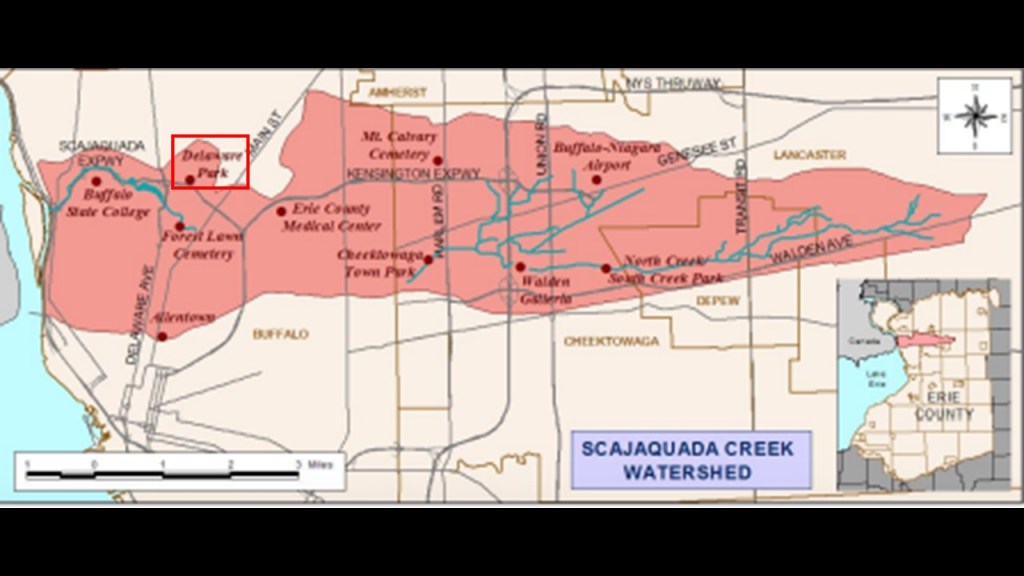
Scajaquada Creek starts in the Town of Lancaster, New York, which is 14-miles, or 23-kilometers, east of Buffalo, and passes through the the Town of Cheektowaga before being diverted into an underground culvert said to have been constructed in the 1920s.
We are told the creek was seen as a nuisance because people were using it as a public sewer and the only way the people of Buffalo thought would make the east-side of Buffalo more livable was to bury it where it cut across the city.
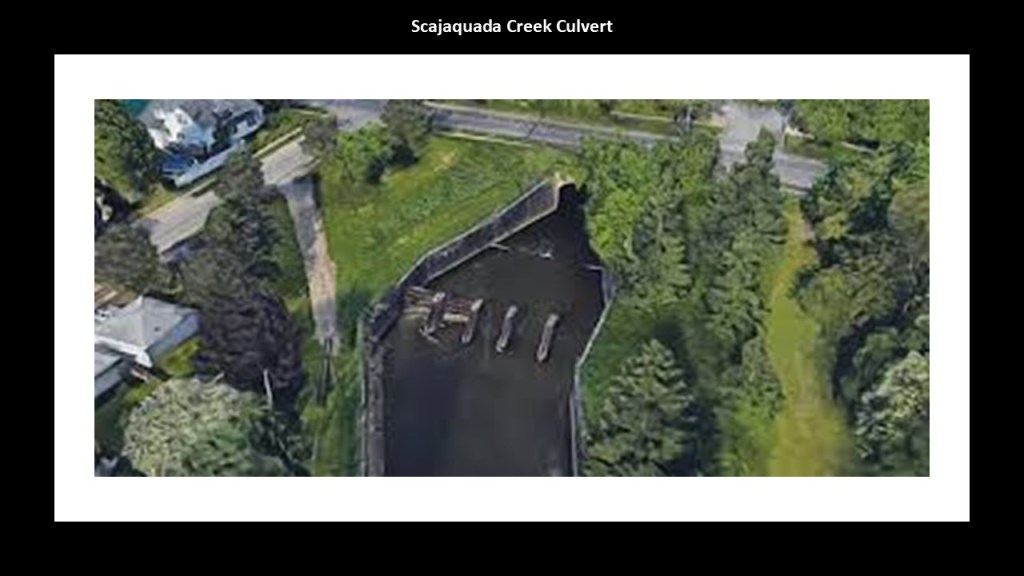
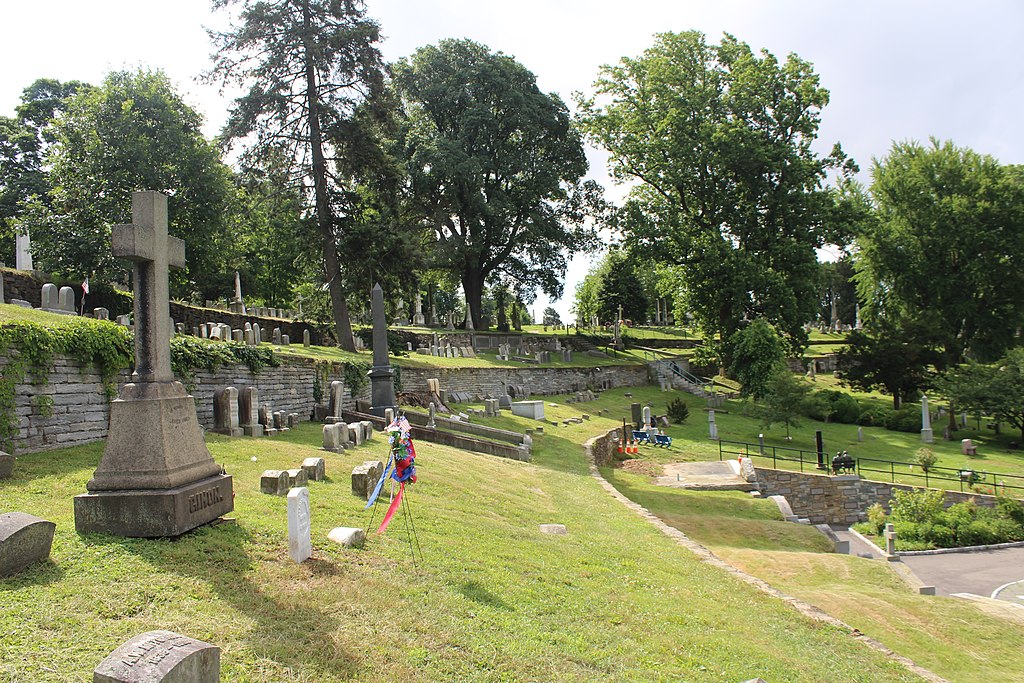
The creek travels for approximately 4-miles, or 6-kilometers, under Buffalo, before emerging from the underground at Forest Lawn Cemetery, which is next to Delaware Park.
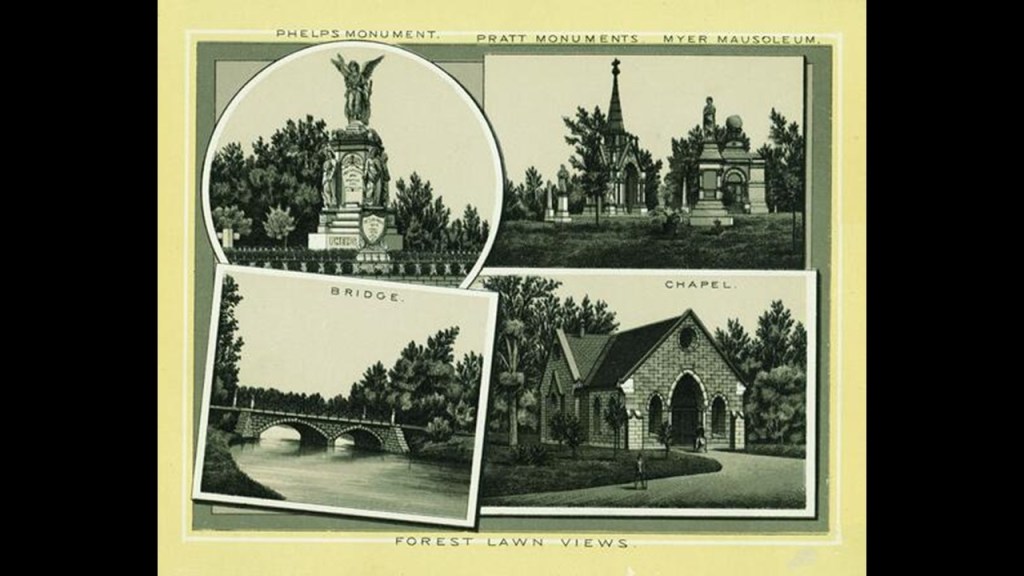
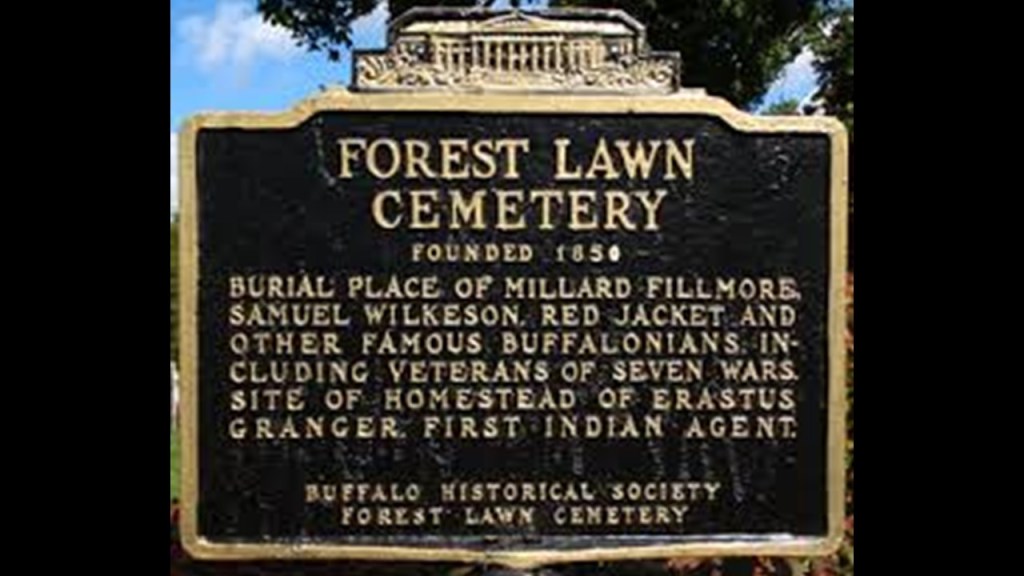
In our historical narrative, Forest Lawn Cemetery was an historic rural cemetery that was founded in 1849, and the burial place of many historical figures including the 13th-U. S. President Millard Fillmore and his wife Abigail, among many others.
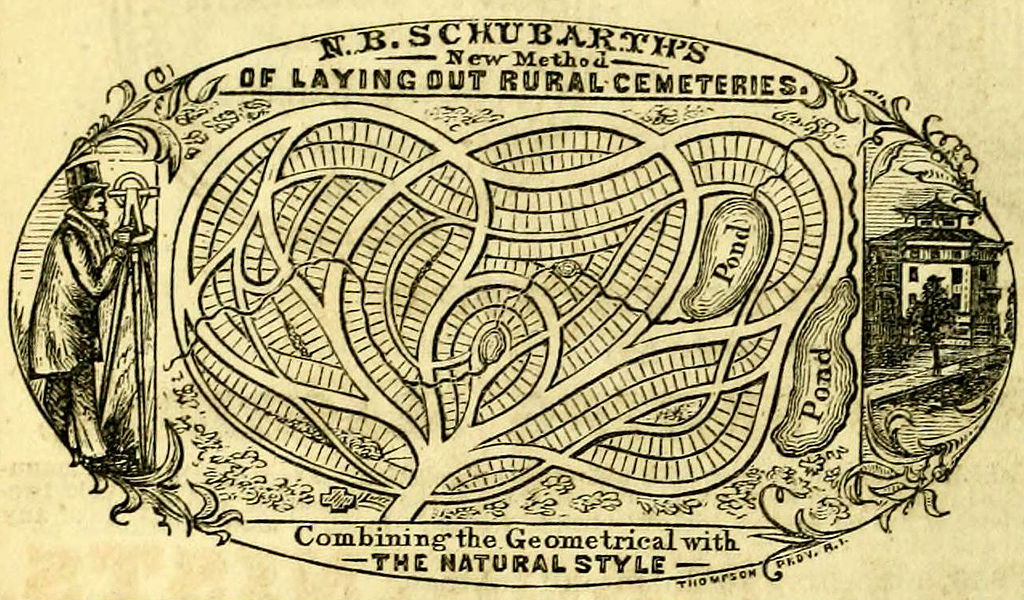
Also known as the “Rural Cemetery Movement,” these were said to have been a style of cemetery that became popular in the mid-19th-century in both the United States and Europe due to the overcrowding and health concerns of urban cemeteries.
They were typically built, we are told, around 5-miles, or 8-kilometers, outside the city in order to both be: 1) separate from the cities; and 2) close enough for visitors.
Not only that, the “Rural Cemeteries” were beautifully landscaped, containing elaborate memorials and mausoleums, and were places that the general public could go for outdoor recreation around art and sculptures, which previously had only been available to the wealthy.
We are told their popularity decreased, however, towards the end of the 19th-century due to: 1) the high cost of maintenance; 2) the development of true public parks; and 3) the perceived disorderliness of appearance due to independent ownership of family burial plots and different grave markers.
Scajaquada Creek passes over Serenity Falls in the Forest Lawn Cemetery on its way to Delaware Park.
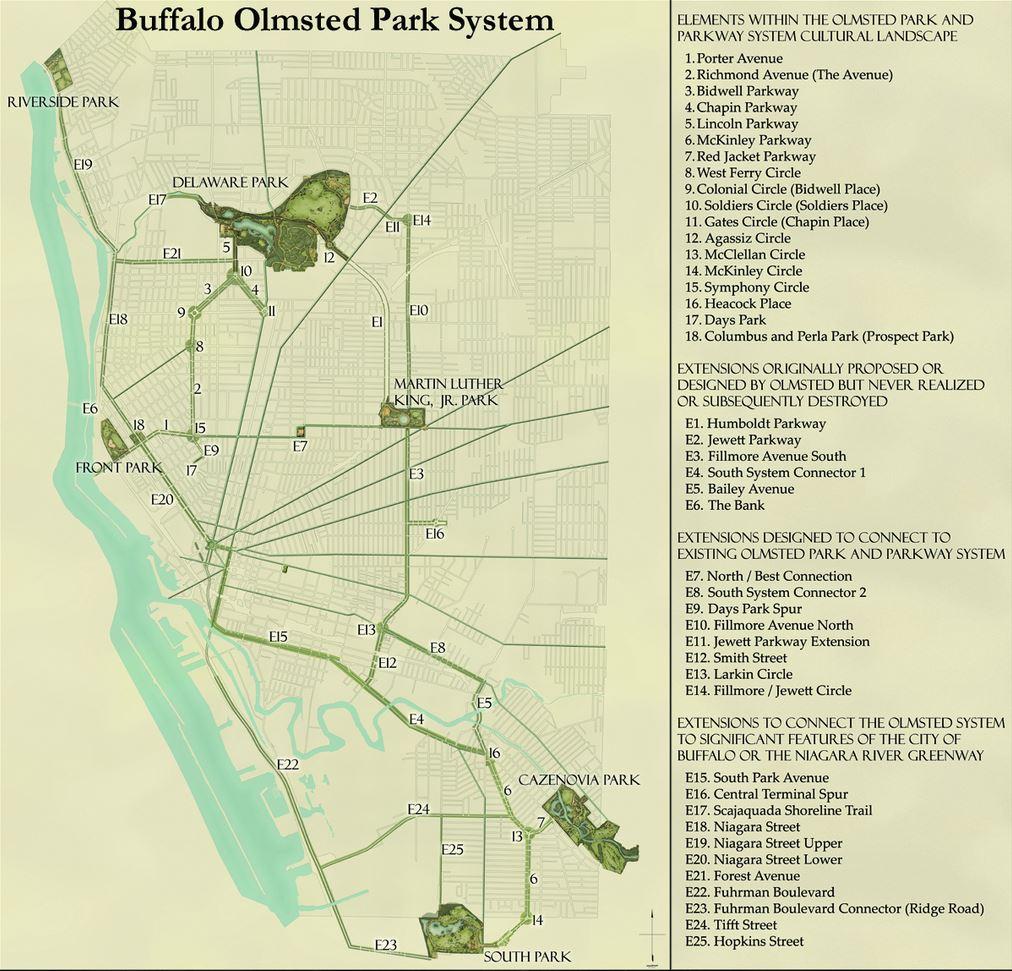
Delaware Park was considered the centerpiece of the Buffalo Olmsted Park System, New York’s oldest system of paths and pathways, which included six parks, seven parkways, eight landscaped circles, and other public spaces, said to have been designed with Calvert Vaux between 1868 and 1876.
This famous duo of landscape architects also received credit for the design of Central Park in New York City in our historical narrative.
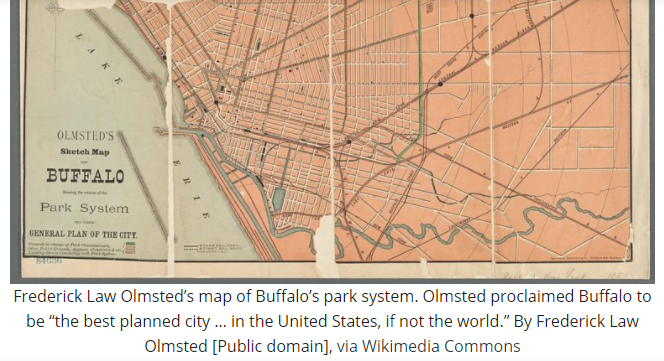
According to the notation on the bottom of this image of his map of the Buffalo Park System, Olmsted proclaimed that “Buffalo was the best planned city in the United States…if not the world.”
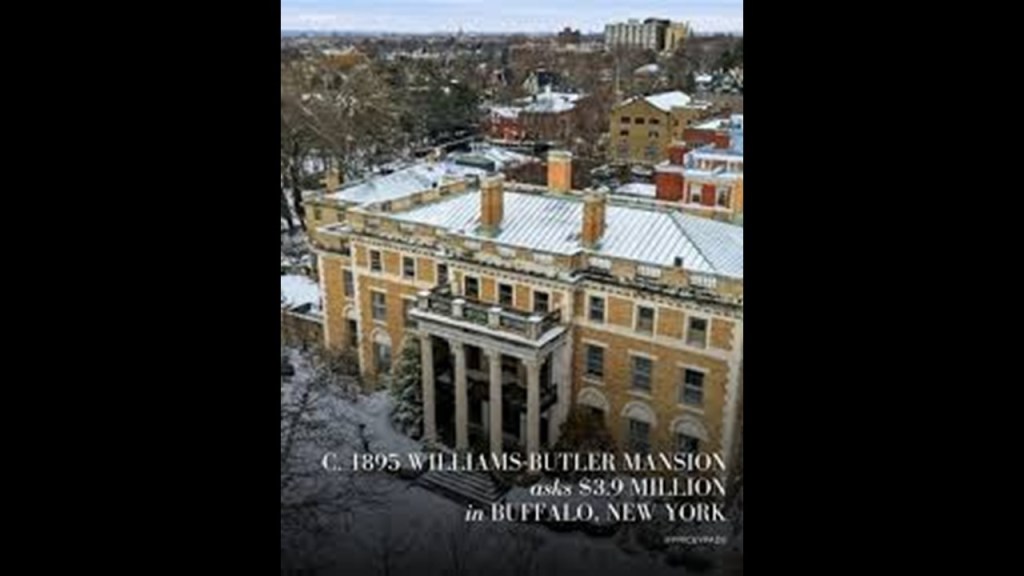
Delaware Park was so-named because of its proximity to Delaware Avenue, where the Historic District there is noteworthy for being the location of Buffalo’s Mansion Row, also nicknamed the “Millionaires’ Mile.”
At one time in our history, Buffalo had more millionaires per capita than any city in America.
We are told the mansions here were built between about 1890 and World War I, which took place between 1914 and 1918.
We are told that Olmsted dammed Scajaquada Creek to create what is called Hoyt Lake today, and that was a feature during the 1901 Pan-American Exposition in Buffalo.
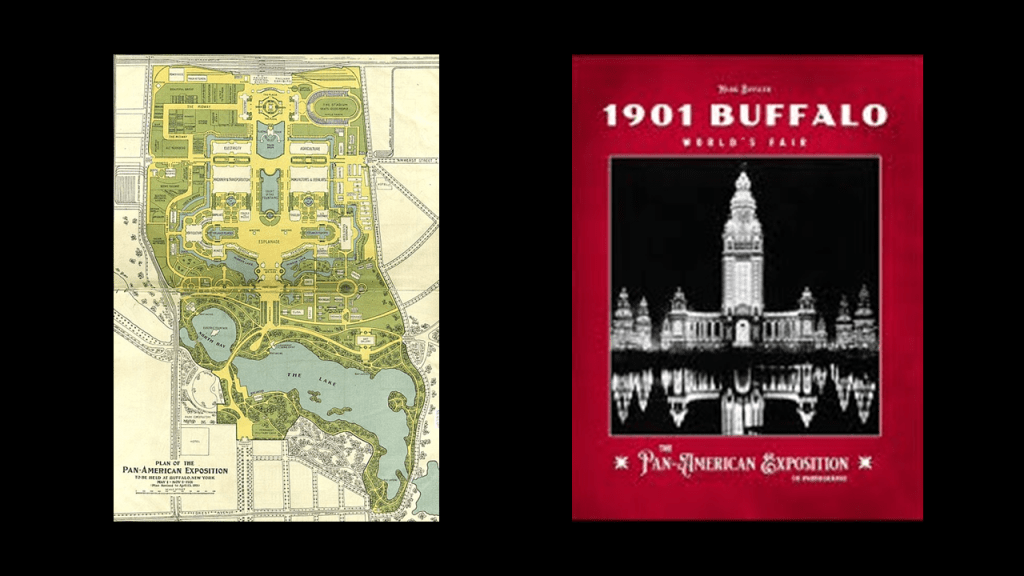
I have believed that Frederick Law Olmsted was a major player in the reset of our history for quite some time, and his name and attributed works have been showing up all around the Great Lakes in this series.
In our historical narrative, Frederick Law Olmsted was a journalist before becoming a prolific and celebrated landscape architect, and said to have gotten his start teaming up with Calvert Vaux in the design and creation of Central Park in New York City.
Olmsted and his firm was credited altogether with some 500 design projects, including, but not limited to, 100 public parks, 200 private estates, 50 residential communities, and 40 academic campus designs.
I talked about his role in-depth in this post “The Life & Times of Frederick Law Olmsted – A Retrospective of Reset History.”
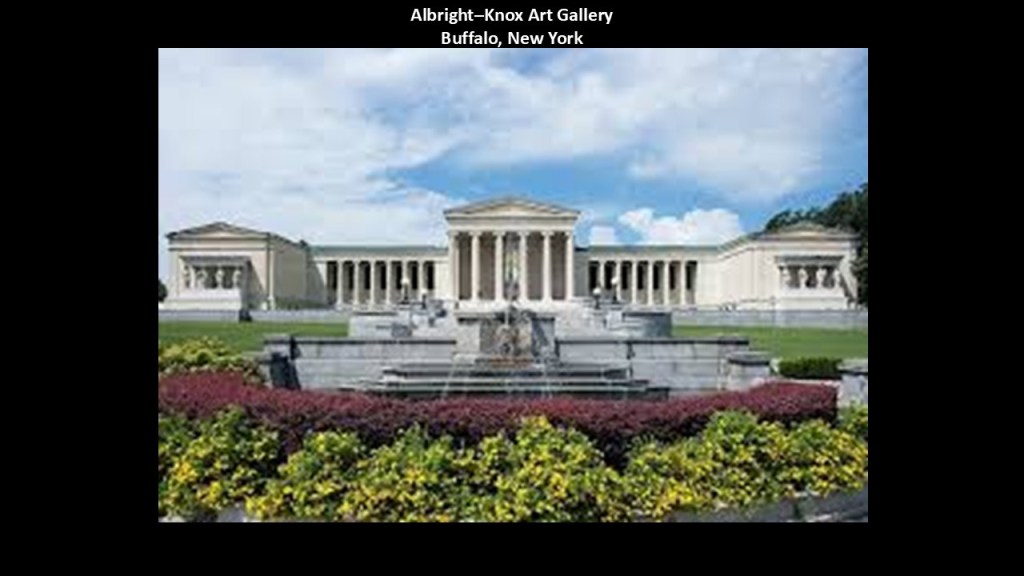
The Albright-Knox Art Gallery is an art museum on the western edge of the park, overlooking Hoyt Lake and Scajaquada Creek.
Though we are told it was originally intended to be used as the Fine Arts Pavilion for the 1901 Pan-American Exposition, it was not completed in time because of construction delays.
It was first opened to the public in 1905 as the Albright Art Gallery.
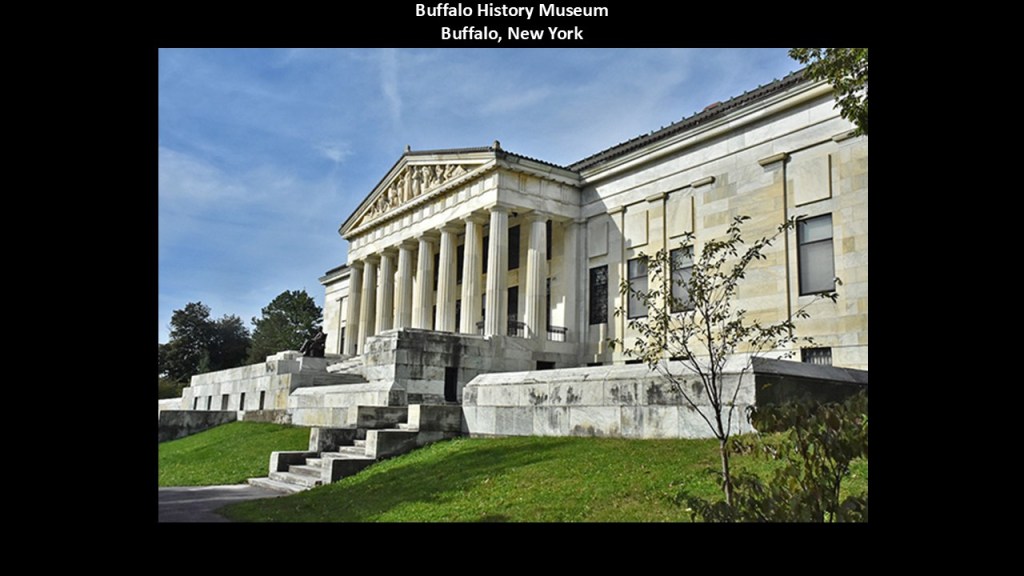
The Buffalo History Museum is located at the northwestern corner of Delaware Park, and this building was said to have been designed and constructed for the 1901 Pan-American Exposition, and the Exposition’s sole-surviving permanent structure.
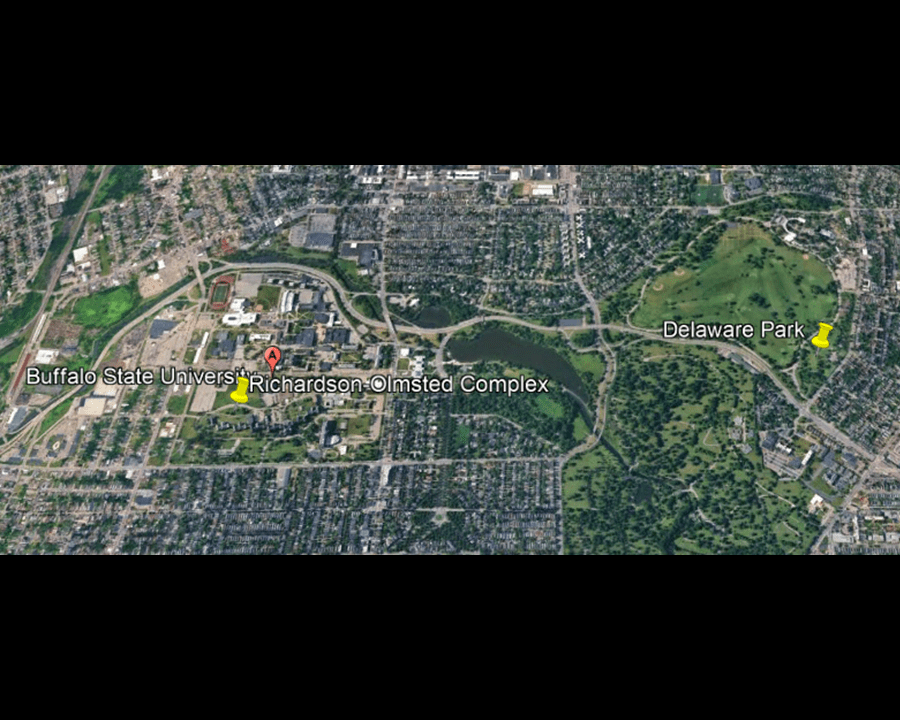
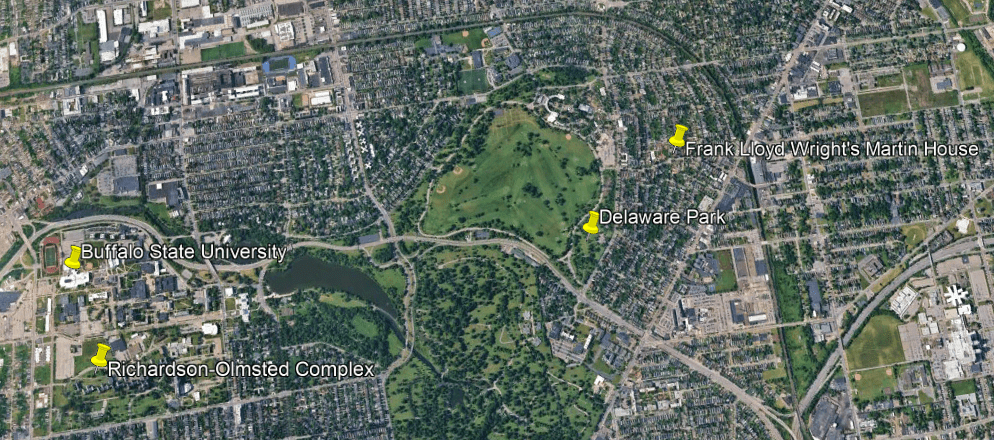
Buffalo State University is situated between Delaware Park and the Black Rock Channel on Scajaquada Creek.
It was first established in 1871 as the Buffalo Normal School to train teachers.
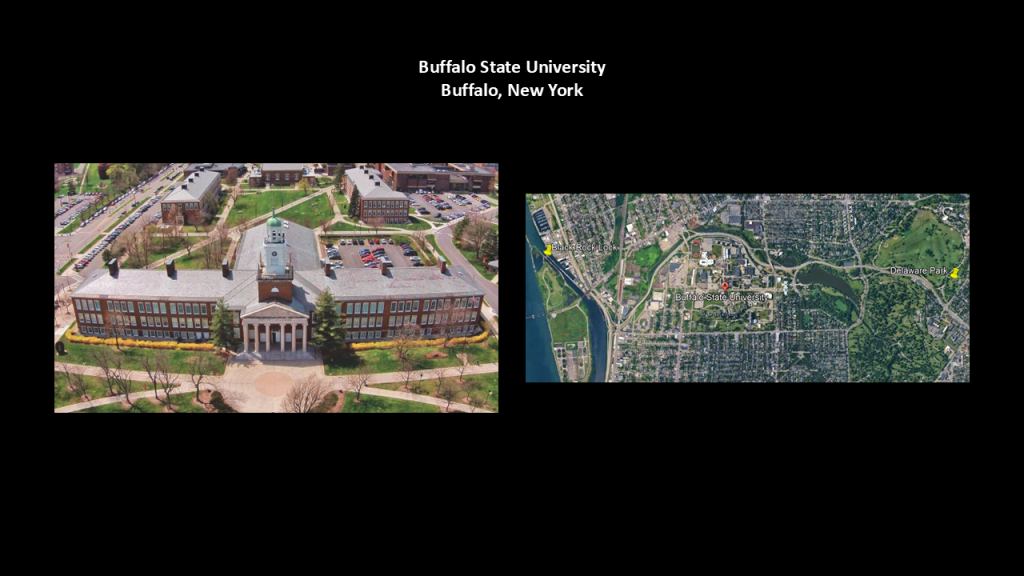
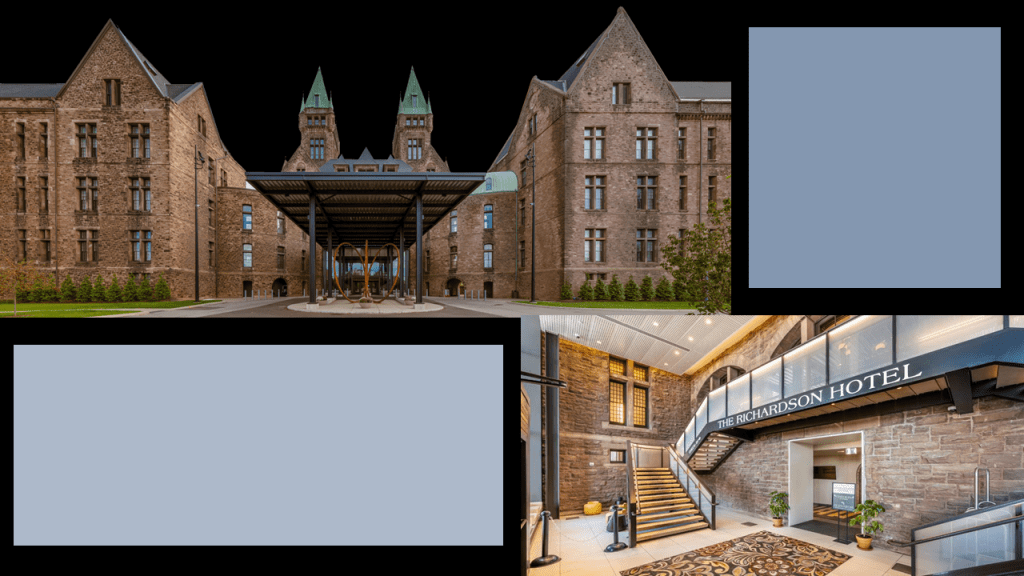
The Richardson-Olmsted Complex is adjacent to the campus of Buffalo State University and Delaware Park.
We are told that the Richardson-Olmsted Complex is in the architectural-style called Richardsonian Romanesque, after architect Henry Hobson Richardson, who first used elements of this style in what was originally the Buffalo State Asylum for the Insane which he was said to have designed in 1870, and for which Frederick Law Olmsted was the landscape architect.
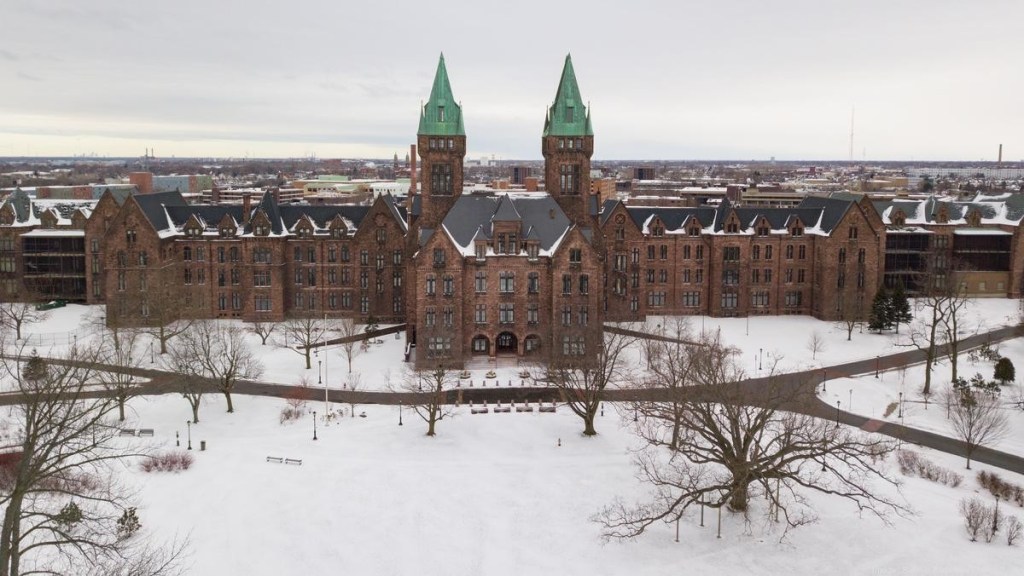
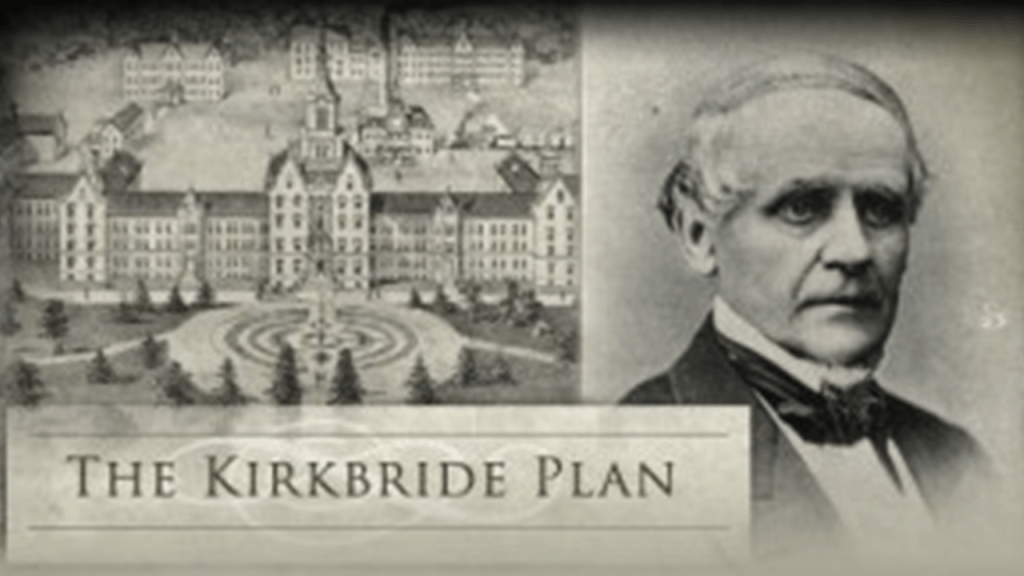
The Kirkbride Plan treatment for people with mental illsness was implemented here.
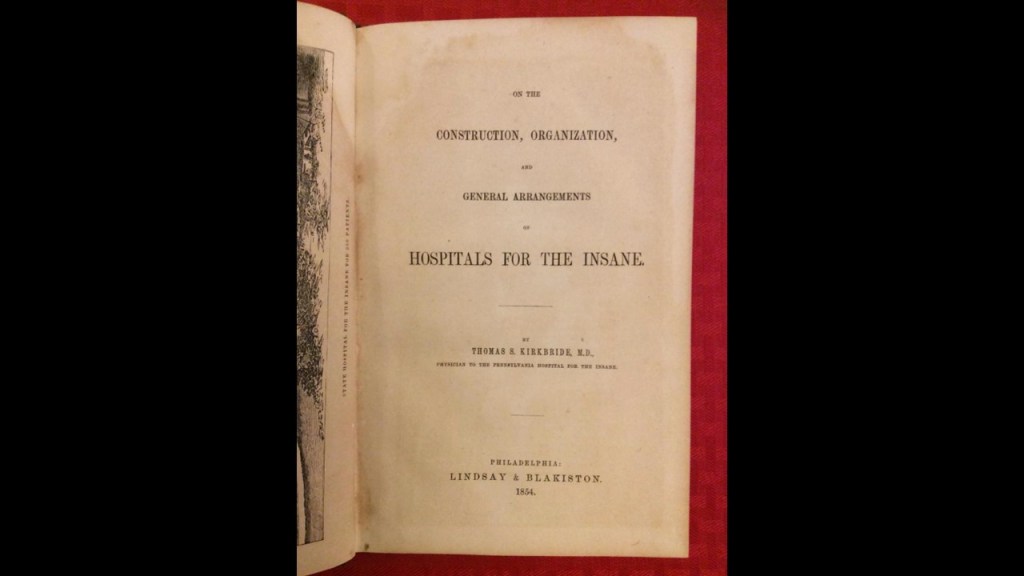
In 1854, Dr. Thomas S. Kirkbride first published what was considered the source book in the 19th-century for Psychiatric Directives entitled “On the Construction, Organization, and General Arrangements of Hospitals for the Insane, ” with some remarks on insanity and its treatment.
We are told that throughout the 19th-century, numerous psychiatric hospitals were designed and constructed according to the Kirkbride Plan across the U. S. and while numerous Kirkbride structures still exist, many have been demolished, partially-demolished, or repurposed.
The Buffalo State Asylum for the Insane was closed for that purpose in the 1970s, and became known as the Richardson-Olmsted Complex, it was repurposed as a hotel which opened in 2023.
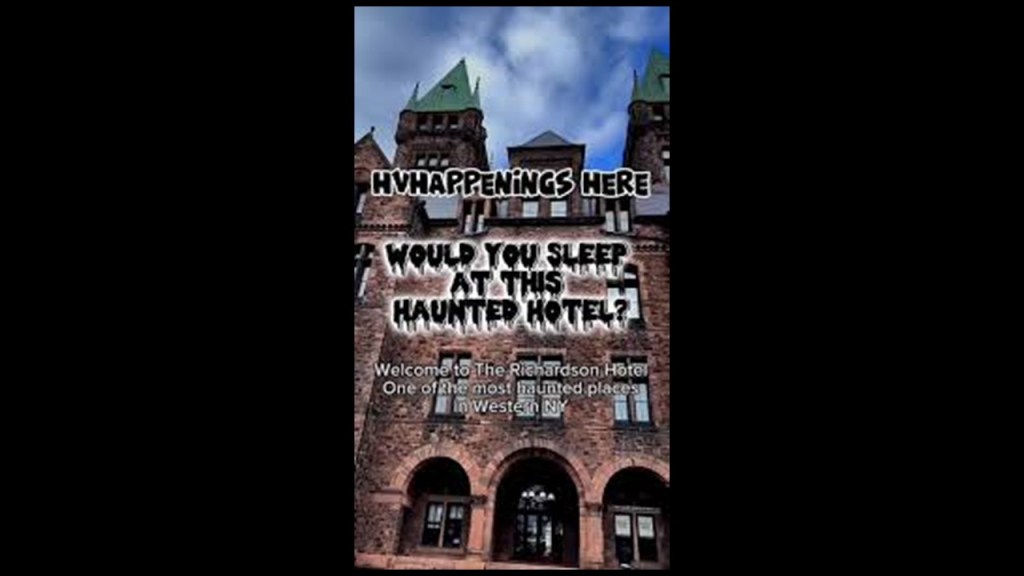
It is considered one of the most haunted places in Buffalo, if not western New York.
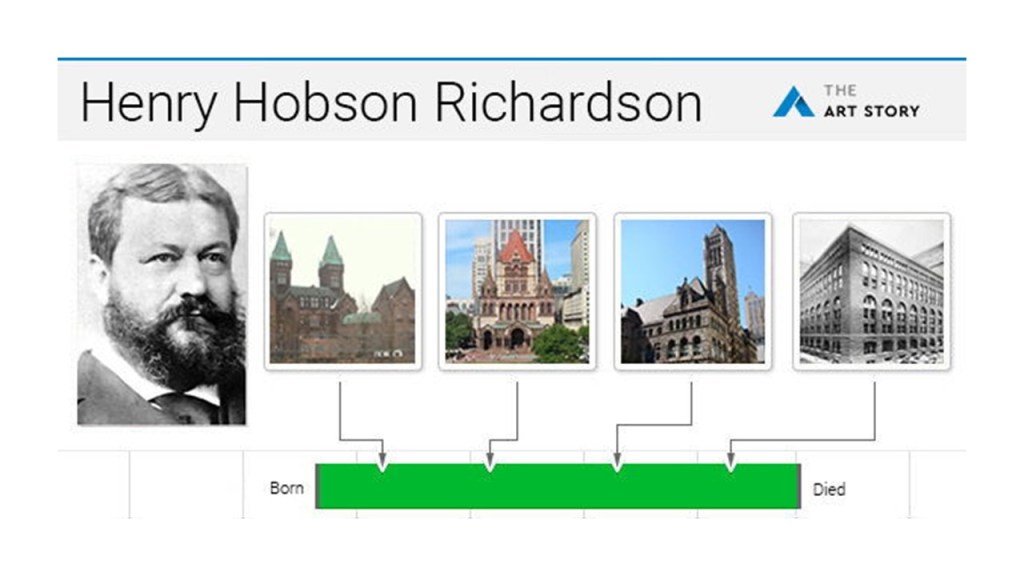
Richardsonian Romanesque is described as a “free-revival style, incorporating 11th- and 12th-century southern French, Spanish, Italian Romanesque characteristics.”
Henry Hobson Richardson had a relatively short career, and didn’t even complete his architecture school training in Paris because he lost family backing because of the American Civil War, yet somehow by the time he died at a relatively young age of 47, he left behind a legacy of mind-blowingly ornate architecture!
Next, Frank Lloyd Wright’s Martin House.
Frank Lloyd Wright’s Martin House is just to the east of Delaware Park on the other side of Buffalo State University and the Richardson-Olmsted Complex, in the Parkside East Historic District.
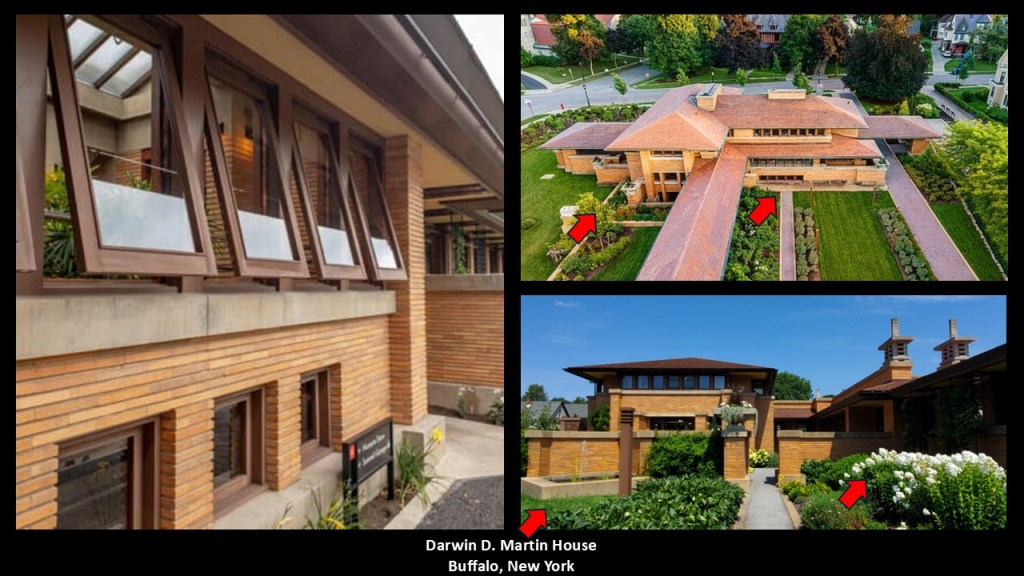
The design of the Darwin D. Martin House was attributed to Frank Lloyd Wright and said to have been built between 1903 – 1905.
It was said to be one of his most important projects in the Prairie School Architectural-style, which was characterized by horizontal lines, flat rooves, and broad, over-hanging eaves meant to evoke the vast, tree-less expanses of the American Prairie.
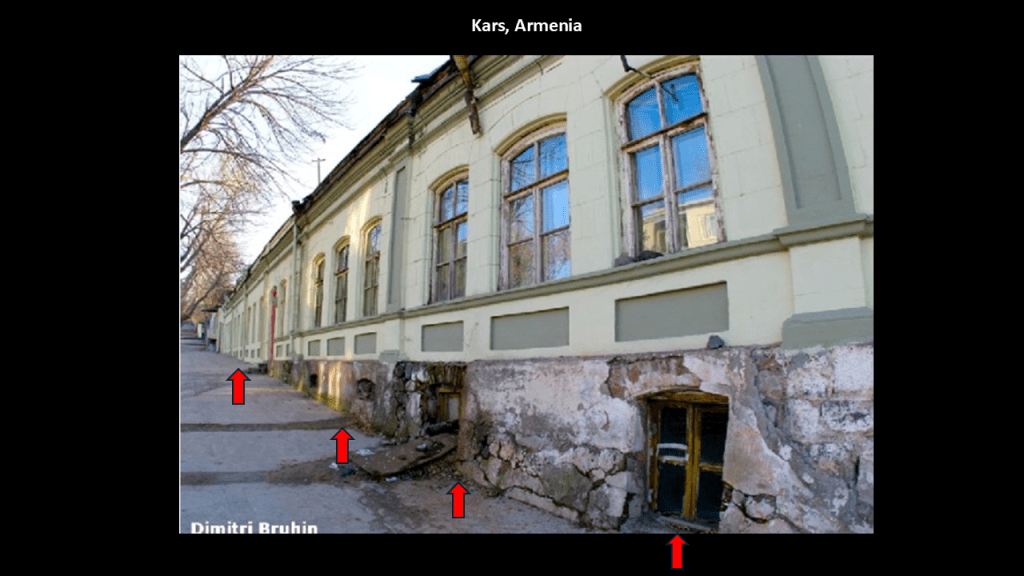
But when I look at the Martin House, I see an uneven appearance throughout the lay-out of the house and ground-floor windows, which are classic indicators of what is called the mud flood, like there is more to the building underneath the ground.
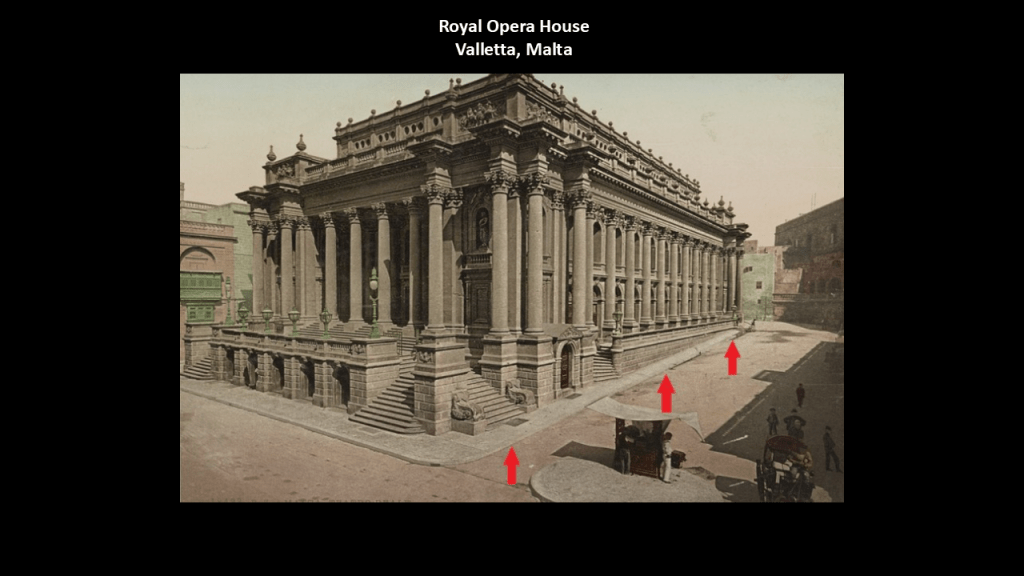
Like the Royal Opera House in Valletta, Malta, said to have been designed by the English architect Edward Middleton Barry in 1866, with windows and columns that are not level with the sloping street beside it…
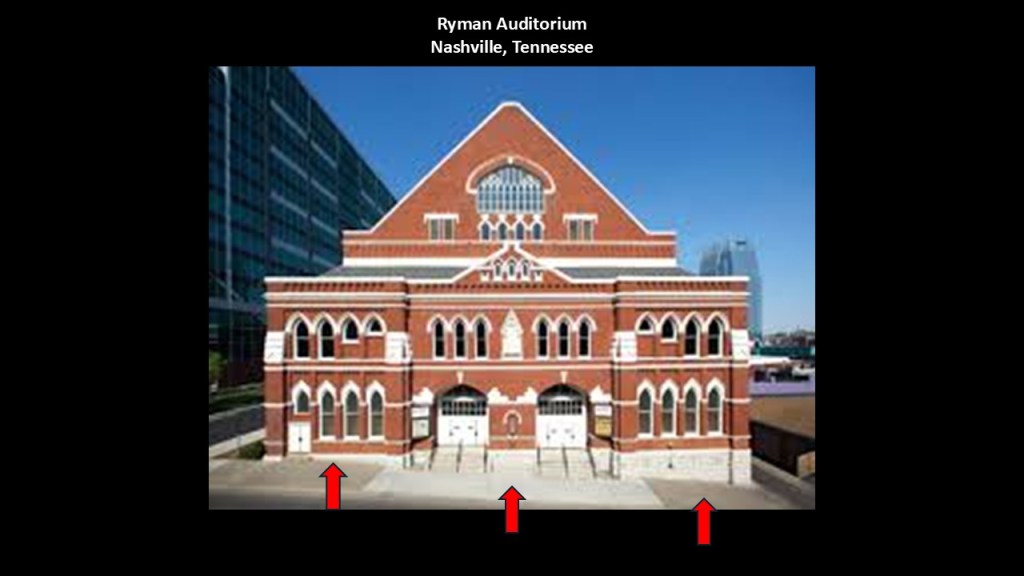
…the historic Ryman Auditorium in Nashville, Tennessee, the home of the “Grand Ole Opry” from 1943 to 1974…
…and this photo taken of a street block in Kars, Armenia, to name a few of countless examples found all over the surface of the Earth.
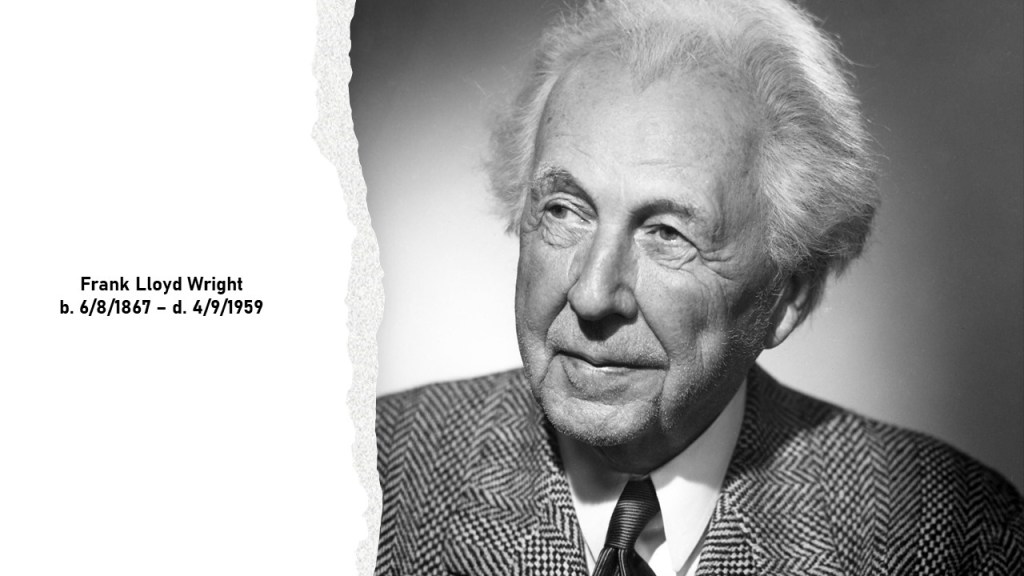
Frank Lloyd Wright was credited with designing over 1,000 structures in a creative period spanning 70-years.
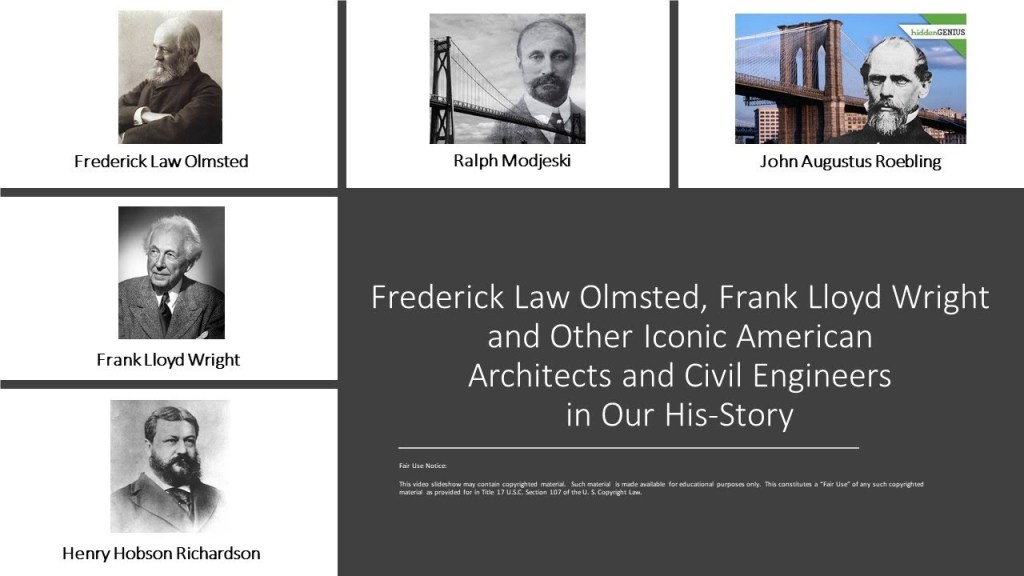
Back in 2021, I looked at Frank Lloyd Wright, Frederick Law Olmsted and Henry Hobson Richardson, as well as two other iconic Civil Engineer bridge-builders, Ralph Modjeski and John Augustus Roebling, that were all credited with the same kind of prodigious output and all occupy a prominent place in our historical narrative to explain how our infrastructure came into existence.
I think these men and many others, including the previously-mentioned Sir Casimir Gzowski, were elevated in stature and ability to provide the explanation for how previously-existing architecture and infrastructure came into existence after something very unnatural happened here in the last 200 – 300 years, wiping the builders of the original advanced civilization off the face of the Earth and from our collective memory.
Next I am going to head south to central and southern Buffalo and take a look at the Buffalo City Hall; the Buffalo River; the three lighthouses in Buffalo; some of the canals in Buffalo; the Caz Creek Waterfalls, the Tifft Nature Preserve; the Highmark Stadium; and the CSX Intermodal Terminal in Blasdell.
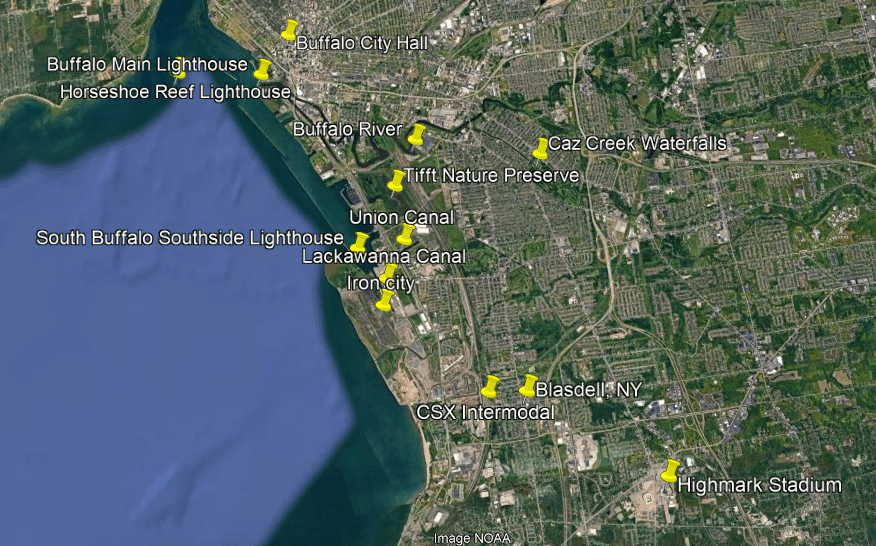
First, the Buffalo City Hall.
The Buffalo City Hall is the seat of the city’s government, and said to have been designed in the Art Deco architectural-style designed and built by the John W. Cowper Company between September of 1929 and November of 1931, which would have been during the Great Depression.
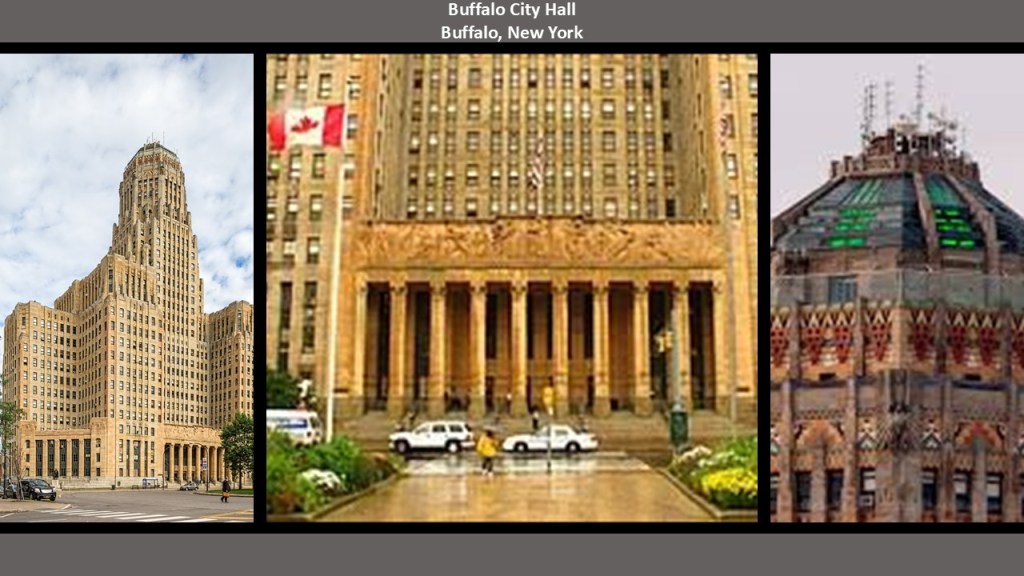
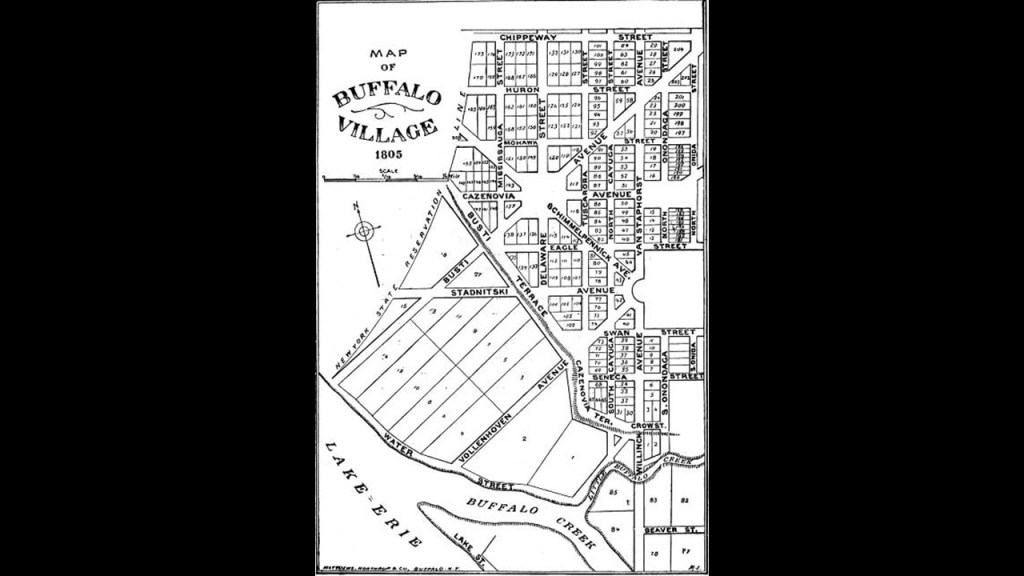
It is located at 65 Niagara Square, which is a square said to be in the original 1805 radial street pattern designed by Joseph Ellicott for the village of New Amsterdam from which eight streets radiated from this central hub.
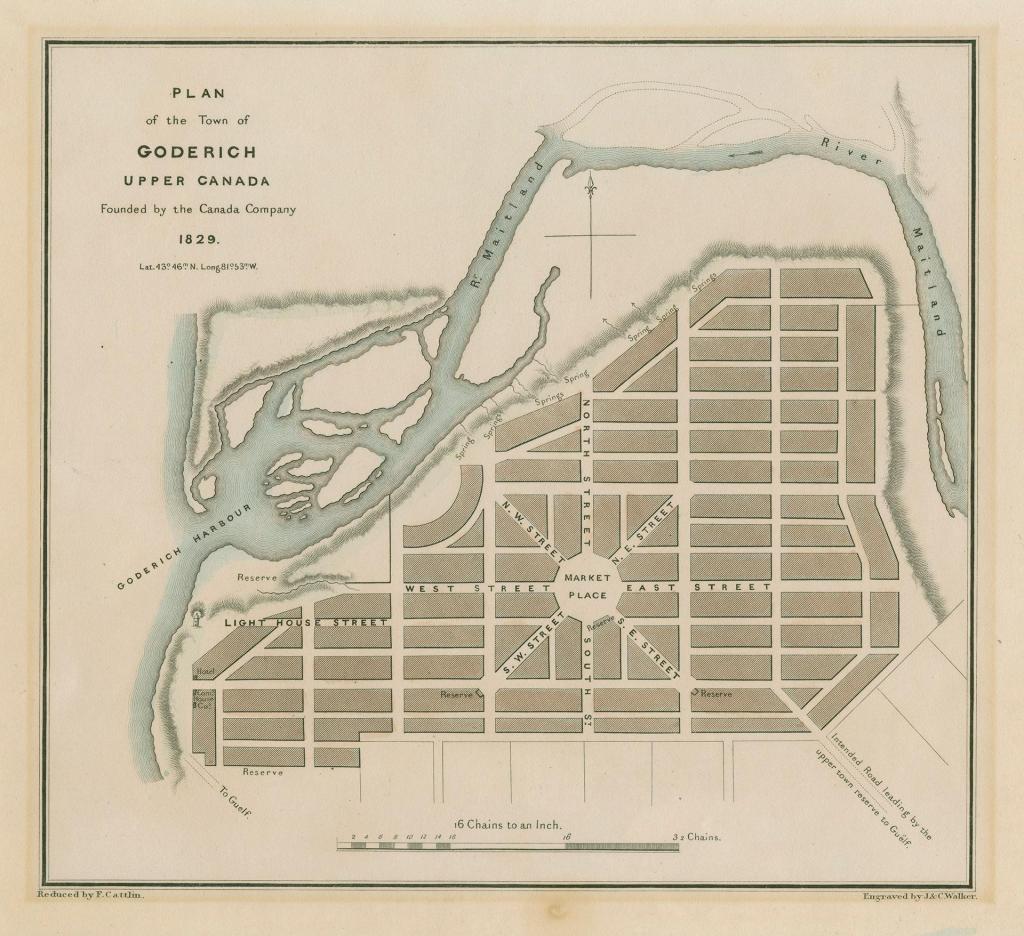
I found a similar street lay-out when I was looking at Goderich on the Ontario-side of Lake Huron.
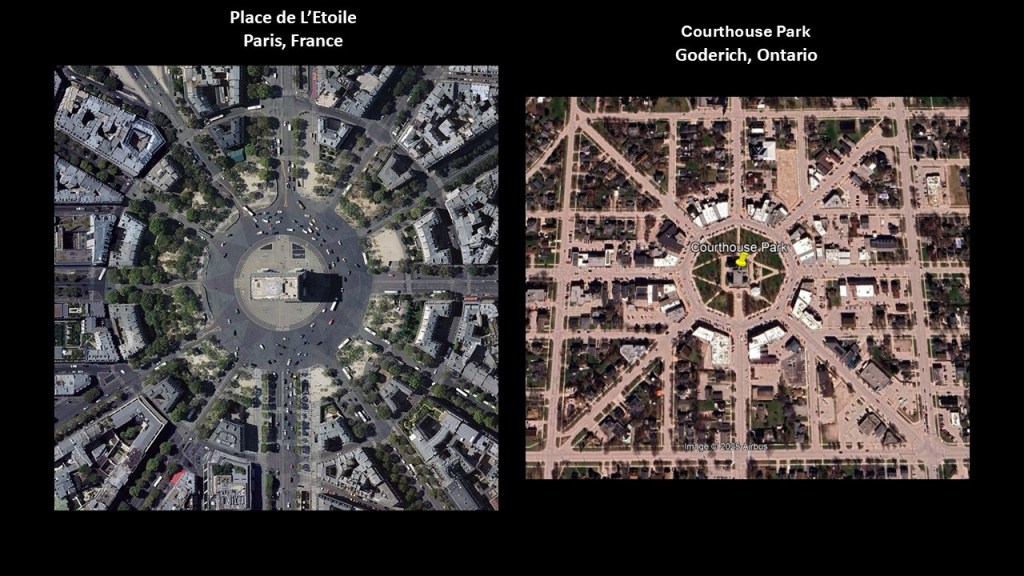
Today’s Courthouse Park is marked “Market Place” on the street plan of Goderich, centrally-placed in a geometric configuration also where eight streets radiate from it.
Courthouse Park in Goderich brought to mind the “Place de L’Etoile” in Paris, which has the Arch de Triomphe sitting in the center of twelve radiating streets.
A viewer brought the murals in the lobby of the Buffalo City Hall to my attention.
She said there are six pieces, circa 1931, and that the architecture of the Buffalo City Hall to her has never really synchronized with these murals, and that the depictions in the murals as rather unsettling and shocking with a lot of detail to absorb.
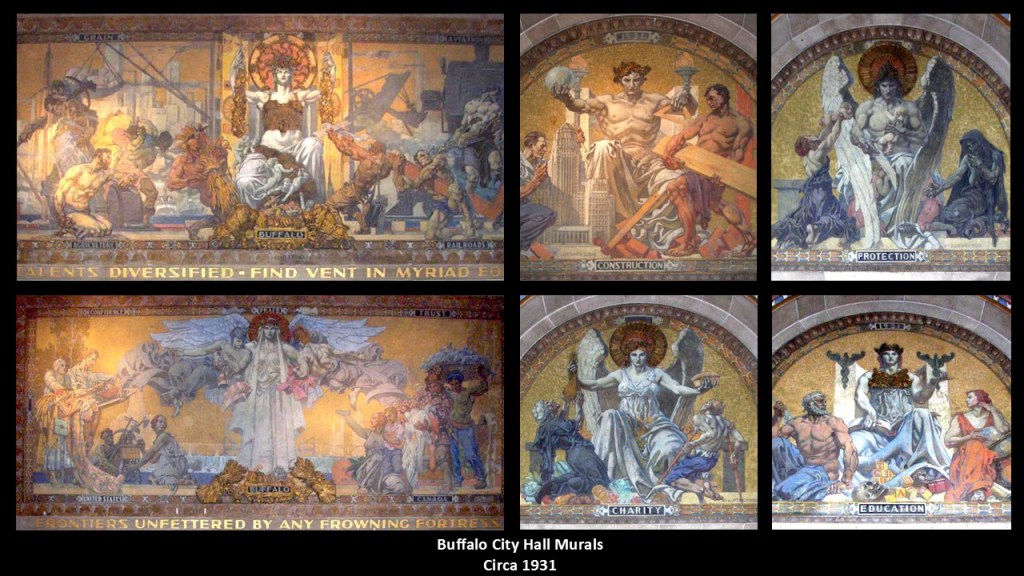
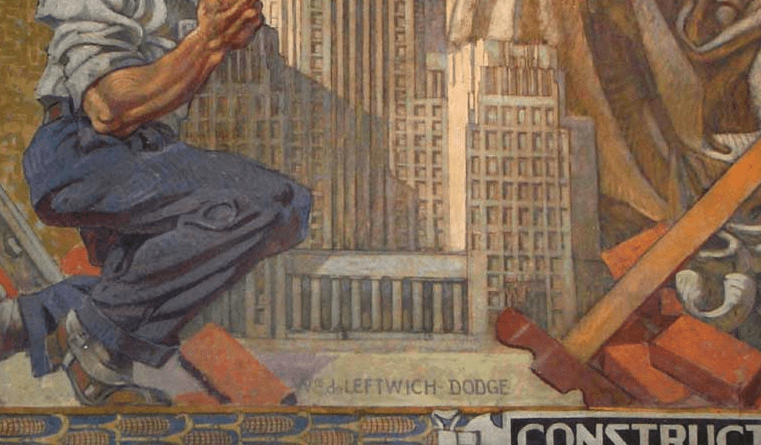
The murals were attributed to William de Leftwich Dodge, a New York City artist.
Next, the Buffalo River.
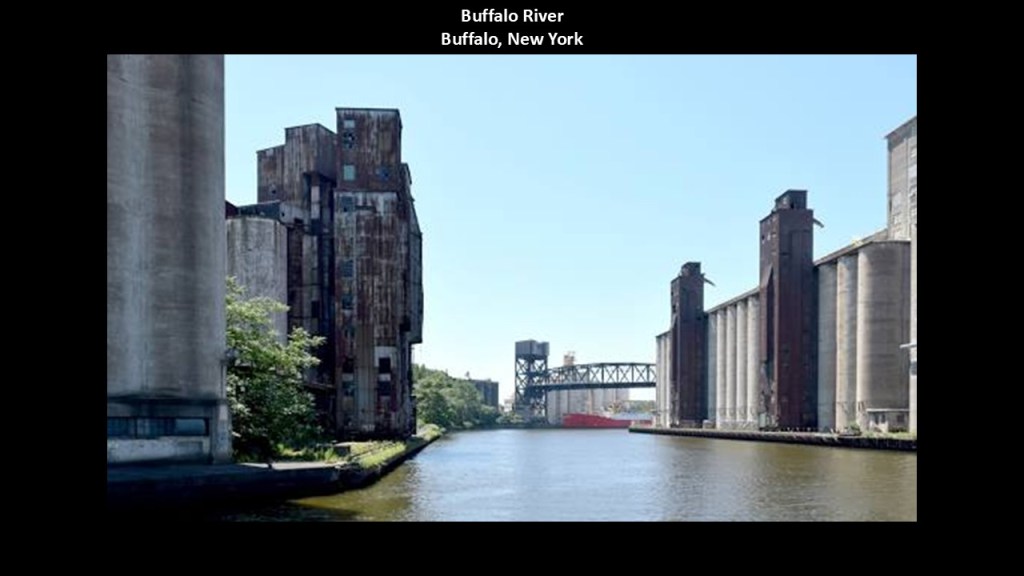
The Buffalo River was the western terminus of the Erie Canal starting in 1825, and later became an industrial use area with things like grain elevators, steel mills and chemical production.
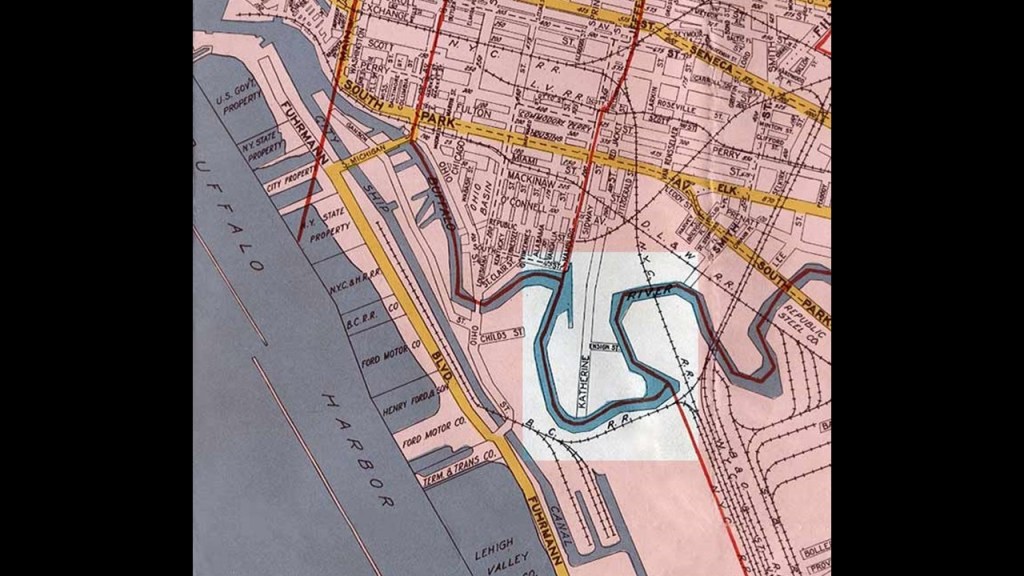
The transportation and industrial uses of the river greatly declined when shipping began to by-pass the Erie Canal in the 1950s, and many adjacent mills and factories were abandoned.
The Buffalo Ship Canal is a federal navigation channel maintained by the U. S. Army Corps of Engineers, at a depth of 23-feet, or 7-meters below-lake-level by dredging to allow for the passage of high vessels.
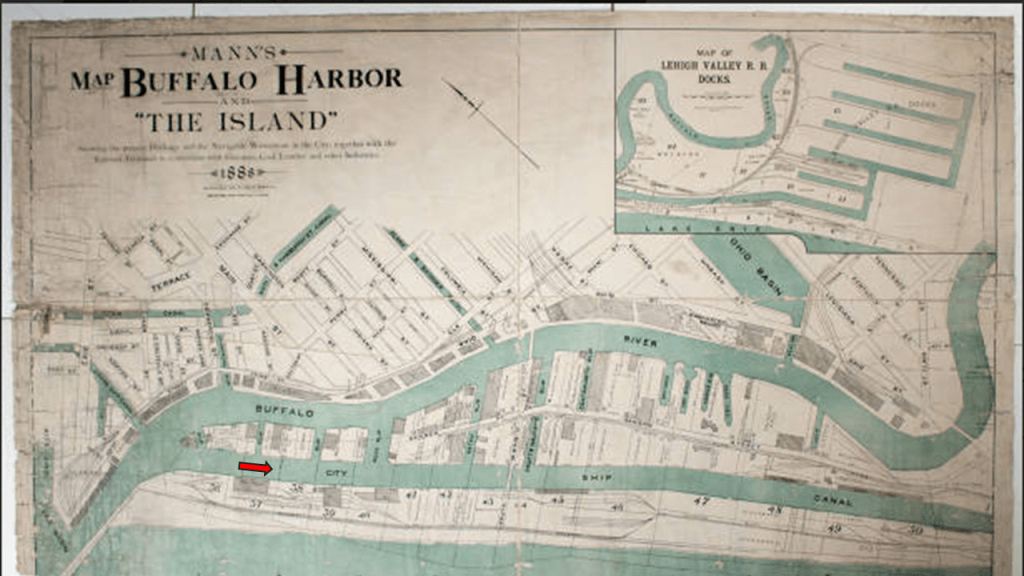
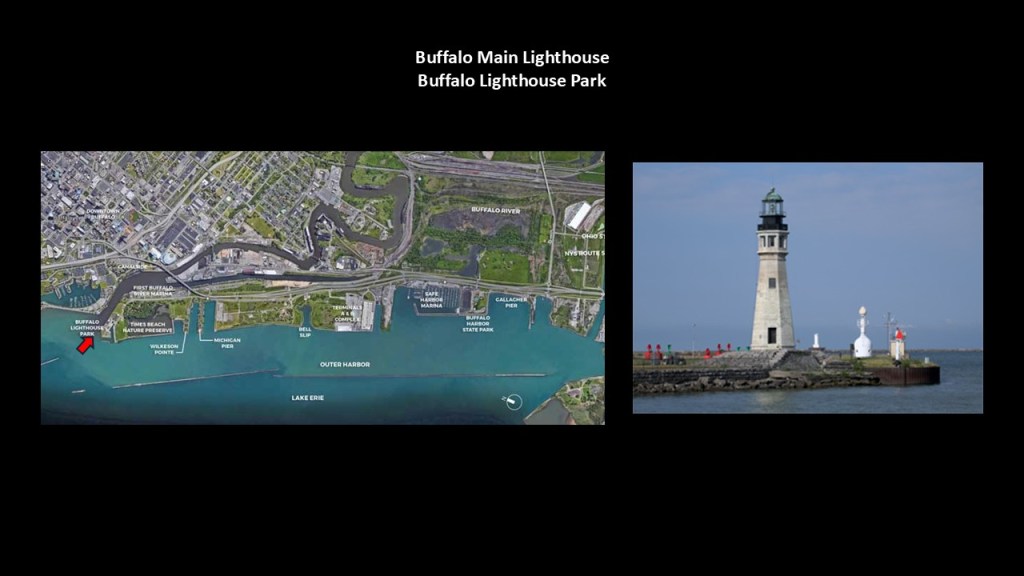
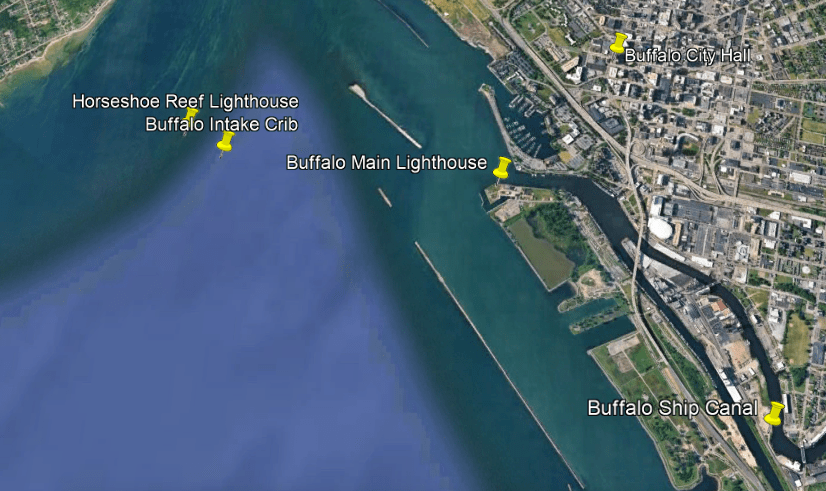
The Buffalo Main Lighthouse was located at the entrance to both the Erie Canal and the Buffalo River.
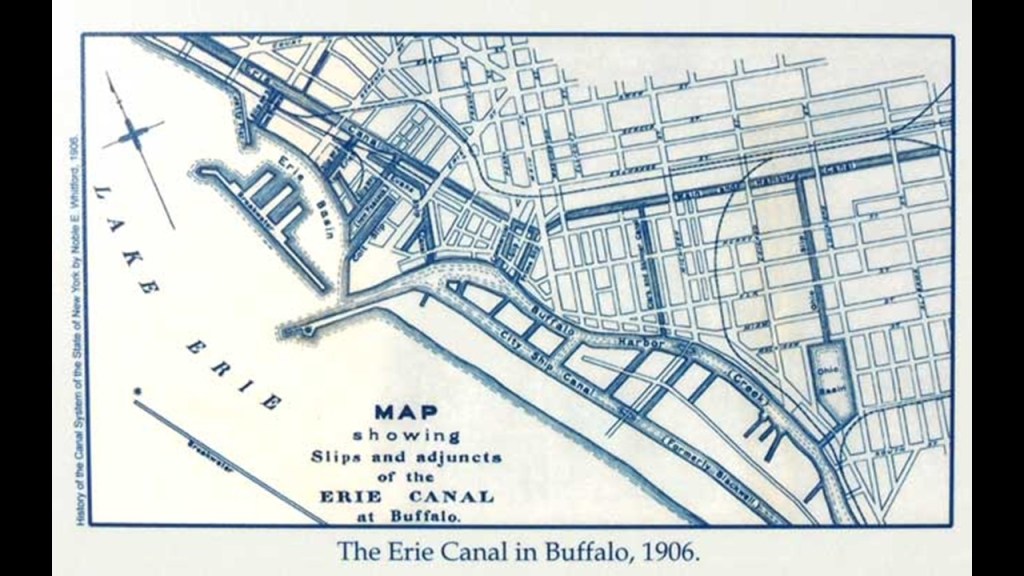
The Buffalo Main Lighthouse was said to have been established and lit in 1833 and deactivated in 1914.
It was constructed out of limestone and cast iron.
These days it is an outdoor museum.
The third-order fresnel lens of the lighthouse is on-display at the Buffalo History Museum.
A third-order fresnel lens is a high-intensity, beehive-shaped glass apparatus used to focus light from a central source in a powerful-beam.
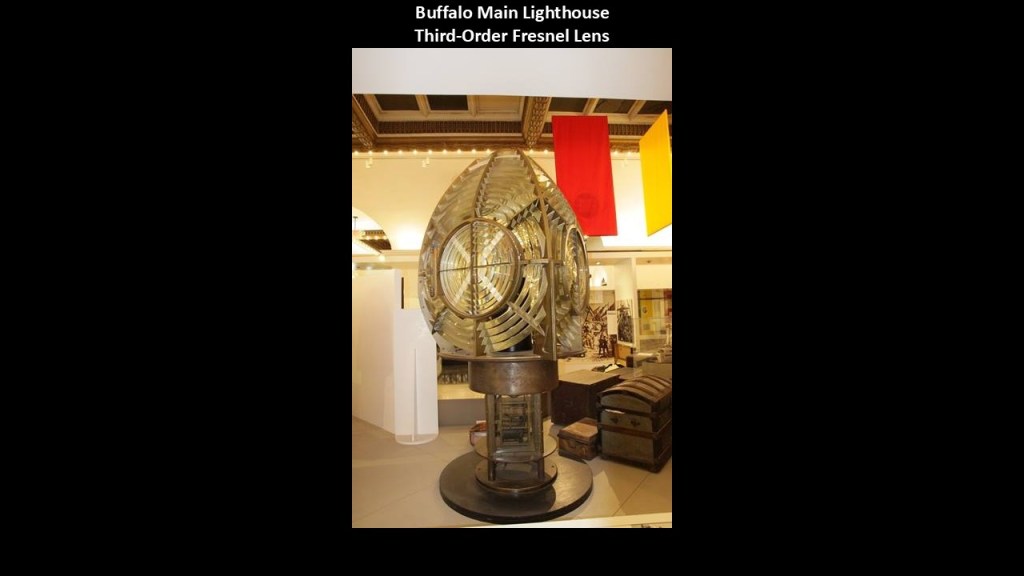
Very few of these original fresnel-lens’ remain in lighthouses.
One that comes to mind that still has one from doing this research on the Great Lakes is the Tibbetts Point Lighthouse at the entrance of the St. Lawrence Waterway in Cape Vincent, New York.
It uses the only classic fresnel lens still in operation on Lake Ontario.
Only 70 such lenses are still operational in the United States, with 16 of them being on the Great Lakes.
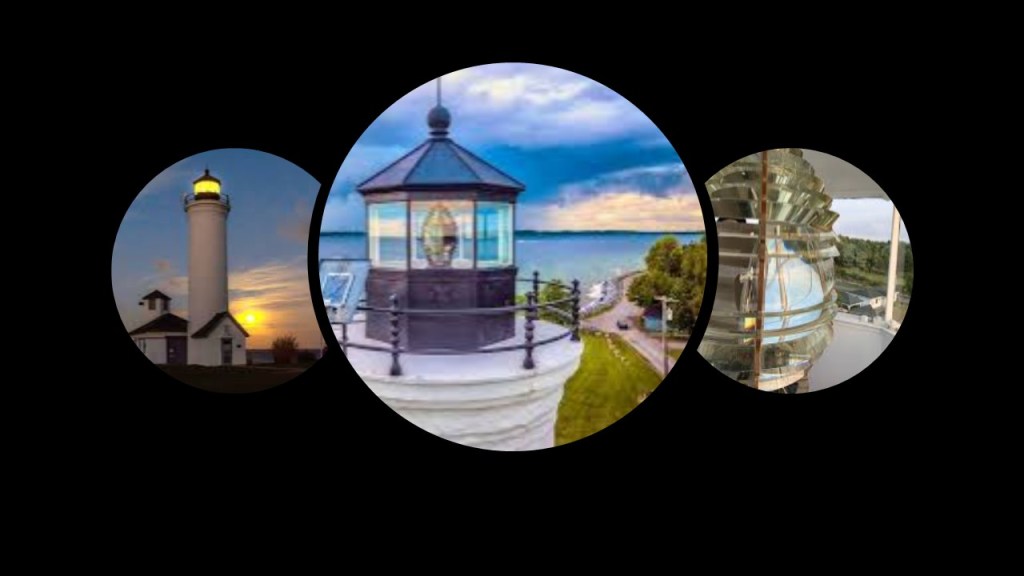
The Tibbetts Point Lighthouse is on the Great Lakes Seaway Trail, a National Scenic Byway of roads and highways that runs for 518-miles, or 834-kilometers, along Lake Erie, the Niagara River, Lake Ontario, and the St. Lawrence River.
I first became aware of the existence of the Seaway Trail when I was looking at the Charlotte-Genessee Lighthouse on the southern-shore of Lake Ontario near Rochester, New York.
The Seaway Trail runs along the southern shore of Lake Erie that I will be taking a close look at in this post.
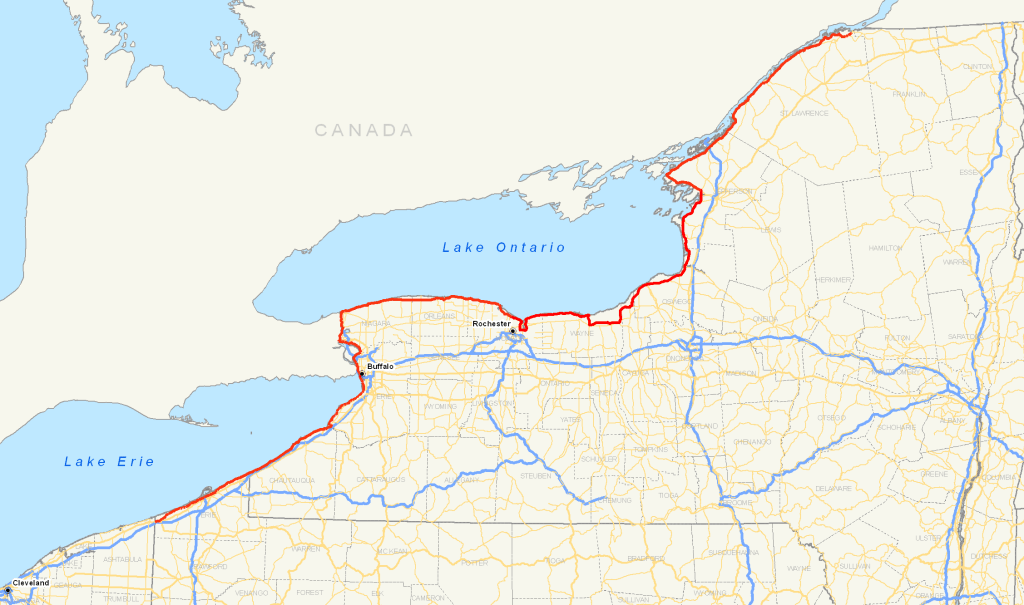
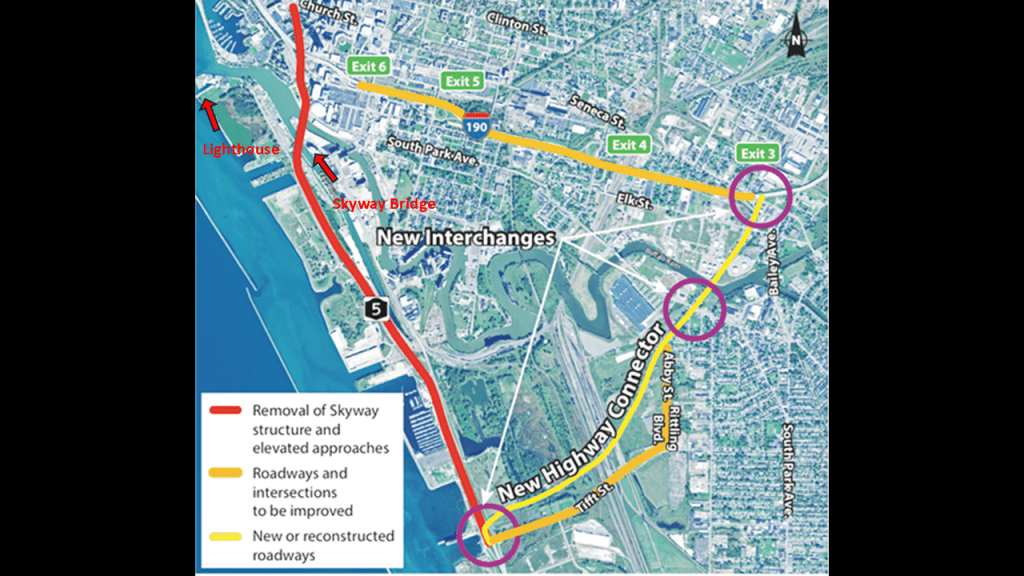
Interesting to note the Buffalo Main Lighthouse is located near where the Great Lakes Seaway Trail, as part of New York State Route 5, crosses over the Skyway Bridge.
More to come later on the Great Lakes Seaway Trail.
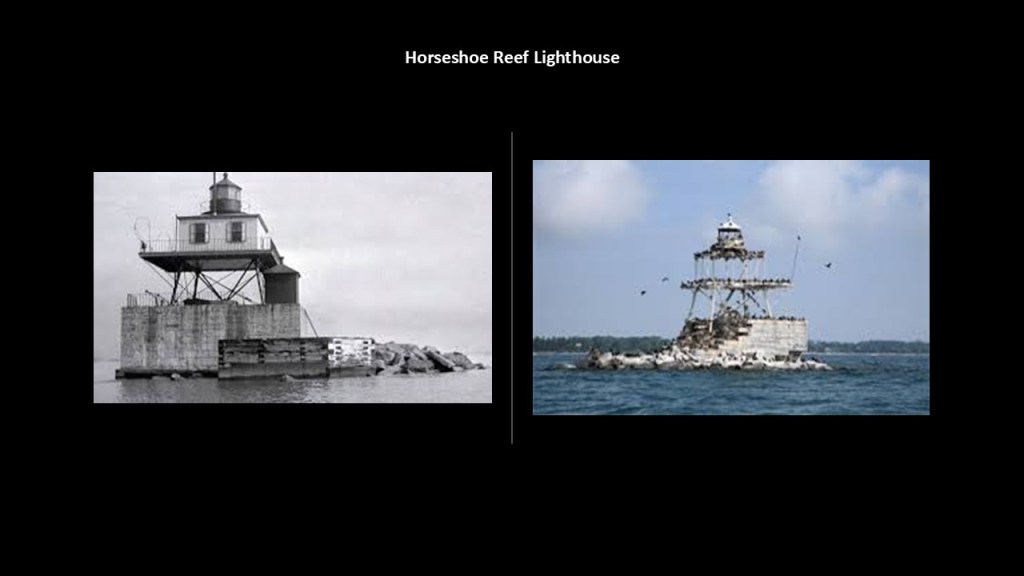
The Horseshoe Reef Lighthouse is next.
Horseshoe Reef, considered to be an underwater hazard, was one-acre of territory ceded by Great Britain to the United States in 1850 and an American enclave on the Canadian-side of the water border.
The building of a lighthouse there was said to be a contingency agreed upon for the transfer of the land, and with Congressional approval coming in 1851 in our narrative.
First lighting of it was achieved in 1856, and operation ceased sometime around 1920.
It has been left in an abandoned and rotting state ever since.
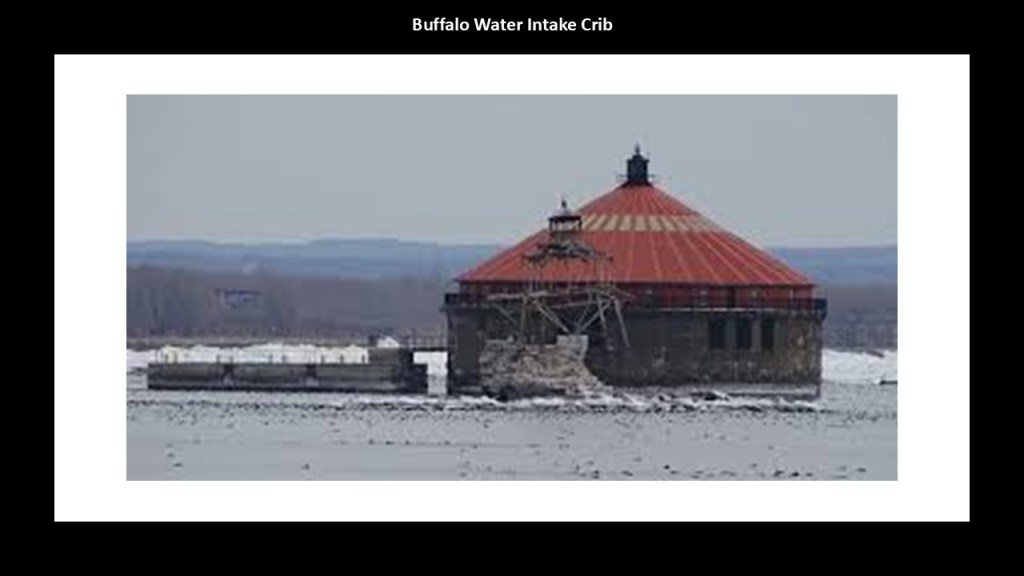
The Buffalo Intake Crib is near the Horseshoe Reef Lighthouse.
The Buffalo Water Intake Crib was said to have been built in 1907.
It has 20-foot, or 6-meter walls beneath the surface of the water and is one of the key water intake locations in the State of New York.
It is described as a round, red-roofed structure sitting on a concrete crib, feeding water via gravity through tunnels deep in the bedrock, and supplies Buffalo with approximately 125-million gallons, or 473,176,473-liters, of water each day.
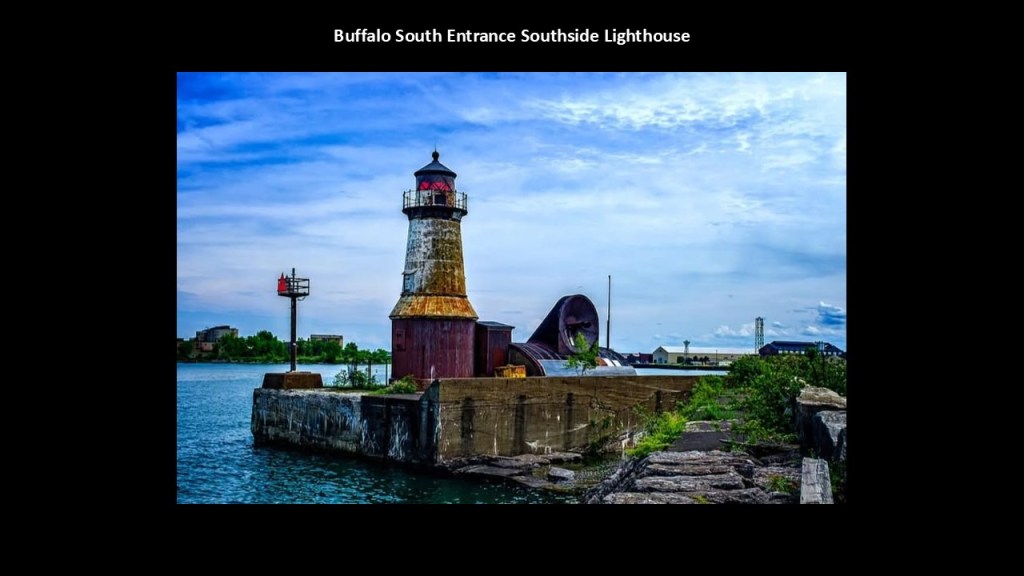
The Buffalo South Entrance Southside Lighthouse was located at Stony Point at the entrance to Buffalo Harbor.
It was said to have been established in 1903 and operational until it was deactivated in 1993, and replaced by a modern post light.
All that’s left of the lighthouse today is the cast-iron, three-story light-tower and its lantern.
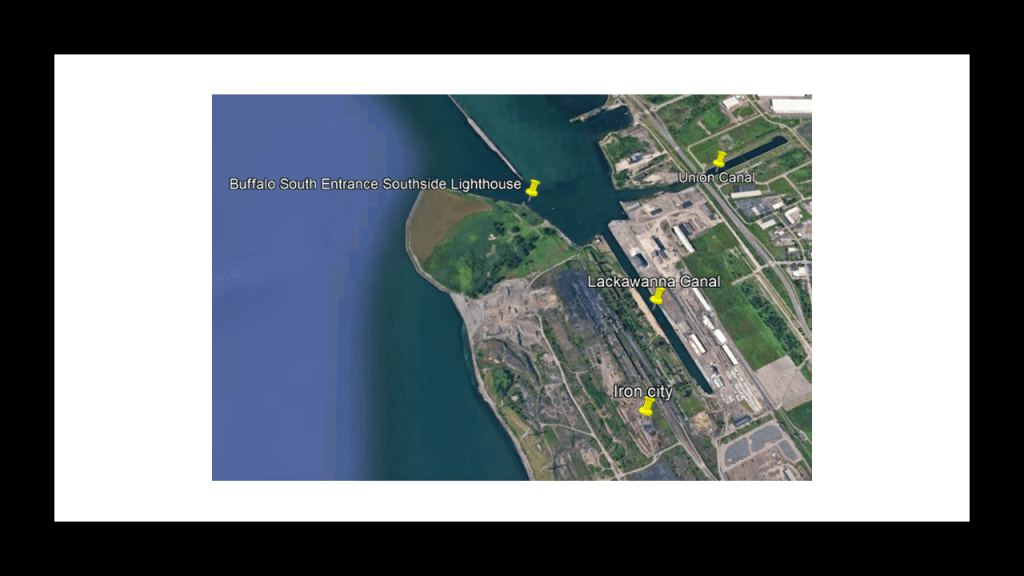
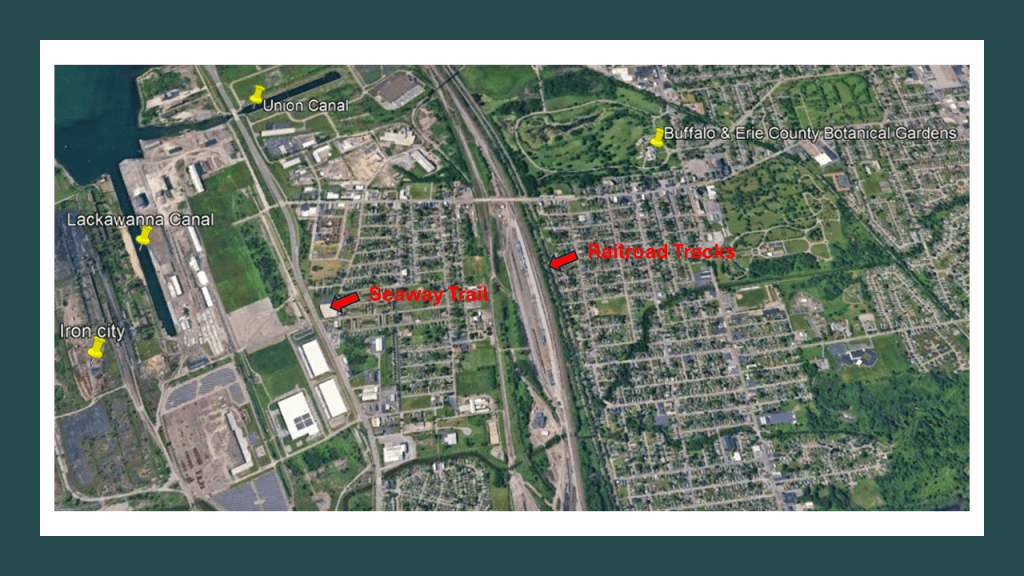
The Buffalo South Entrance Southside Lighthouse was in close proximity to the Tifft Nature Preserve; the Union Canal; the Lackawanna Canal; what is called Iron City; the Caz Creek Waterfalls and the Buffalo and Erie County Botanical Gardens.
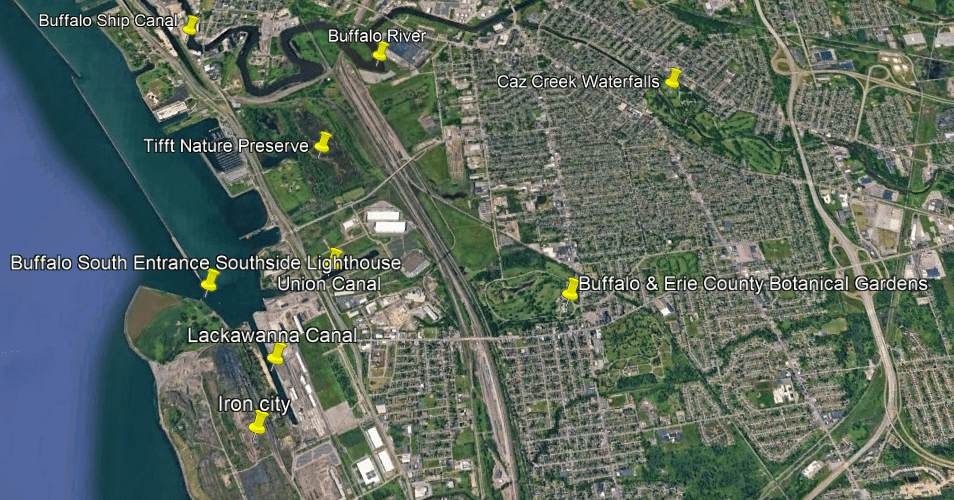
The Tifft Nature Preserve is just a 5-minute drive from downtown Buffalo and is one of the largest municipal nature preserves in New York State, at 264-acres, or 107-hectares.
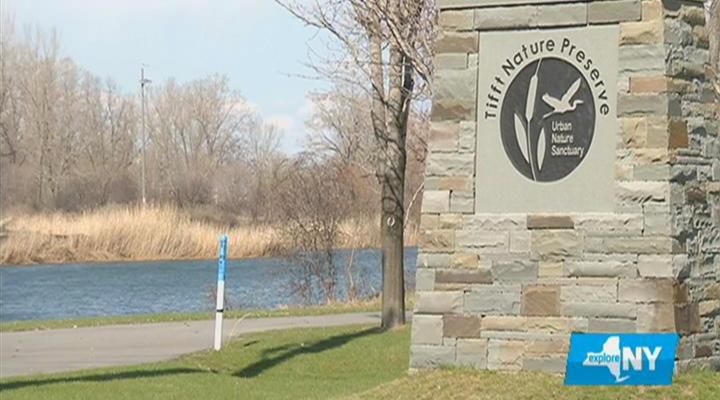
Its history goes something like this.
In 1858, 600-acres, or 243-hectores, of land here was purchased by George Washington Tifft, and he started a large dairy farm.
It was in the Tifft family until 1883.
Then in 1900, the land became a trans-shipment center for coal and iron, with twelve shipping lanes and docked 83 vessels, and this ended in 1912 with the passage of the Panama Canal Act in 1912, which forced the separation of rail and shipping interests.
Afterwards, the land became an unofficial dump, and was purchased by the City of Buffalo to became a landfill site in the 1970s.
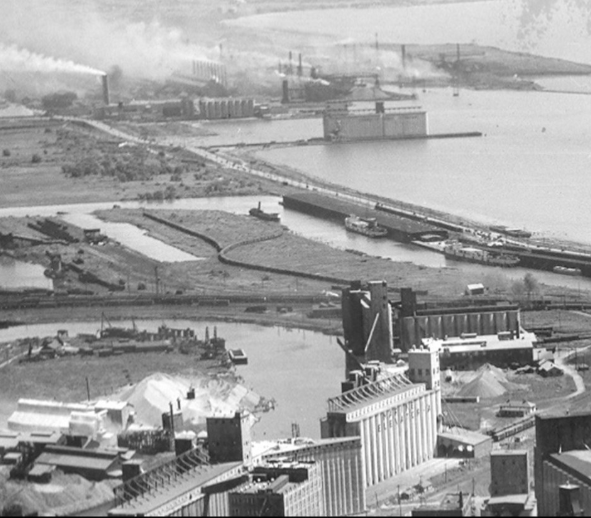
Then in 1976, following public outcry, a non-profit was organized with city-support; a visitor center completed in 1978; and it was merged with the Buffalo Museum of Science in 1982.
In 1983, the preserve was temporarily closed for the removal of hazardous waste.
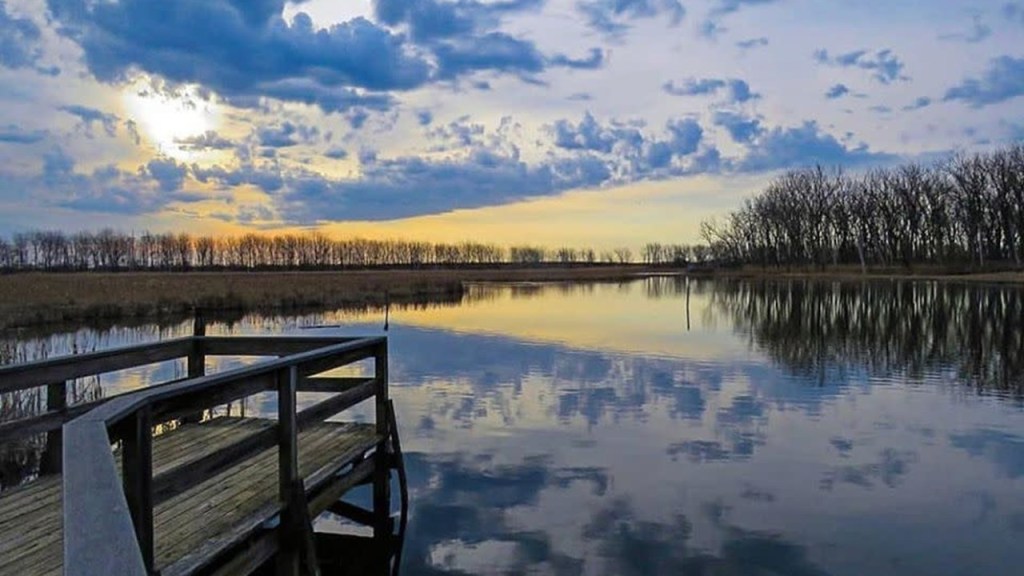
Public access is provided by 5-miles, or 8-kilometers, of nature trails and three boardwalks with viewing blinds in or next to the cattail marsh.
Wetlands, including marshes and swamps, are on my radar for being destroyed land.
I have been finding them all around the Great Lakes and in many places along leylines I have tracked in past research, and we will see more examples before the end of this post.
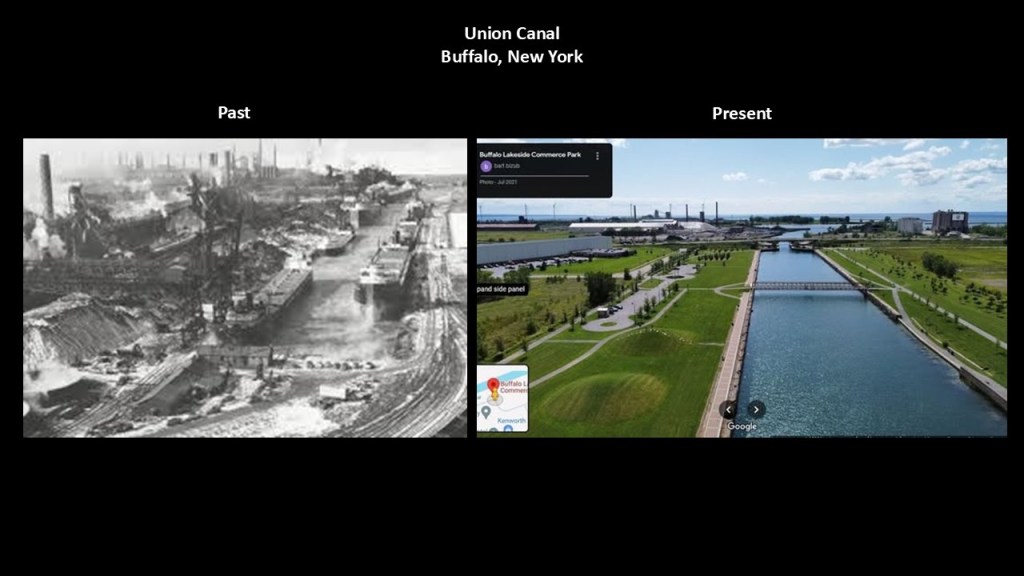
Technically located in Buffalo, the Union Canal is the city’s boundary with the city of Lackawanna.
It was said to have been dug by the Goodyears in order for lake freighters to access the Susquehanna Iron Company and Pennsylvania Railroad’s Ore Docks.
The Susquehanna Plant changed hands and was owned by Hanna Furnace for quite some time.
Bethlehem Steel operated the short section of dock from Route 5 to the Harbor.
The area underwent major rehabilitation and remediation, and today the Union Canal is the centerpiece of the Buffalo Lakeside Commerce Park, and is a popular spot for fishing.
The nearby Lackawanna Canal runs along what used to be the Bethlehem Steel Plant property, and was used as a commercial service canal tied to industrial and port activity.
Today its main role is commercial navigation to support bulk cargo movement into and out of the Port of Buffalo.
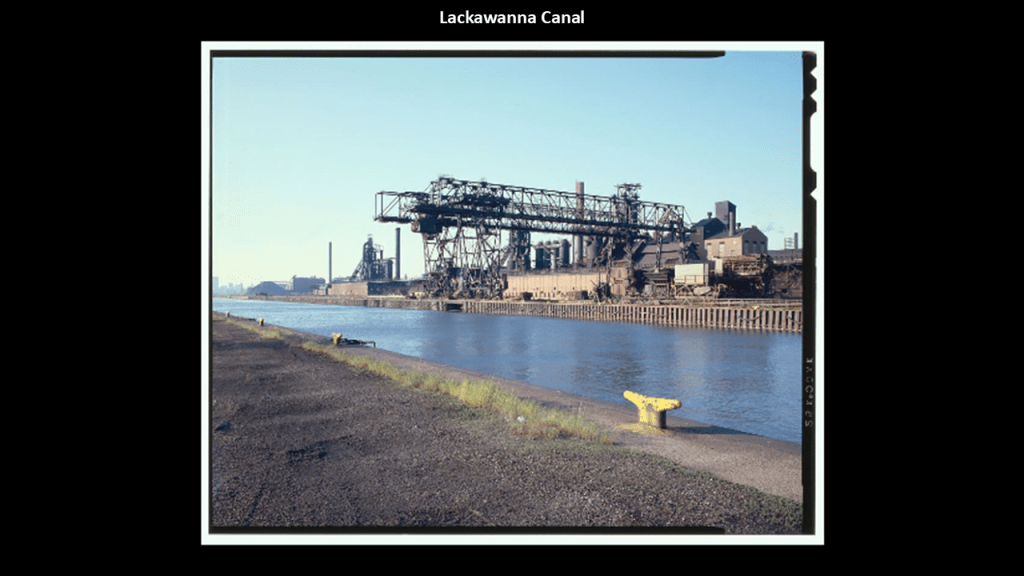
Today, there is place marked “Iron City” just to the south of the former lighthouse at South Point, and west of the Lackawanna Canal.
It is a supplier of aggregate materials, which are inert, granular materials like sand, gravel and crushed stone, and used in concrete, mortar and asphalt to provide bulk, strength and stability.
I have have looked at numerous aggregate-supply companies around the Great Lakes and suspect there is more to the story than what they are telling us about what the source of the materials actually is, like perhaps unidentified masonry structures or something along those lines.
The city of Lackawanna was founded in 1909 after the Lackawanna Steel Company moved its steel plant here from Scranton, Pennsylvania.
During the early 20th-century, the Lackawanna Steel Plant was the largest in the world.
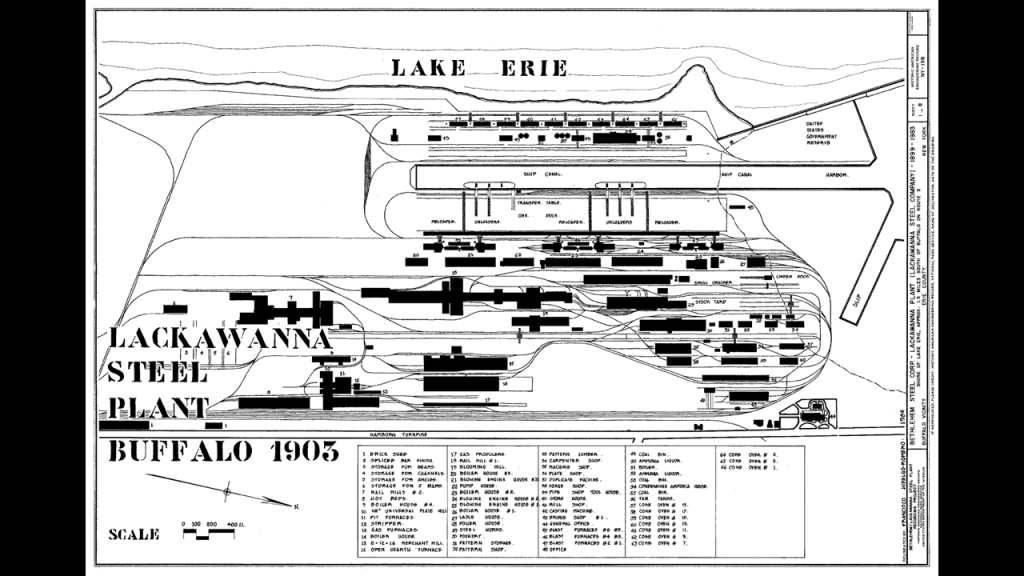
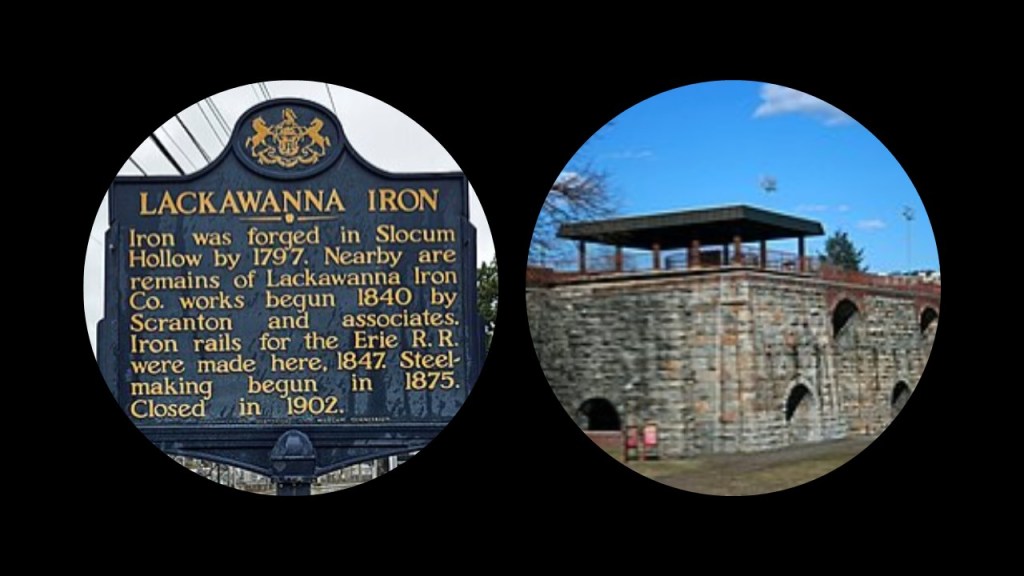
Lackawanna Steel Company was said to have been established in 1840 by the Scranton brothers in the Lackawanna Valley in Pennsylvania, which was rich in anthracite coal and iron deposits.
The Scranton brothers were credited with developing the steel-making techology to mass produce the rails needed for railroad construction, and the town of Scranton was said to develop around the company’s original location.
The Bethlehem Steel Company acquired the Lackawanna Steel Company in 1922.
At its peak, the company employed 20,000 people and attracted immigrants from all over the world to come to work there.
In the second-half of the 20th-century, with industrial restructuring and high-city taxes, the steel plant declined in business and eventually closed in 1983.
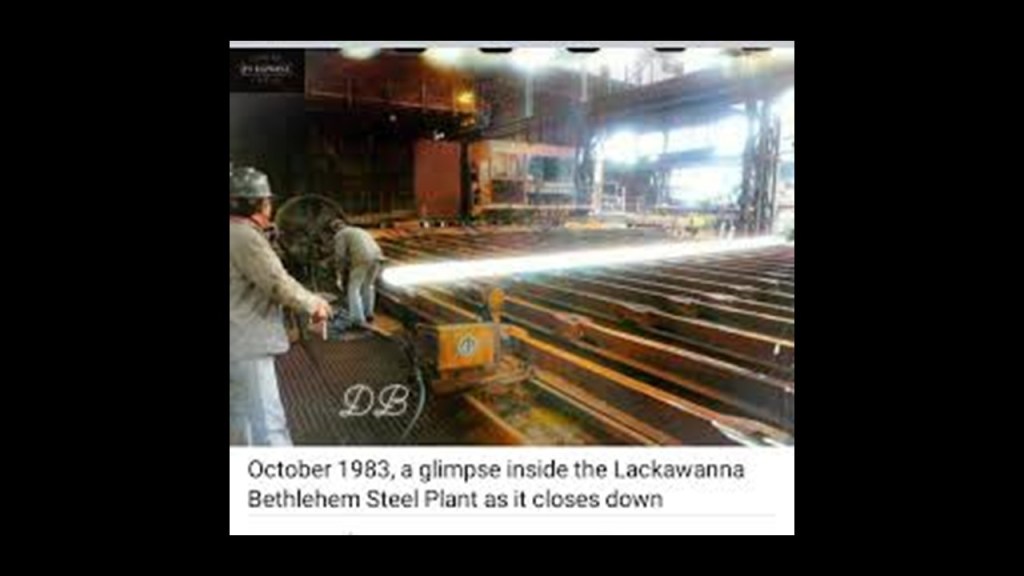
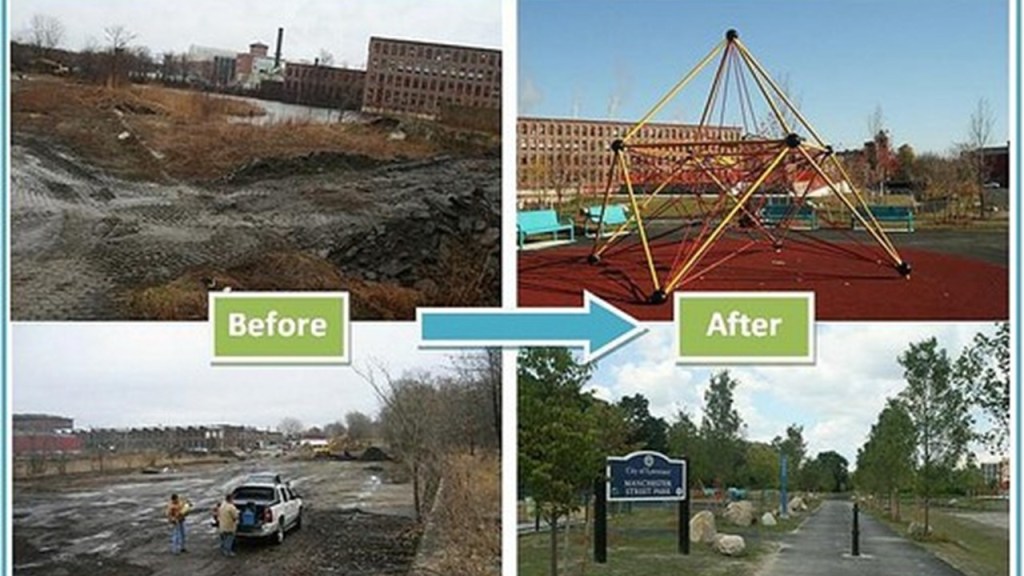
This brownfield site has undergone redevelopment for other uses though opponents of this say that the brownfields still contain hazardous contaminants.
A brownfield site is defined as an abandoned or underused property whose expansion, redevelopment or reuse is complicated by the actual or perceived presence of hazardous substances, pollutants, or contaminants.
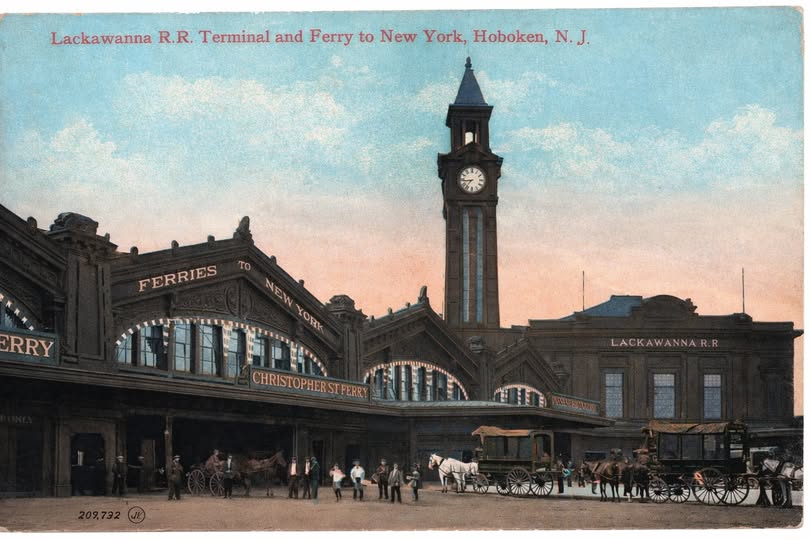
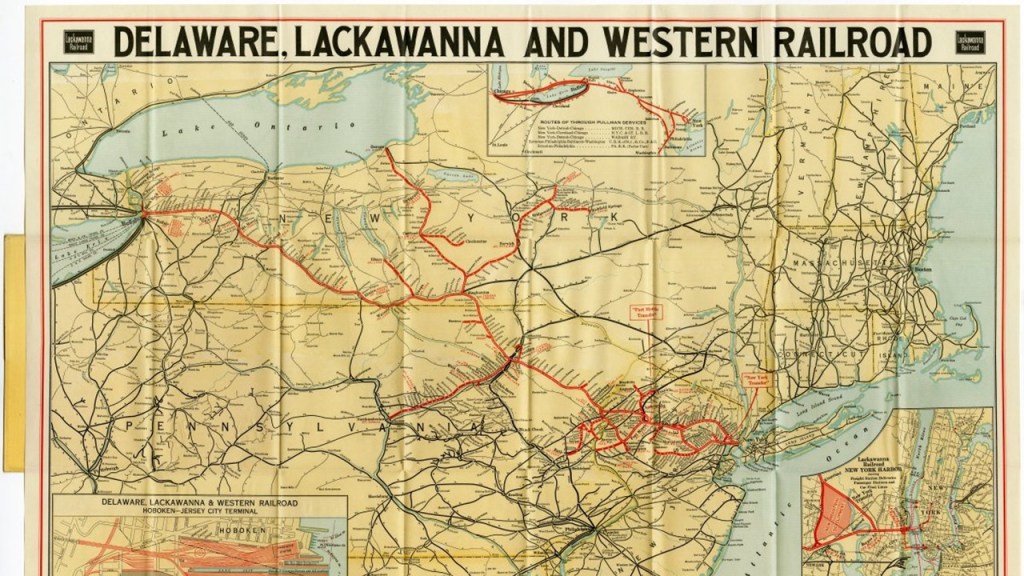
The Delaware, Lackawanna and Western Railroad connected Buffalo with Hoboken, New Jersey, and by ferry with New York City.
One of the New York area’s major transportation hubs, the terminal at Hoboken was said to have been constructed by the Delaware, Lackawanna and Western Railroad in 1907, and combined railroad, ferry, subway, streetcar and pedestrian services.
It is still in use today as a transportation hub for commuter rail, ferry, and bus services.
We are told that numerous electric streetcar lines originated and ended at the station until the completion of “Bustitution” in August of 1949, at which time they were replaced by buses.
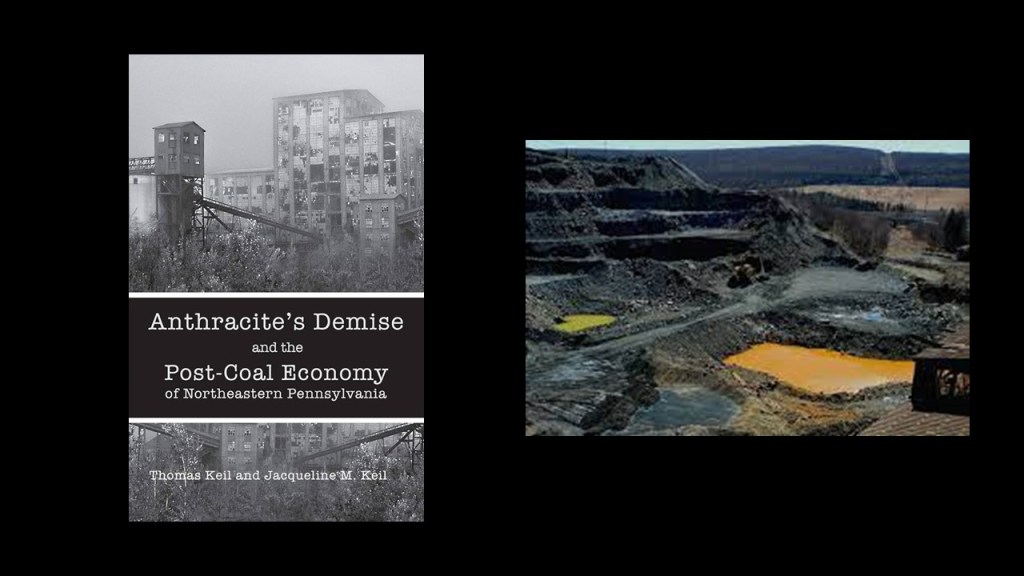
This railroad was incorporated in Pennsylvania in 1853 to provide a way to transport anthracite coal from the coal region in northeast Pennsylvania to larger coal markets in New York City and Buffalo.
Today, this part of northeastern Pennsylvania known as the “Coal Region” is considered one of the largest concentrations of disturbed terrain in the world, with billions of tons of debris found in the landscape of abandoned strip mines and this region has among the highest poverty and unemployment rates in the United States with job loss from the decrease in coal mining and the out-migration of people because of it.
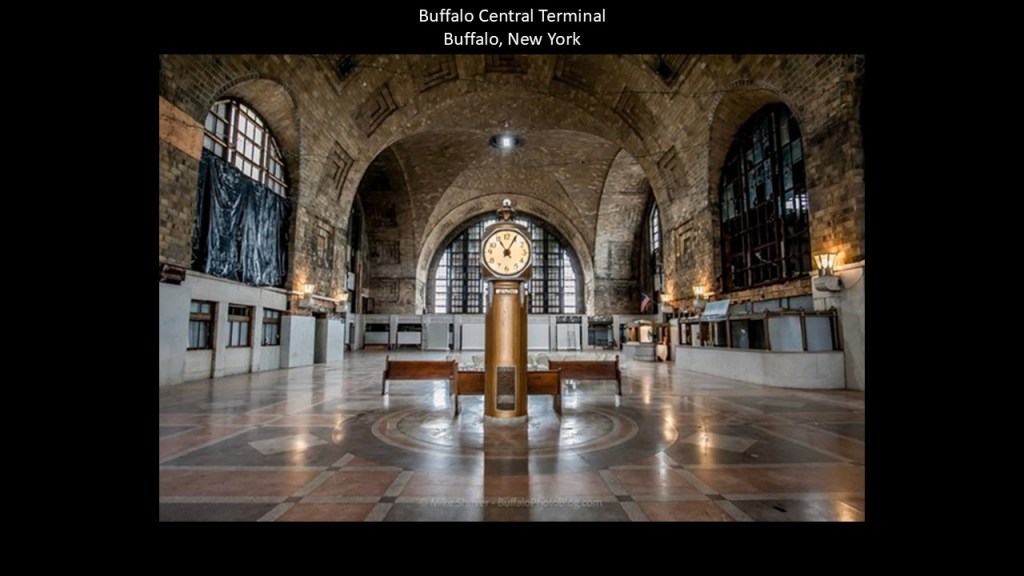
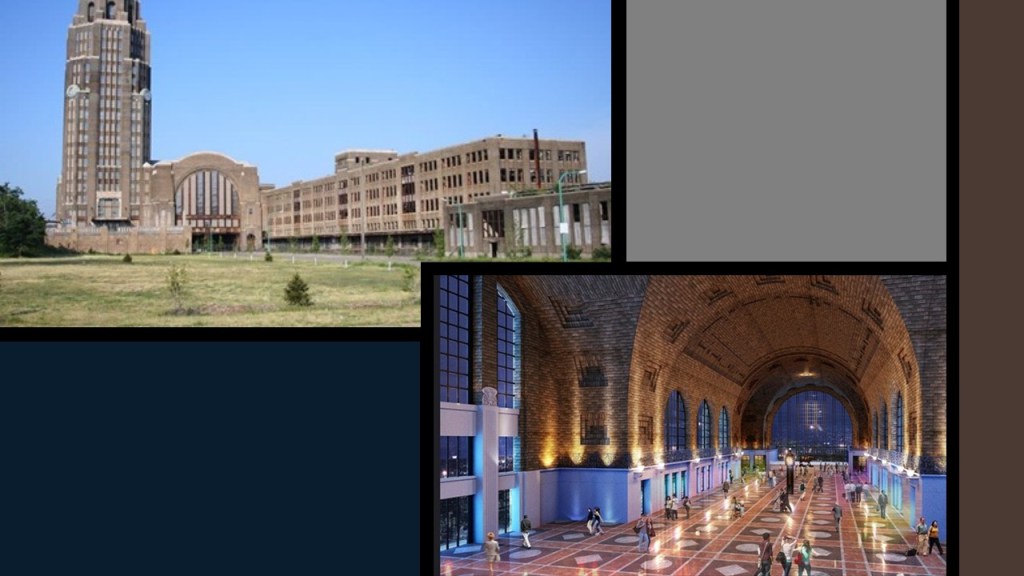
The Buffalo Central Terminal was attributed to Fellheimer and Wagner in the historical narrative, with its construction starting in 1925, and operating as an active station from 1929 to 1979.
Fellheimer and Wagner were a prominent New York architectural firm credited with designing iconic Beaux-Arts and Art Deco Railroad Stations.
It was abandoned for years, and now owned by a non-profit preservation group working on restoring and repurposing the complex.
Back in South Buffalo and Lackawanna, it is interesting to note that the Buffalo and Erie County Botanical Gardens are located just to the east of this former heavily industrialized area, across where the Great Lakes Seaway Trail and the still-used railroad tracks pass through the area.
I found the same juxtaposition in Hamilton, Ontario, with the Royal Botanical Gardens spread across one-side of Hamilton Harbor, and the Bayfront Industrial Area on the other side, which includes major steel producers and Canada’s largest Great Lakes port with marine, rail and road connections.
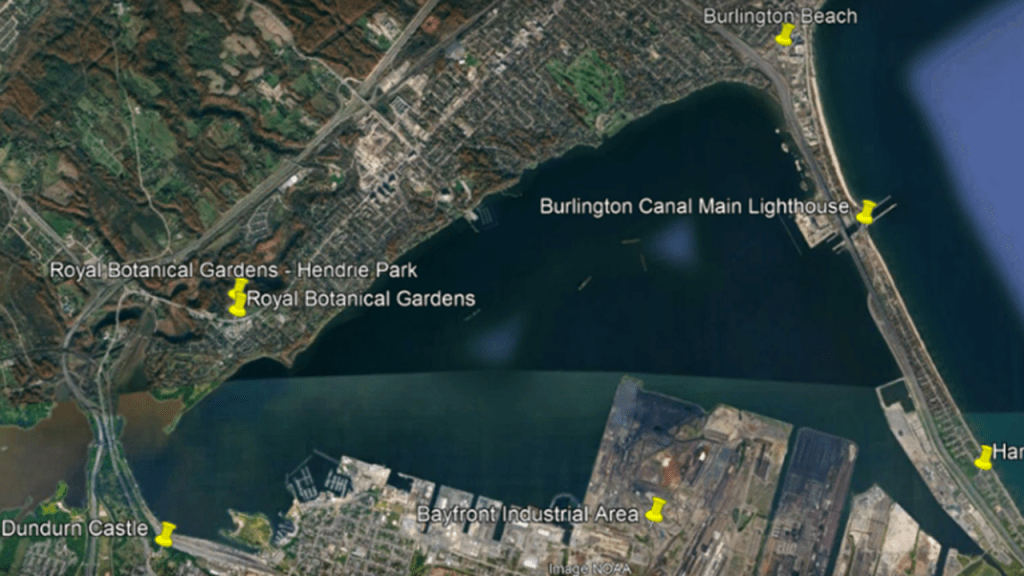
A juxtaposition is defined as two things being seen or placed together with contrasting effect.
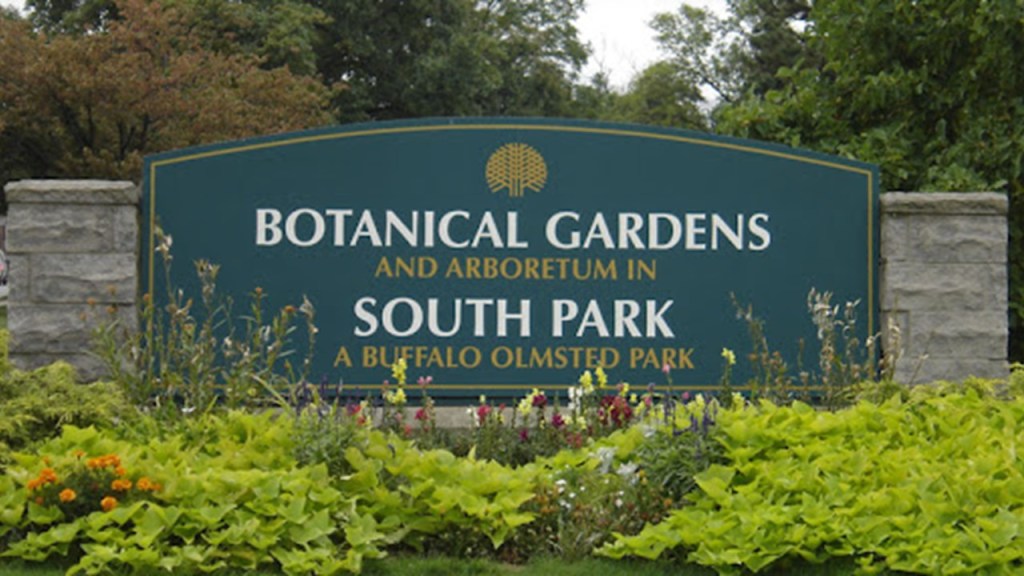
The Buffalo and Erie County Botanical Gardens are botanical gardens in South Park in Buffalo.
They were said to have been designed by Frederick Law Olmsted; glass-house architects Lord & Burnham; and botanist and plant explorer John F. Cowell.
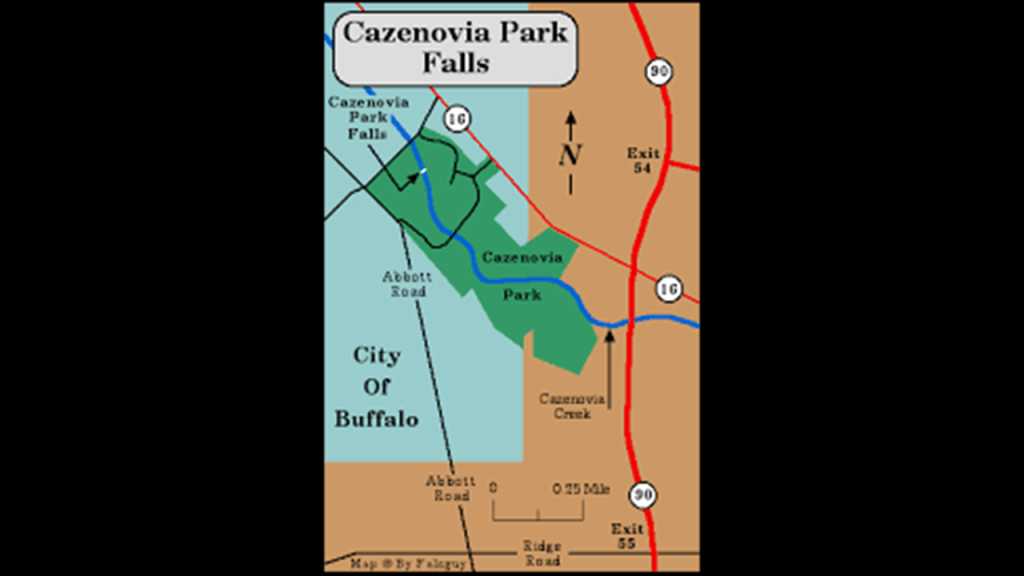
Firstly, the Cazenovia Park – South Park System is described as an historic park system in South Buffalo said to have been designed by Frederick Law Olmsted as an interconnected set of parkways and parks inspired by the parkland, boulevards and squares of Paris, France.
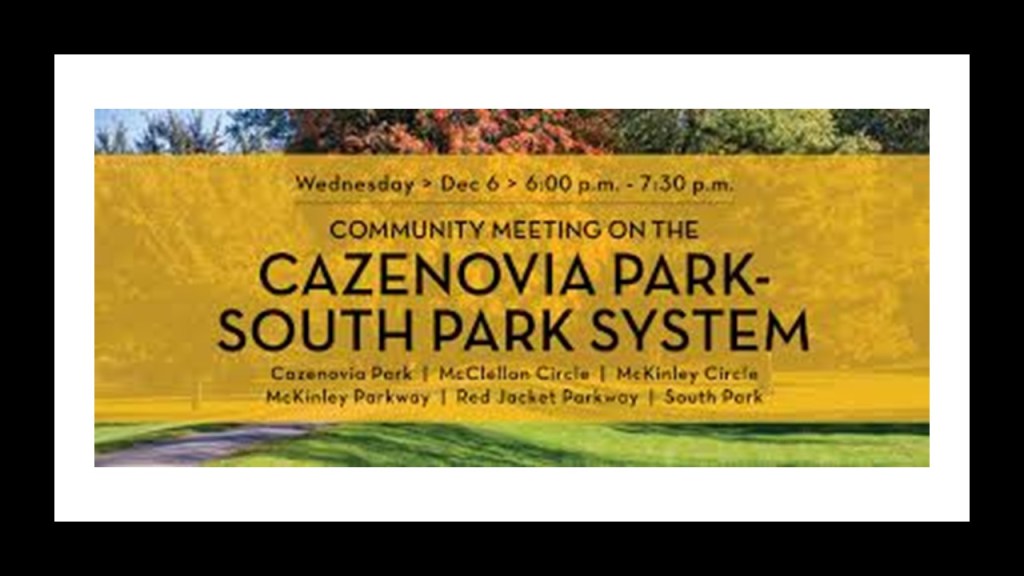
We are told that Olmsted’s final design of South Park included a conservatory and formal gardens surrounding it.
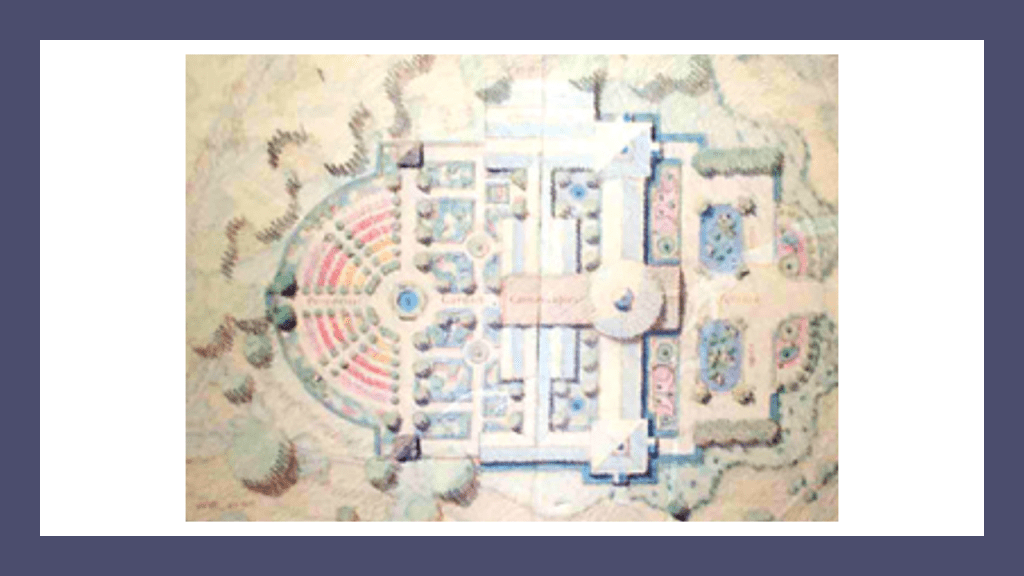
While South Park was under construction, in our historical narrative, Lord & Burnham was designing the South Park Conservatory, which we are told was modelled after glass conservatories in England and built by the Buffalo construction company George P. Wurtz & Son for the cost of $130,000.
When it opened in 1900, it was said to be the ninth-largest public greenhouse in the world and the third-largest in the United States.
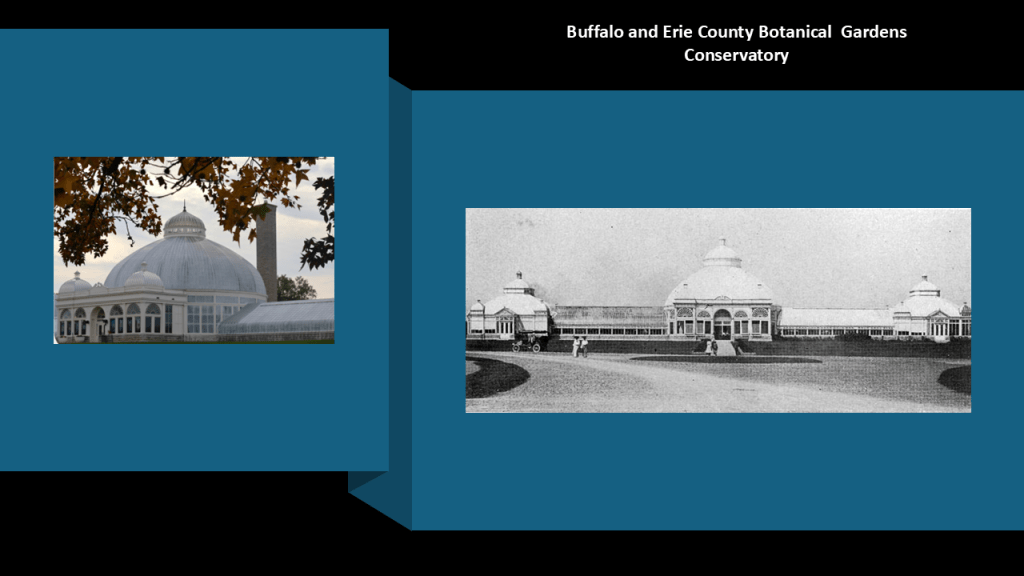
We are told that In 1894, Professor John F. Cowell was appointed the first director of the Conservatory and to oversee plantings in the South Park.
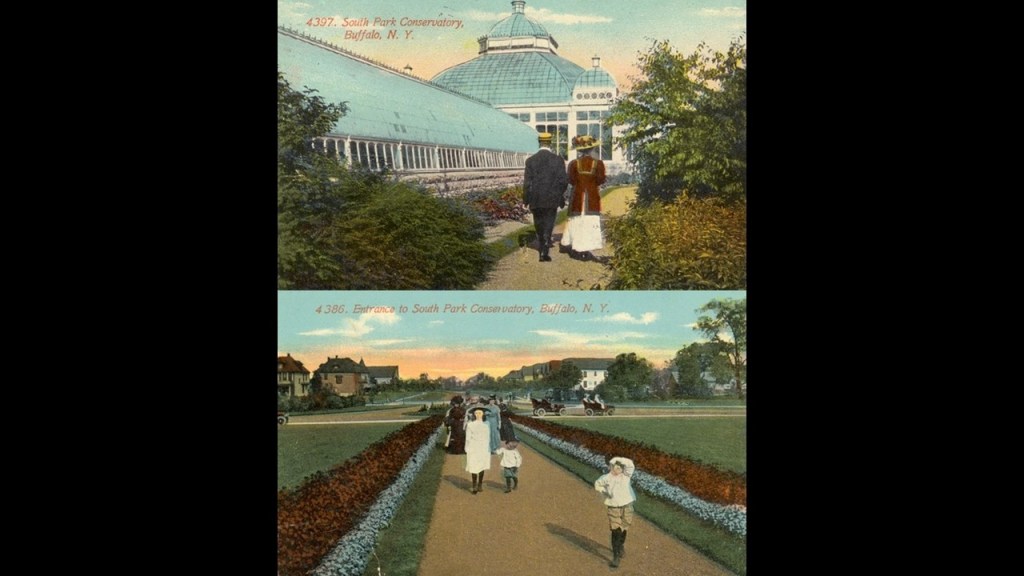
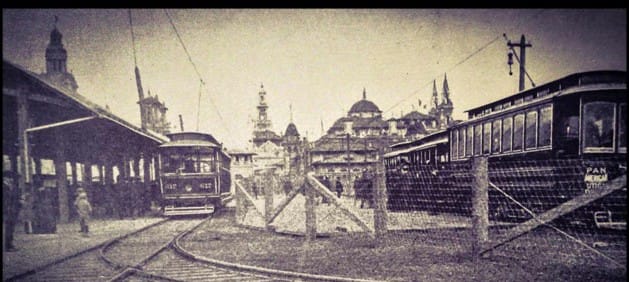
In his day, he was considered a genius in botany and horticulture and that he gathered plants, trees and flowers everywhere in the world, and that during the 1901 Pan American Exposition, throngs of visitors travelled south by trolley to see the exotic varieties of plant life on display at the Conservatory and Botanical Gardens.
Next I am going to take a look at Cazenovia Park, and what’s found there.
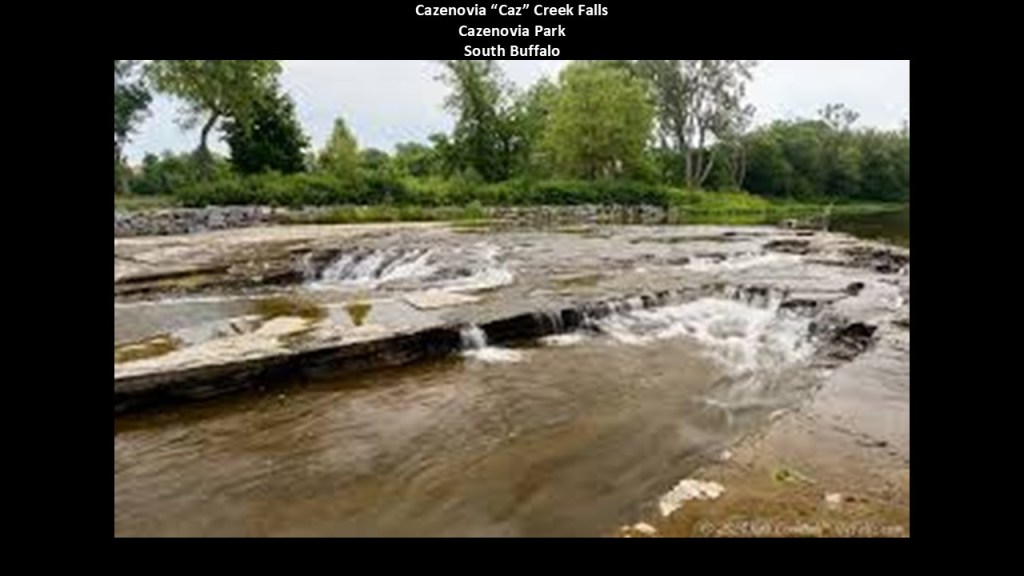
Like the previously-mentioned Cazenovia Creek Waterfalls are in Cazenovia Park.
Also called the Caz Creek Waterfalls, they are described as a series of V-shaped ledges totalling 4 to 5 -feet. or 1 to 1.5-meters, in height.
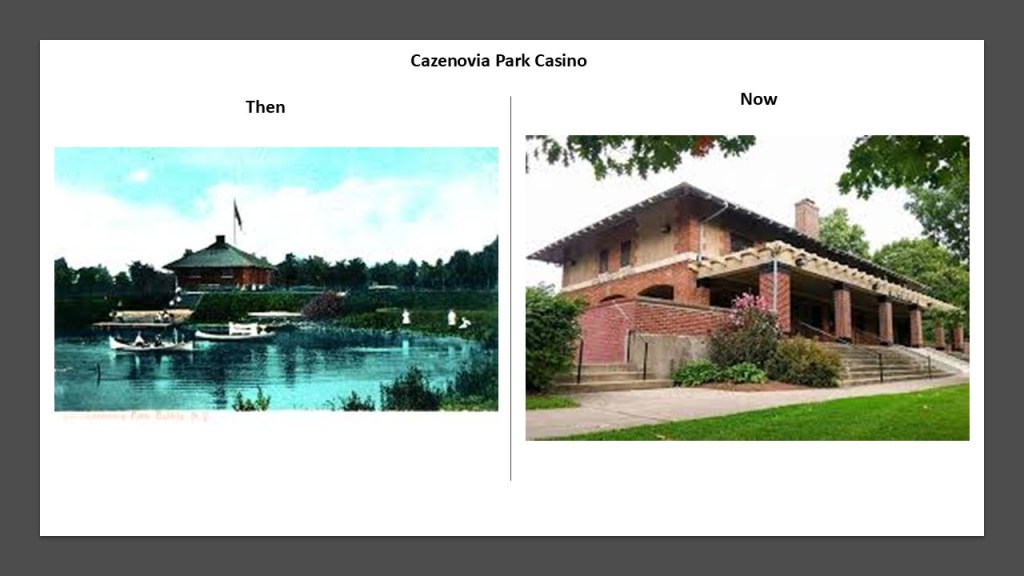
Other significant features of today of Cazenovia Park include the Casino, baseball diamonds, and a 9-hole public golf course.
The Cazenovia Casino was said to have been designed by the Buffalo architectural firm of Esenwein and Johnson and completed in 1912.
In this case the meaning of the word “Casino” pertained to a public place used for gatherings and recreation and not used for gambling.
It had bathrooms, locker rooms, an ice cream parlor, and enough lights to allow night-skating in the winter-time.
Baseball has been a part of the history of Cazenovia Park for over a century and it is one of Buffalo’s key amateur baseball hubs.
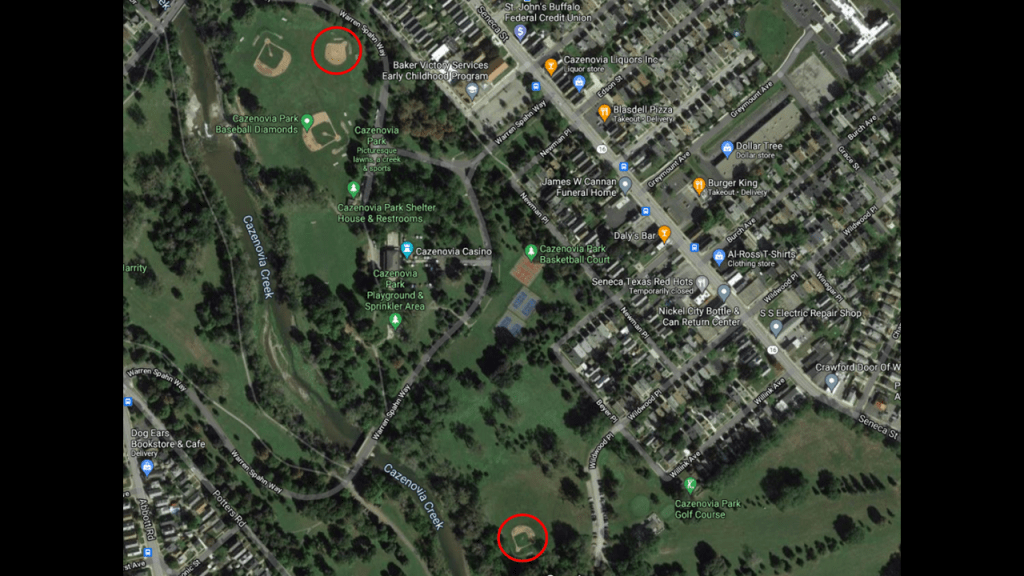
The Cazenovia Park also has one of three 9-hole public golf courses in the Buffalo-Olmsted Park System.
The other two are at Delaware Park and South Park.

Next, I am going to take a look at the CSX Intermodal Terminal in Blasdell; the Highmark Stadium; and the Owens Falls Sanctuary.
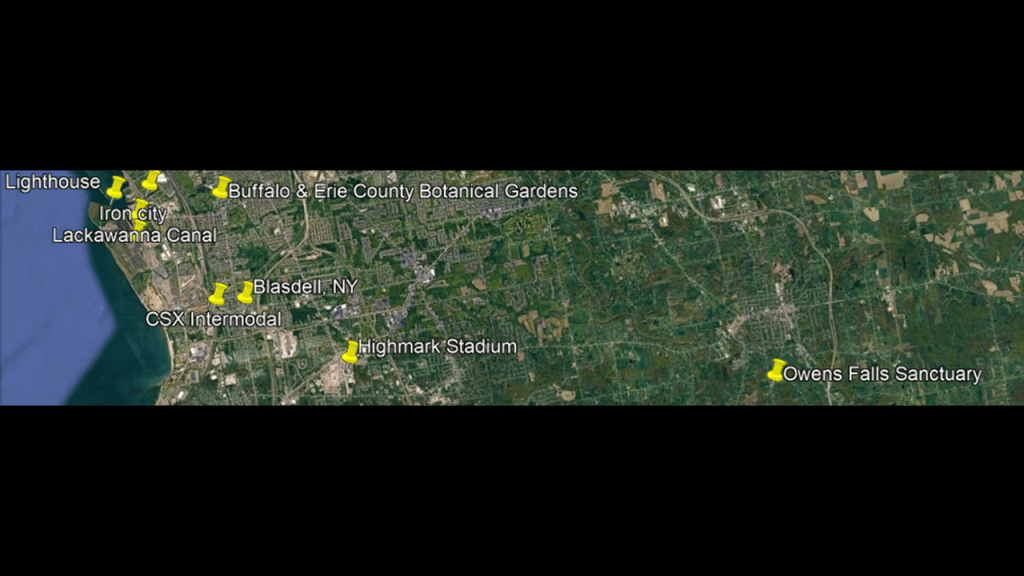
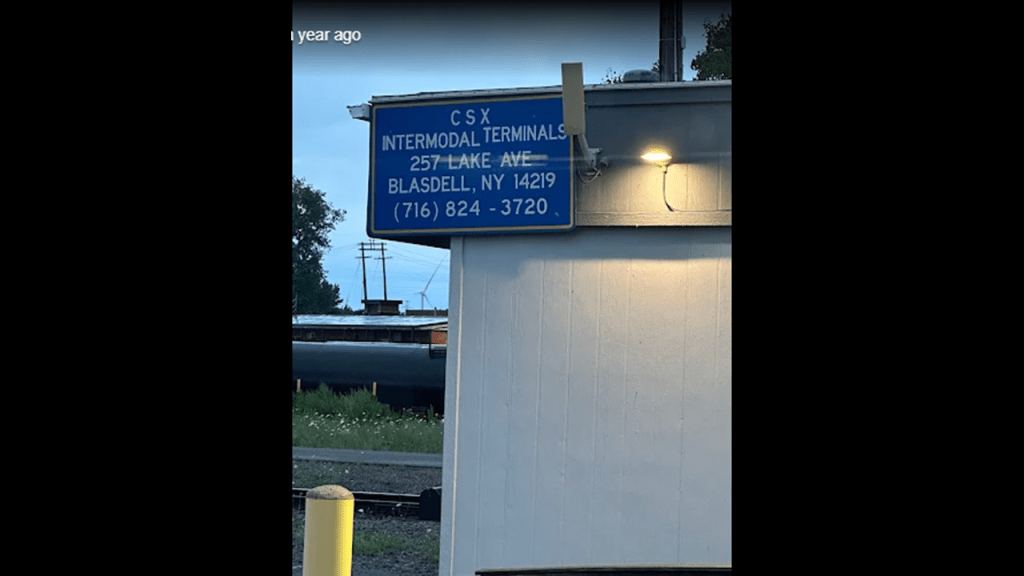
First, the CSX Intermodal Terminal in Blasdell.
Since opening in 2008, the CSX Intermodal Terminal is a major regional hub linking the Buffalo-area with Philadelphia and the Port Authority of New York and New Jersey.
It’s a key facility for moving freight from rail-to-truck, focusing on containers.
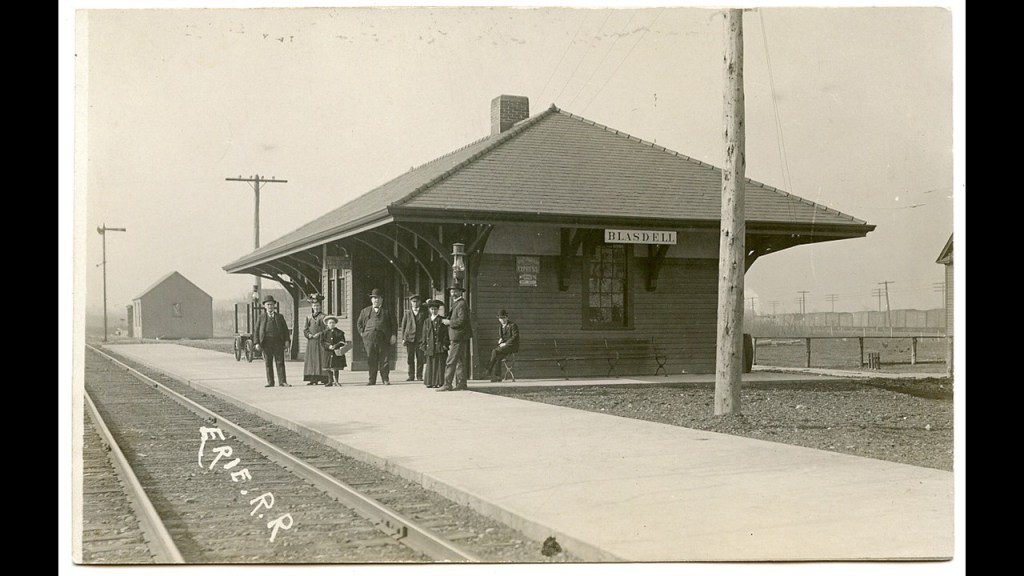
Blasdell grew as a railroad town around the Erie Railroad, and was first incorporated as a village in 1898.
It was named after Herman Blasdell, the first station master of the Erie and Pennsylvania Railroad Depot.
Blasdell was at a junction point for connecting lines like the Erie Railroad and the Pennsylvania Railroad.
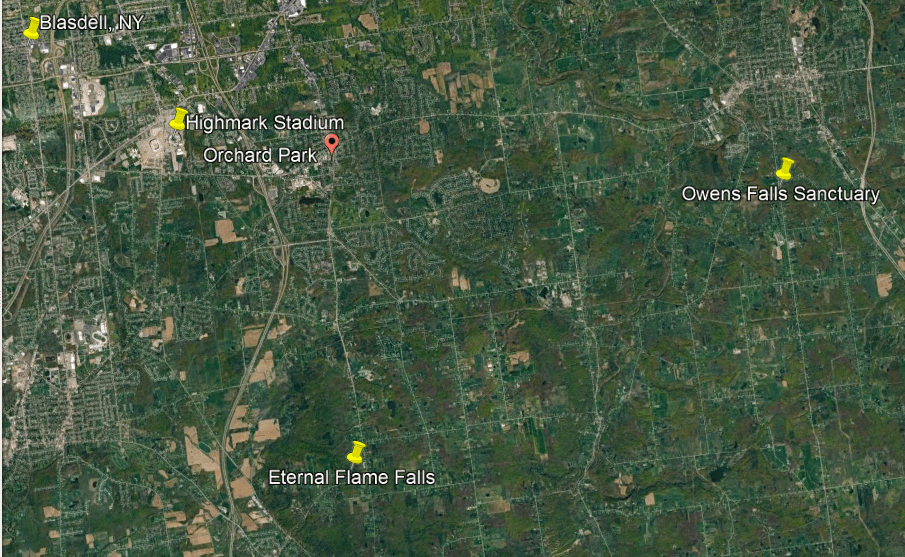
The Highmark Stadium is in-between the CSX Intermodal location in Blasdell and the Owens Falls Sanctuary in East Aurora, New York.
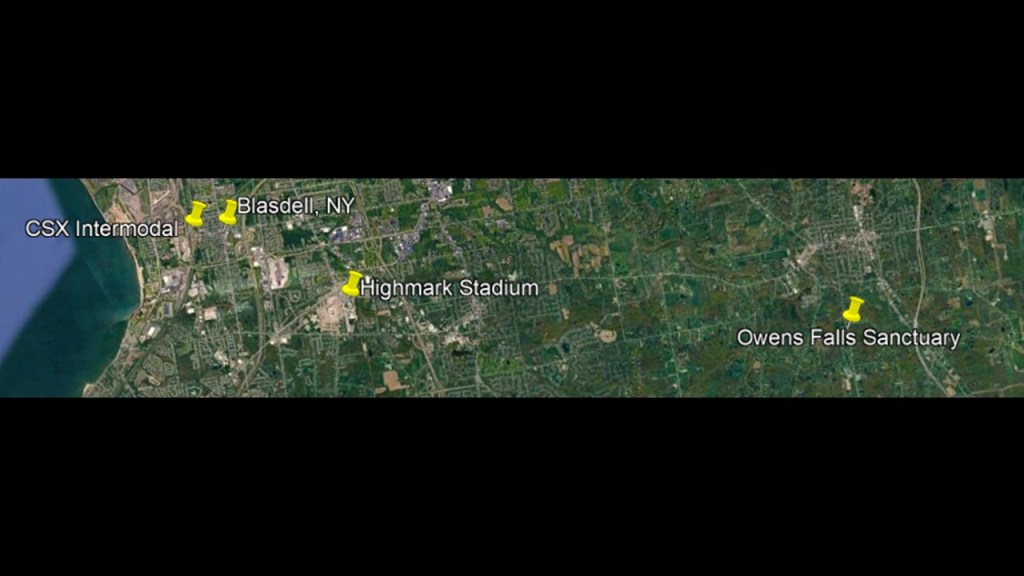
Highmark Stadium is the home venue of the National Football League’s Buffalo Bills.
Also known in the past as the Rich Stadium; the Ralph Wilson Stadium; the New Era Field; and the Bills Stadium, the last major league football game was played here just this past January 4th of 2026 in its last season game against the New York Jets.
Interestingly, the Buffalo Bills played against the New York Jets in the first game played here on September 30th of 1973.
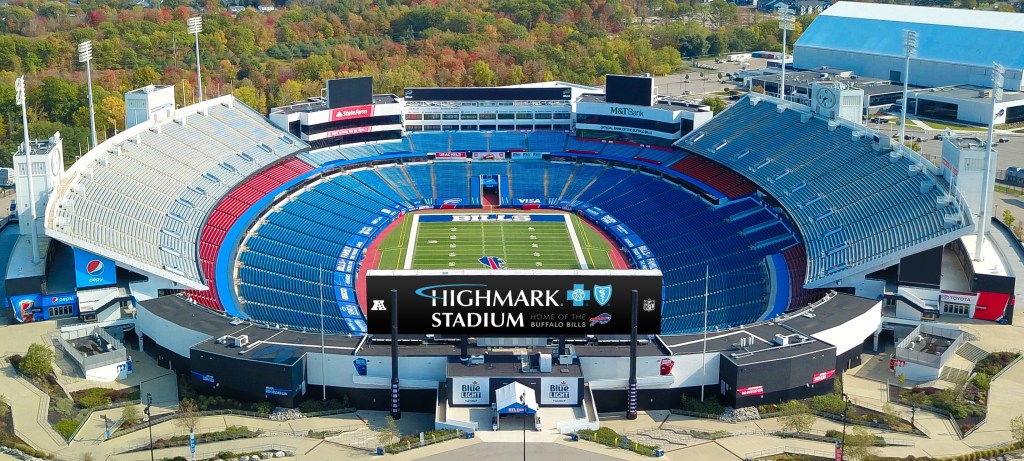
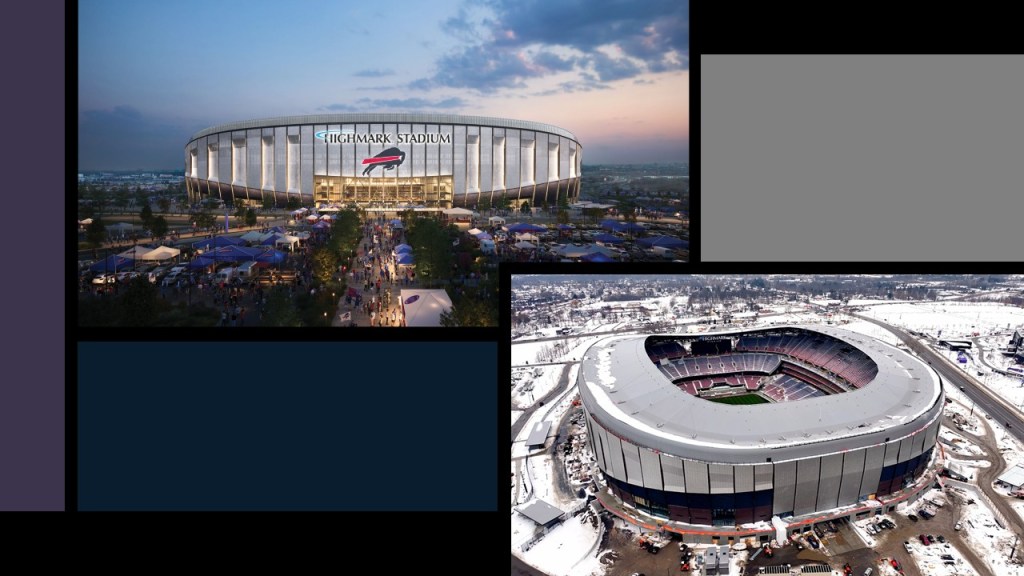
This Highmark Stadium is scheduled for demolition in March of 2027 because of the construction of a new Highmark stadium across the street from the old stadium that is expected to be ready in time for the 2026 NFL Season.
The original stadium for the Buffalo Bills, along with other Buffalo sports’ teams, was the War Memorial Stadium in East Buffalo, said to have been constructed as a Works Progress Administration project in 1937, one of the New Deal Era programs of President Roosevelt during the Great Depression.
It also had a race track and hosted several NASCAR events.
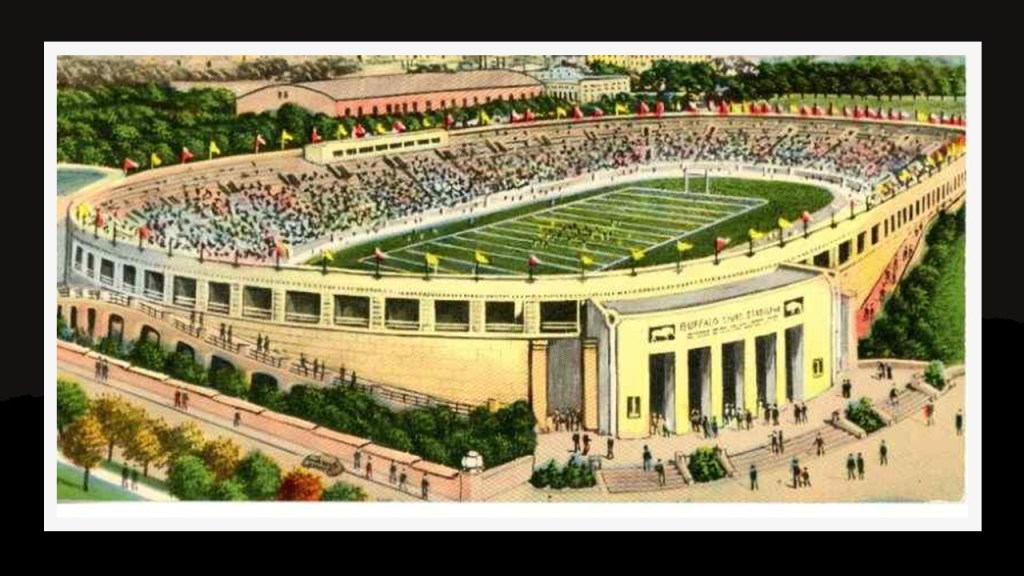
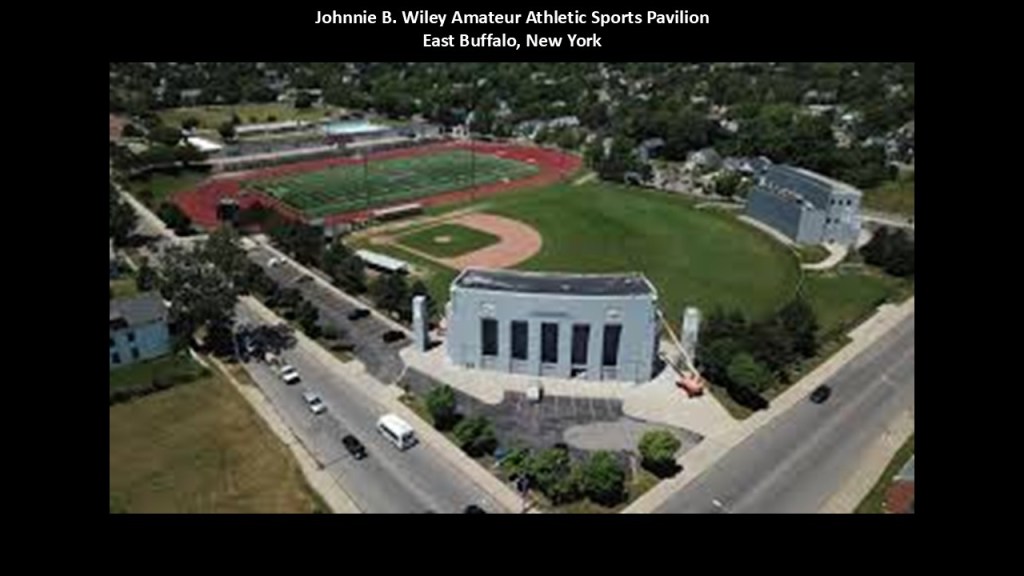
It was demolished in 1989, and replaced with the Johnnie B. Wiley Amateur Athletic Sports Pavilion, which retained entrances from the original War Memorial Stadium.
Highmark Stadium is in Orchard Park, New York, one of Erie County’s earliest settlements.
It was known for its abundant fruit orchards.
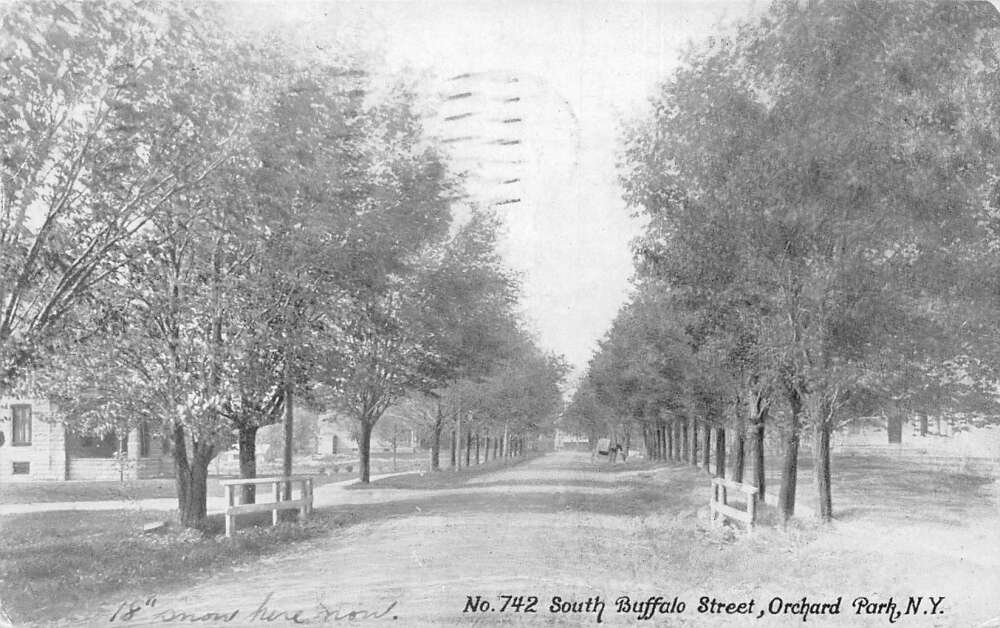
Most of the orchards here were gradually replaced by suburban development, and today it is best known for being the suburban community that is home to the Buffalo Bills.
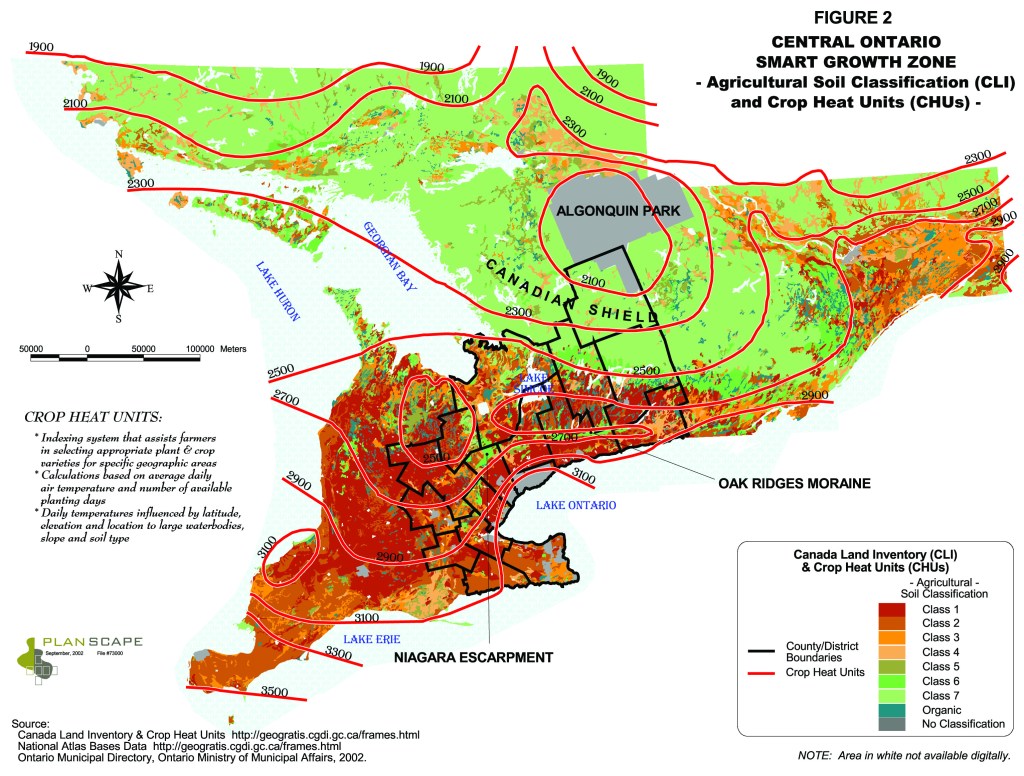
I have been finding fertile agricultural lands throughout this Great Lakes region, including but not limited to, orchards and vineyards in the Niagara region in the last part of the series on the Ontario-side of Lake Ontario.
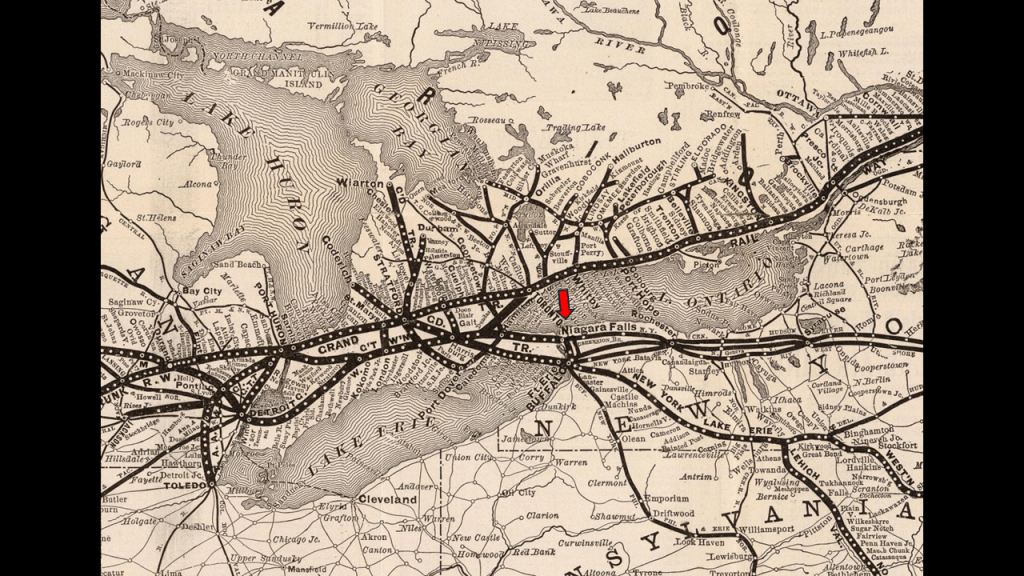
There was a significant historical rail presence all throughout this region.
I suspect the agricultural productivity of this region to be in part due to a connection from the original energy grid system between the railroad, hydroelectric system, and all kinds of agricultural activity, functioning as the original electroculture, today a gardening practice that harnesses atmospheric electricity using copper wires or antennas.
I consistently find historic railway and hydroelectric connections through areas known for high-yield and high-quality agricultural production.

Including Orchard Park.
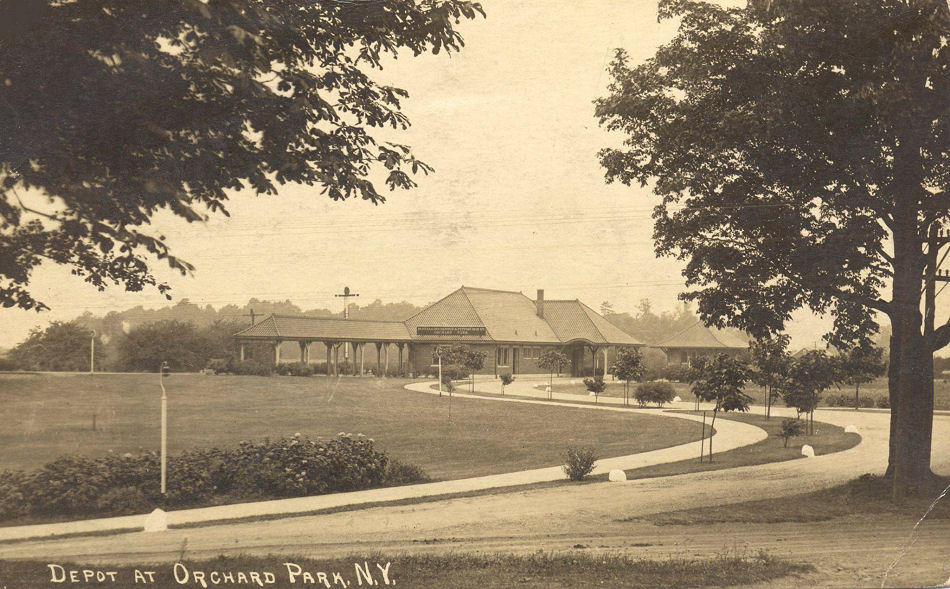
We are told that the Buffalo, Rochester and Pittsburgh Railway built a new train depot in Orchard Park that was first opened to the public in 1912.
We are told the Orchard Park Depot was an exact replica of the Auburndale Train Station in Massachusetts that Henry Hobson Richardson was credited with circa 1884.
We are told that in the 1880s, Buffalo was a rapidly growing lake port with freight interchanges between lake freighters and railroads and the Buffalo, Rochester and Pittsburgh Railway was first completed between those three cities in 1883.
It hauled freight like coal from the rich mines in Pennsylvania to the lake ports, but also products like oil, steel, lumber and agricultural produce, as well as providing the most modern available passenger service of the time.
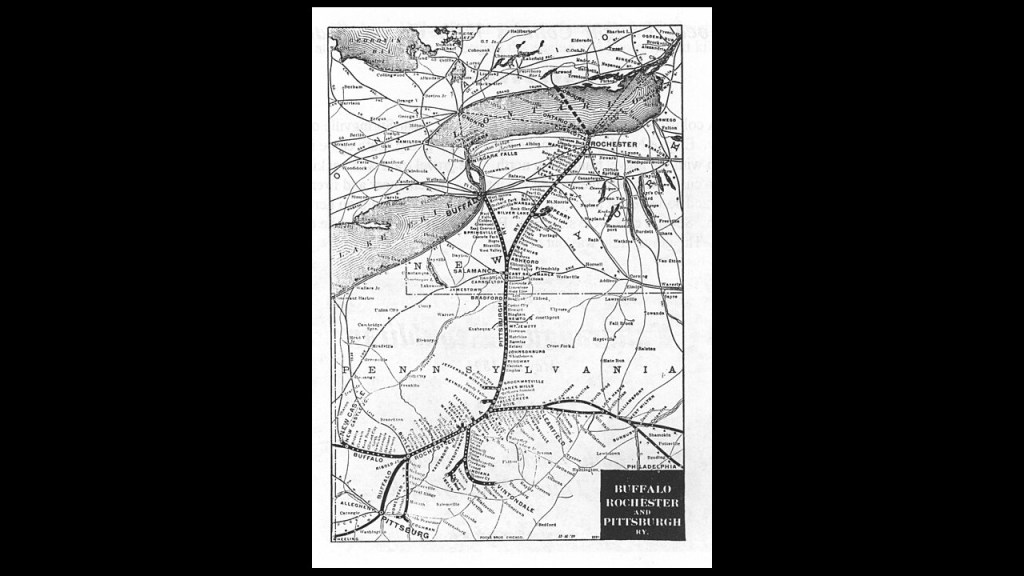
Passenger service continued through the Orchard Park Depot until October of 1955, and freight service ended through there in May of 1977.
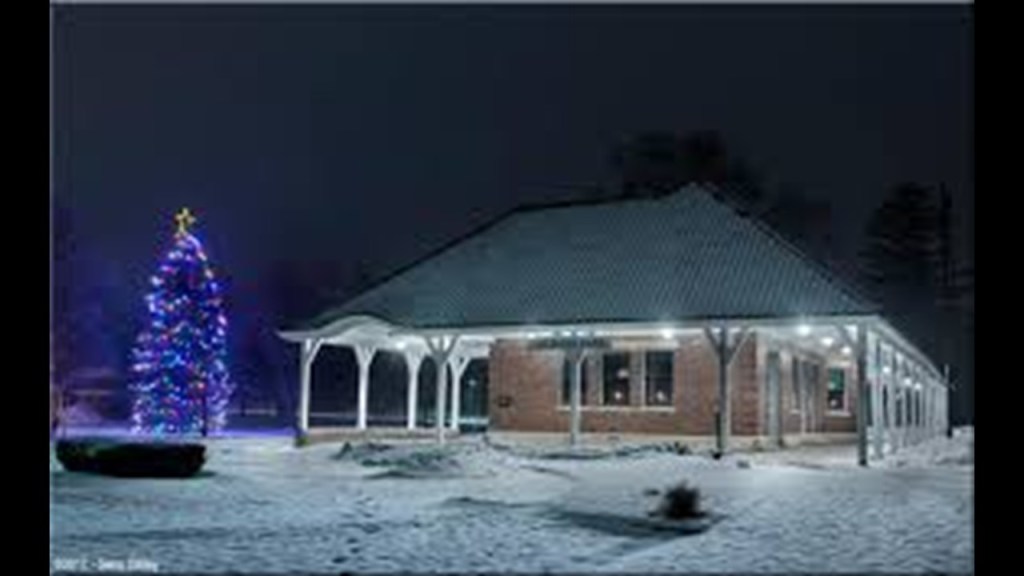
Most of the railroad track has been removed, but the Orchard Park Train Depot still remains as an historic building that is used as a community event venue.
The Eternal Flame Falls are in Orchard Park at the Shale Creek Preserve in Chestnut Ridge Park.
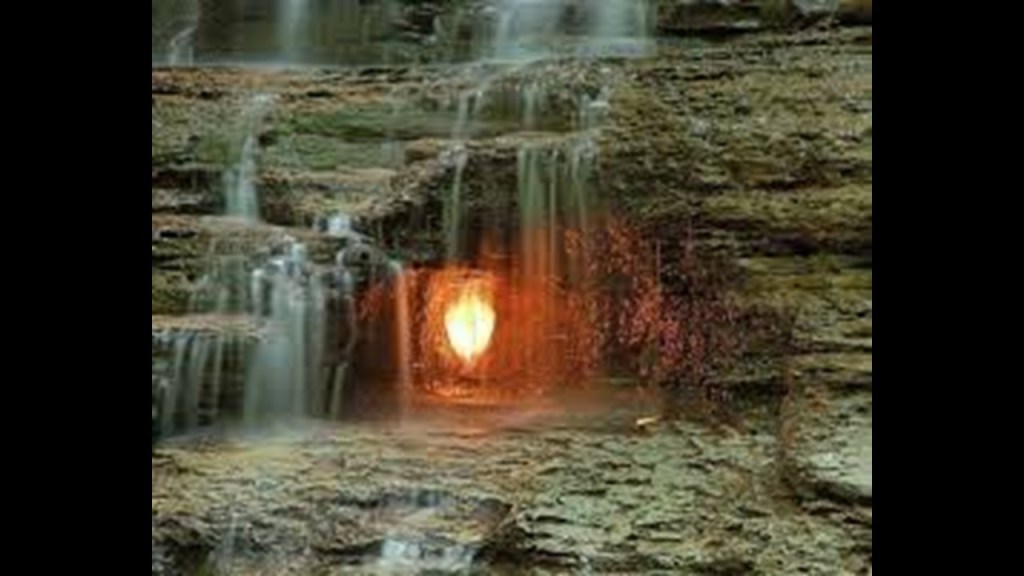
The Eternal Flame Falls on Shale Creek are approximately 35-feet, or 11-meters, in height, with a flame in the grotto at the base of the falls.
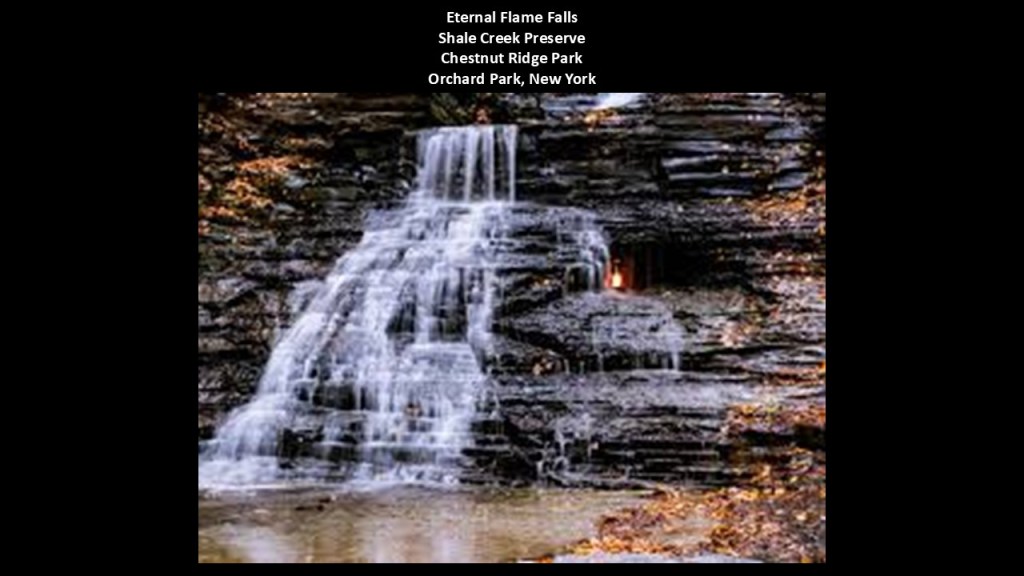
Natural gases of methane and propane come from a hydrocarbon seep here, with an estimated 2.2 lbs, or 1 kg, of methane emitted here per day.
The flame behind the waterfalls is visible year-round, which needs to be re-lit from time-to-time.
Chestnut Ridge Park where the Eternal Flame Falls are located was so-named for chestnut trees on its hills.
The Chestnut Ridge property was acquired by Erie County in 1926, and was one of the county’s first parks.
We are told the Works Progress Administration (WPA) improved the park’s facilities and landscape throughout the 1930s.
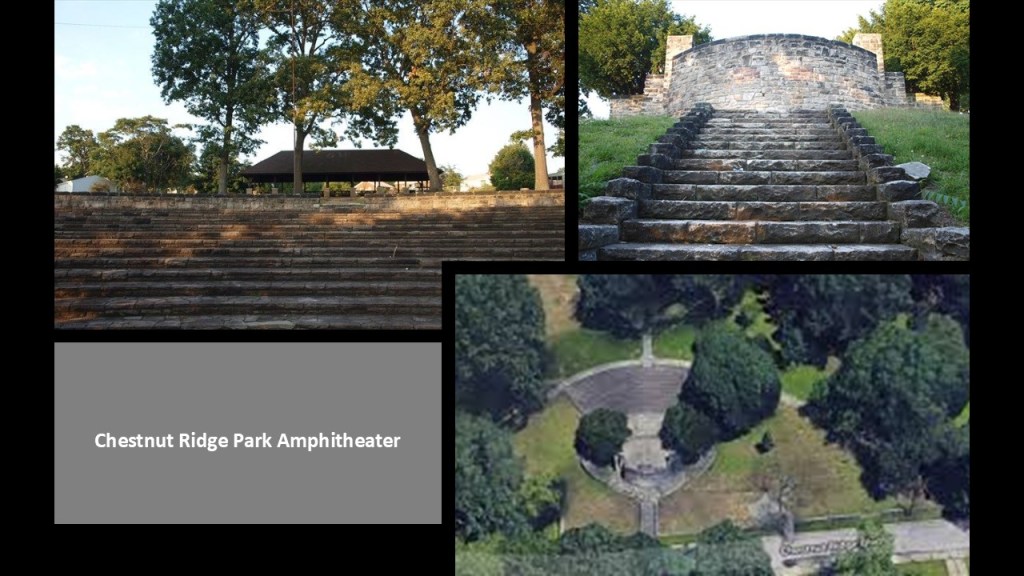
For example, the WPA was credited with building the park’s amphitheater between 1935 and 1936.
The Buffalo Philharmonic Orchestra has held summer concerts here.
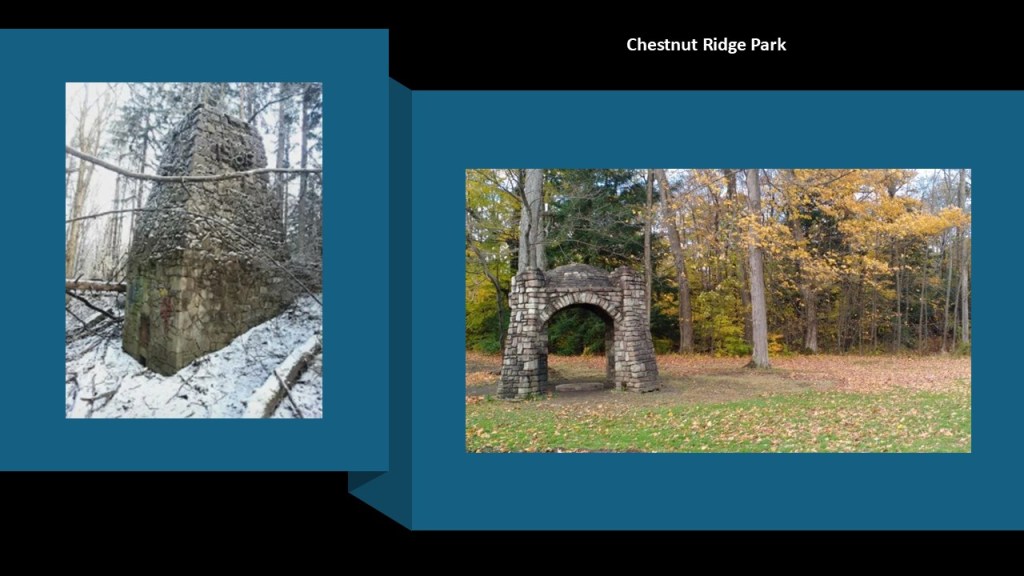
Besides the Eternal Flame Falls, there are other interesting sights found in the park, like these old stone structures.
There’s a lot more to find here at Chestnut Ridge, but this gives you the idea.
The Owens Falls Sanctuary is to the east of Orchard Park and the Eternal Flame Falls in Chestnut Ridge Park, and Colden Falls to the southeast.
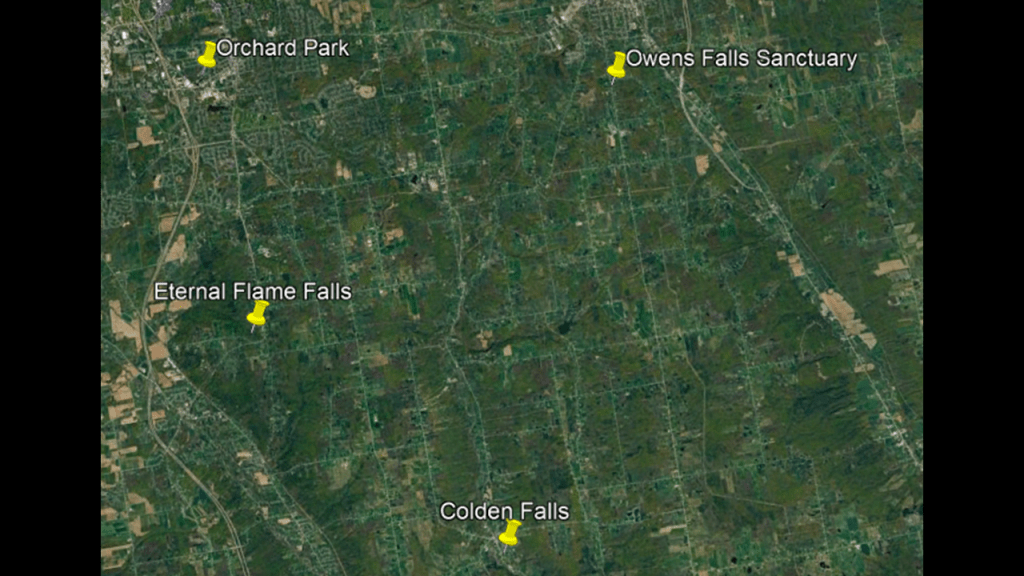
The Owens Falls Sanctuary is in East Aurora, New York.
The Owens Falls consist of an upper and lower waterfall through a 100-foot, or 30-meter, deep gorge on an unnamed creek that is a tributary to the East Branch of Cazenovia Creek.
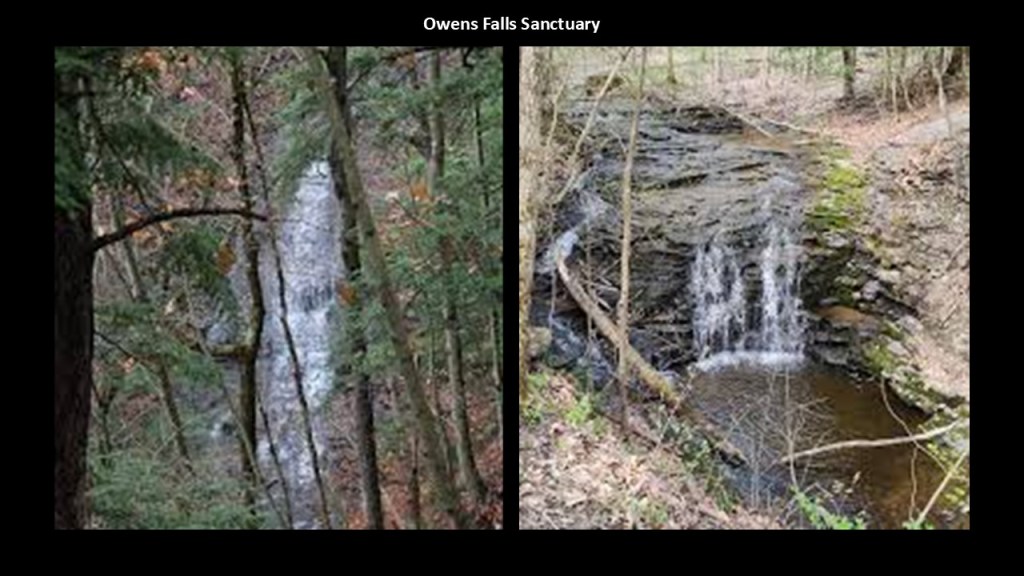
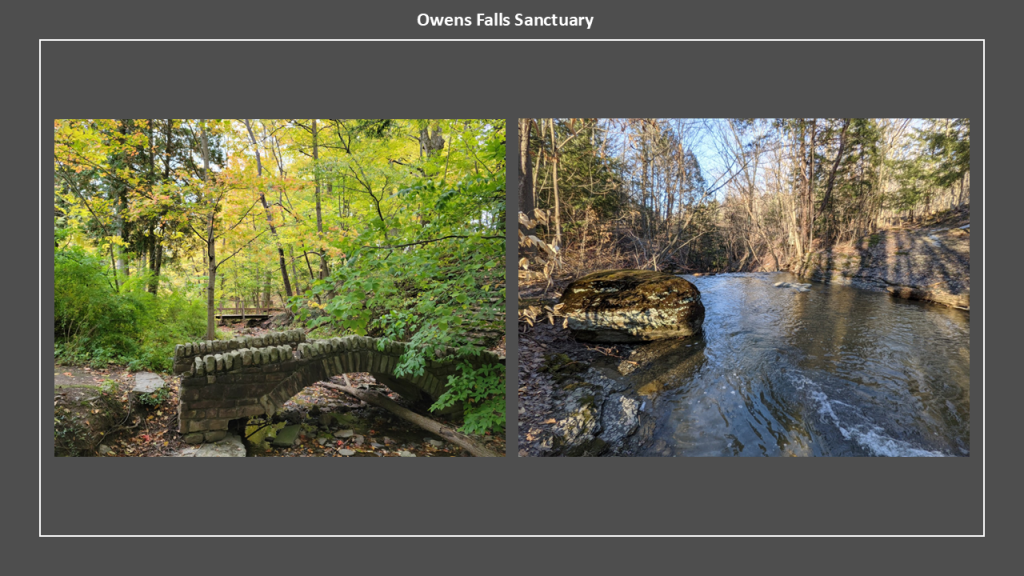
The 57-acre, or 23-hectare, property that is the sanctuary today had been listed for sale for potential development, but with substantial community support, the Land Conservancy successfully turned it into protected land.
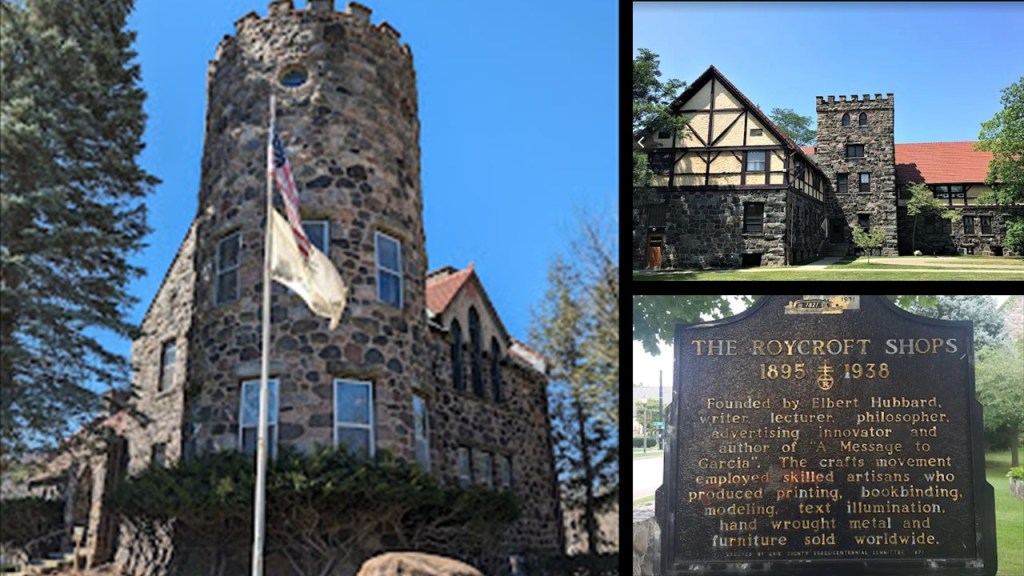
East Aurora is the home to the Roycroft Campus, a reformist community of craft workers and artisans that was founded in 1895.
Colden Falls, which are located to the southwest of Owens Falls and the southeast of the Eternal Flame Falls, are on the west branch of Cazenovia Creek in the Village of Colden.
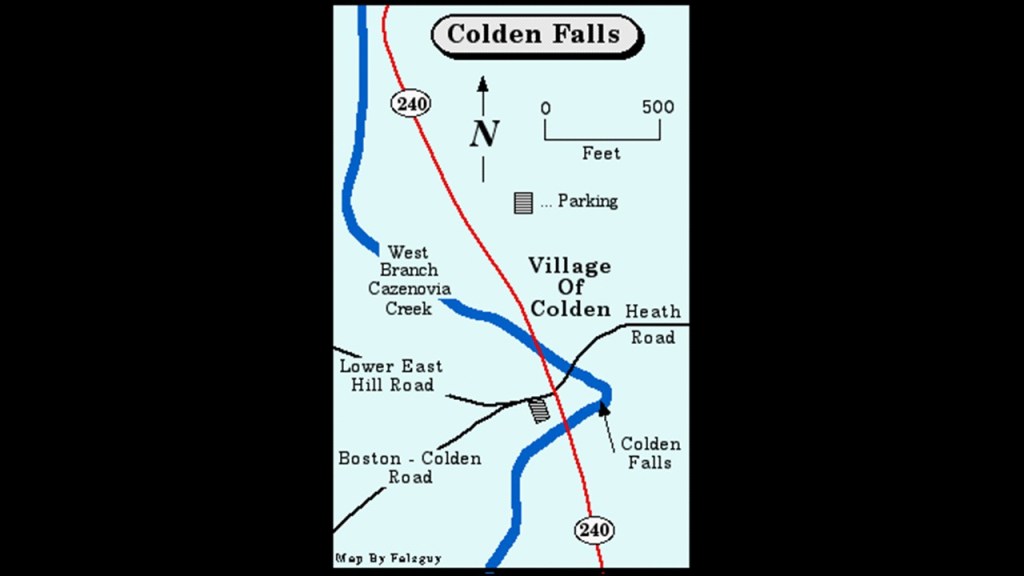
The Colden Falls flow over a 15-foot, or 5-meter, cascade a long an S-shaped bend in the creek.
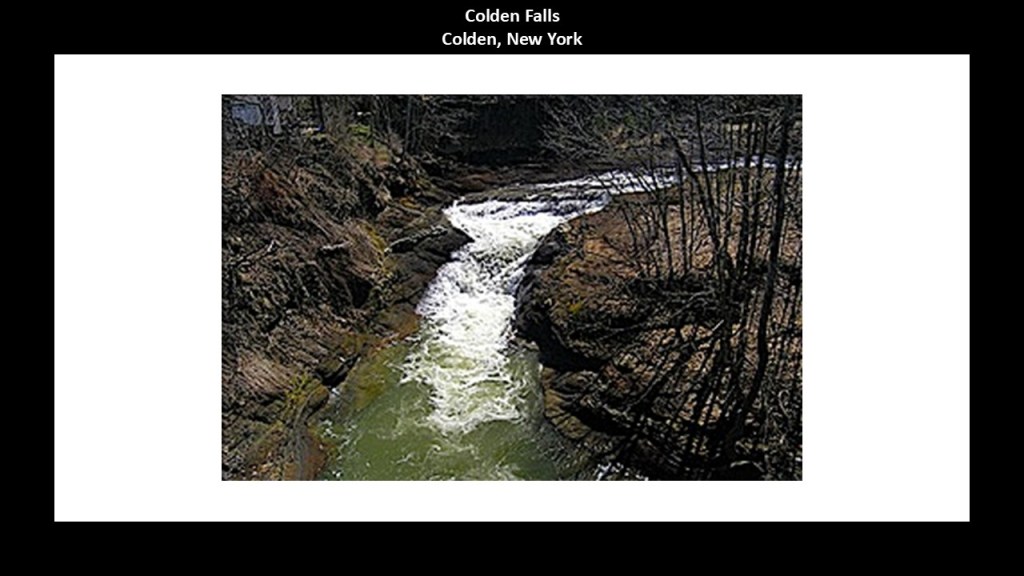
The falls are viewable from the Boston Colden Road Bridge near the road which goes to the Kissing Bridge Ski Resort in Glenwood, New York.
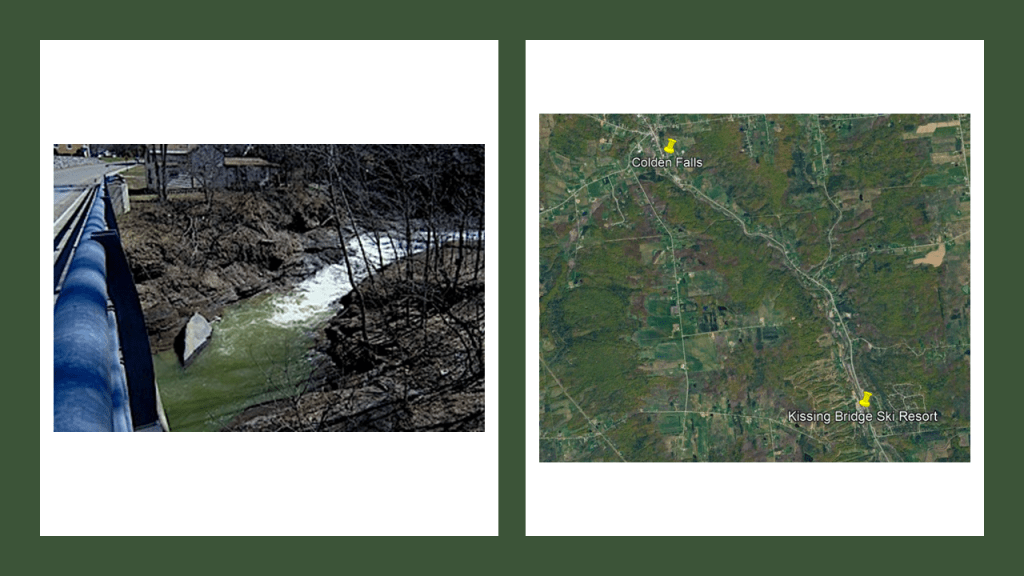
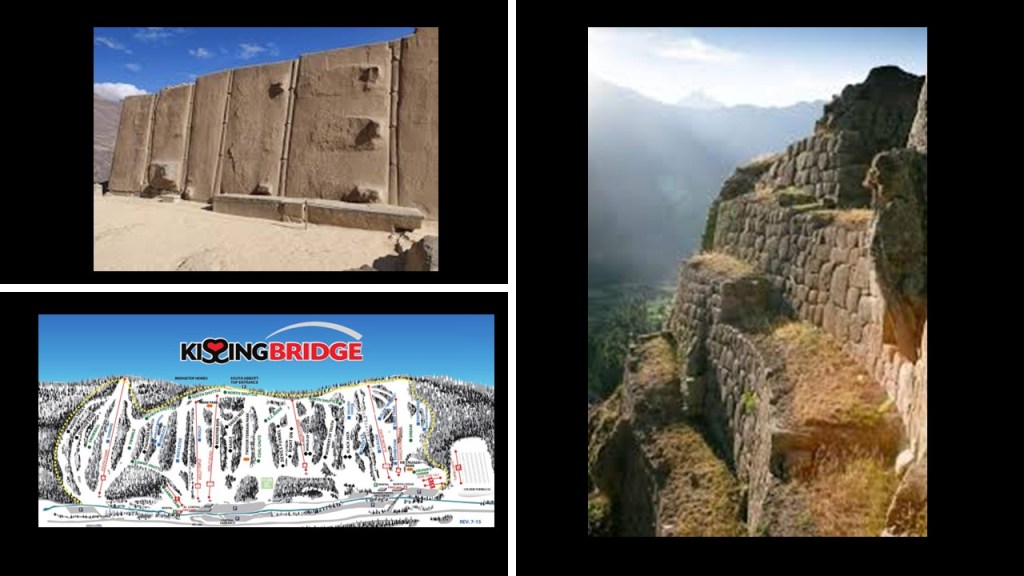
The Kissing Bridge Ski Resort features a 550- to 600-foot, or 168- to 183-meter, vertical drop across 39 slopes.
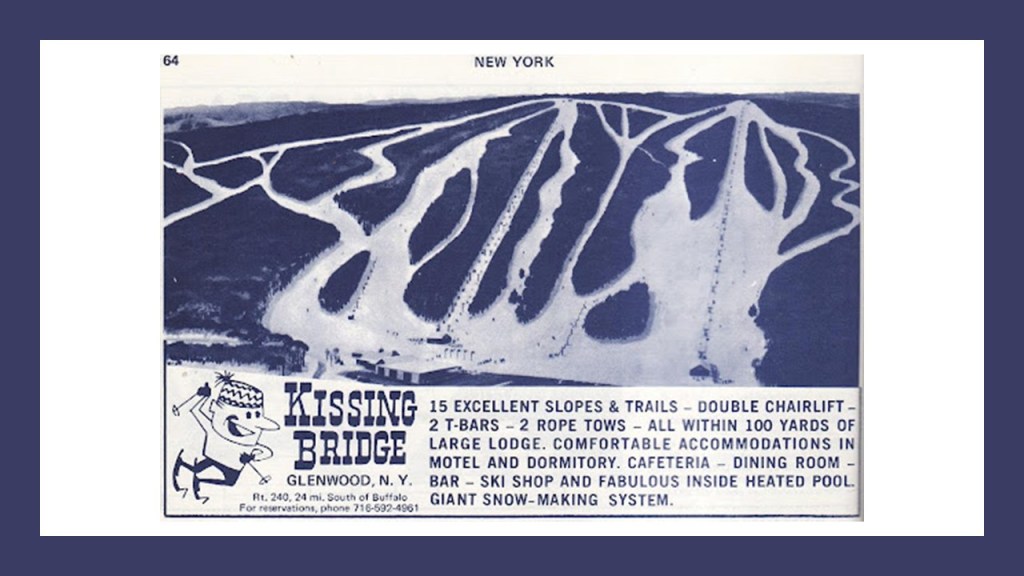
Just wondering if there might be infrastructure with steep vertical walls underneath the ski slopes, like as seen with these two massive masonry structures in Ollantaytambo, Peru
I wonder the same thing about what’s beneath sand dunes, like the Moreeb Dune, the tallest dune in the United Arab Emirates and one of the highest sand hills in the world at 984-feet, or 300-meters, high, with a 50-degree angle from the ground to the top.
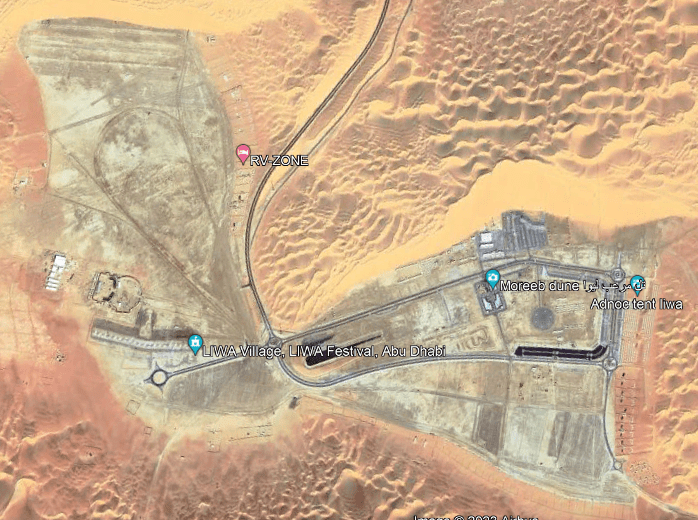
Among other things, it is popular for organized car-racing, and other vehicular activities.
Must have a pretty hard surface underneath all of the sand!

This is part of what is known as the “Empty Quarter, the largest desert in the world that encompasses most of the southern-third of the Arabian peninsula…
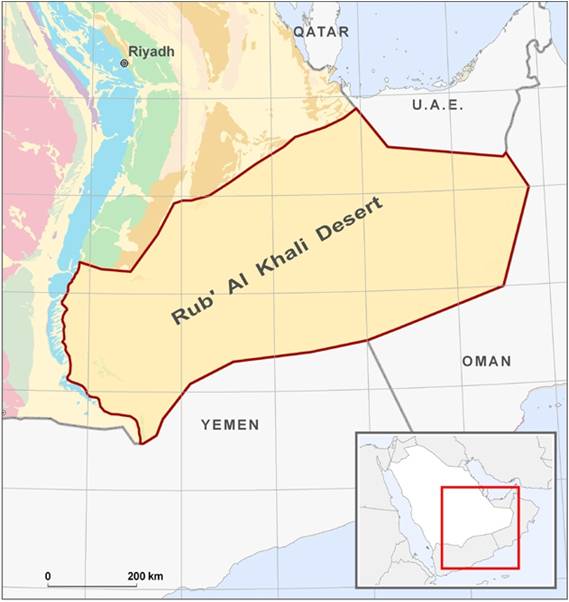
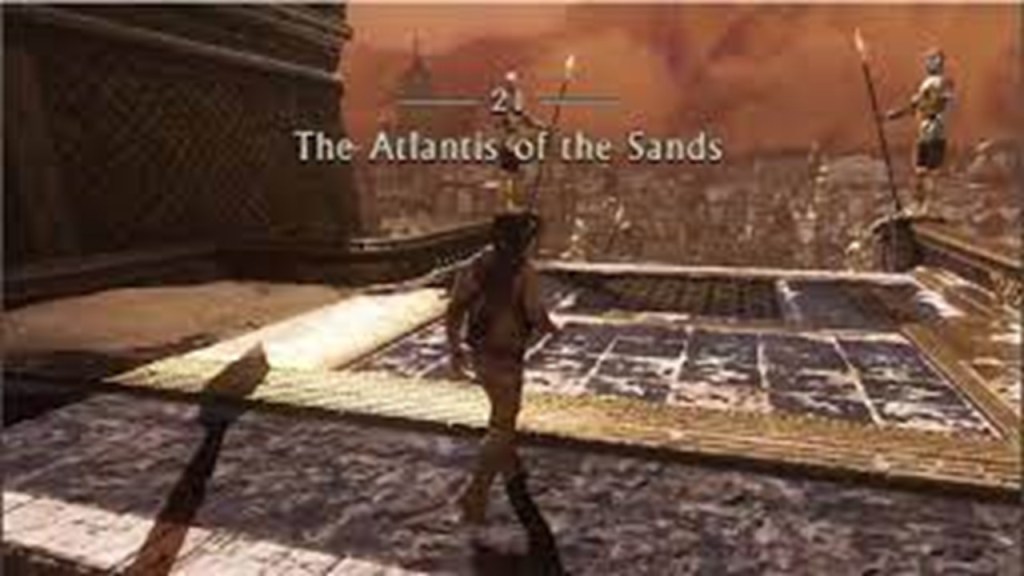
…and somewhere in the Empty Quarter is believed to be the location of the lost city of “Iram of the Pillars.”
Its location has been searched for over the years and no place has ever been conclusively identified as such.

It intriguingly has the nickname of “Atlantis of the Sands.”
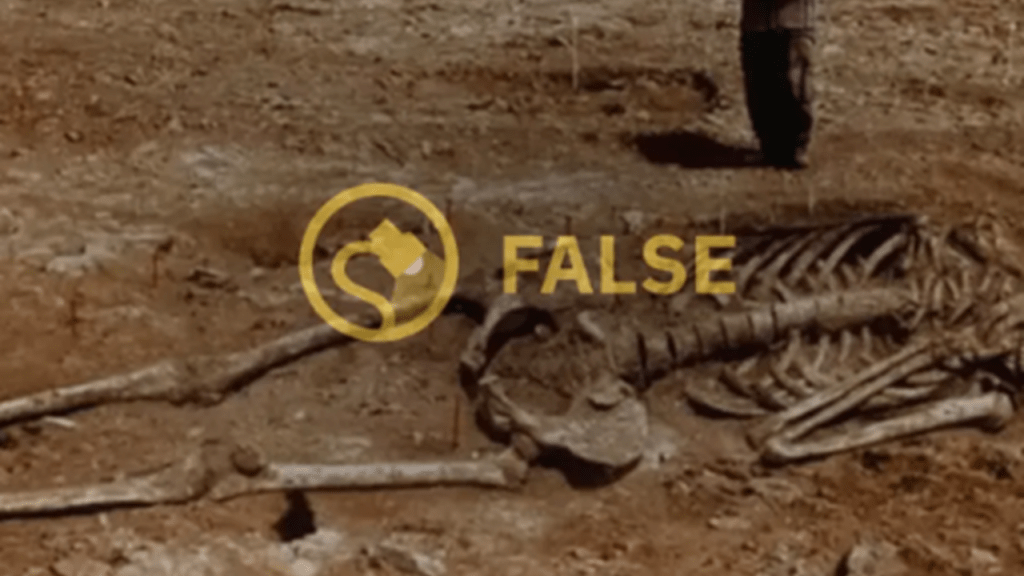
Also, in the process of oil and gas exploration in the Empty Quarter, giant skeletons apparently have turned up from time to time, though you find things like this fact-checked and flagged as hoaxes.
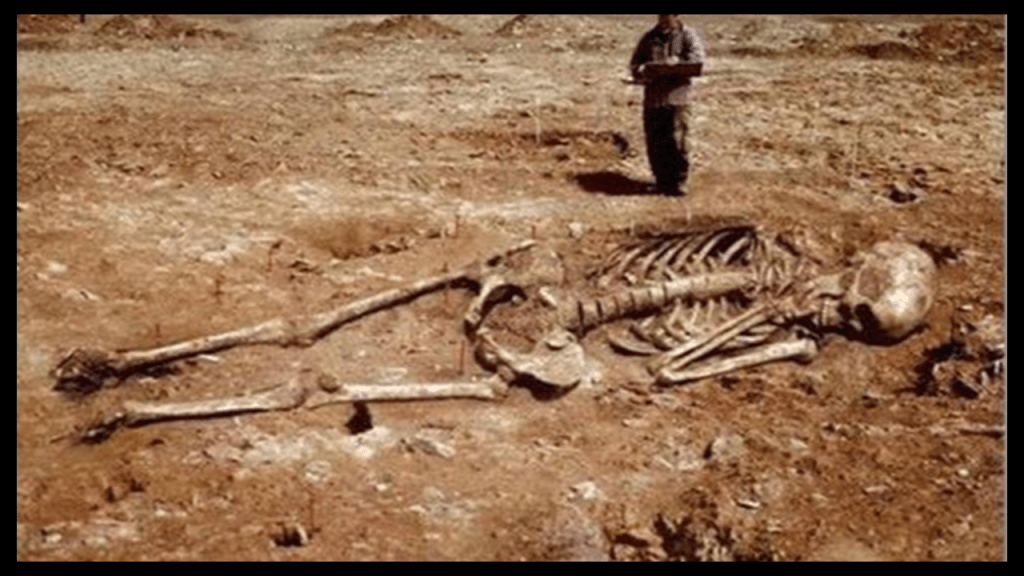
Like for some reason they really don’t want us to know giants existed upon the Earth once upon a time.
Back in Colden, the previously-seen Buffalo, Rochester and Pittsburgh Railway operated a line which passed through Colden, with records indicating that it ran under the previously-seen Boston Colden Road Bridge next to the Colden Falls.
The tracks were active in the vicinity of Richmond Hills and near the Kissing Bridge area.
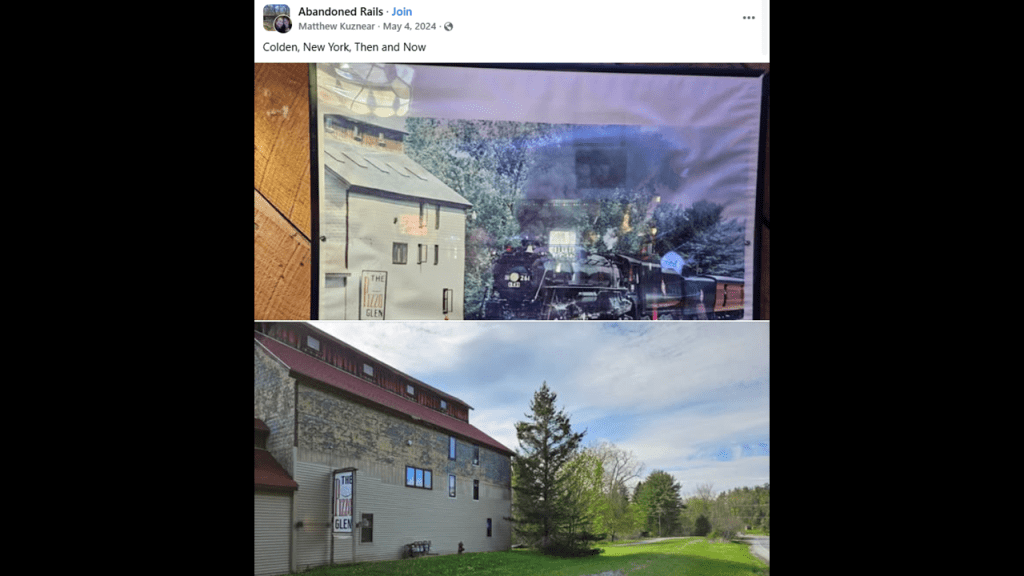
I am bringing attention to this because I am certain after years of researching this subject that there is a connection between railroads and waterfalls on the Earth’s original energy grid.
The first time I looked into this subject in-depth was in the summer of 2023 in my blog post “Of Railroads and Waterfalls and Other Physical Infrastructure of the Earth’s Grid System” where I looked at a number of examples from across the United States, and I found the same patterns and configurations of railroads, waterfalls, gorges, rapids, bridges, canals, dams, reservoirs and hydroelectric facilities, along with lighthouses and star forts, and in the years since then, I continue to encounter the same findings everywhere, including in this Great Lakes series among many other places in the world.
Now I am going to focus my attention on the south shore of Lake Erie in the area just to the southwest of Blasdell, and take a look at the following places – the Lake Erie Seaway Trail Center, and the two country clubs near it – Wanakah and Cloverpark; Frank Lloyd Wright’s Graycliff; Eighteenmile Creek and Park; the Hobuck Flats and the Sturgeon Point Historical Lighthouse.
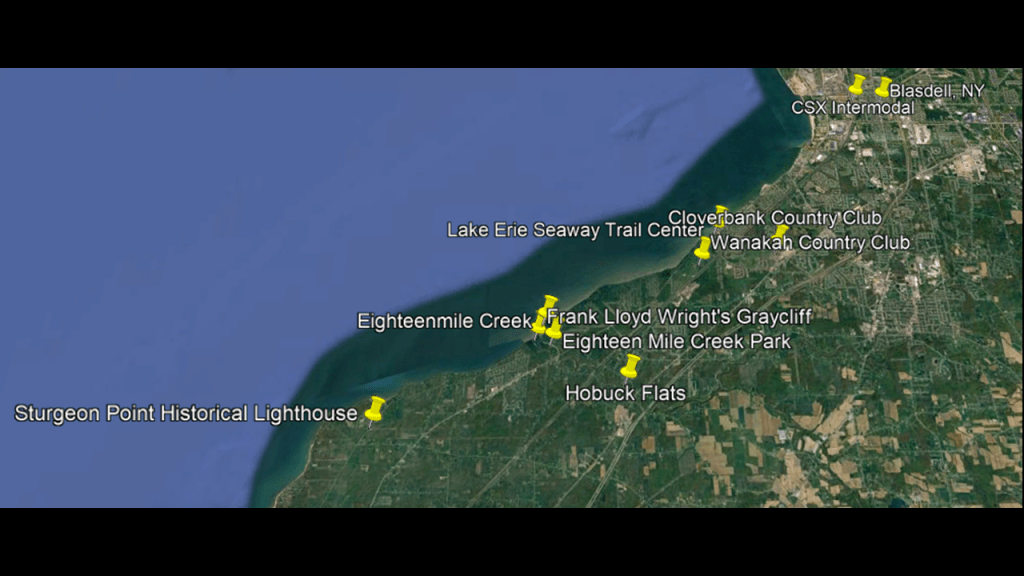
First, the Lake Erie Seaway Trail Center.
The Lake Erie Seaway Trail Center in Hamburg, New York, is right on the shore of Lake Erie.
As a matter of fact, it looks like it is practically in Lake Erie.
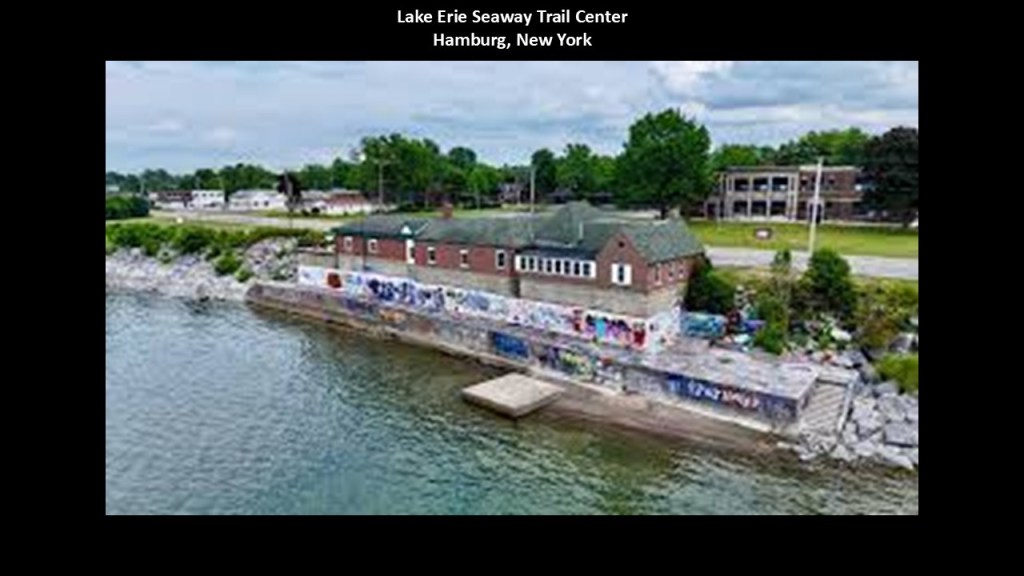
The center is housed in the former Wanakah Water Works building, said to have been built in 1910 and served as a water pumping station until 1990.
The building was repurposed and opened as the Lake Erie Seaway Trail Center in 1995.
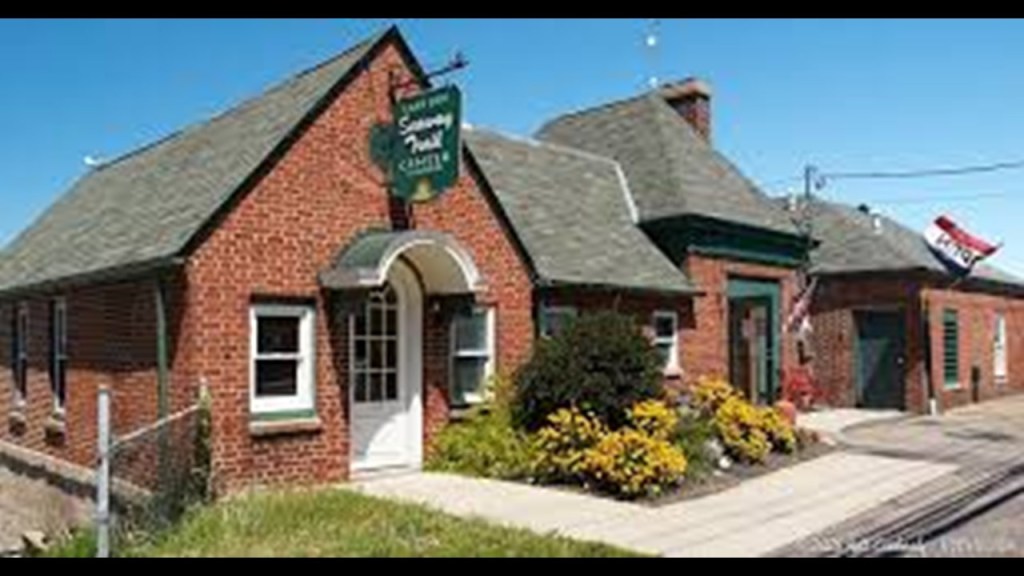
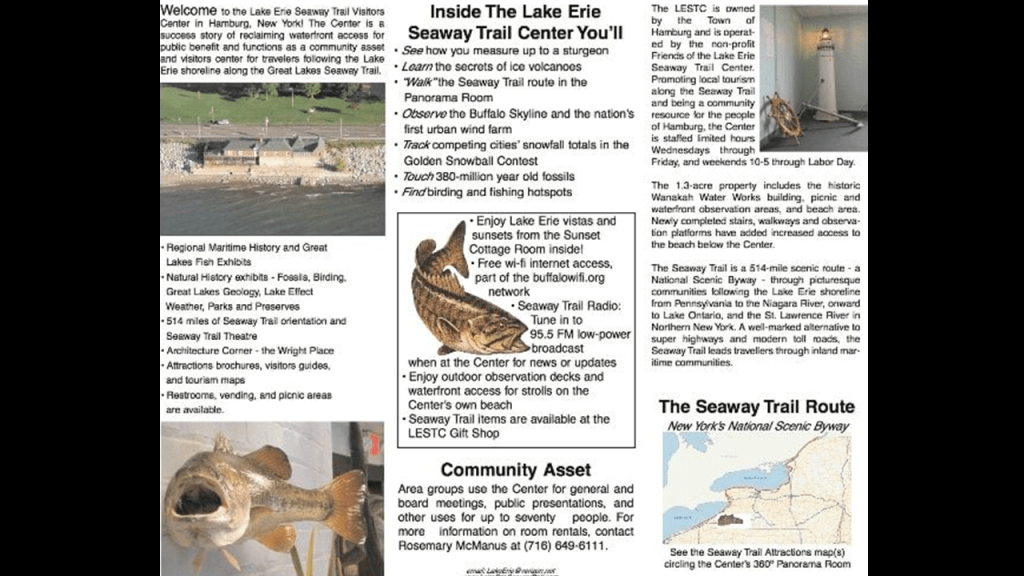
The center offers information on local attractions and accommodations, as well as having things like an education center with exhibits.
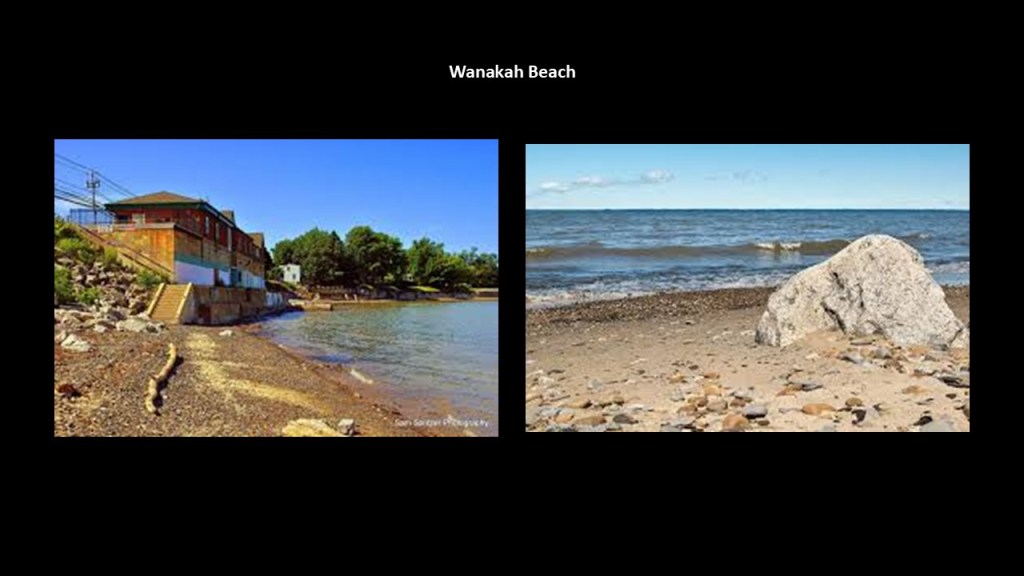
Wanakah Beach runs along the lakeshore here.
It is described as a scenic rocky beach that is known for its beach glass and sunsets.
The Wanakah Country Club and the Cloverbank Country Club are nearby as well.
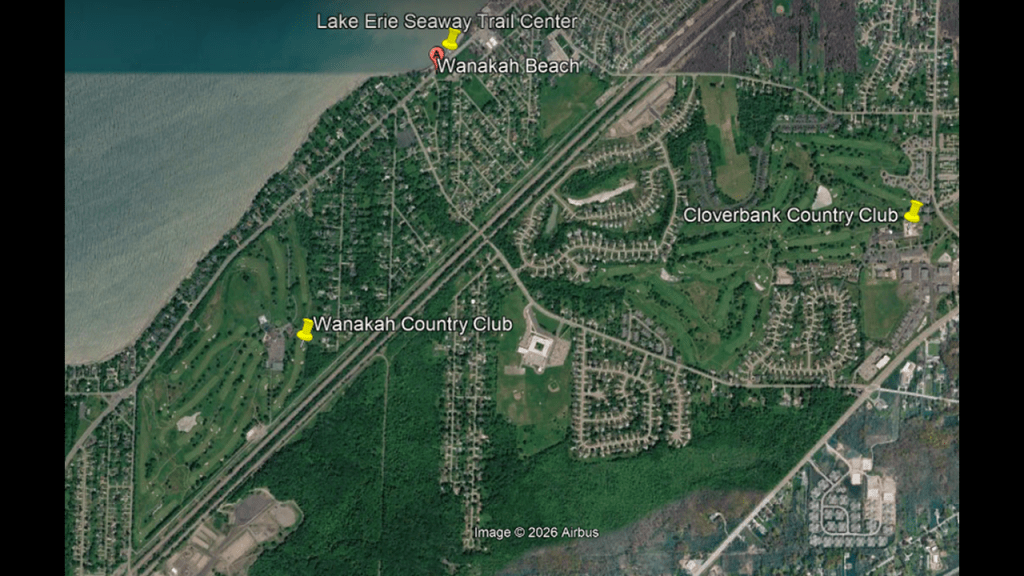
The Wanakah Country Club is a private club that was founded in 1899 by several prominent Buffalo businessmen as the Wanakah Golf Club, and rechartered as the country club in 1913.
It is right on the shore of Lake Erie.
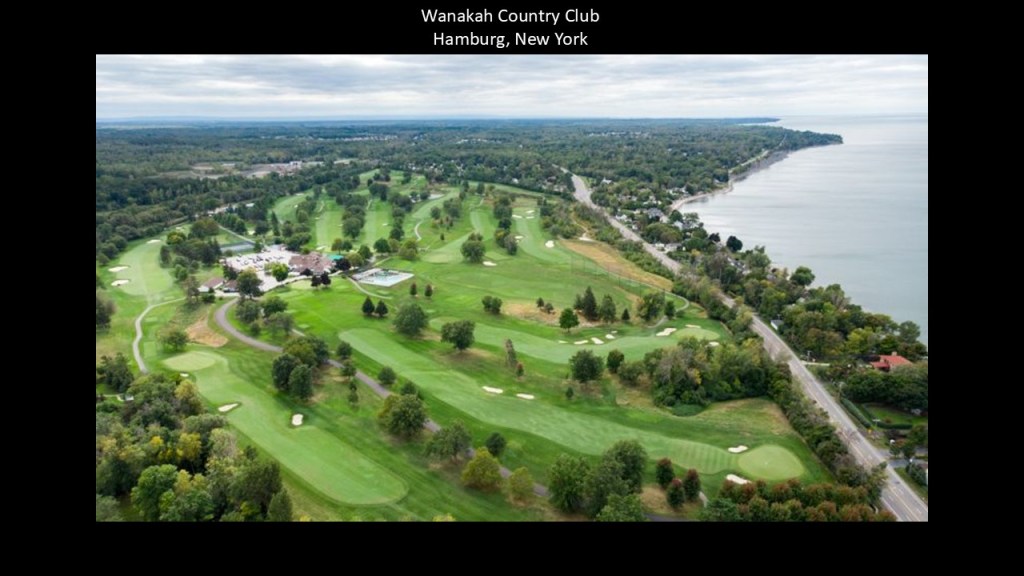
The Wanakah Country Club is in- between New York Route 5, otherwise known as the Seaway Trail, and the railroad tracks going through the area, and the Cloverbank Country Club is on the other side of the tracks from it.
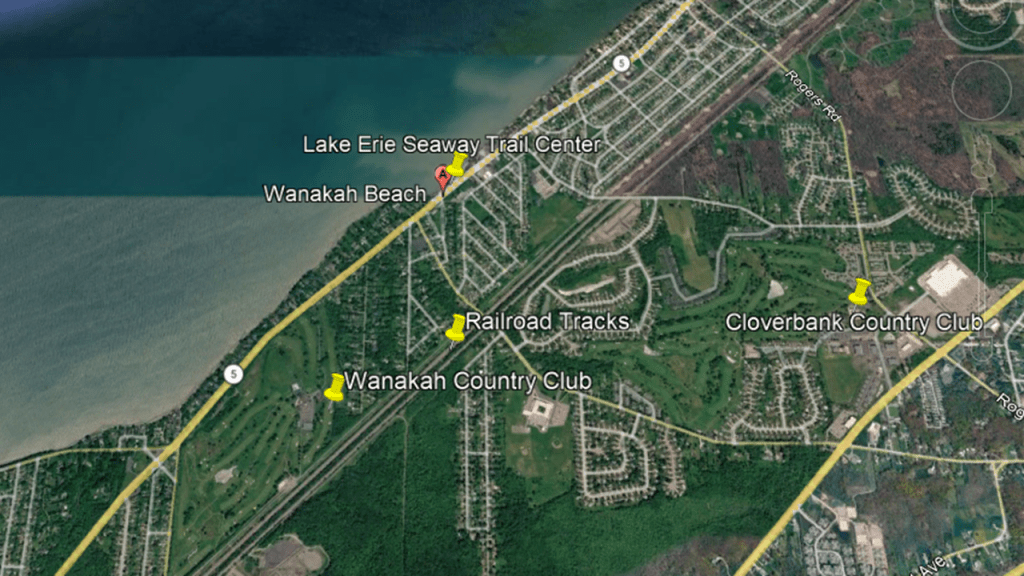
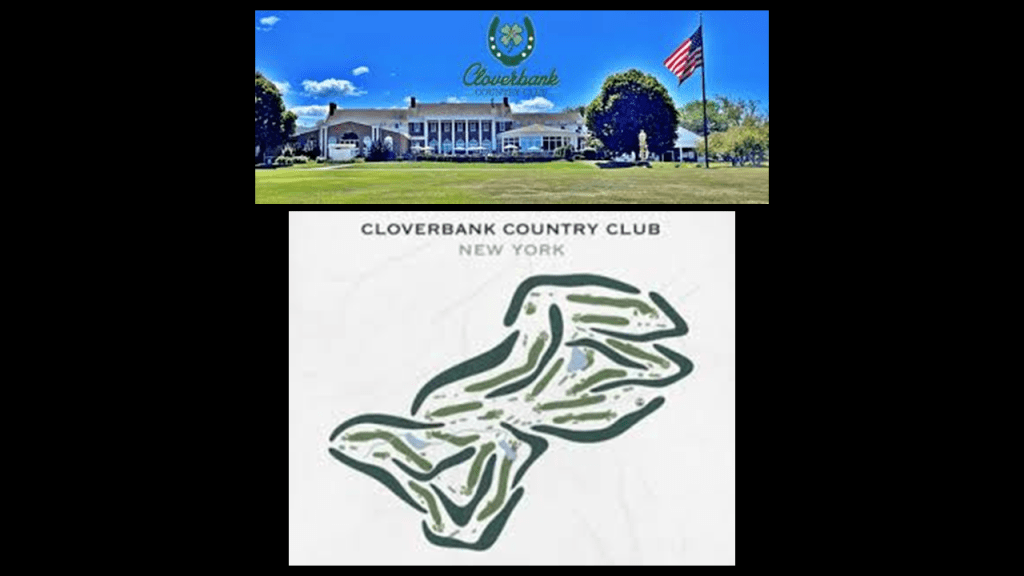
The Cloverbank Country Club is also a private club.
It was established in 1958 as the Bethlehem Management Club for Bethlehem Steel employees and their families, and has changed ownership several times since then.
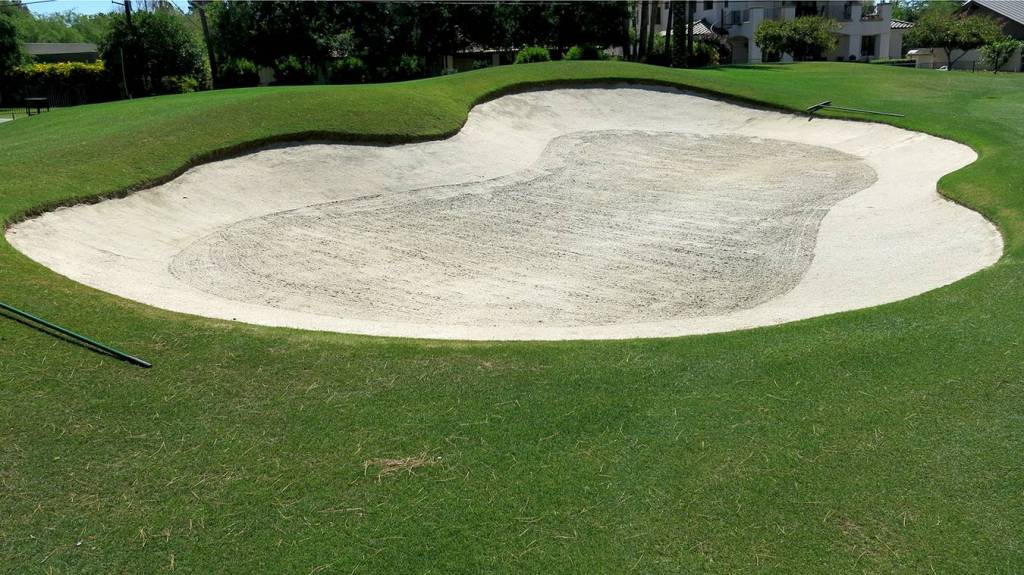
I have been talking throughout this series, and in other places before that, about golf courses being cover-ups of mound, or earthwork, sites and part of the original energy grid.
Just carve out the top of a mound, and voila, you have a bunker.
The term “Links” is another name used for golf courses.
I think this name tells us their actual purpose in the Earth’s grid system, perhaps as “links” or “linkages” of the circuitry of electrical and magnetic components.
I have been finding golf courses throughout this series, like along the shoreline of Lake Huron like these examples…
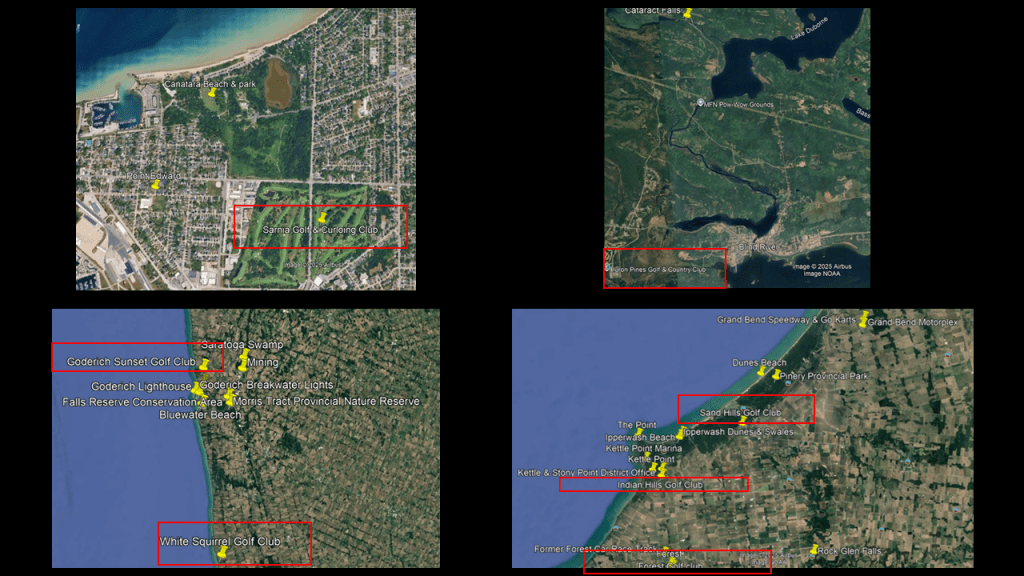
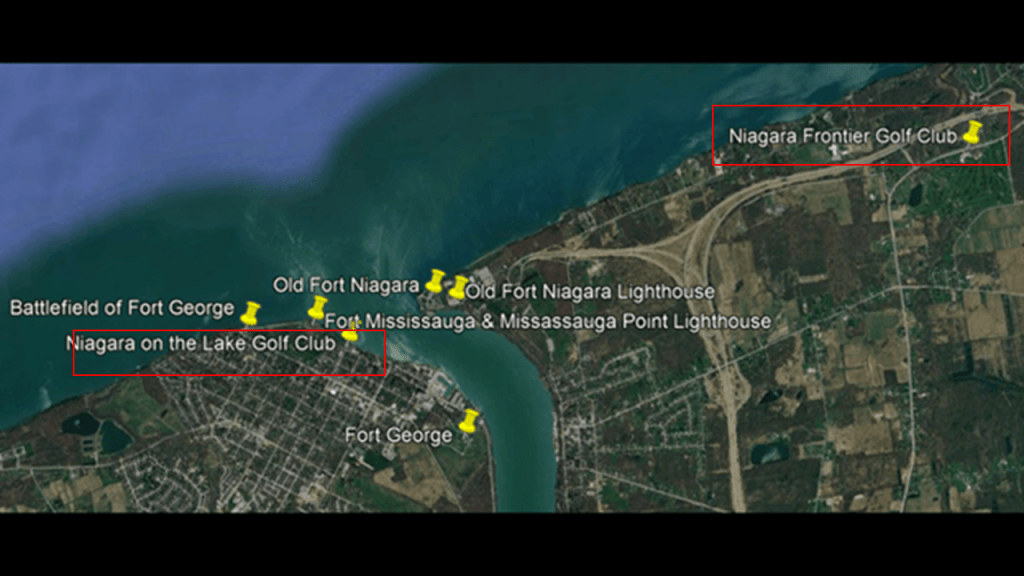
…and like this example on both sides of the Niagara River on Lake Ontario.
As I mentioned previously, the Seaway Trail is a National Scenic Byway of roads and highways that runs for 518-miles, or 834-kilometers, along Lake Erie, the Niagara River, Lake Ontario, and the St. Lawrence River.
While the Seaway Trail starts to the southwest at US-20 at the Ohio-Pennsylvania border, it quickly becomes Pennsylvania Route 5, and continues in New York as New York Route 5 through Buffalo.
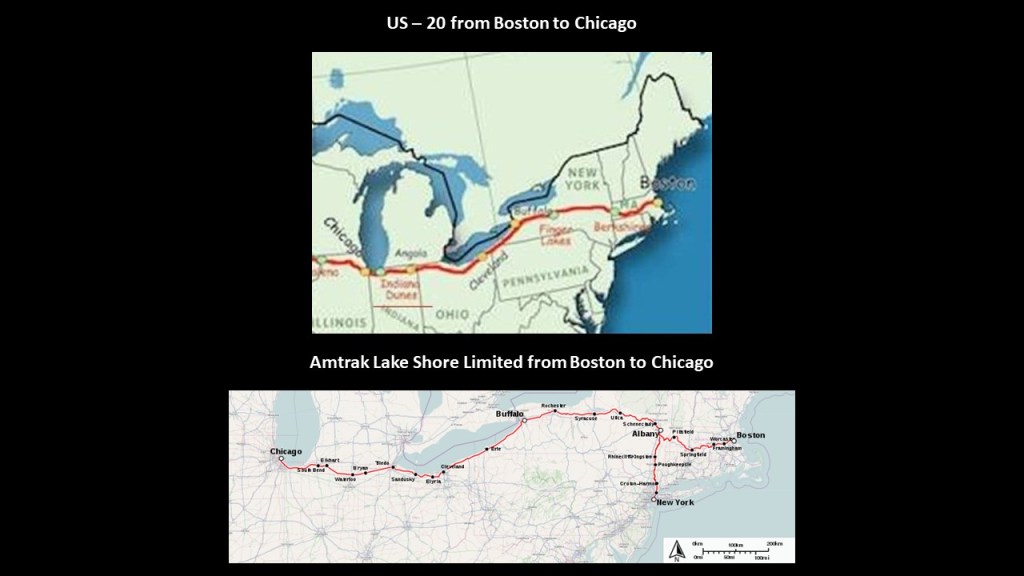
US-20 is a major east-west highway that runs all the way across the continent, and runs along the southern shores of both Lake Erie and Lake Michigan, starting at Route 2 at Kenmore Square in Boston, Massachusetts, and ending at US 101 in Newport, Oregon.

Interstate-90 from Logan International Airport in Boston runs roughly parallel to US-20 until Rockford, Illinois, where I-90 heads northwest towards Seattle and US-20 heads northwest to Newport, Oregon.
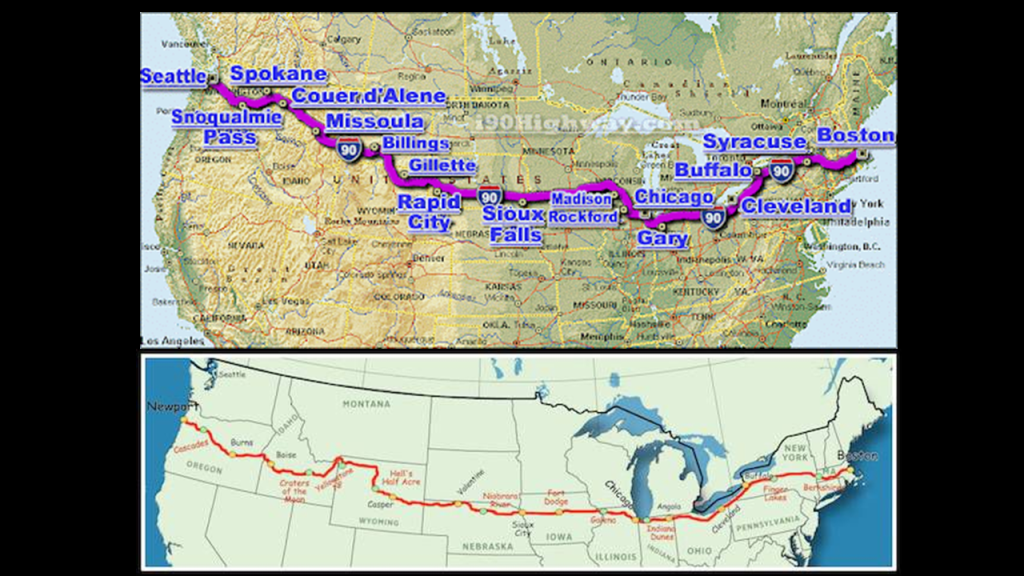
The Lake Shore Line runs a similar route together from Boston to Chicago, along with US-20 and Interstate-90.
The Lake Shore Line is operated today by Amtrak as the “Lake Shore Limited” and is an overnight passenger train.
The central segment of the route runs along the southern shore of Lake Erie.
Now, I will take a look at Frank Lloyd Wright’s Graycliff.
We are told the Graycliff Estate was designed by Frank Lloyd Wright, and built between 1926 and 1931 in the hamlet of Derby as a summer residence for Isabelle Reidpath Martin, and her husband Darwin D. Martin, the Buffalo entrepreneur whose Martin House we saw earlier near Delaware Park that was also said to have been designed by Frank Lloyd Wright.
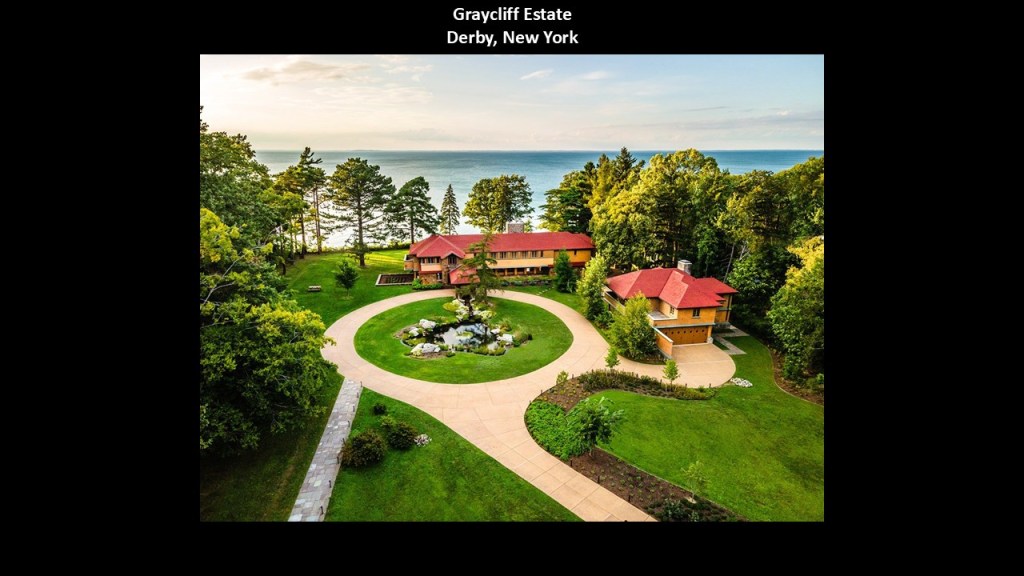
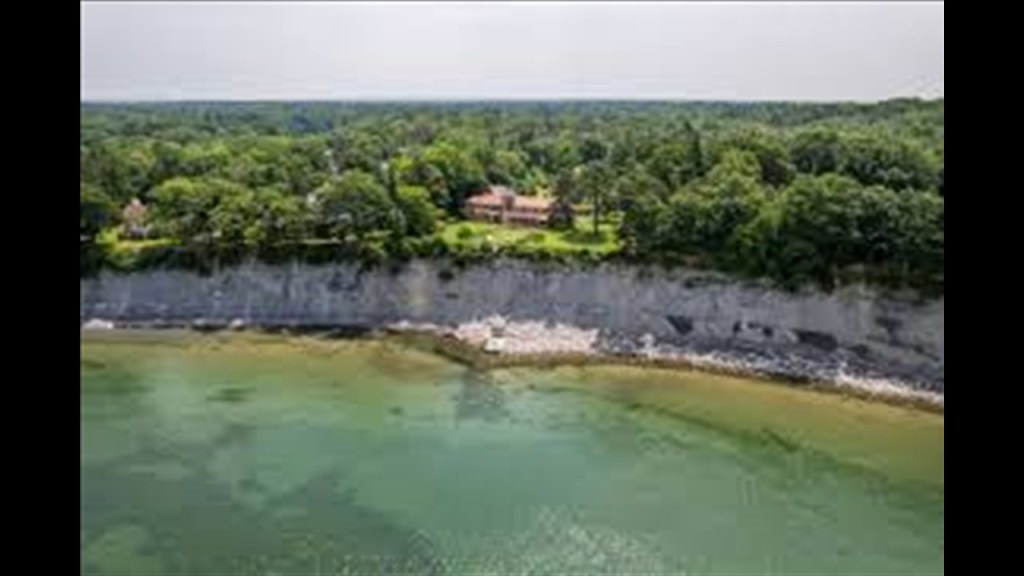
It is situated atop a high, gray-limestone cliff overlooking Lake Erie.
We are told that Graycliff was designed in Wright’s Organic architectural-style, which is described as a philosophy of architecture that promotes harmony between human habitation and the natural world.
These days it is an historic house museum and hosts a market on certain Thursdays in the summer months.
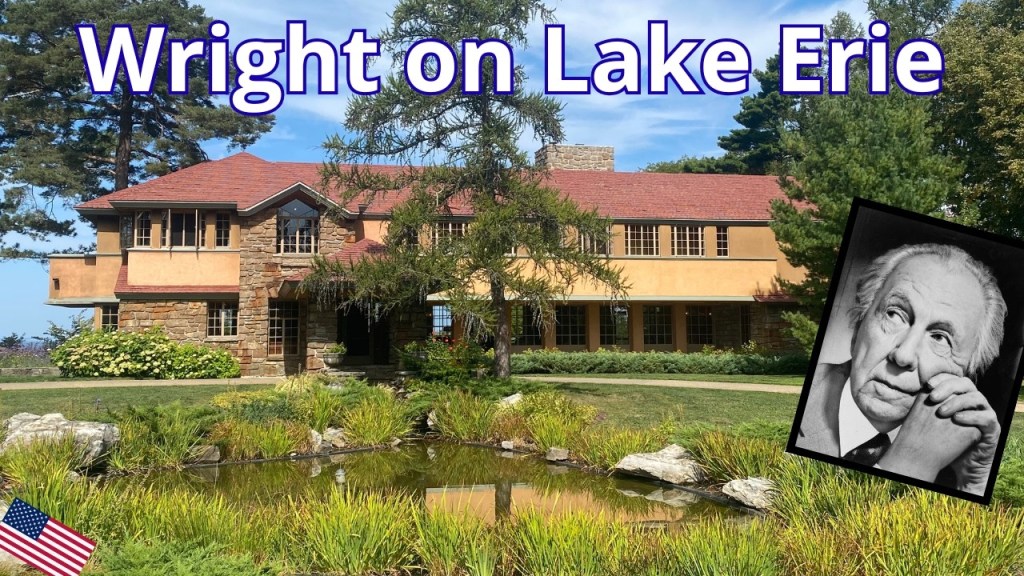
It is interesting to note that Frank Lloyd Wright attended the University of Wisconsin-Madison in 1886 when he was admitted as a special student and worked under civil engineering Professor Allan D. Conover, though he left the university soon, and without taking a degree.
Much later in his life, the University of Wisconsin-Madison granted him an honorary doctorate in 1955.
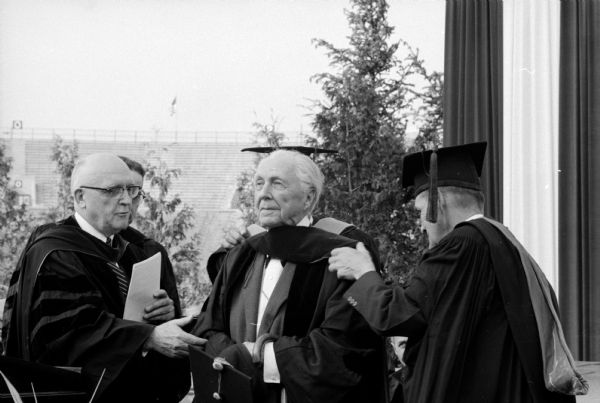
After leaving the university, we find Frank Lloyd Wright landing in Chicago in 1887 looking for a job, where we are told architectural work was plentiful as a result of the 1871 Great Fire of Chicago.
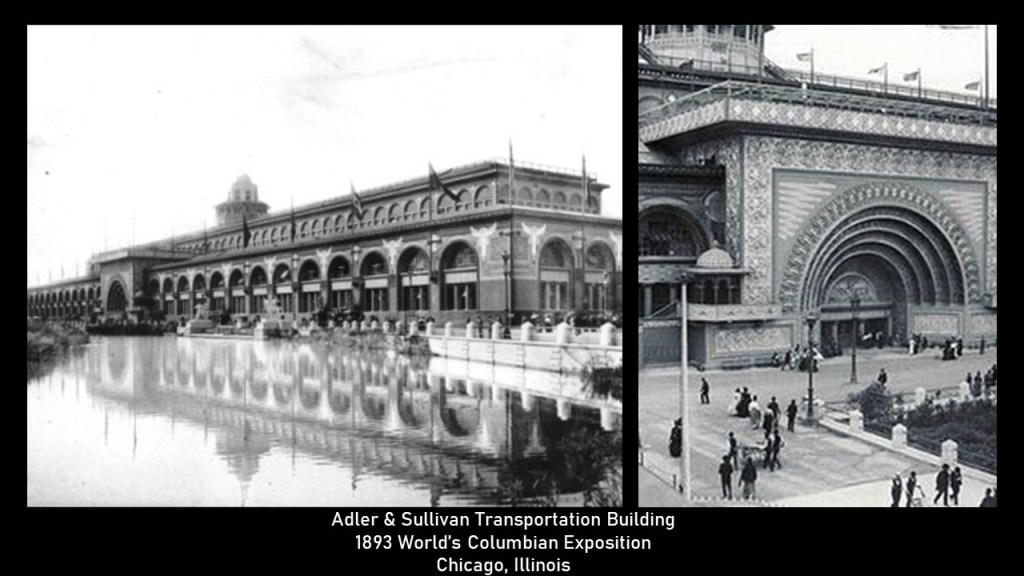
In 1888, Frank Lloyd Wright became apprenticed to the firm of Adler & Sullivan, where prominent Chicago architect Louis Sullivan, called the “Father of Skyscrapers” and the “Father of Modernism,” took Wright under his wing.

The firm of Adler & Sullivan, and primarily Louis Sullivan, was credited with designing the Transportation Building for the 1893 World Columbian Exposition in Chicago.
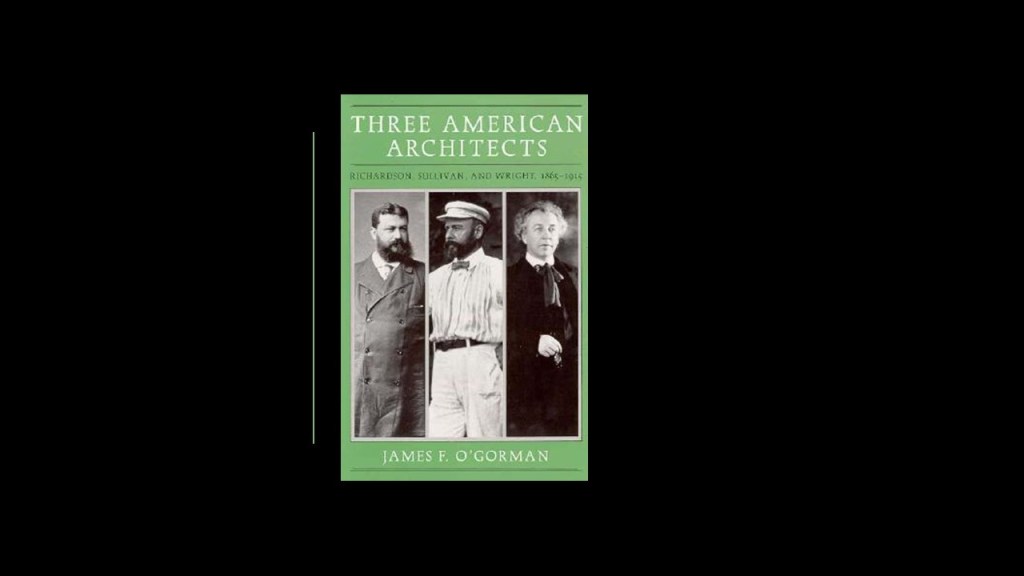
Louis Sullivan, Frank Lloyd Wright, and Henry Hobson Richardson form what is called the “Recognized Trinity of American Architecture.”
Next up, Eighteenmile Creek and Conservation Park, and Hobuck Flats.
The S-shaped Eighteenmile Creek is so-named for being 18-miles south of the Niagara River in Buffalo, which is 29-kilometers, and is Lake Erie’s second-largest tributary, after the Maumee River, the entrance to which is in Toledo.
Frank Lloyd Wright’s Graycliff Estate is located right next to the entrance to the Eighteenmile Creek on Lake Erie.
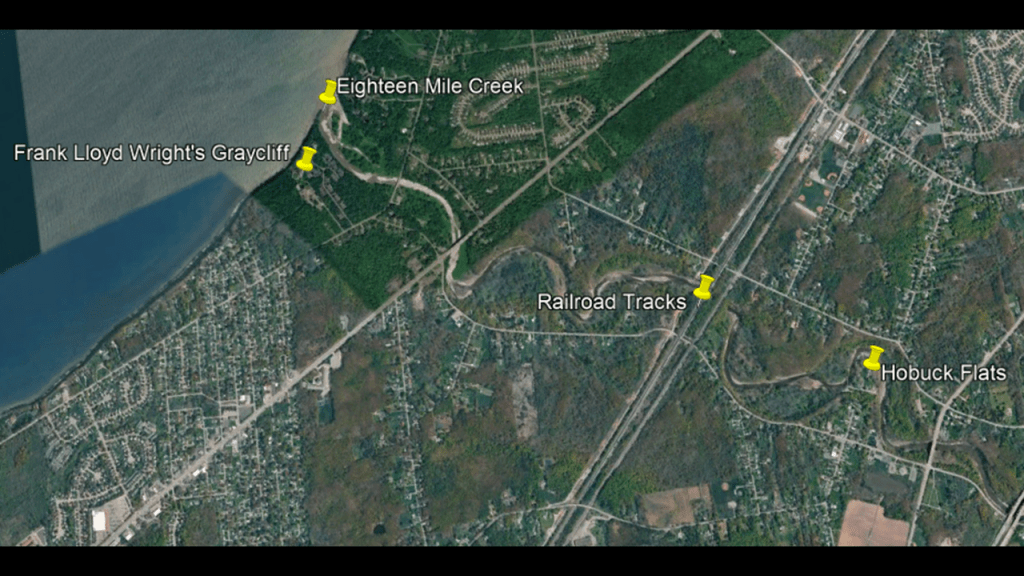
The Eighteenmile Creek Conservation Park is located on the southern edge of the town of Hamburg, in-between the north fork and the south fork of the Eighteenmile Creek before it becomes one creek going into Lake Erie, and to the east of NY-5, the railroad tracks, US-20 and I-90 which all occupy a narrow stretch of land near the shore of Lake Erie.
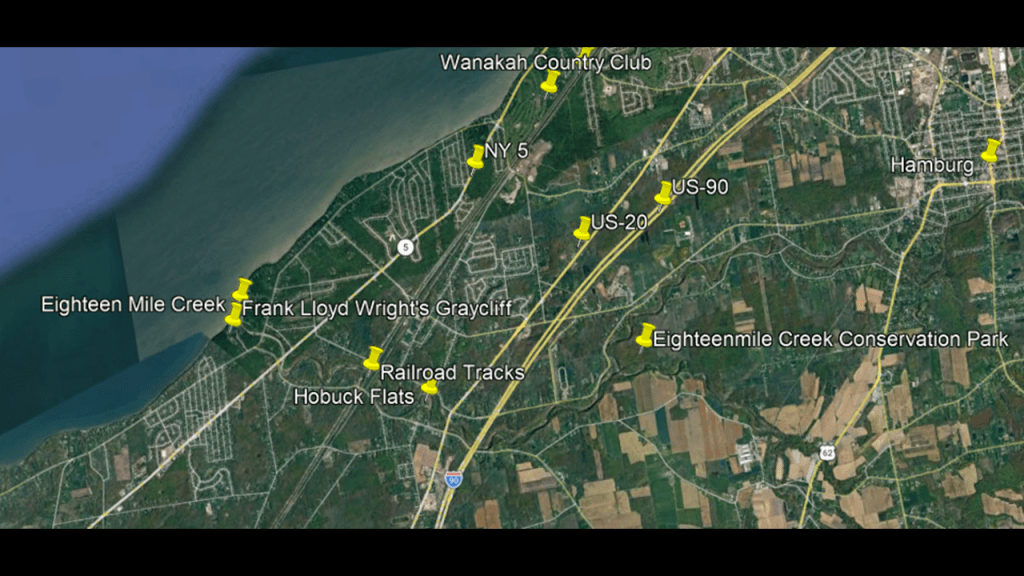
The Eighteenmile Creek Conservation Park, a recreational area for hiking, fishing, and wildlife viewing, is described by things like having difficult access and hard to find with little signage apart from the parking area and limited trail signage.
The parking area here is surrounded by megalithic stone blocks.
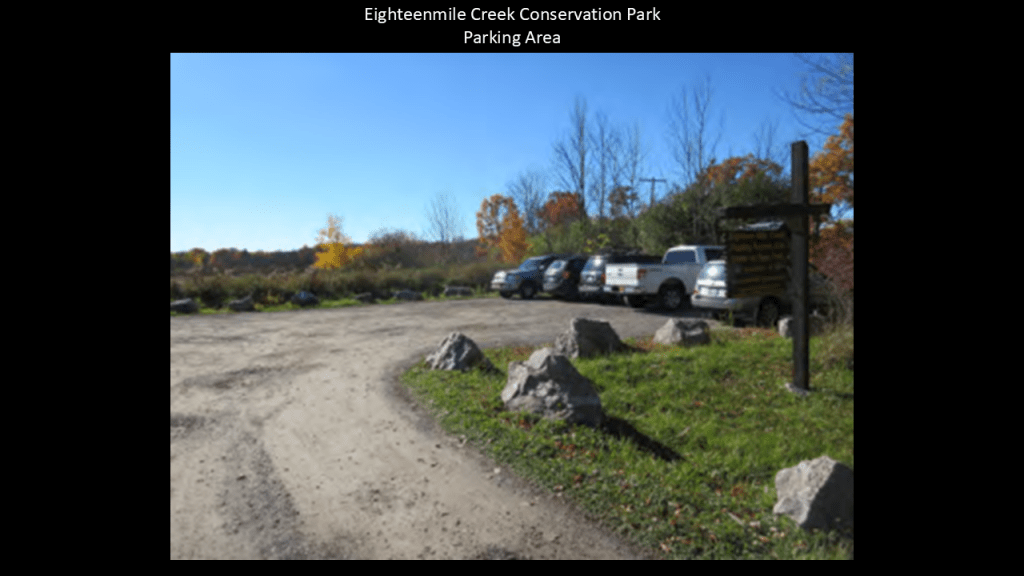
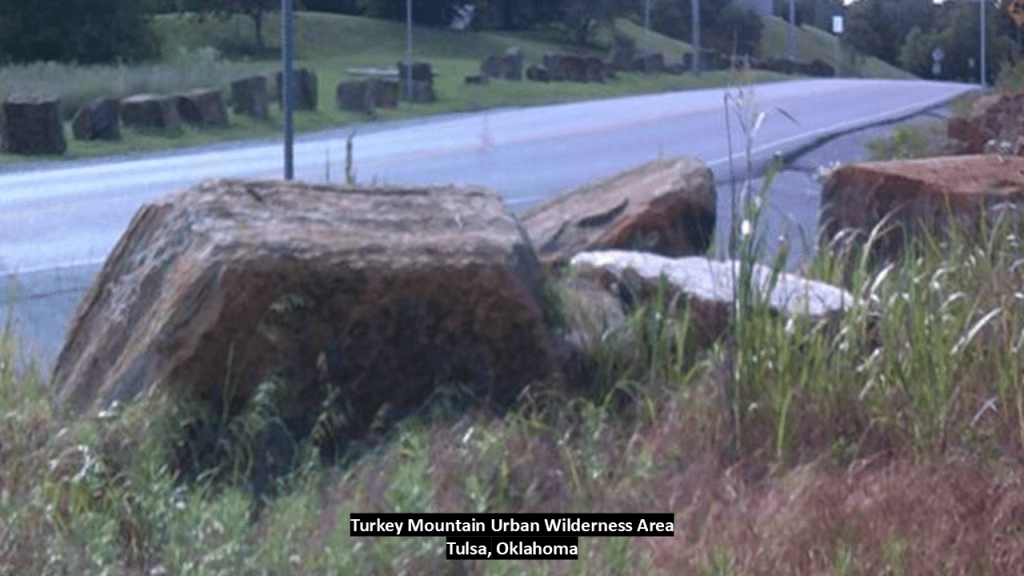
I had the same experience when I was looking for the Turkey Mountain Urban Wilderness Area in Tulsa, Oklahoma, many years ago when i was first waking up to all this.
It was on the map but hard to find with little signage apart from the parking area and limited trail signage.
The parking lot for Turkey Mountain was also surrounded by megalithic stone blocks, and they were the size of VW buses!!!
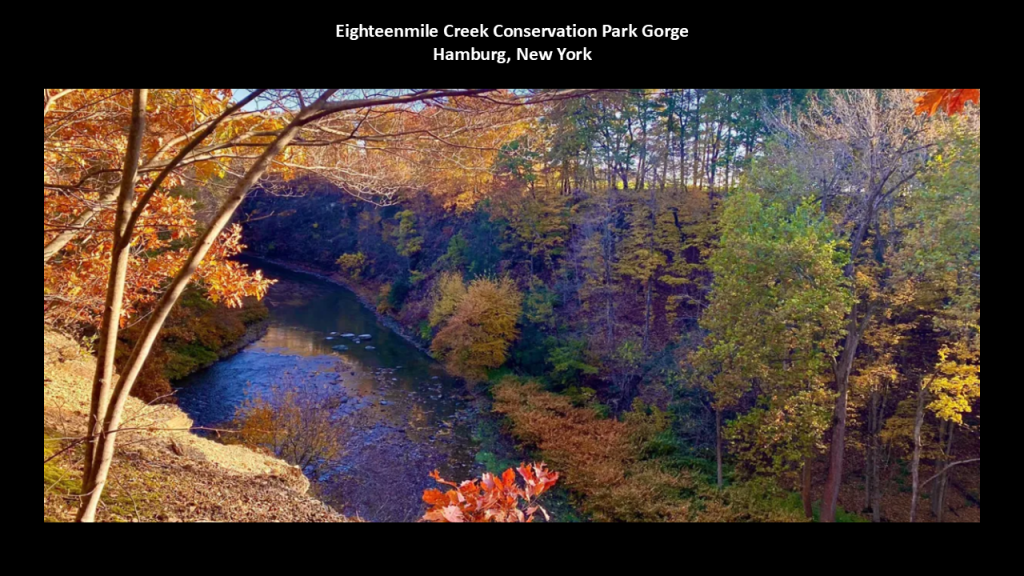
The Eighteenmile Creek Conservation Park is notable for having a 60-foot, or 18-kilometer, -deep gorge…
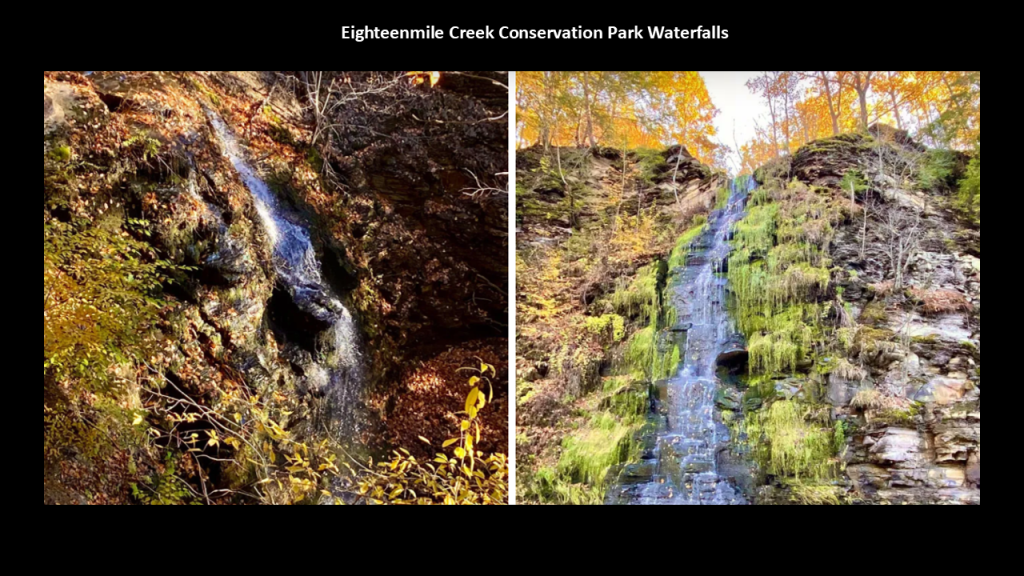
…and two waterfalls.
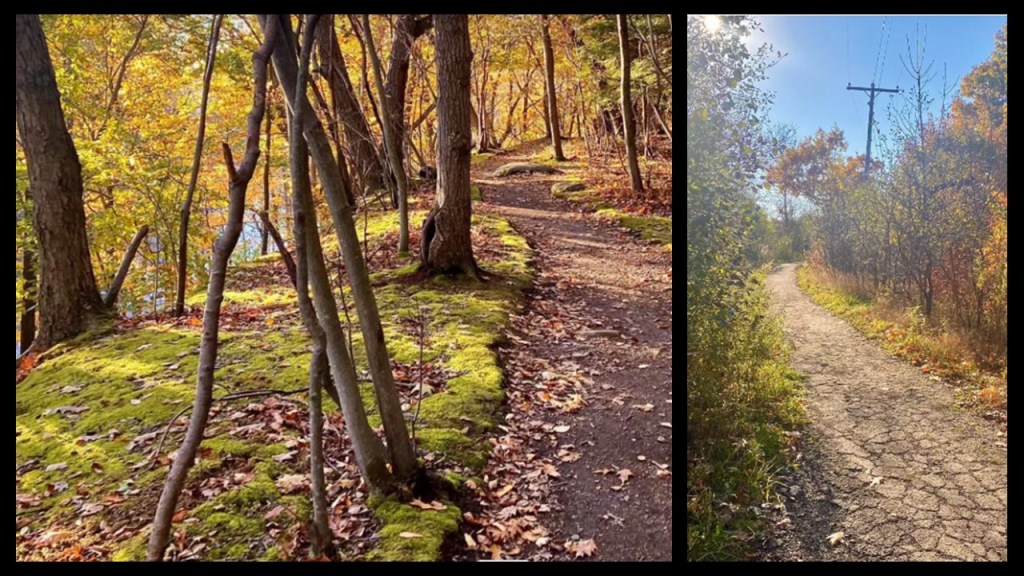
At the top of the gorge, the hiking trail between the north fork and south fork of the Eighteenmile Creek is flat.
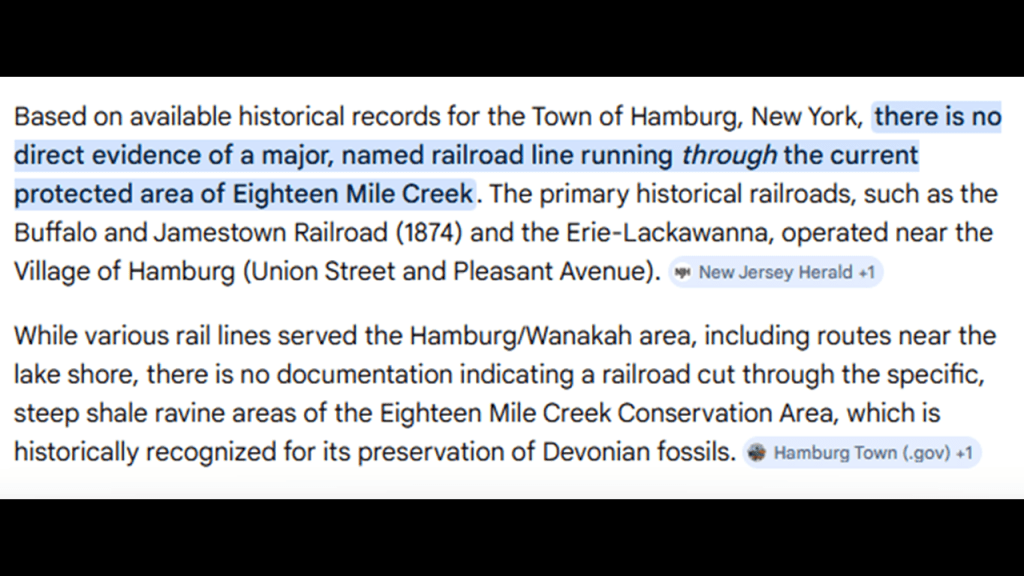
I do suspect there was a railroad track through here at one time because of the correlation I have found between railroads, gorges, and waterfalls, and how so many former railroad lines have been turned into rail-trails.
Also seeing the electrical utility pole on the trail here is a sign to me that there was once a railroad here.
But that information is really hard to find because it’s pretty much been scrubbed if there was one here.
This brings me to the Hobuck Flats.
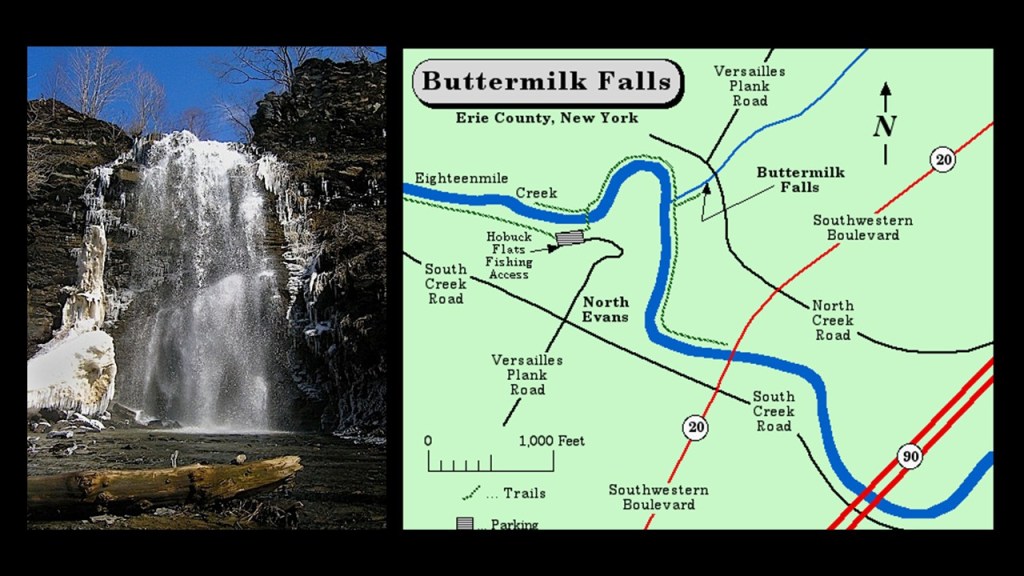
The Hobuck Flats is a roughly 26-acre, or 10.5-hectare, undeveloped scenic natural area on Eighteenmile Creek to the west of US-20 and I-90 as it heads towards Lake Erie as one waterway.
There is a short hiking trail at Hobuck Flats that leads to Buttermilk Falls on an S-shaped bend of Eighteenmile Creek.
This immediately brings to mind a location on the New River in West Virginia’s New River Gorge, which is one place I know of that still has an active railroad line running along the New River.
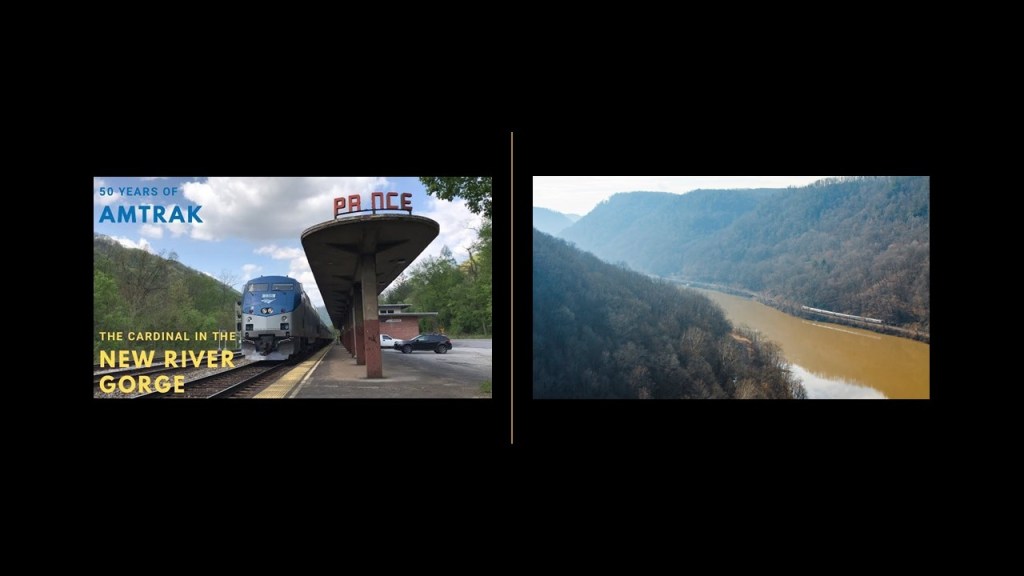
There are waterfalls and hydro-electric projects found on the New River as it winds its way through the New River Gorge.
I was able to find several waterfalls here that are accessible by road, and reference to over 100 others.
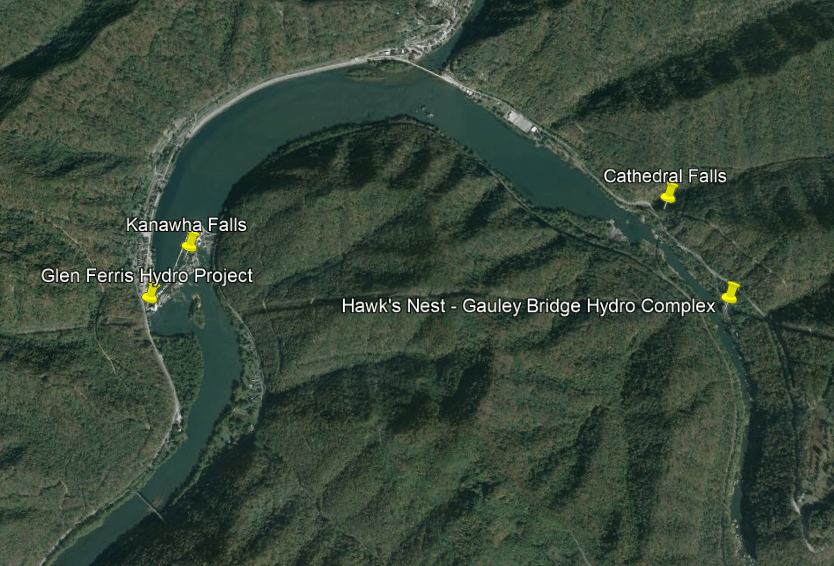
The first two waterfalls I found that are accessible by road are the Kanawha Falls and Cathedral Falls.
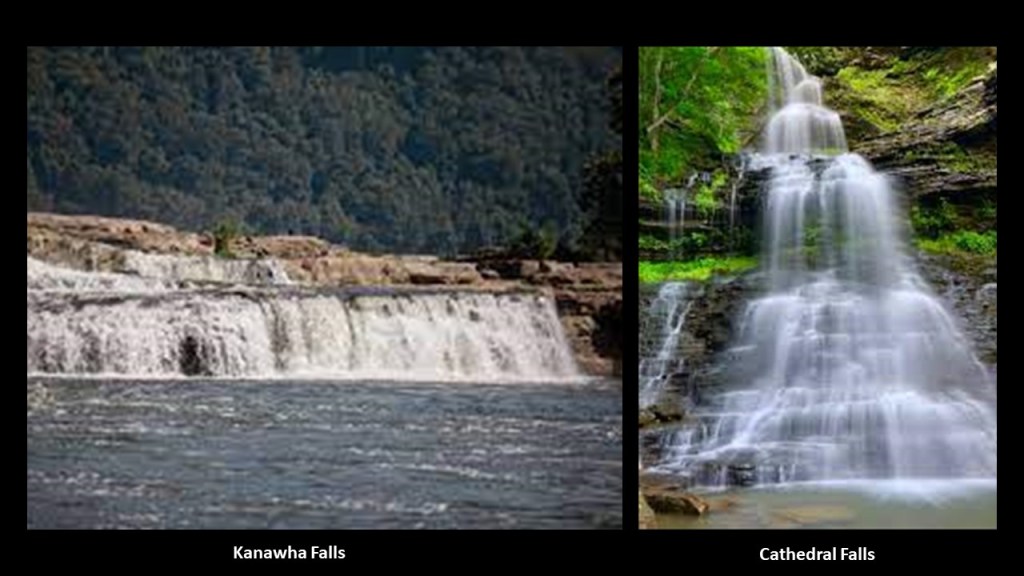
They are directly across from each other on a river-bend, and they both have hydro projects next to them.
There is no doubt in my mind that there was an energy-generating connection for the original civilization between the railroad, s-shaped river bends, hydro-electricity generation, waterfalls and gorges, and that it was deliberately replaced by nonrenewable energy resources like coal.
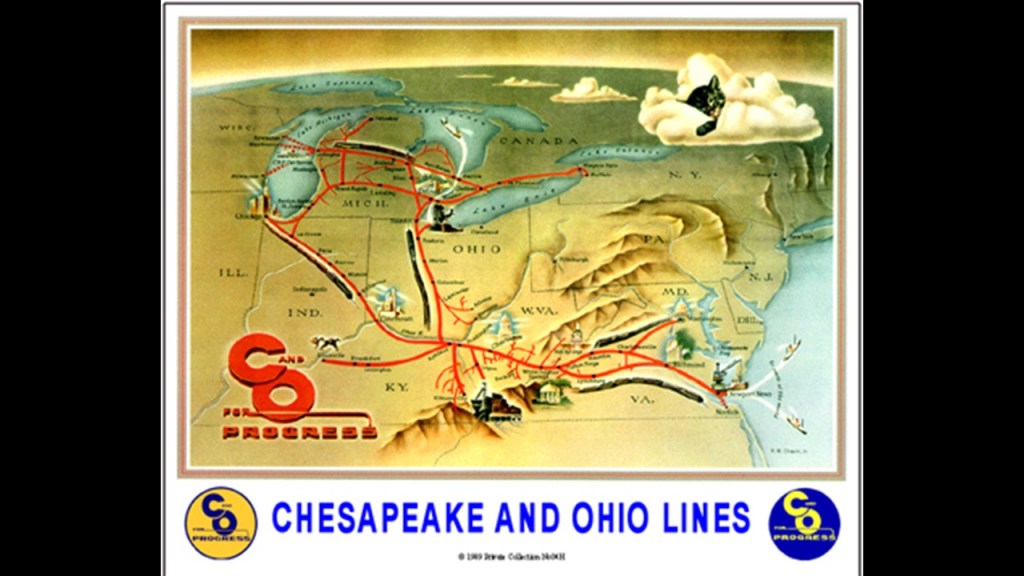
We are told that after the Chesapeake and Ohio Railway opened up this rugged wilderness in 1873, coal was carried out of the New River Gorge to the ports in Virginia and to cities in the Midwest.
The C & O Railway was formed in 1869 from several smaller Virginia Railroads under the guidance of of Collis P. Huntington, in order to connect the coal reserves of West Virginia with the new coal piers that were built in Hampton Roads and Newport News, Virginia, and first opened in 1873, forging a rail link to places like Chicago in the Midwest.
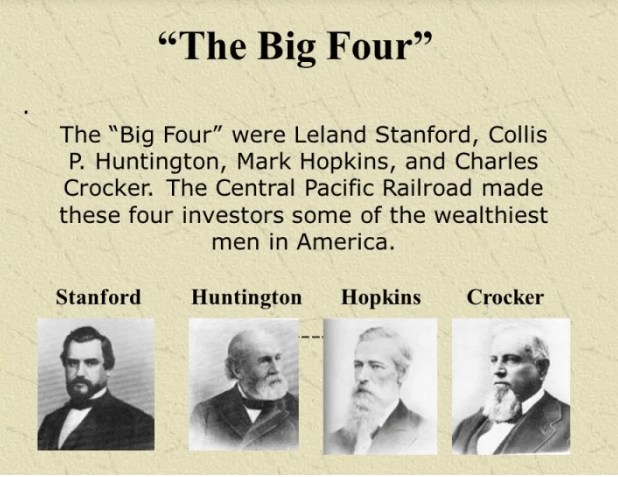
Collis P. Huntington was one of the Big Four of western railroading, along with Leland Stanford, Mark Hopkins and Charles Crocker.
Then in 1888, Huntington lost control of the railroad to J. P. Morgan, an American financier and investment banker who dominated corporate finance on Wall Street during the Gilded Age between 1877 and 1900, and William K. Vanderbilt, who managed the Vanderbilt family’s railroad investments.
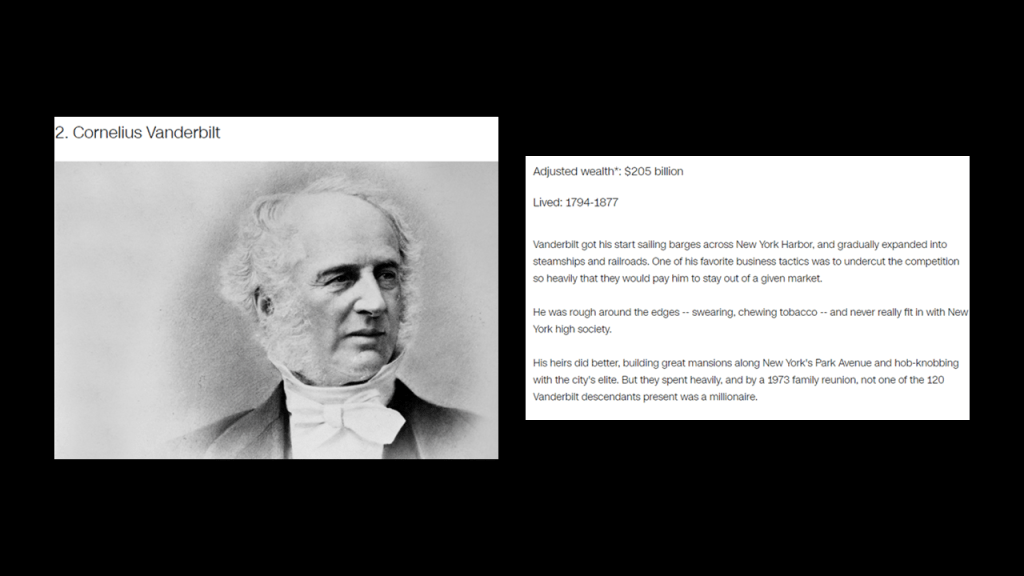
William K. Vanderbilt was was the grandson of Cornelius Vanderbilt, one of the richest Americans in history, who was an American magnate, and who built his family’s fortune in shipping and railroads.
The process continued on for the C & O Railroad to consolidate and merge railroads, and, for example, to gain access to productive coal fields throughout the region, through the 1920s.

According to CNN Business, Cornelius Vanderbilt was the second-richest American in history, with an adjusted wealth of $205-billion.
It is definitely interesting to note that there is an old abandoned steel-truss railroad bridge back at Hobuck Flats…with megalithic stone blocks here as well.
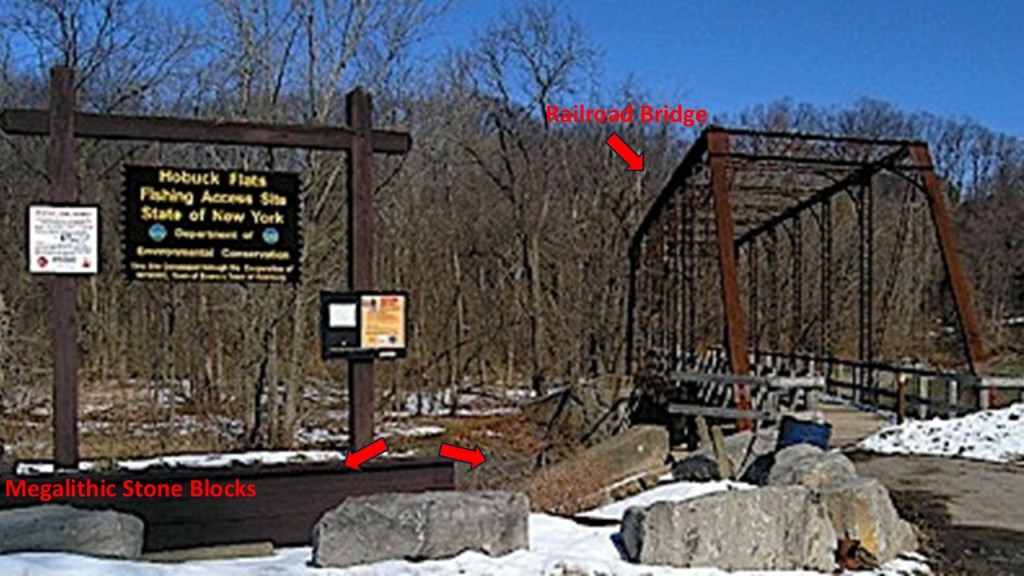
Though interestingly they don’t call it an old railroad bridge, which is what I think it is.
They call it the old “Versailles Road Plank Bridge.”
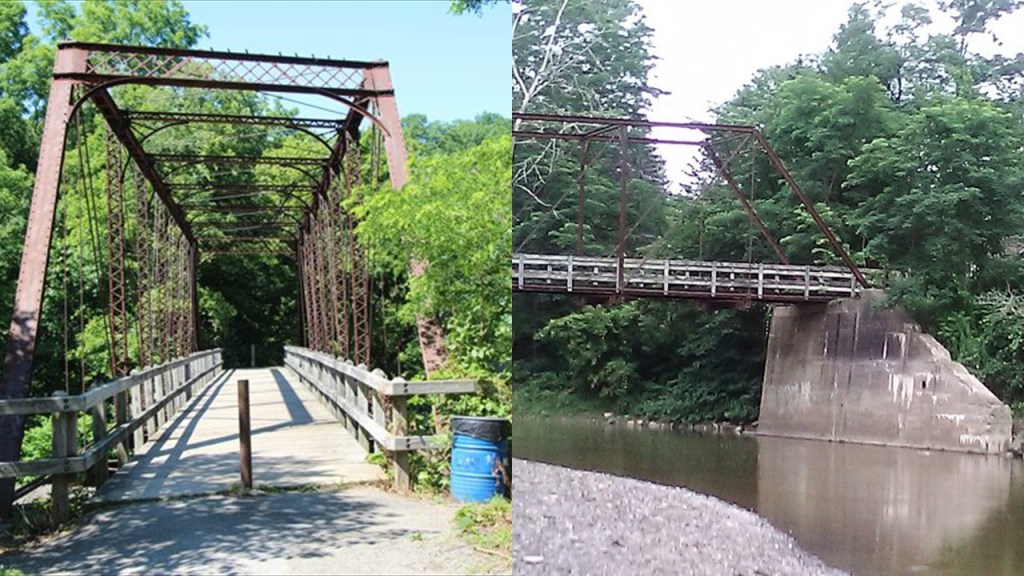
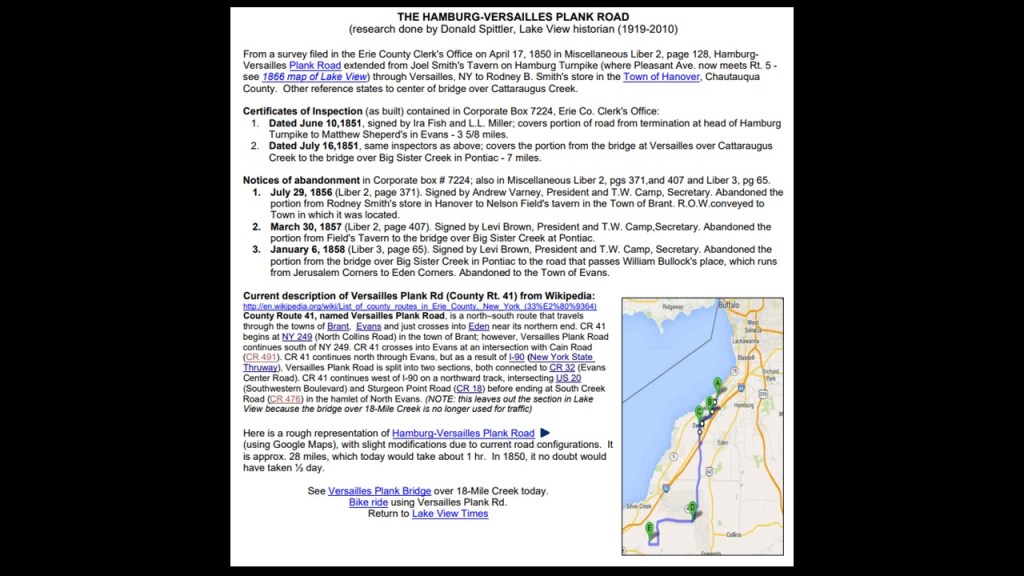
The Versailles Plank Road is today’s County Route 41 beginning in the town of Brant on the southern end to Evans on the northern end.
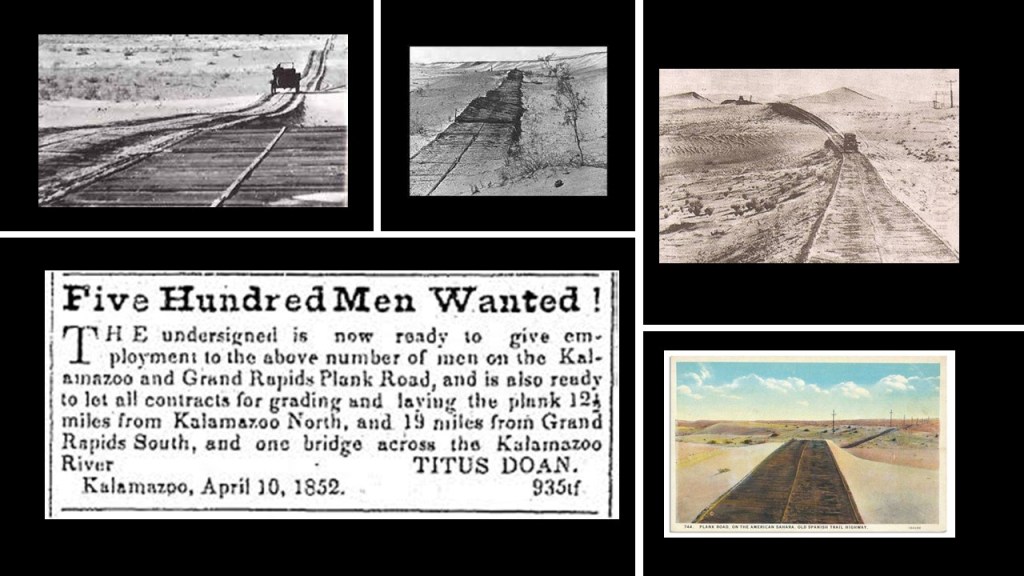
Here’s what we are told in our narrative about “plank roads.”
The “Plank Road Boom” lasted in the United States from 1844 to the mid-1850s, with more than 10,000-miles, or 16,000-kilometers, of plank roads built across the country.
Newspapers and Magazines of the time, including the New York Tribune and Scientific American, extolled plank roads as being easy to construct and a way to transform the rural transit trade of the country.
As we see in these photos, plank roads are crossing over landscapes covered in sand and dunes, but I think they were a cover-up explanation for the pre-existing railroad tracks of railroad lines that were part of the energy grid that was deliberately destroyed, creating among many other things, deserts, dunes, swamps and bogs.
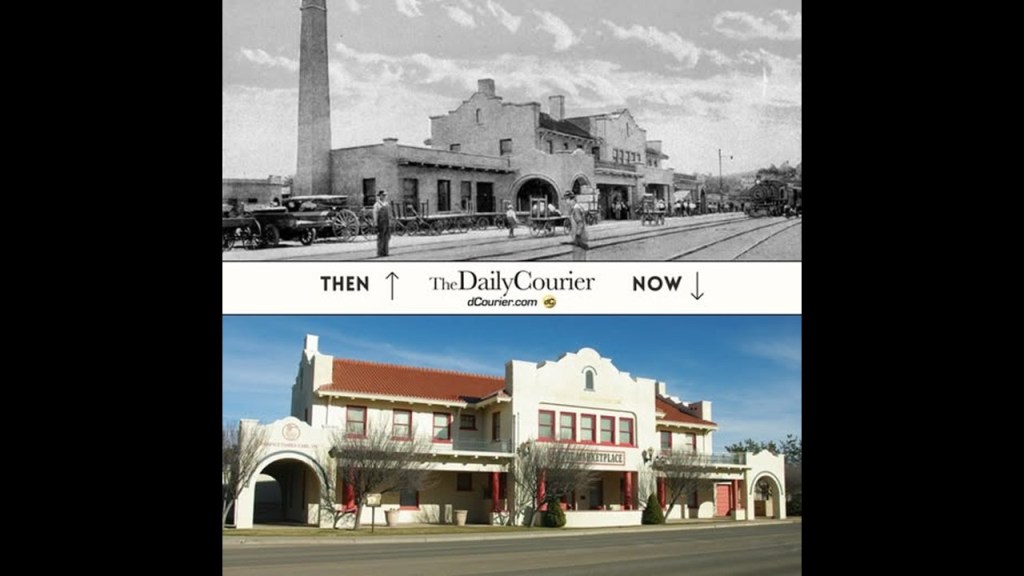
This steel truss pedestrian bridge in downtown Prescott in Arizona where I live is next to the Hilton Garden Inn located at the intersection of Sheldon Street and South Montezuma Street, and was actually called the “Granite Creek Railroad Bridge.”
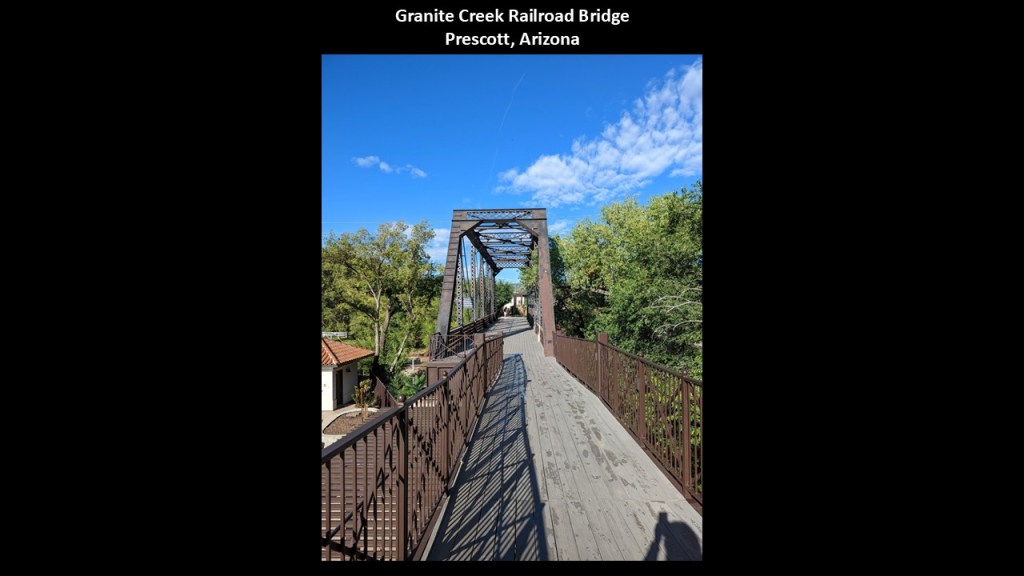
The bridge was said to have been first constructed in 1893 and reconstructed in 1910, as part of the Santa Fe, Prescott and Phoenix Railway going through downtown Prescott on Sheldon Street near this location.
The original train depot was directly across the street from the railroad bridge, which is today a real estate office at a shopping center called “Marketplace Depot,” with the line having been abandoned in 1984, and the tracks removed for good by 1992.
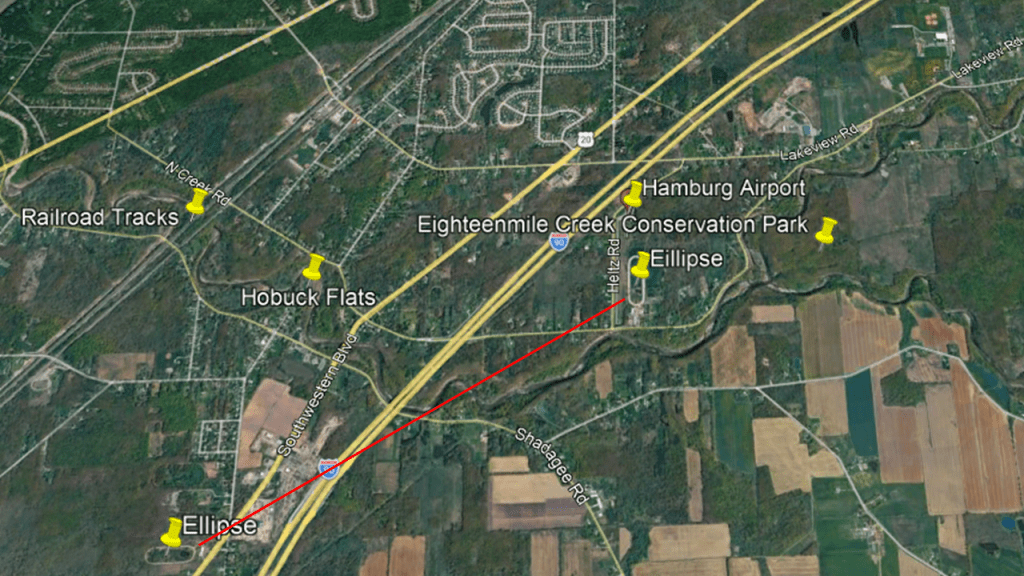
When I was looking at Google Earth around the areas on Eighteenmile Creek that I have been looking at, there are some things that popped out at me, primarily the presence of elliptical shapes and an airport in close proximity to each other in-between Hobuck Flats and the Eighteenmile Conservation Park, as well as close to I-90 and US-20.
I consistently find airports and elliptical shapes in close proximity to each other, and have found many examples throughout this series and in other work that I have done.
In most cases the elliptical shapes, which I believe were circuits on the original energy grid, are now typically race-tracks, in particular horse and/or auto racing, another name for which is “racing circuit.”
In these cases, I can find nothing to indicate what the ellipses are being used for, if anything, but they both have the same elliptical shape of being long and narrow.
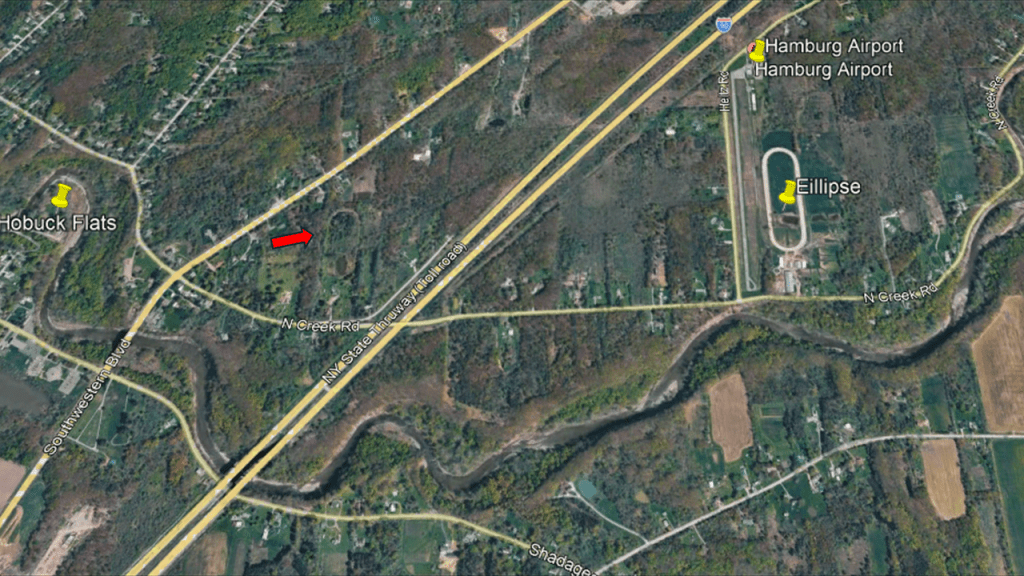
I did find another faint elliptical shape in the landscape in-between I-90 and US-20, and in-between Hobuck Flats and the elliptical shape adjacent to the Hamburg Airport.
The Sturgeon Point Historical Lighthouse is near the shore of Lake Erie to the southwest of the Hamburg area that I have been looking at.
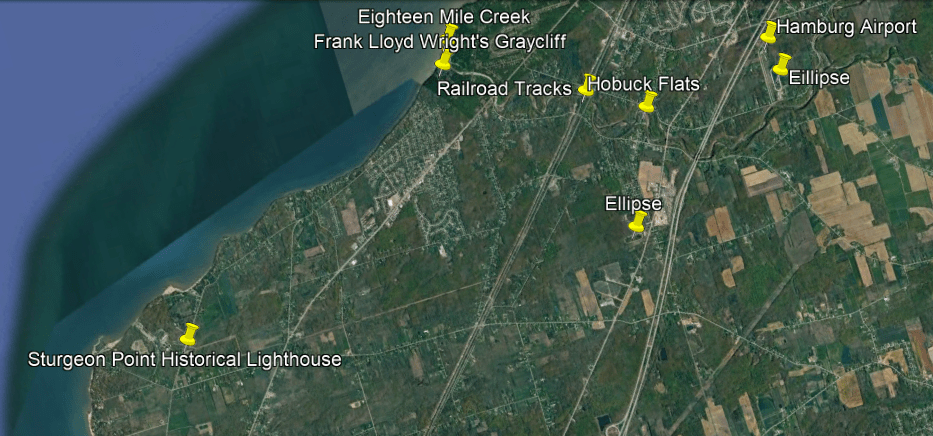
This is what I was able to find out about it.
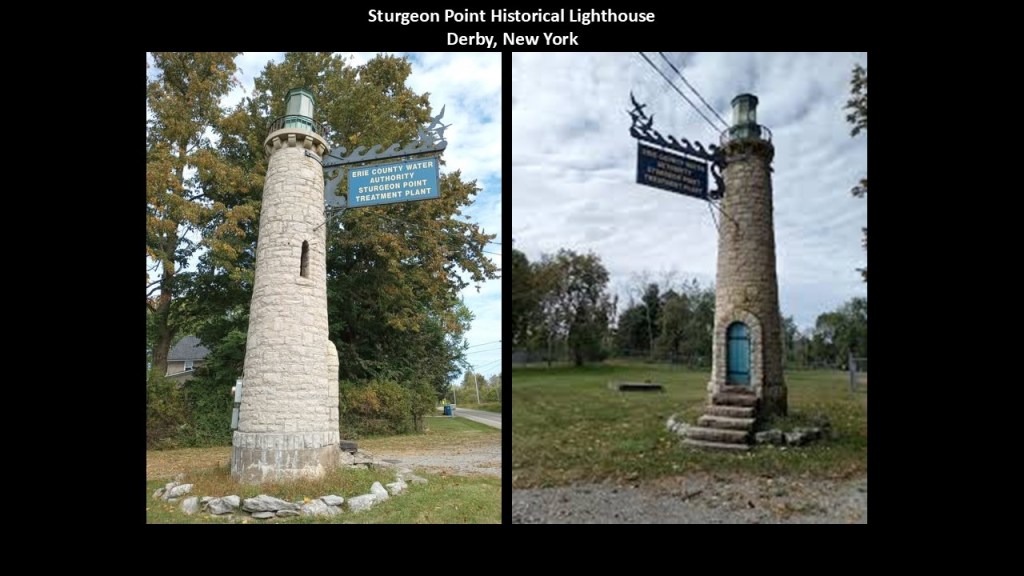
The Sturgeon Point Historical Lighthouse is a small lighthouse that was built in 1924 to mark a subdivision near Sturgeon Point on Lake Erie.
It was moved to Derby, New York, at the entrance to the water treatment plant and is now land-locked.
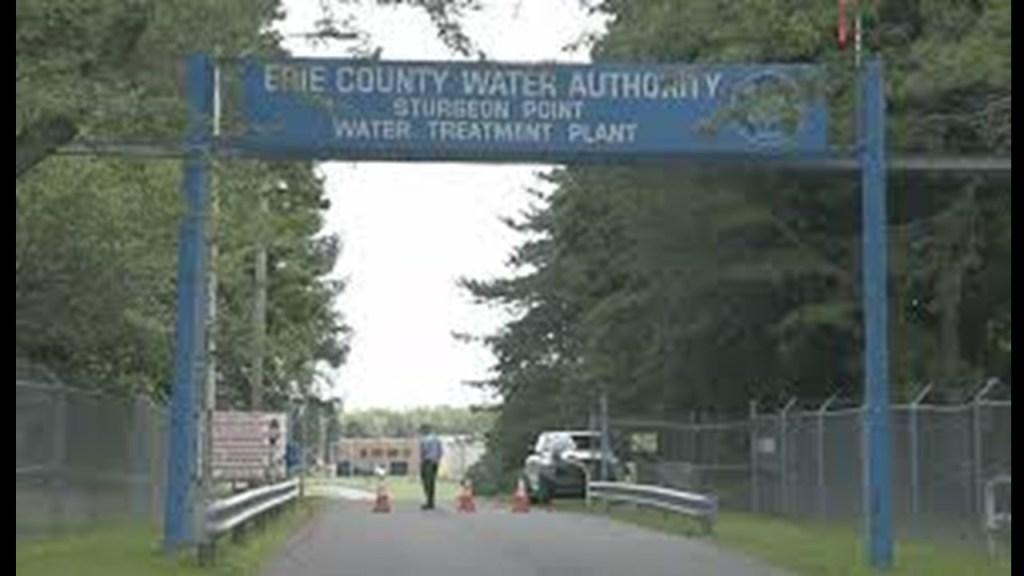
The Erie County Water Treatment Plant at Sturgeon Point is a major drinking water facility.
It draws raw water from Lake Erie and treats it so it can be distributed as drinking water to the area served by the Erie County Water Authority system.
Polyaluminum Chloride is used as the chemical agent by which the lake water is treated so it can be safely filtered out as drinking water.
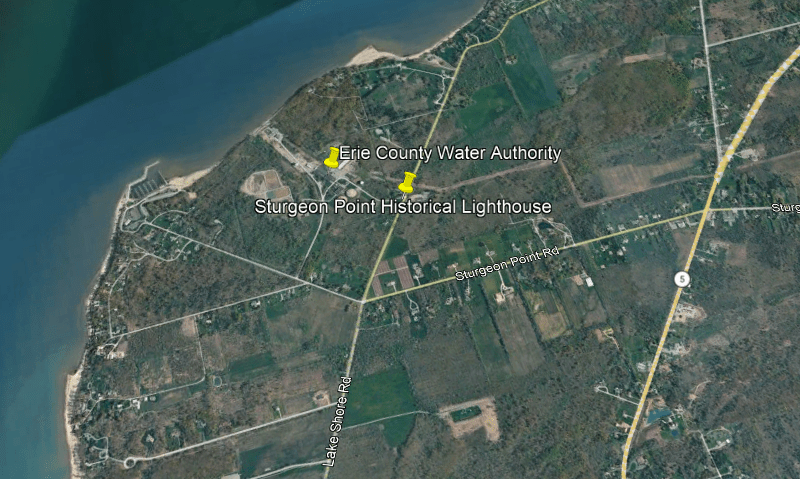
These locations I have just been looking at in Derby are a short distance to the west off of NY-5, the Seaway Trail.
Next I am going to head south of the Sturgeon Point Historical Lighthouse area, and take a look at the Dunkirk Lighthouse; the Shorewood Country Club; The Vineyards Golf Course; Lake Erie State Park; Shumla Falls; Arkwright Falls, Burr Falls and the community of Lily Dale, and to the east of this area, the Zoar Valley Multiple Use Area; the Gossamer Cascade Waterfall; the Stoney Pitcher Falls and Linda’s Falls.
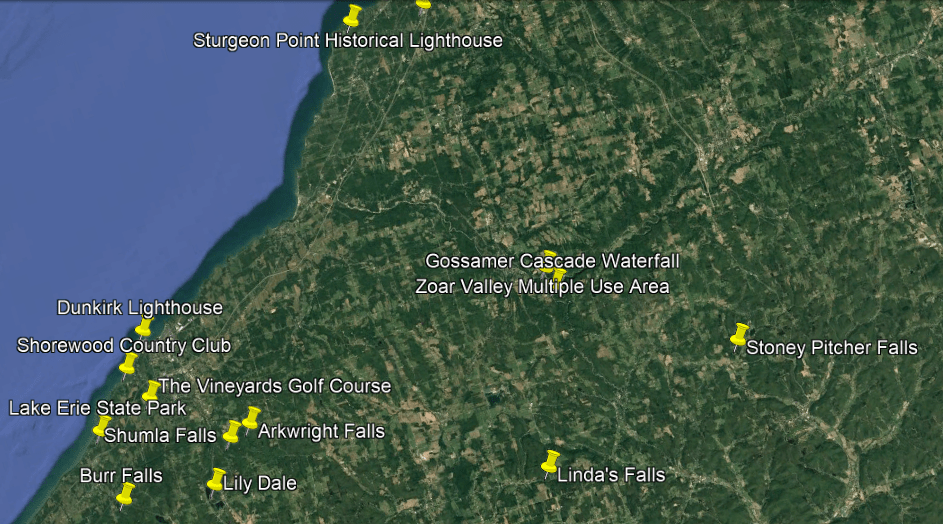
First, the Dunkirk Lighthouse.
The Dunkirk Lighthouse, also known as the Point Gratiot Lighthouse, is still an active lighthouse.
We are told that it first established in 1826; that the original lighthouse needed to be rebuilt because it was falling into disrepair; and that the current tower was first lit in 1875.
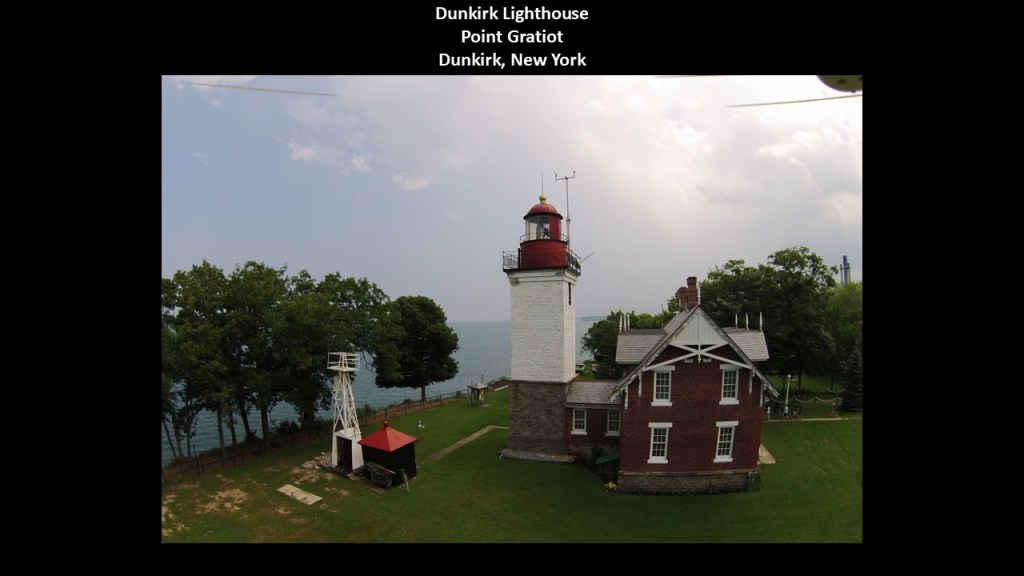
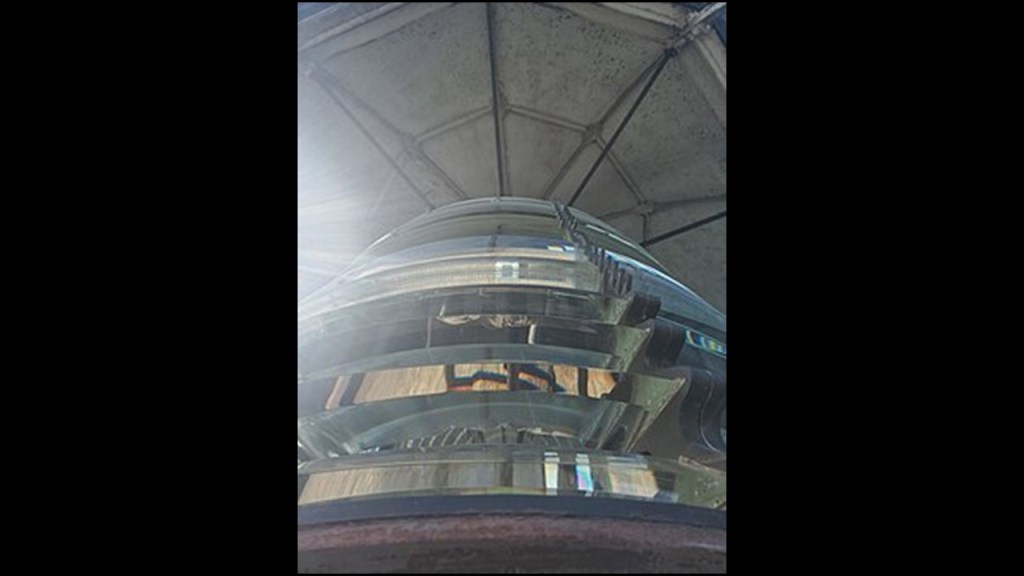
Like the previously-mentioned Tibbetts Point Lighthouse at Cape Vincent, New York, at the entrance to the St. Lawrence Waterway on Lake Ontario, the Dunkirk Lighthouse is one of the only 16 lighthouses on the Great Lakes that has its original third-order fresnel lens.
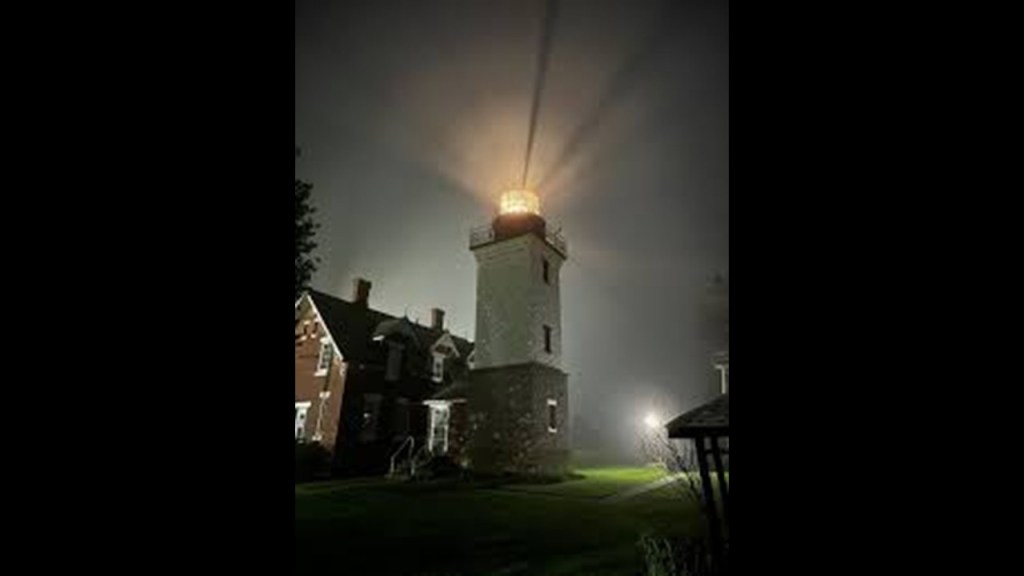
The third-order fresnel lens at the Dunkirk Lighthouse is currently valued at USD $1.5-million.
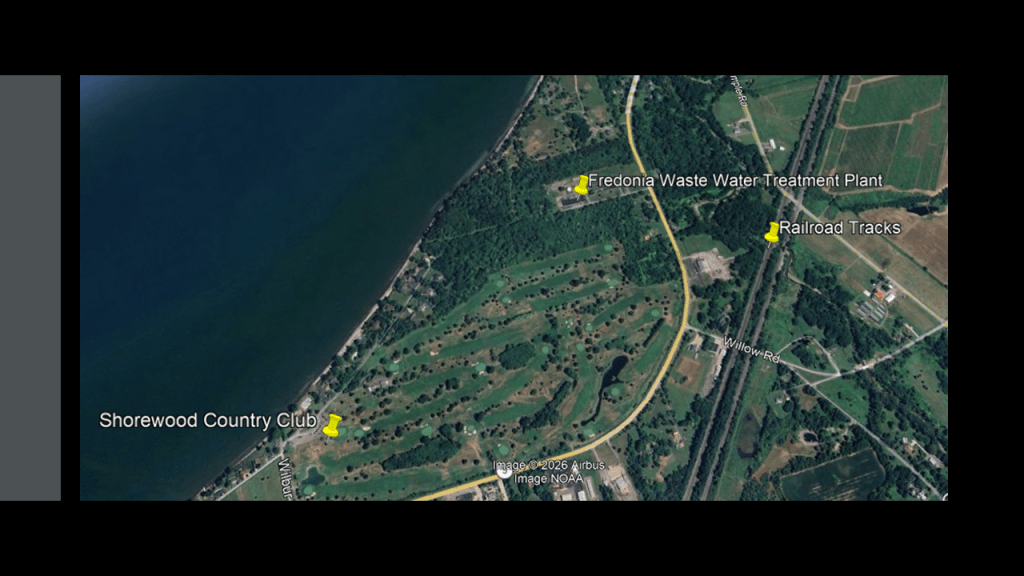
The Shorewood Country Club is just down the Lake Erie shore from the Dunkirk Lighthouse, just west of NY-5 and the railroad tracks.
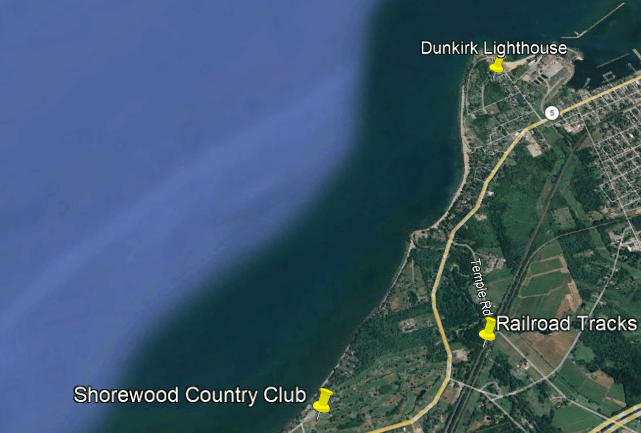
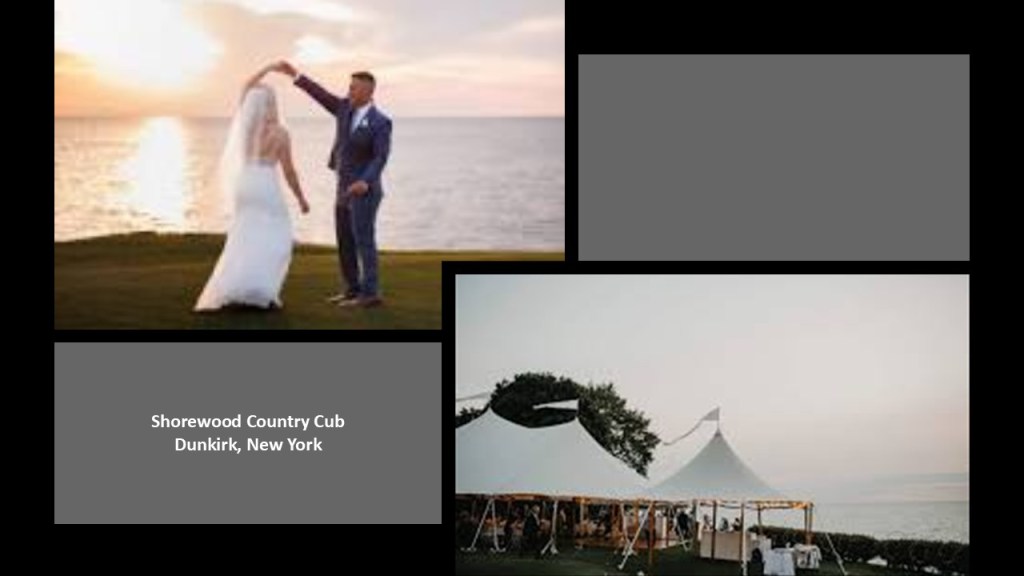
The Shorewood Country Club is a semi-private club that was first established in 1918, and offers a variety of amenities besides the golf course, including social events and weddings.

It is known for its panoramic views of Lake Erie.
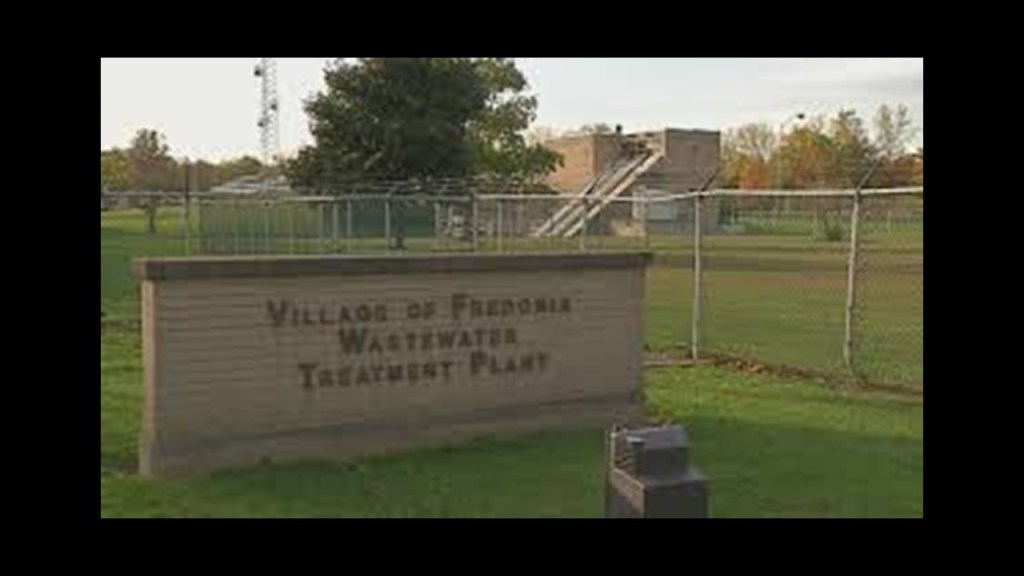
The Fredonia Wastewater Treatment Plant is adjacent to the Shorewood Country Club.
As a wastewater treatment plant, this is a location where previously-used water from homes, businesses and industries has pollutants removed chemically so that it can be reused and returned to the water distribution system.
The almost 100-year-old facility here is addressing critical, aging infrastructure and has been experiencing significant, recurring failures.
Discussions are underway regarding rehabbing the plant or decommissioning it.
I came across the Clarkson Wastewater Treatment Plant on Lake Ontario in Mississauga near Toronto in the last part of this series.
It is important to note that Wastewater Treatment Plants even without infrastructure problems are a major source of things like bioaerosols, which may constitute a health risk for workers and people living in the surrounding area.
Bioaerosols contain different microorganisms that can cause diseases and allergies.

I found more interesting shapes in the landscape at the State University of New York (SUNY) Fredonia and Chautauqua County Fairgrounds, just a short-distance to the east of the Wastewater Treatment Plant and the Shorewood Country Club.
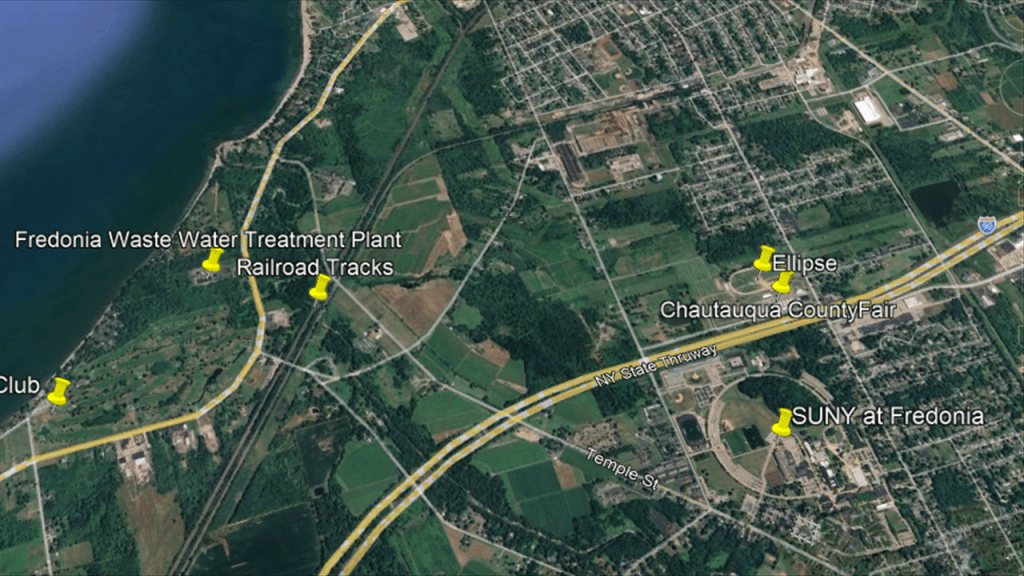
The SUNY Fredonia location has a perfect circle on its campus, the there is another elliptical shape at the neighboring fairgrounds, which are separated by I-90.
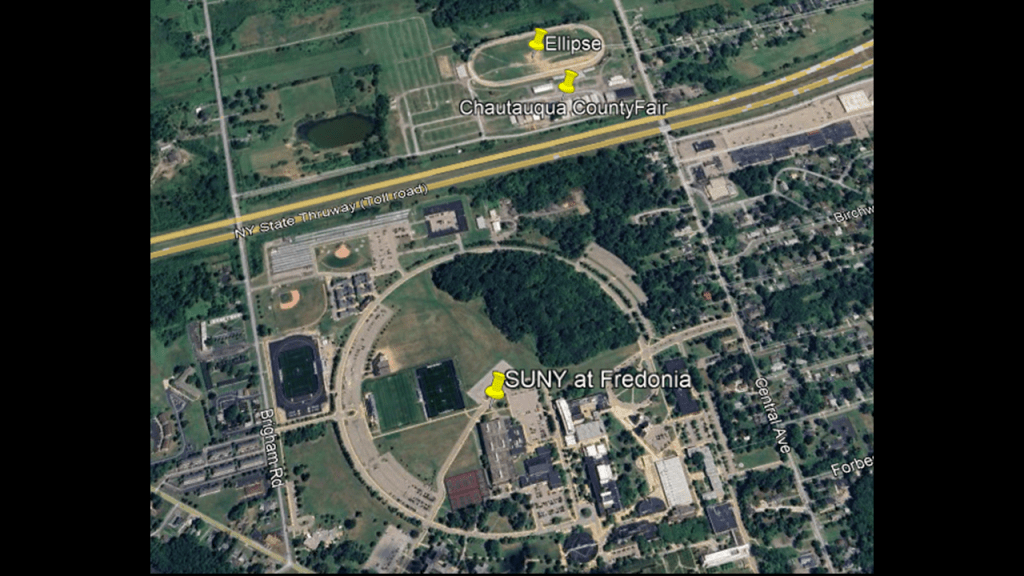
The perfectly circular shape brought to mind the shape of a particle accelerator, like the Cornell Electron Storage Ring, the particle accelerator that is 40-feet, or 12-meters, below the football field on the Cornell University Campus in Ithaca, New York.
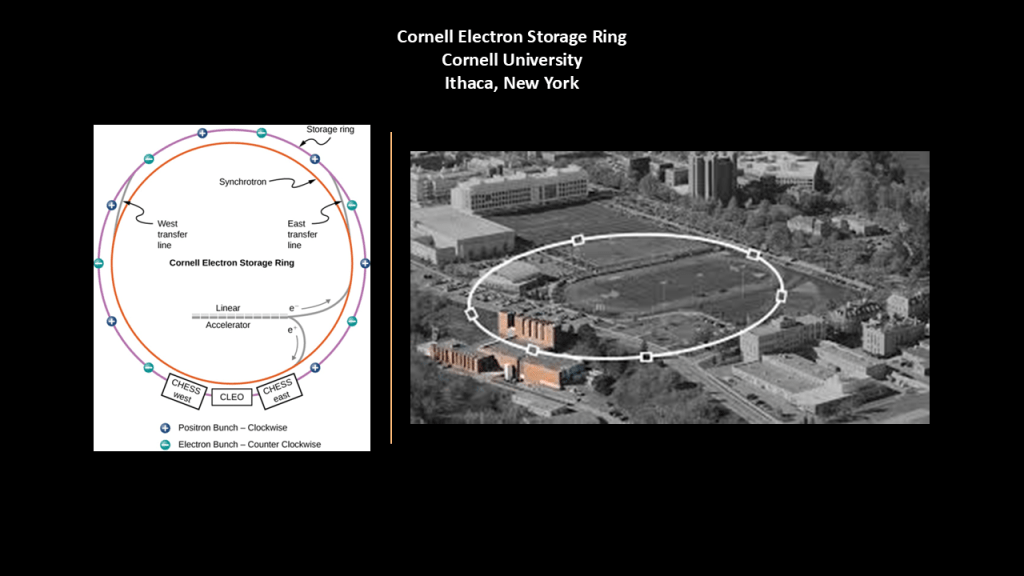
While I can’t find a direct reference to a particle accelerator at SUNY Fredonia, I did find some intriguing connections.
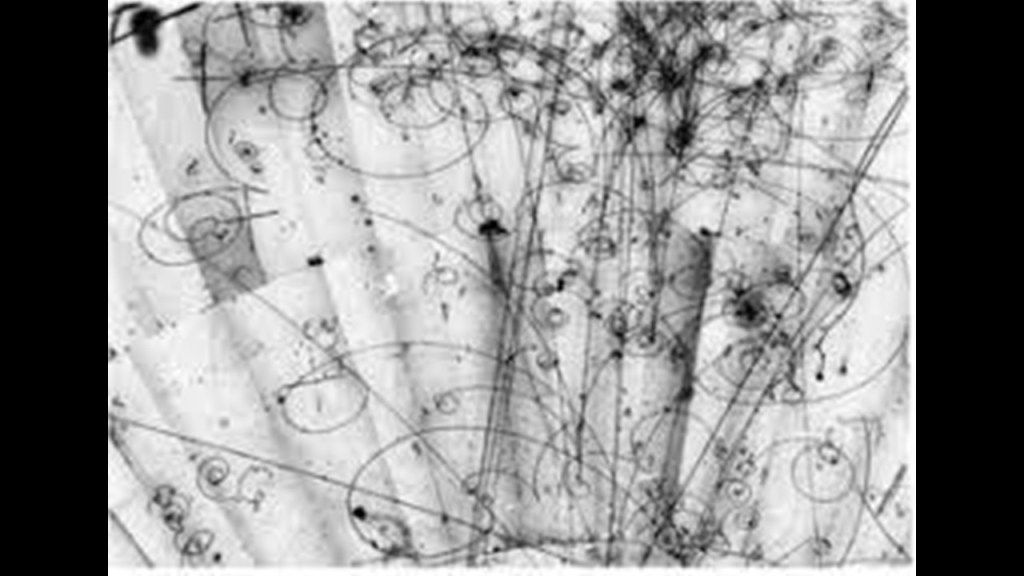
The Physics Department utillizes what is called a “Bubble Chamber” to analyze particle interactions.
A “Bubble Chamber” is a charged particle detector that uses a superheated liquid to visualize the paths of charged subatomic particles.
Researchers at SUNY Fredonia are said to focus on analyzing data from major national and international accelerators, like CERN, for researching high-energy experiments.
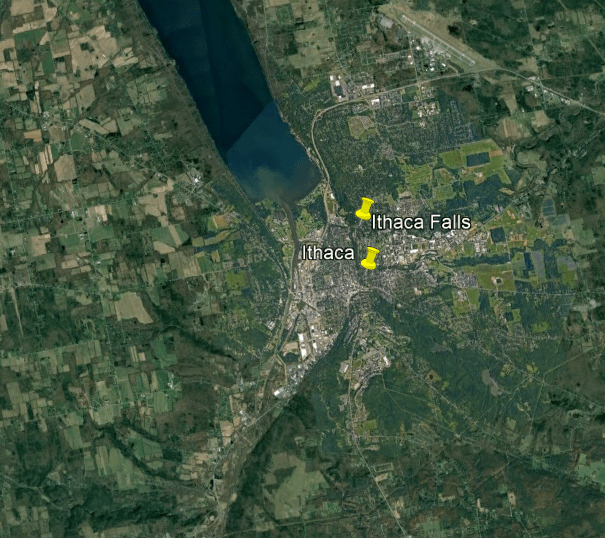
Ithaca, the location of Cornell University, is located at the southern end of Cayuga Lake, the longest and second largest of the Finger Lakes in New York State, after Seneca Lake.
In our historical narrative, European settlement of Ithaca began in 1800, and in the 19th-century, it became a transshipping point for things like salt and gypsum.
The town of Ithaca was organized and incorporated in 1821, and in 1834, the Ithaca and Owego Railroad’s first horse-drawn trains began service.
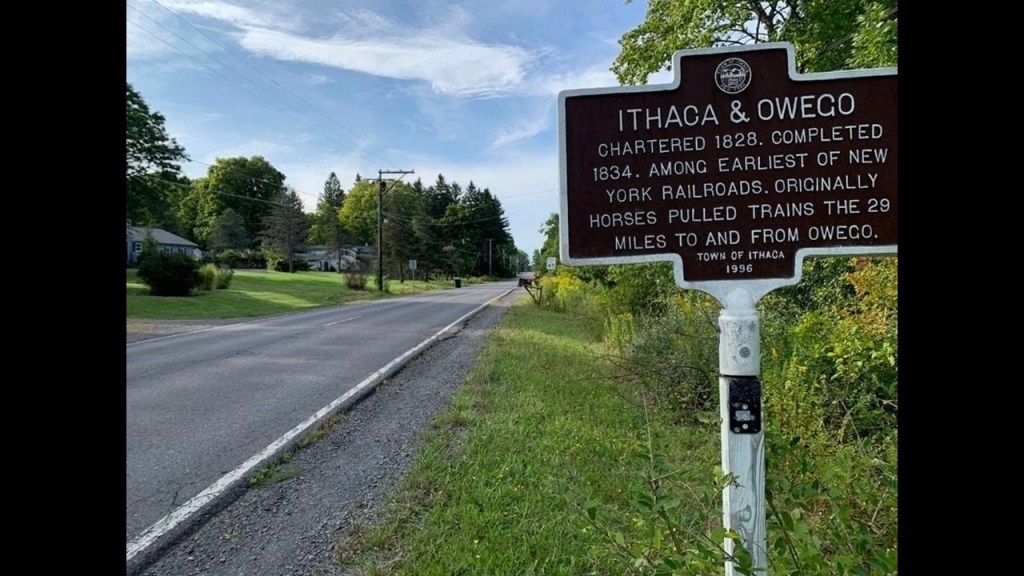
The Ithaca and Owego Railroad was reorganized as the Cayuga and Susquehanna Railroad in 1842.
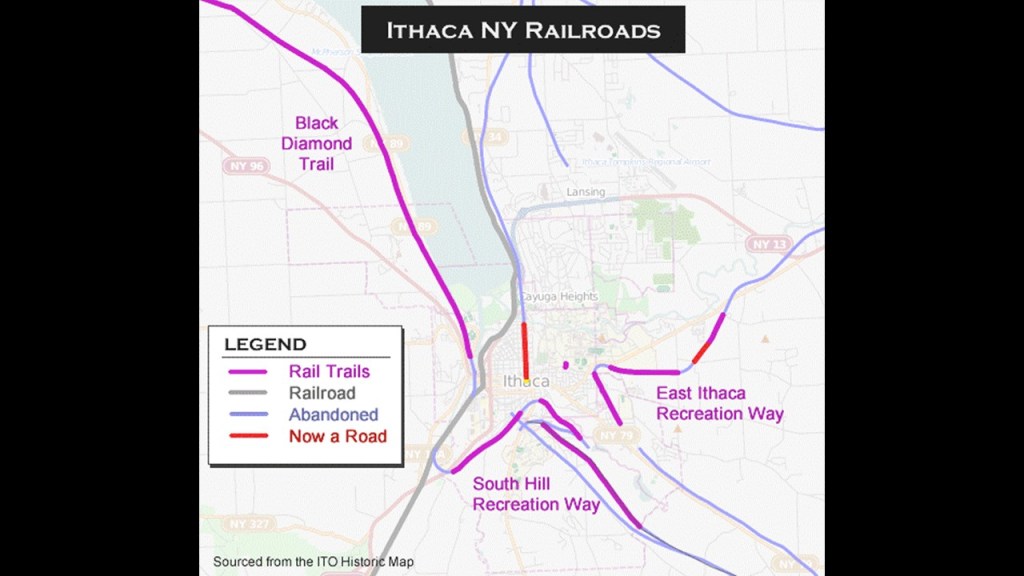
In 1956, this railroad’s physical right-of-way was completely abandoned, and later incorporated into the South Hill Recreation Way in Ithaca.
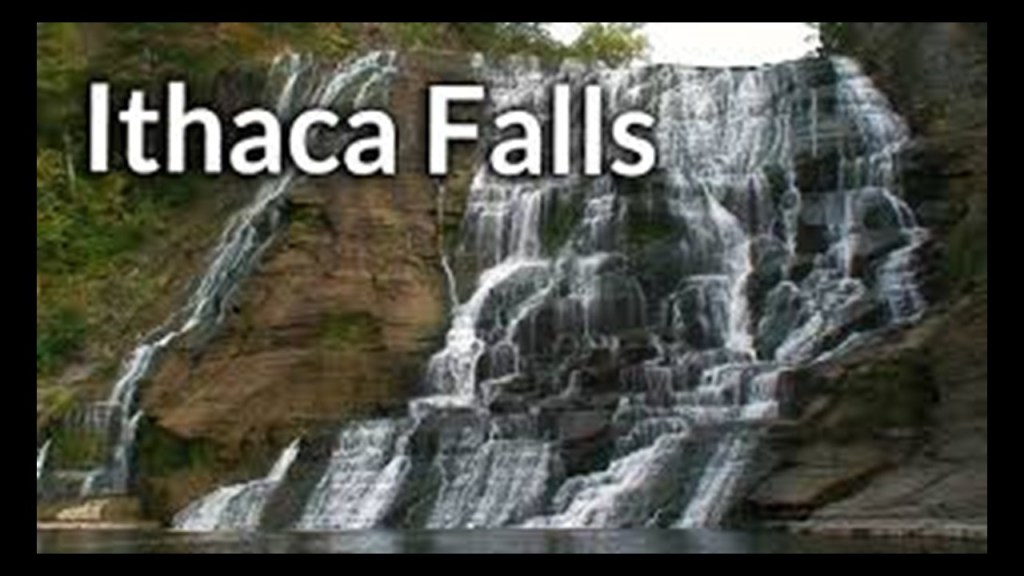
Ithaca Falls is located in downtown Ithaca in a gorge on Fall Creek, and is 150-feet, or 46-meters, -high.
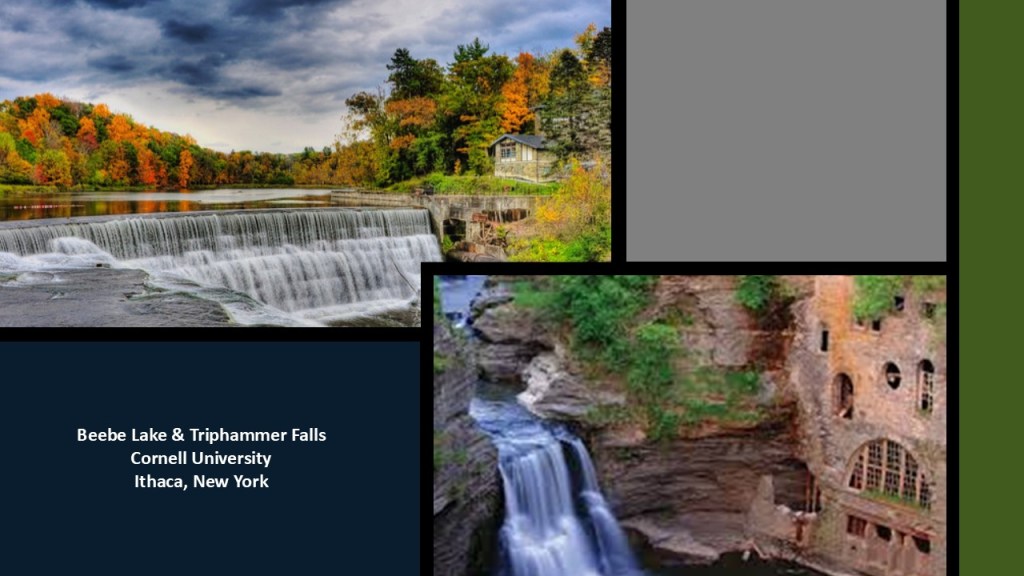
Fall Creek makes its way through the campus of Cornell University.
Beebe Lake and Triphammer Falls on campus are some of its notable features.
Beebe Lake is a reservoir that we are told was on land that was once forested swamp, and needs to be dredged every ten years to keep it from returning to wetlands.
The Triphammer Falls Hydroelectric Plant on the Cornell University Campus, pictured on the lower right, was said to have been established in the 1880s with the present structure dating to 1902.
It powered the campus until the 1950s, and then was restarted in the 1970s and continues to operate today.
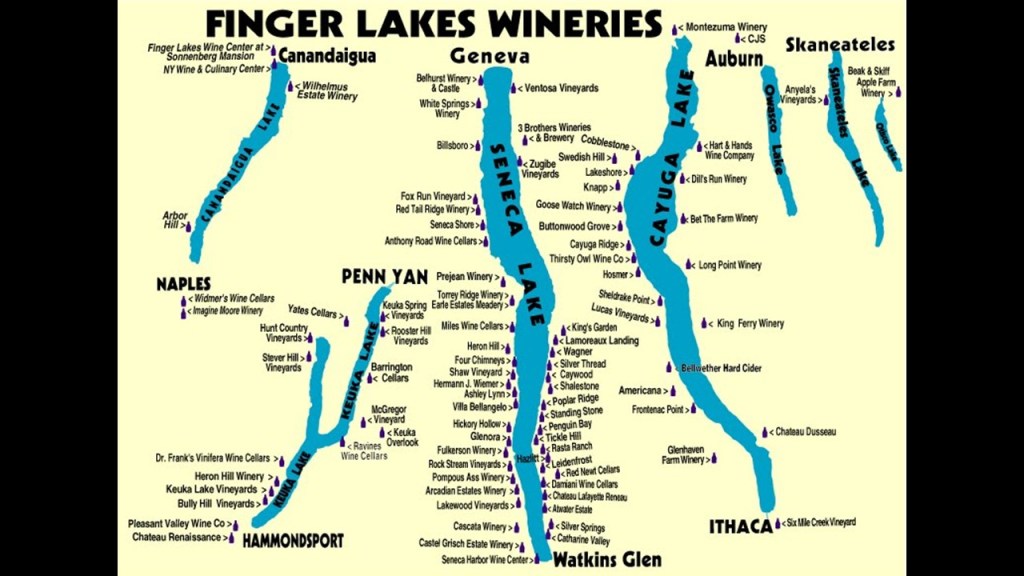
The Finger Lakes Region, especially around Seneca Lake and Cayuga lake, is an American Viticultural Area known for its grape-growing, and accounts for about 80% of New York State’s wine-production.
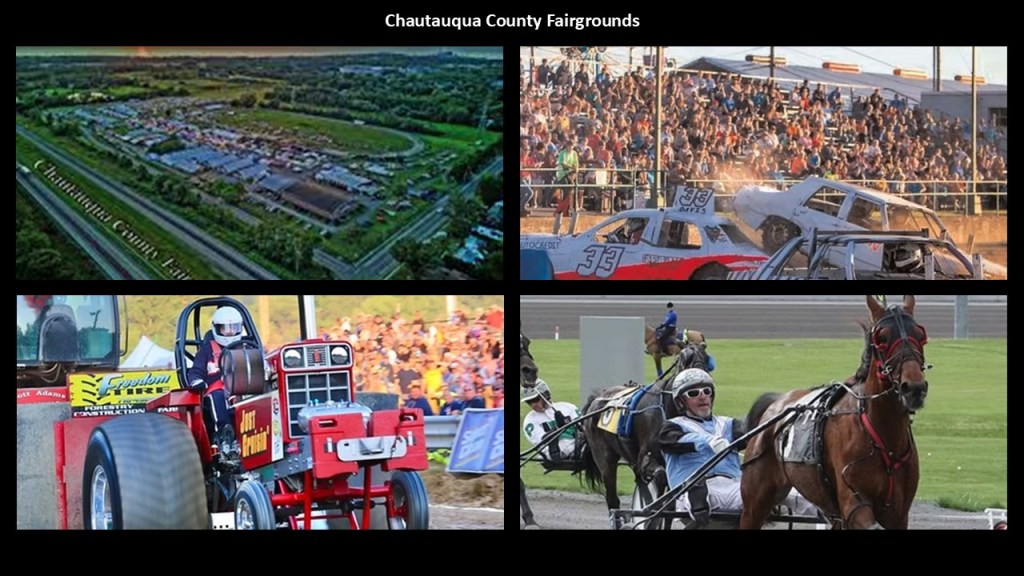
The Chautauqua County Fairgrounds just across I-90 from SUNY at Fredonia, is in Dunkirk.
The elliptical track at the fairgrounds during fair week is used for harness horse-racing; demolition derby and Figure-8 racing; tractor pulls and specialty motorsports; and livestock showing.
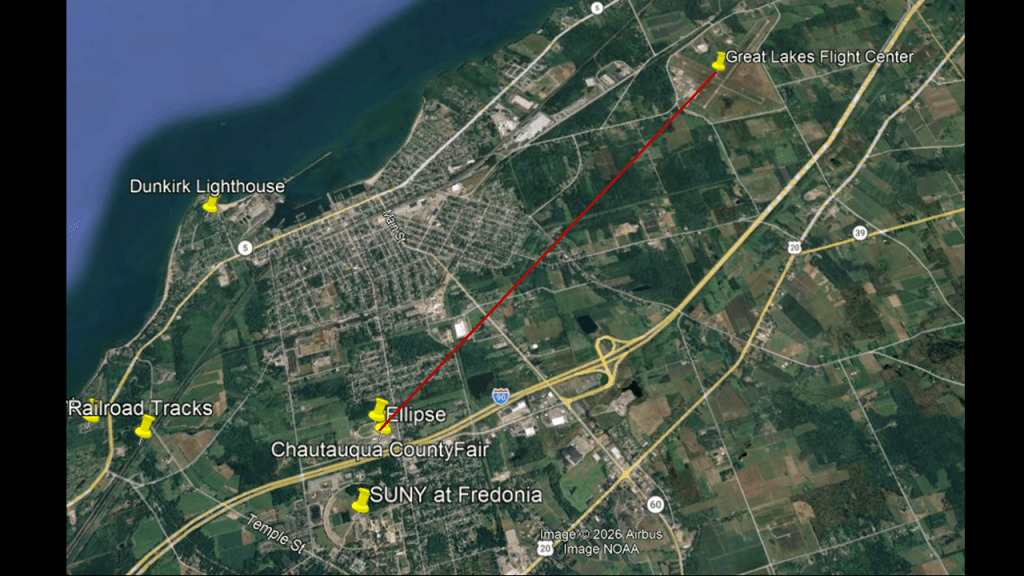
I looked and found the Chautauqua County Jamestown Airport in a linear alignment to the northeast of the elliptical track at the fairgrounds.
It is mostly used for general aviation, and houses the Great Lakes Flight Center, which offers things like flight-training and aircraft rentals.
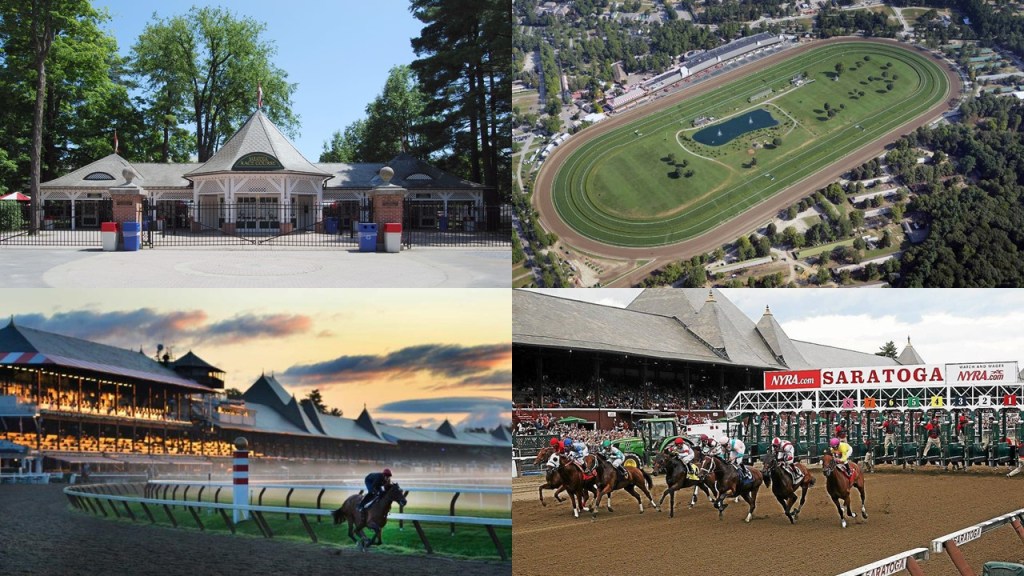
For examples of similarities in other places, this is a Google Earth screenshot showing the angular relationships between the Saratoga Race Course, and just a portion of the large number of airparks, airfields, and airstrips in this part of New York State.
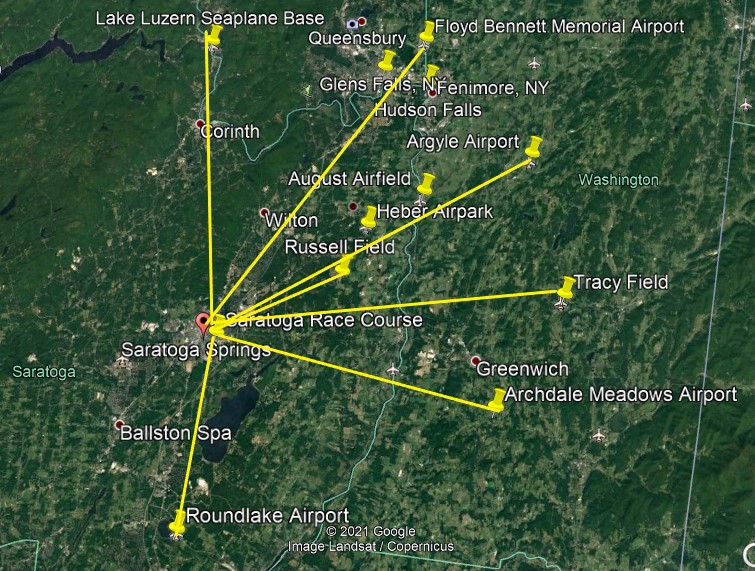
The Saratoga Race Course is a thoroughbred horse racing track in Saratoga Springs, New York. It is one of the oldest sporting venues in the United States, having opened on August 3rd of 1863 (which would have been in the middle of the American Civil War).
The Saratoga Race Course has been in use pretty much continuously since it first opened.
This linear relationship between racetracks and airports shows up everywhere, like for another example, in Hot Springs, Arkansas, where the Oaklawn Racing Casino Resort, a thoroughbred horse-racing track that first opened in February of 1905, is near, and in an angular relationship to, the Memorial Field Airport.
These are just a few of countless examples.

Now moving to the south of SUNY Fredonia, we come to The Vineyards Golf Course; Lake Erie State Park; Shumla Falls; Arkwright Falls; Burr Falls; and the community of Lily Dale.
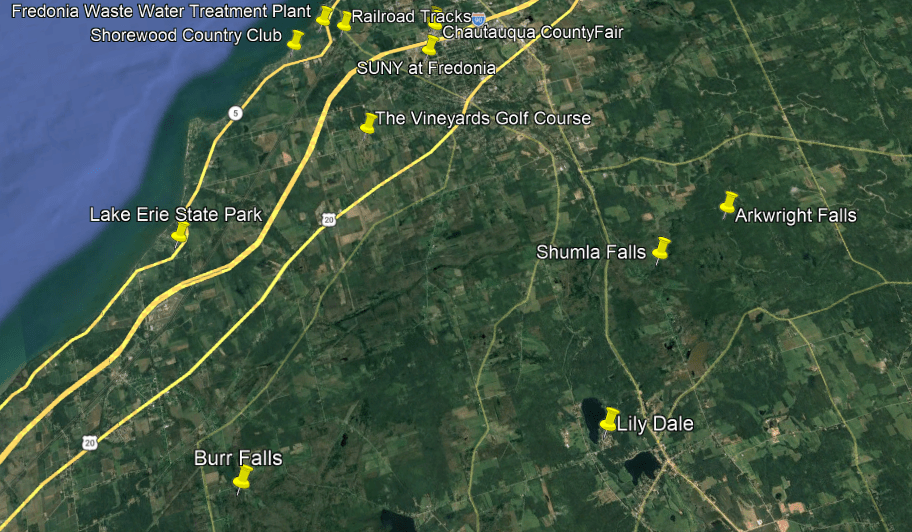
First, The Vineyards Golf Course.
The Vineyards Golf Course is situated in-between I-90 and US-20, and is the short distance of 2.6-miles, or 4.25-kilometers, to the southwest of SUNY Fredonia.
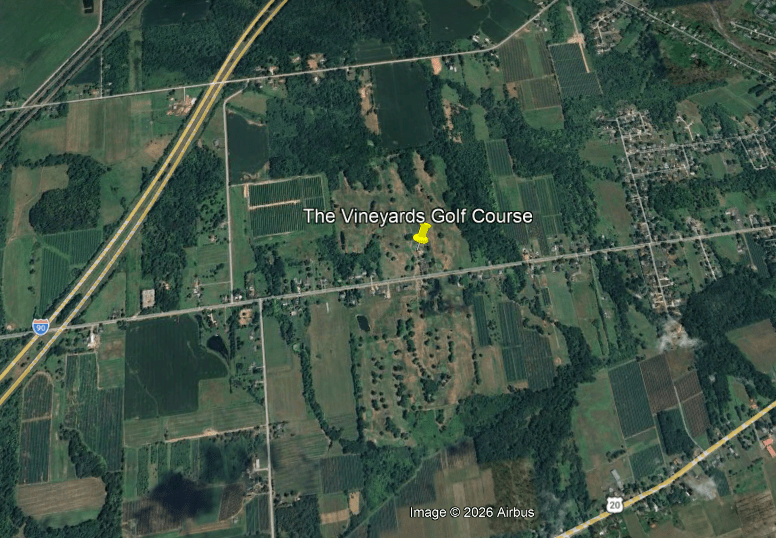
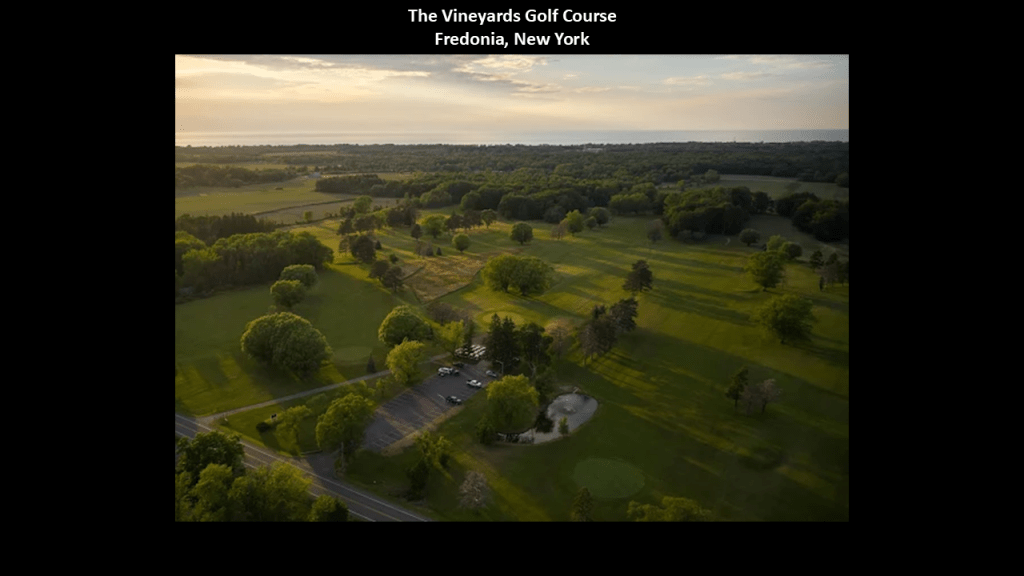
The Vineyards Golf Course is a public, 18-hole golf course nestled among willows, pear trees, apple trees, and maple trees with views of local vineyards.
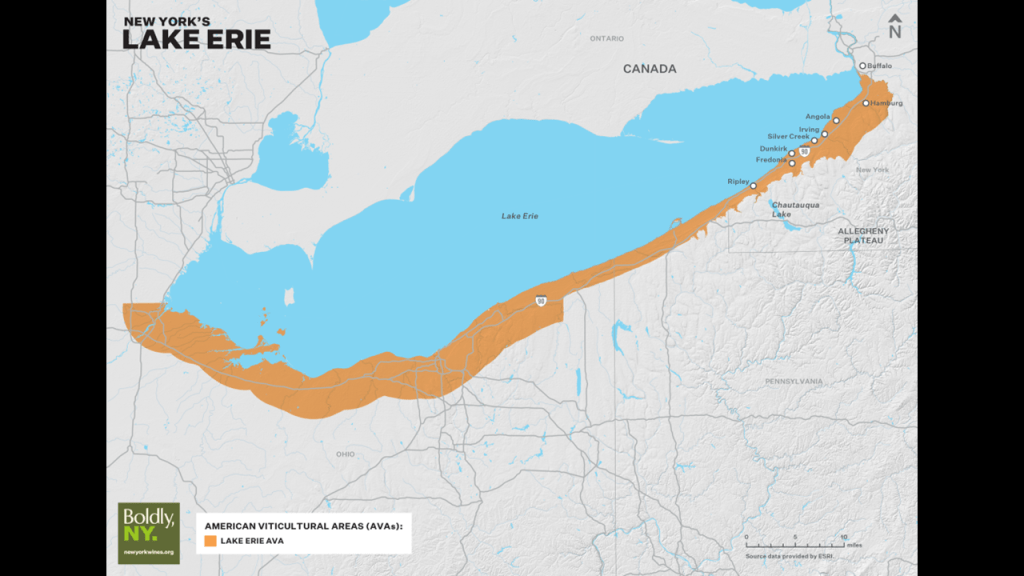
We are currently in the Lake Erie American Viticultural Area (AVA), a 53-mile, or 85-kilometer, -long grape-growing region covering 2.2-million-acres, or 890,000-hectares, along the southern-shore of Lake Erie, stretching from Toledo, Ohio, to Buffalo, New York.
It is the largest AVA east of the Rockies, and known for its unique “lake effect” climate that is ideal for the growing of concord grapes, among other varieties, as the shallow lake moderates temperatures from harsh winters, protecting the vines and extending the growing season.
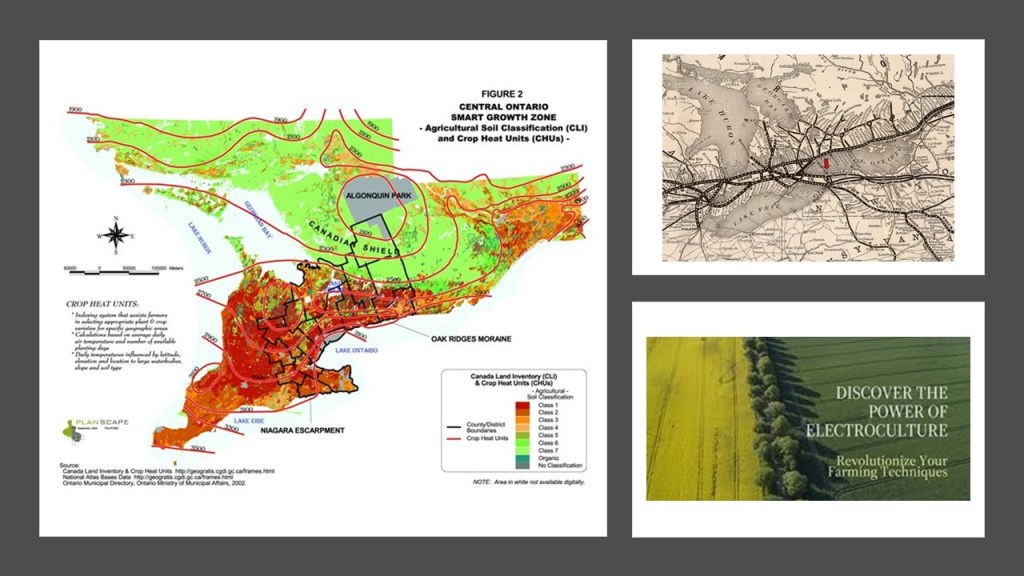
Like I said back in Orchard Park, where Highmark Stadium is located, I have been finding fertile agricultural lands throughout this Great Lakes region, including but not limited to, orchards and vineyards in the Niagara region in the last part of the series on the Ontario-side of Lake Ontario, and there was a significant historical rail presence all throughout this region.
I suspect the agricultural productivity of this region to be in part due to a connection from the original energy grid system between the railroad, hydroelectric system, and all kinds of agricultural activity, functioning as the original electroculture.
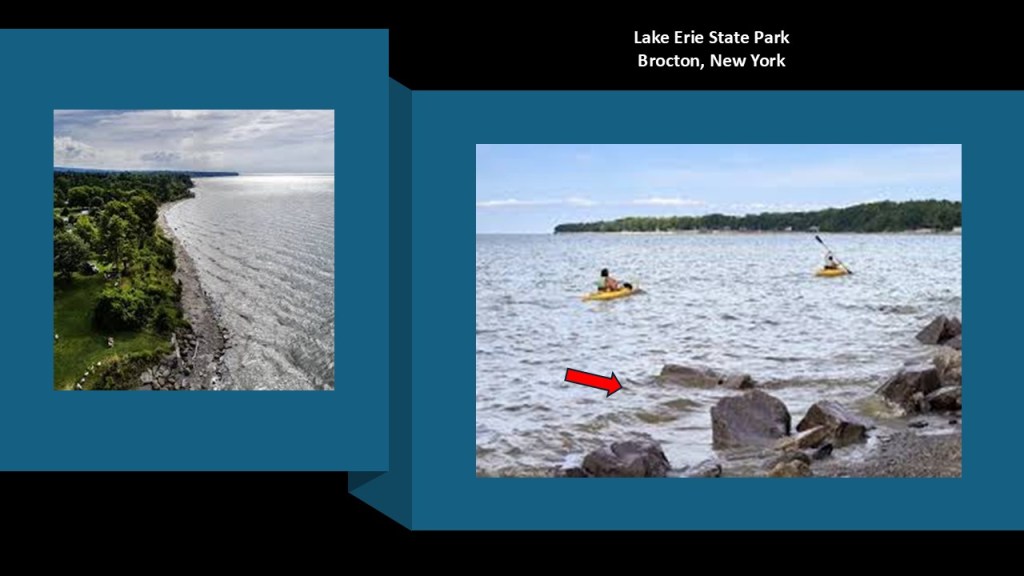
Chautauqua County’s Lake Erie State Park is in Brocton, New York.
It has facilities for camping, hiking, cross-country skiing, bird-watching, fishing, and other recreational activities.
It is the location of Lake Erie Beach, where there are megalithic stone blocks on the lake shore.
Lake Erie State Park is the location of the “Shipwreck Bluff” Disc Golf Course, an 18-hole disc golf course on a high bluff overlooking Lake Erie.
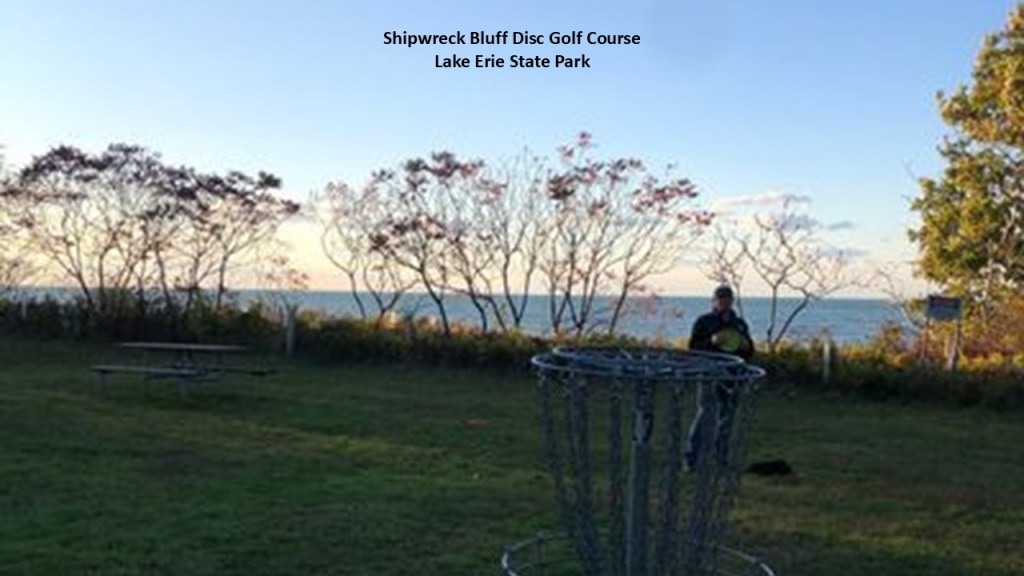
It received the name “Shipwreck Bluff” because of the high concentration of historic shipwrecks in the area, often exposed or found near the shore, and the region is known for its dangerous and shallow waters, prone to high waves and powerful winds.
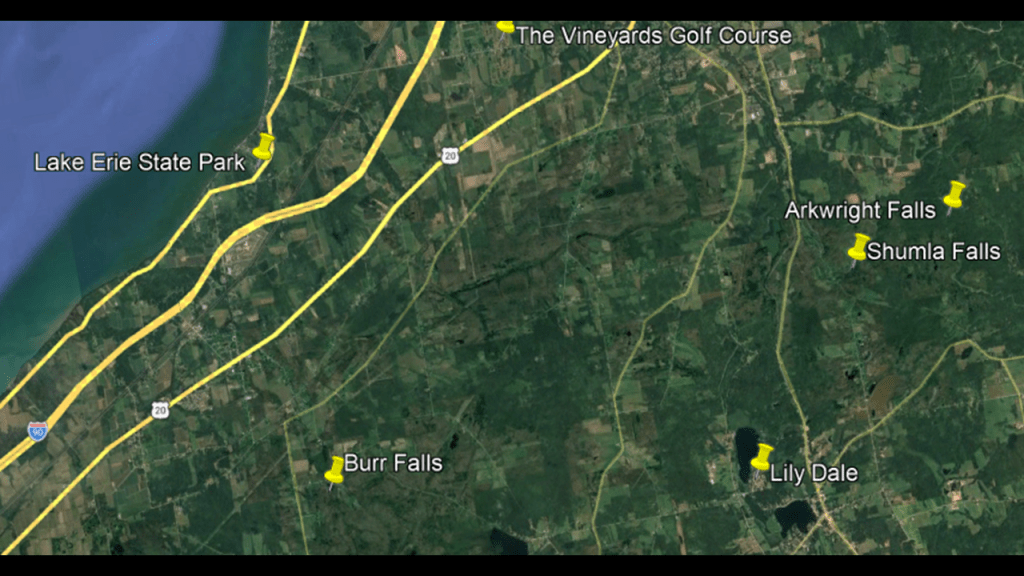
Lake Erie State Park is on the Seaway Trail, and the other places I want to look at – Burr Falls, Lily Dale, Shumla Falls and Arkwright Falls – are across I-90 and US-20 from there, and Burr Falls is the first place we come to.
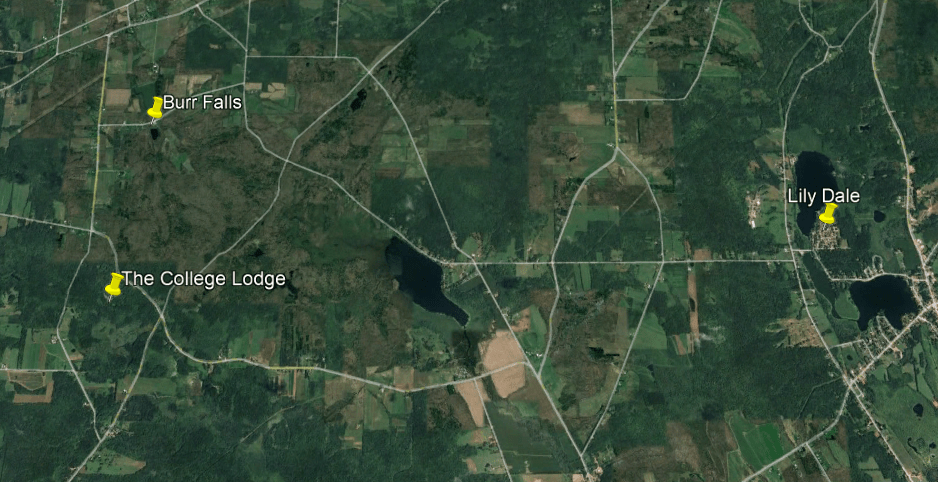
In looking into the general area of Burr Falls, I found the Lakeview Shock Incarceration Correctional Facility; the Brocton Arch; and The College Lodge.
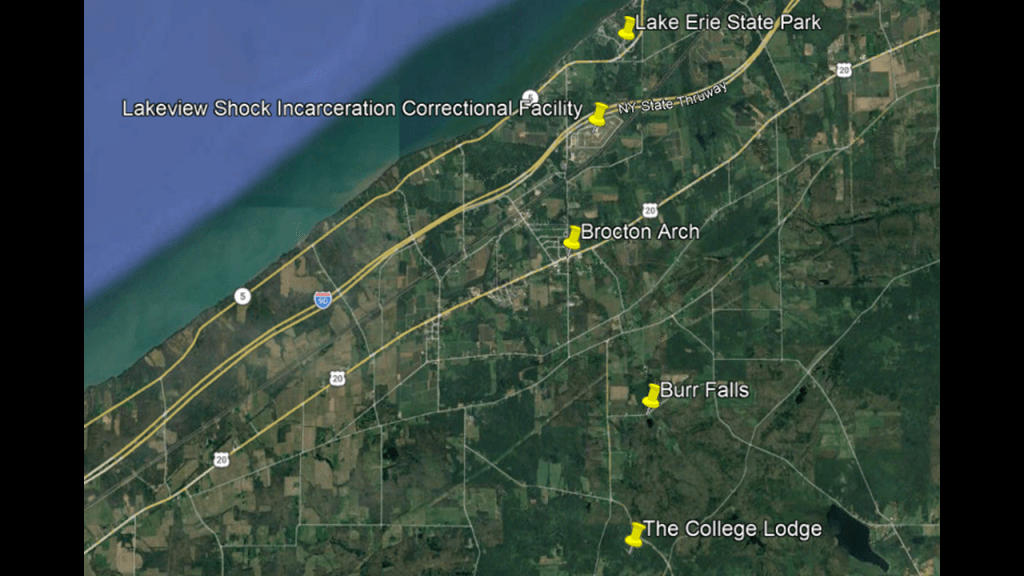
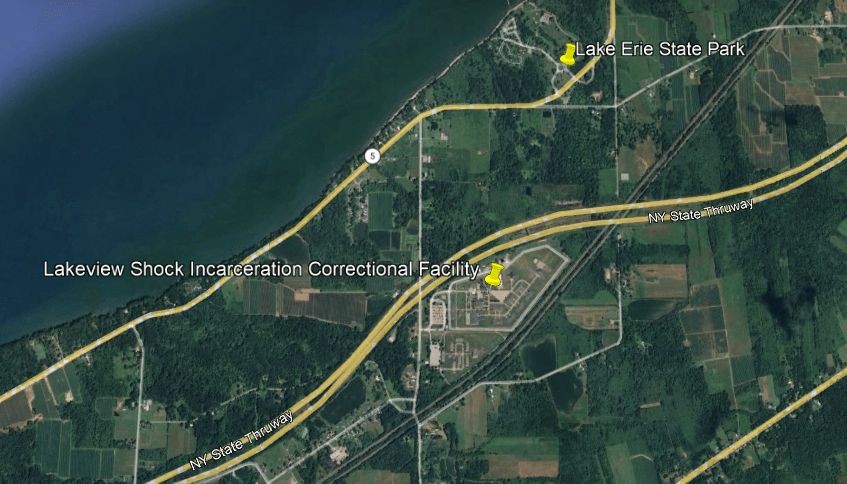
The Lakeview Shock Incarceration Correctional Facility is in-between I-90 and the railroad tracks, not far from Lake Erie State Park.
It is not unusual to find prisons, and homeless shelters for that matter, near railroad tracks, and I believe this is noteworthy because railroads were part of the original energy grid and I don’t believe placement of these types of facilities occur randomly.
The Lakeview Shock Incarceration Correctional Facility is a medium-security prison for non-violent offenders.
It is a six-month program set-up by the State of New York that is structured like a military boot-camp intended to shock an offender into changing poor behavioral patterns.
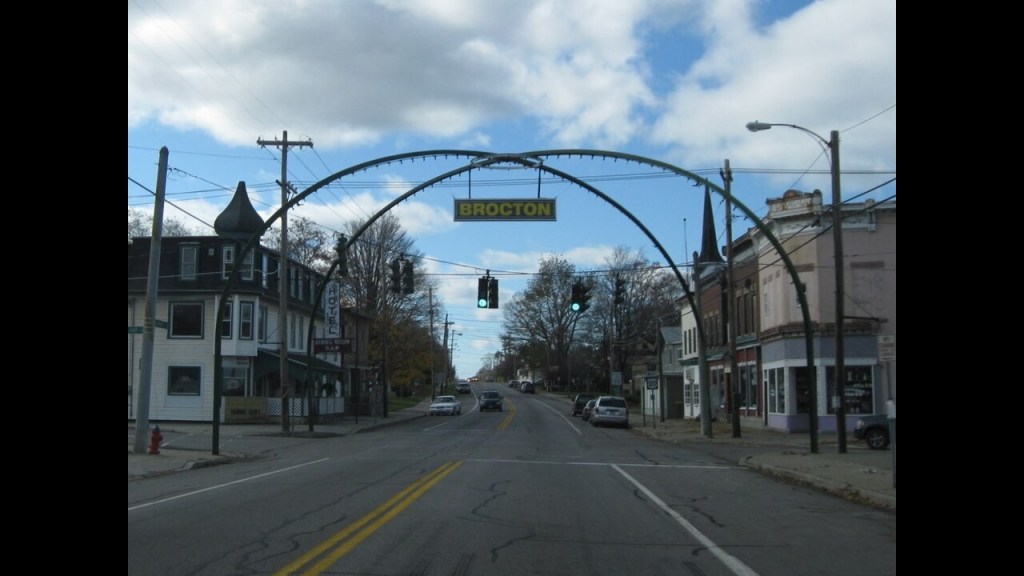
The Brocton Arch is a free-standing steel arch said to have been erected in 1913 to celebrate the centennial of the nearby Town of Portland.
It is a double-span, four-way street arch over US-20, which is also Brocton’s Main Street, and believed to be the only one remaining of its kind in the United States.
It was said to have been constructed high and wide enough to allow the interurban cars on the tracks of the Buffalo and Lake Erie Traction Company to travel beneath it.
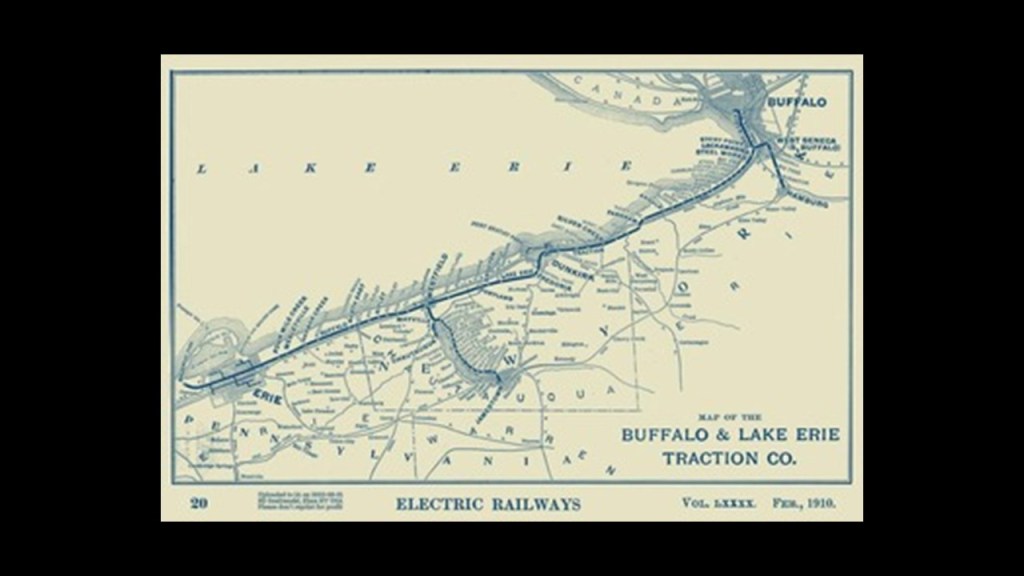
The Buffalo and Lake Erie Traction Company interurban line between Buffalo, New York, and Erie Pennsylvania, was in operation between 1906 and 1924, at which time it was replaced by buses and cars.
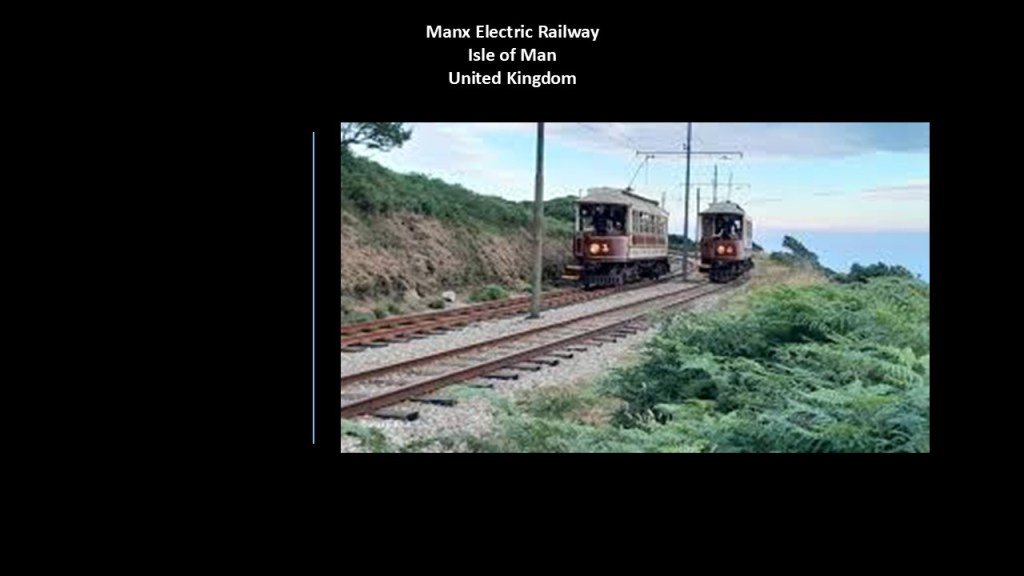
Interurbans functioned as streetcars between cities and were worldwide, and made to go away for the most part a long time ago.
Just a few remain in operation compared to what there once was, like this one on the Isle of Man in the United Kingdom, which is an interurban that connects the island’s capital Douglas with Laxey in the east and Ramsey in the north.
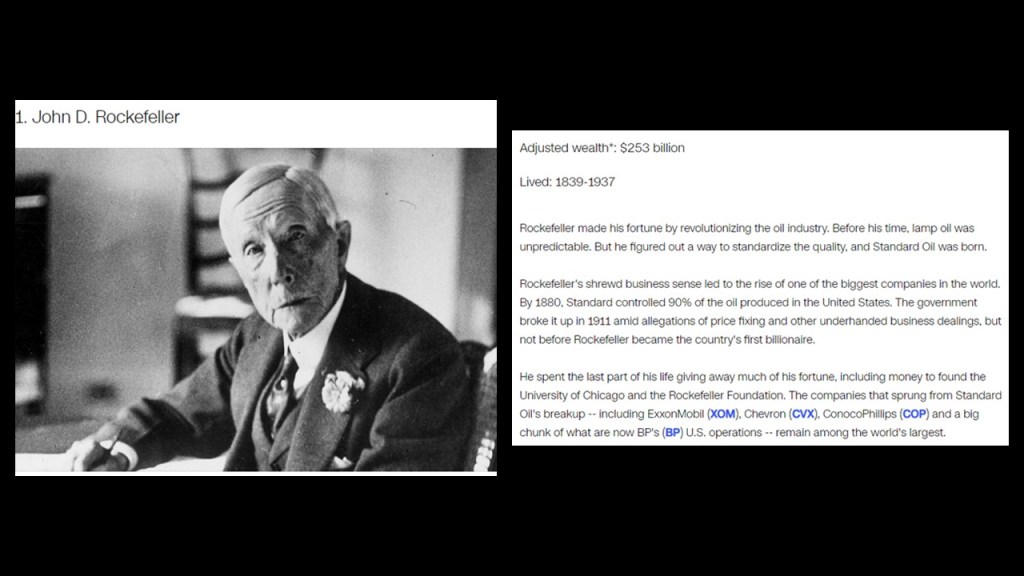
John D. Rockefeller, one of the founders of Standard Oil in 1870, became the wealthiest American of all time, as seen in this #1 ranking by CNN Business, with an adjusted wealth of $253-billion.
Rockefeller’s wealth soared as kerosene and gasoline grew in importance, and at his peak, he controlled 90% of all oil.
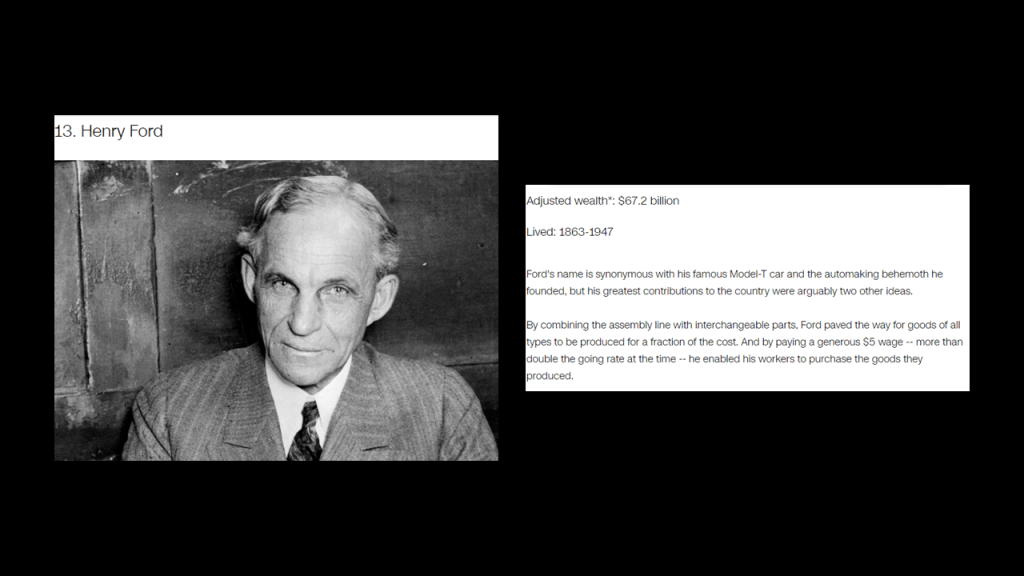
Henry Ford, who introduced and refined the assembly line for the mass production of new cars, was the 13th-wealthiest American of all-time according to CNN Business, with an adjusted wealth of $67.2-billion.
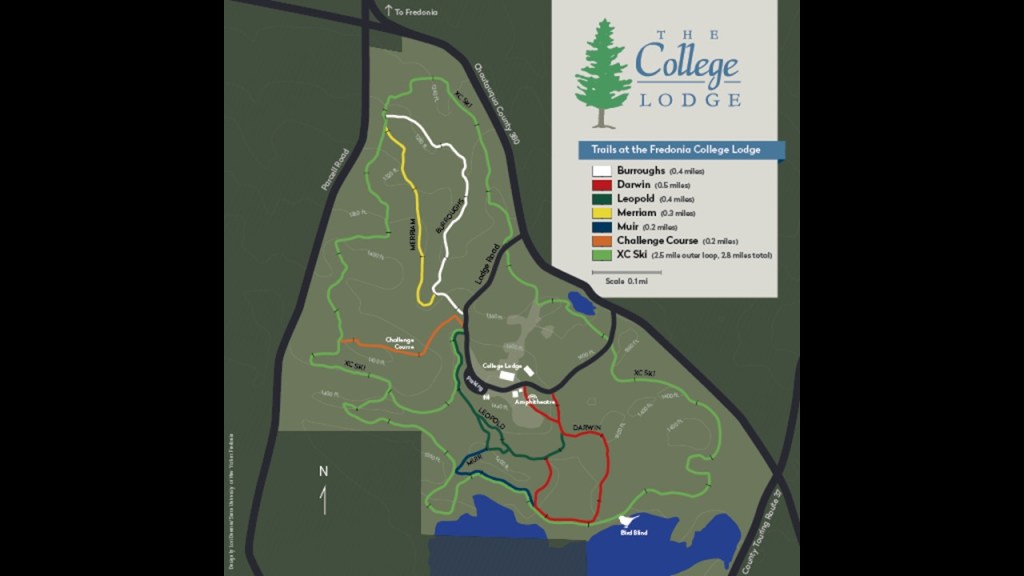
The College Lodge near Burr Falls is a conference and events center in the woods operated by the Faculty Student Association of SUNY Fredonia, with a number of recreational trails.
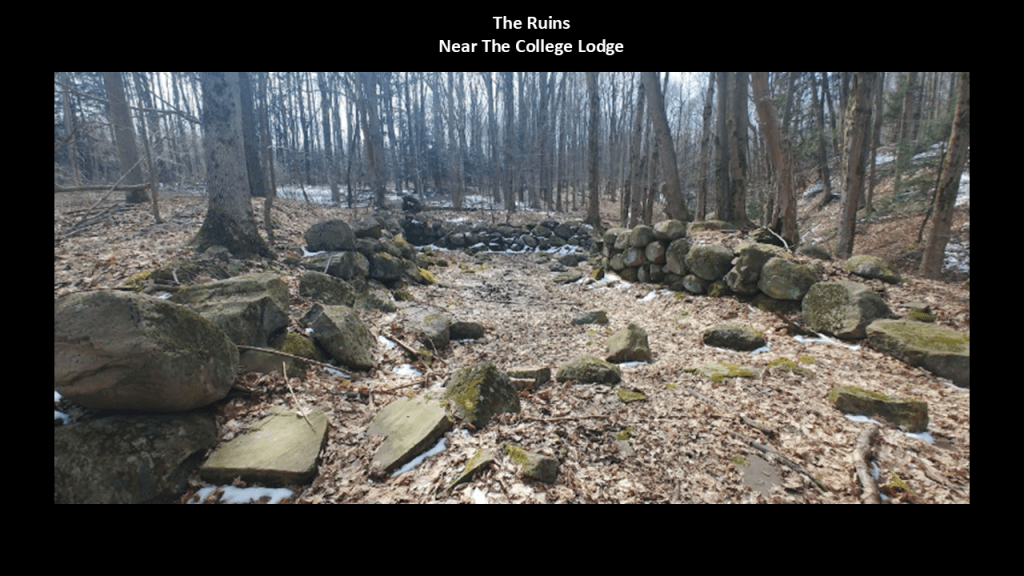
One of the trails you can hike on there leads to a place that is called simply “The Ruins.”
The explanation given about “The Ruins” is that it was once a sawmill from one of the first settlers of the area.
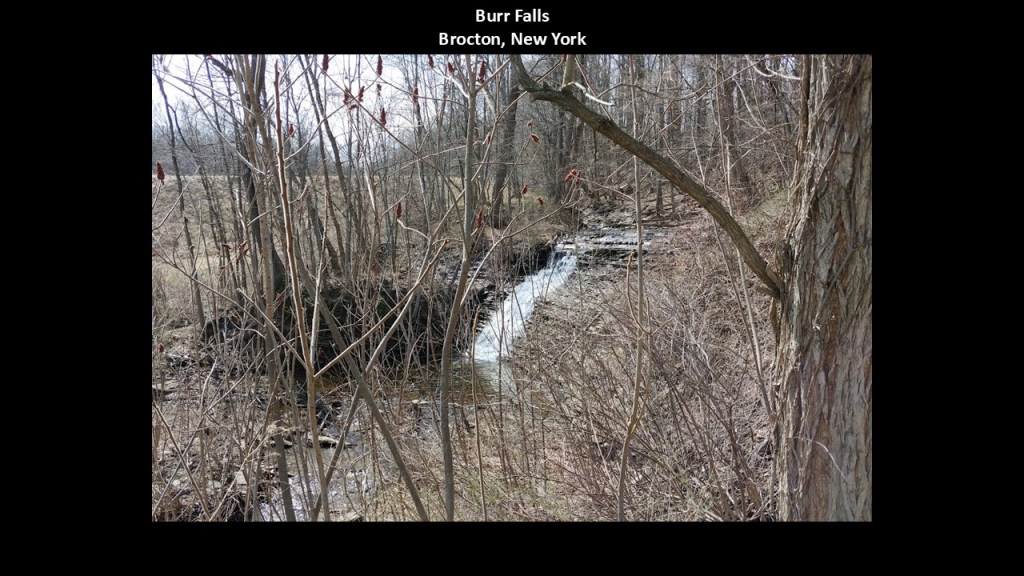
The College Lodge came up because it is a short drive to the Burr Falls, which is hard to find information on.
The community of Lily Dale is a short-distance to the east of these two locations.
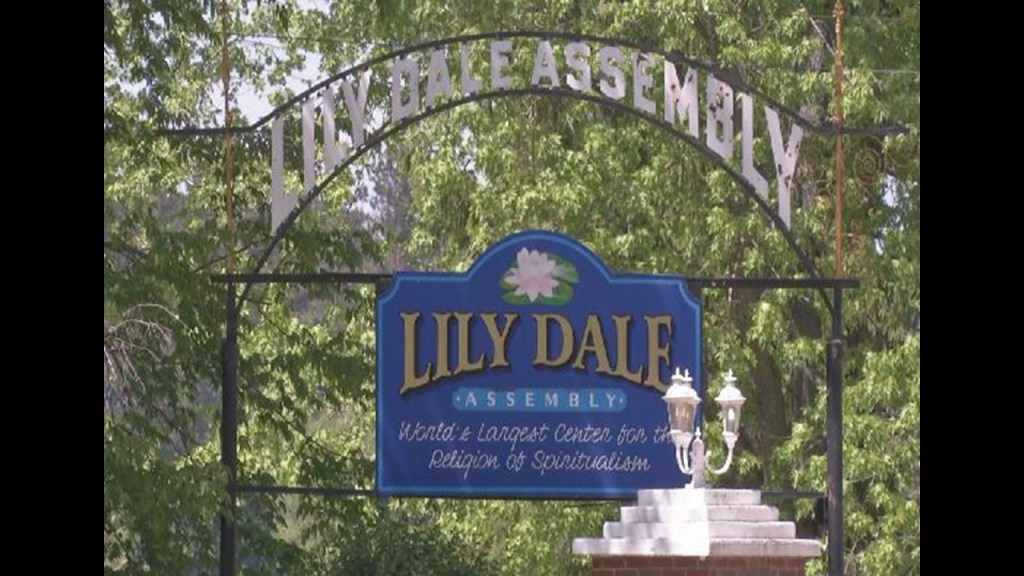
Lily Dale is the world’s largest center for the Spiritualist Movement.
It was founded in 1879 as a summer camp for mediums, healers and lecturers.
It hosts thousands of visitors annually for readings, workshops and medium services.
Shumla Falls and Arkwright Falls are relatively close to each other and both are located a short distance to the northeast of Lily Dale.
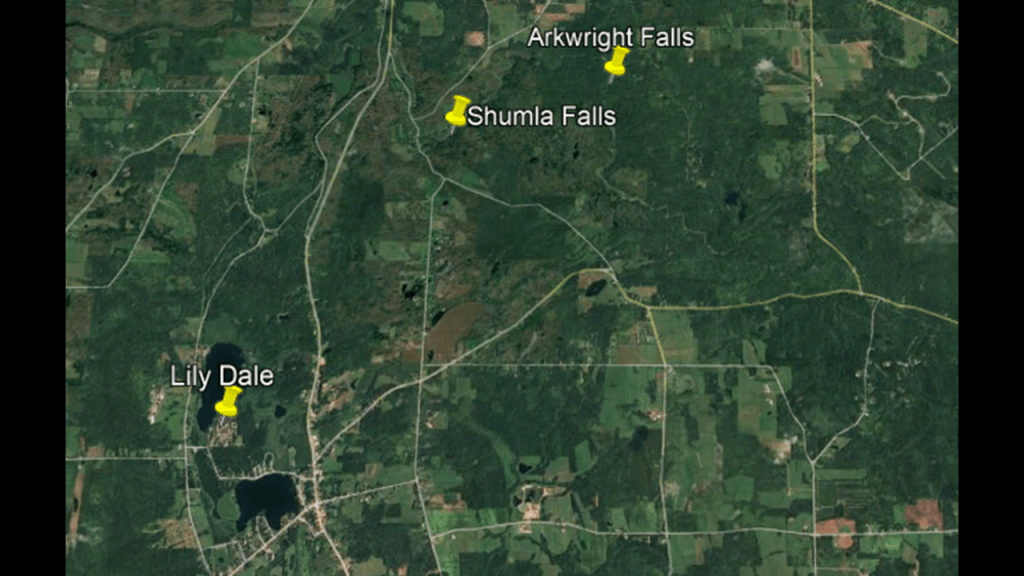
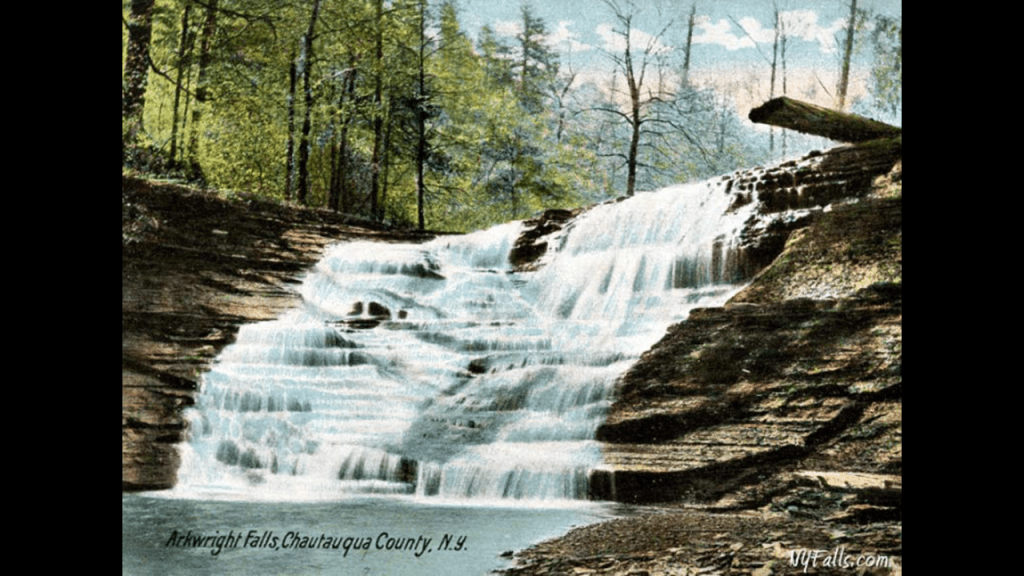
Shumla Falls and Arkwright Falls are at different locations on Canadaway Creek on private property in Chautauqua County.
The area is known for its steep, scenic gorges.
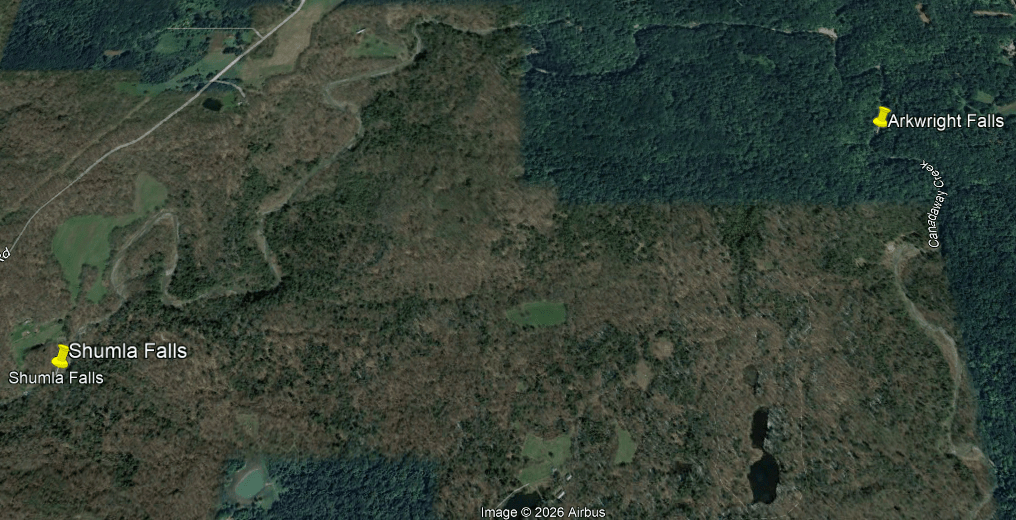
I can only find a photo of Arkwright Falls, and from what I can tell looking for images, there are numerous waterfalls in Chautauqua County.
The same is true of neighboring Cattaraugus County in western New York.
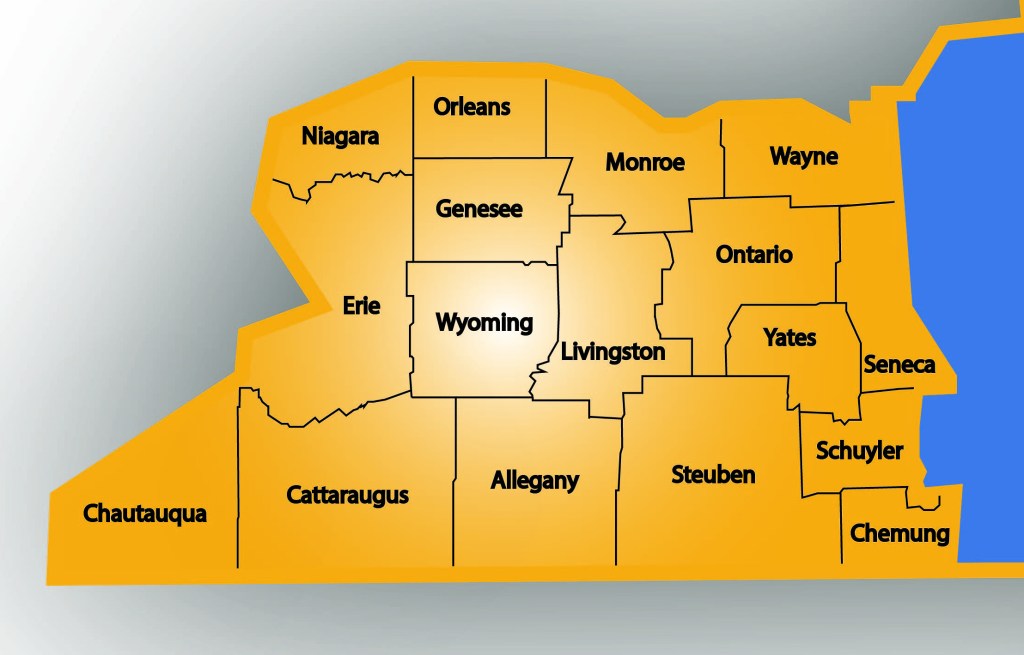
In Cattaraugus County further east, we find places like the Zoar Valley Multiple Use Area with the Gossamer Cascade Waterfall; the Stoney Pitcher Falls; Linda’s Falls; and the Bridal Falls in Allegheny State Park.
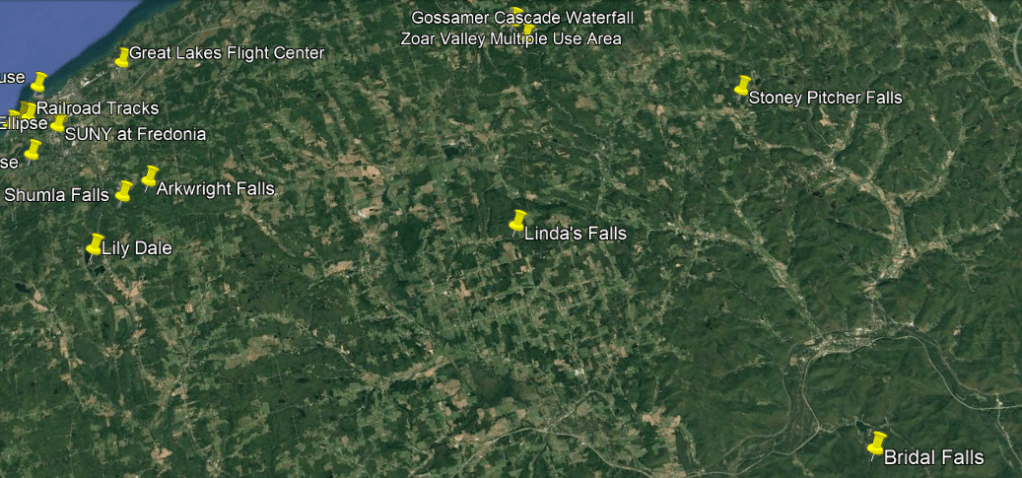
The Zoar Valley is an area of deep gorges along the main and south branches of Cattaraugus Creek in western New York, on the border of Cattaraugus County and Erie County, roughly between the villages of Gowanda to the west and Springville to the east.
The core area at the confluence of these two branches of Cattaraugus Creek is protected as the Zoar Valley Multiple Use Area, a conservation area located in the towns of Otto, Collins and Persia, and open to the public for a variety of recreational purposes.
The Zoar Valley area has over twenty waterfalls, though most are harder to get to than others.
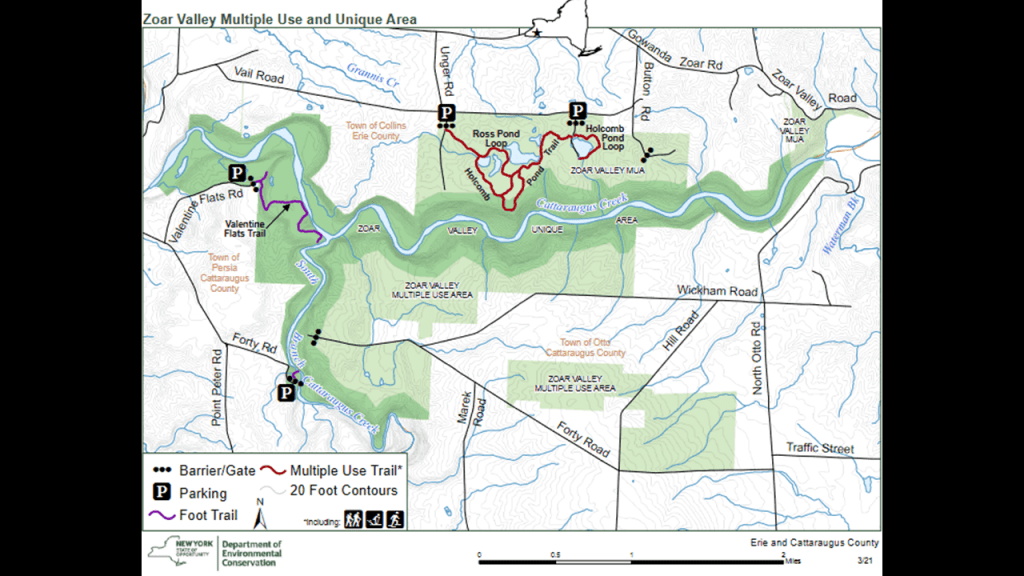
More accessible ones include the Gossamer Cascade that I have already mentioned, which is 130-feet, or 40-meters, – high…
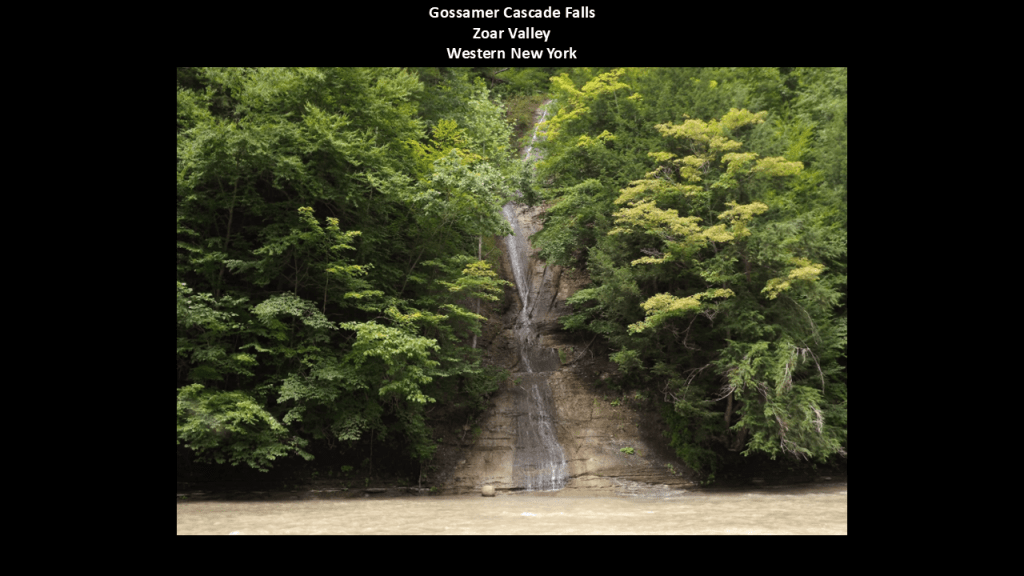
…and the Buff Cascade Falls, at 120-feet, or 61-meters, – high.
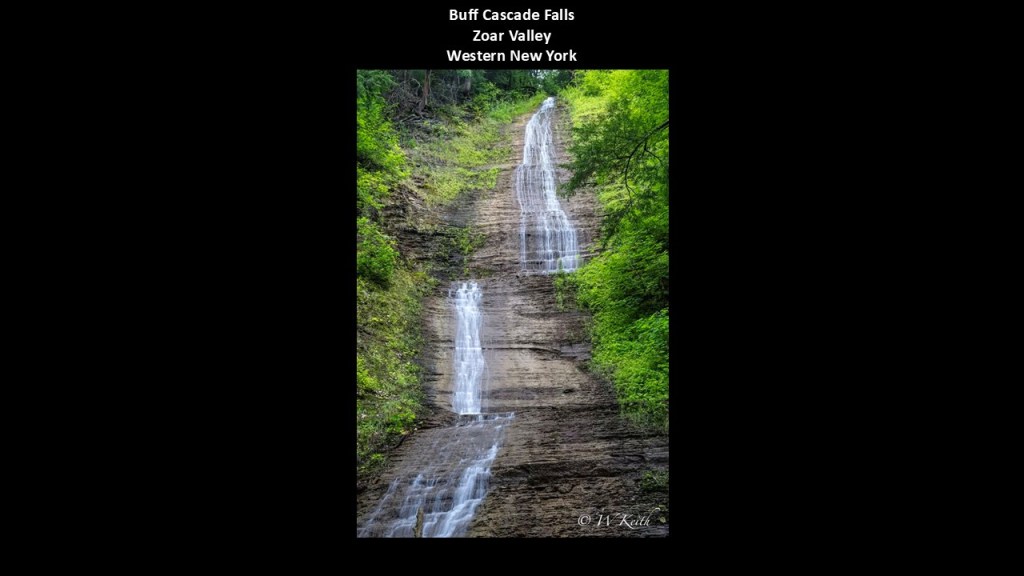
Canyon depths along the Cattaraugus Creek range up to 380-feet, or 120-meters, on the South Branch, and up to 480-feet, or 150-meters on the Main Branch, with several nearly vertical rock faces.
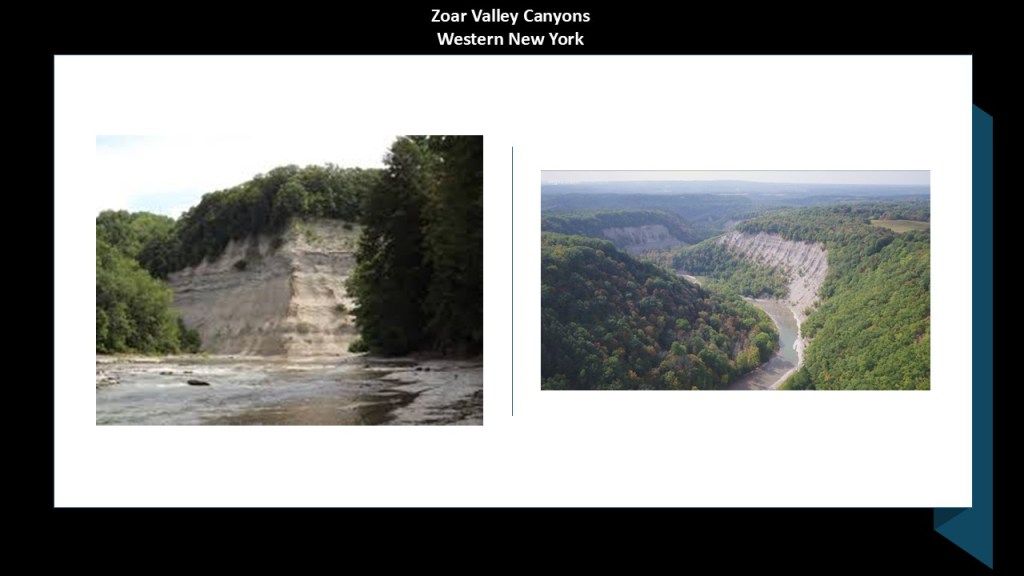
The Zoar Valley Unique Area hosts the tallest forest in the northeastern United States, which are said to be remnants of the region’s old-growth forests, and was designated as a unique area for protection from logging and development.
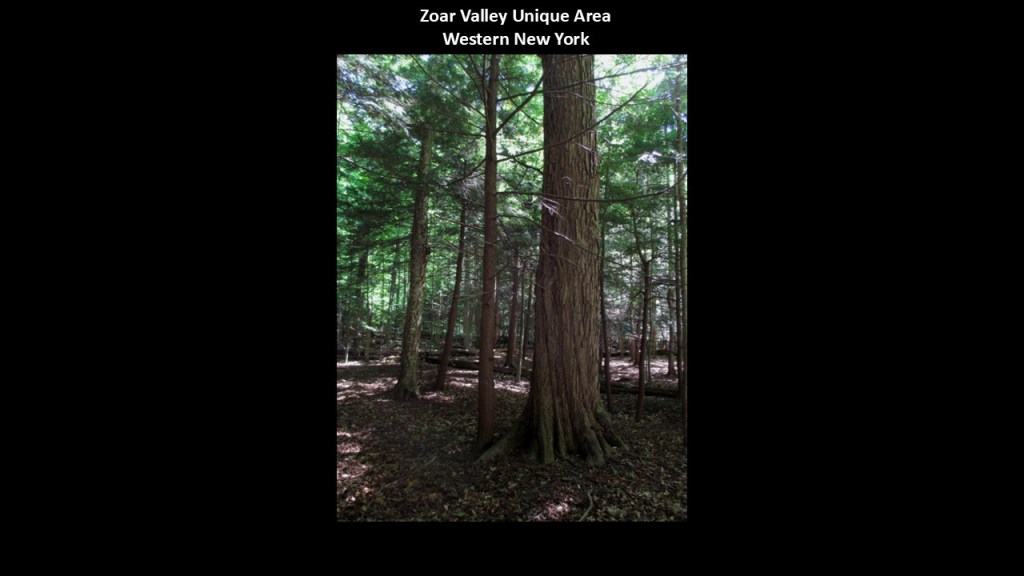
I looked to see what I could find out about a railroad history on Cattaraugus Creek, and these are the kinds of things I was able to find.
Like the Buffalo and Jamestown Railroad.
First incorporated in 1872, it spanned roughly 75-miles, or 121-kilometers, from Buffalo to Jamestown, passing through communities like Hamburg, Eden and Gowanda, and became the Buffalo and Southwestern Railroad in 1877.
The line peaked in the 1920s with daily passenger and freight trains, but passenger service ended in 1952.
After various mergers, the freight service ended for all intents and purposes around 1976.
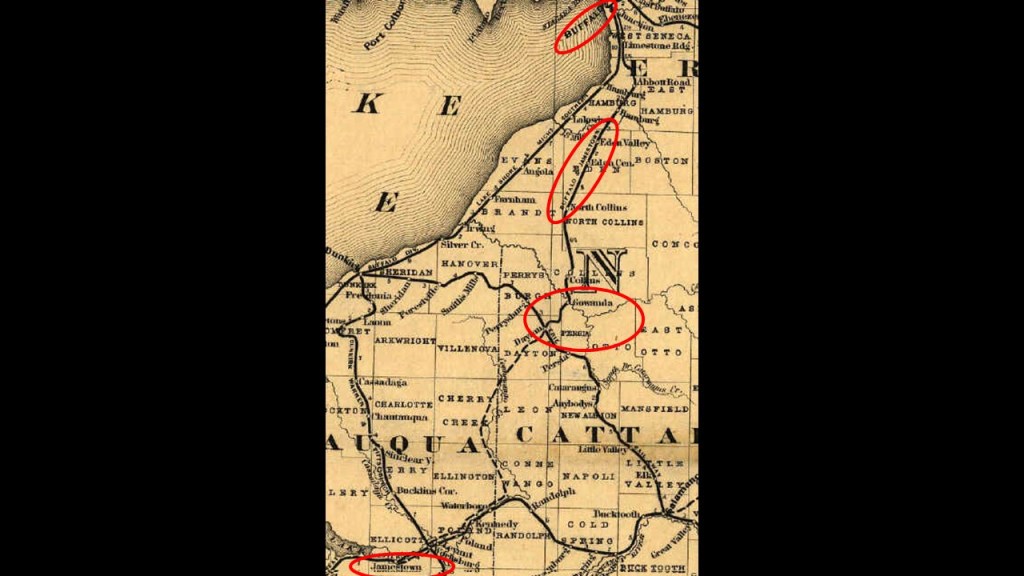
All that remains today of it is the short-line Buffalo Southern Railroad for freight…
…and the Buffalo, Cattaraugus and Jamestown Scenic Railway based in Hamburg for tourist excursions and has a museum.
This bridge over Cattaraugus Creek on one-side of the Zoar Valley Multiple Use Area at Gowanda was said to have been built for it during the 1870s.
This historical structure has been replaced with another bridge.
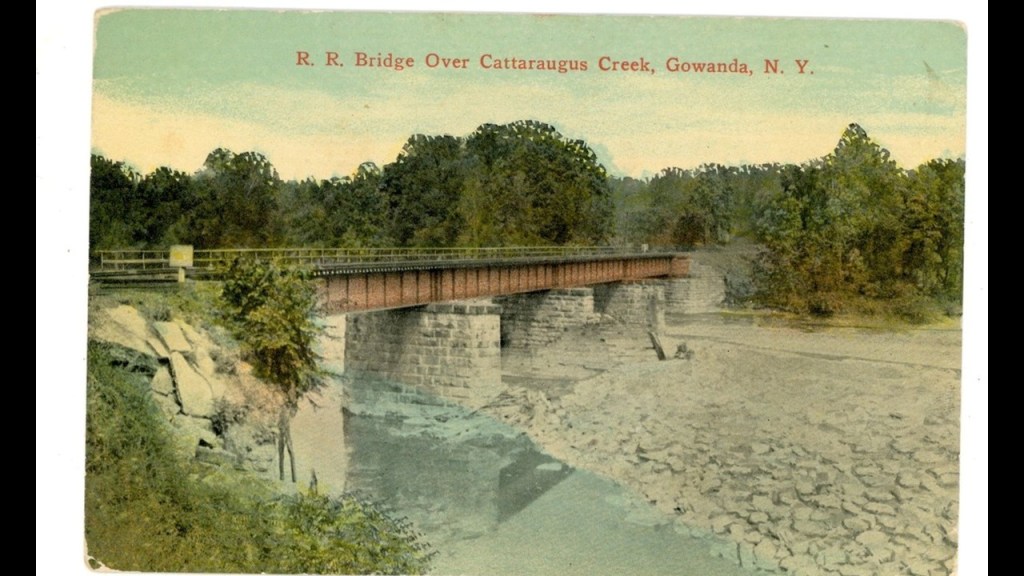
At Springville, on the other side of the Zoar Valley Multiple Use Area, there was a railroad trestle crossing Cattaraugus Creek.
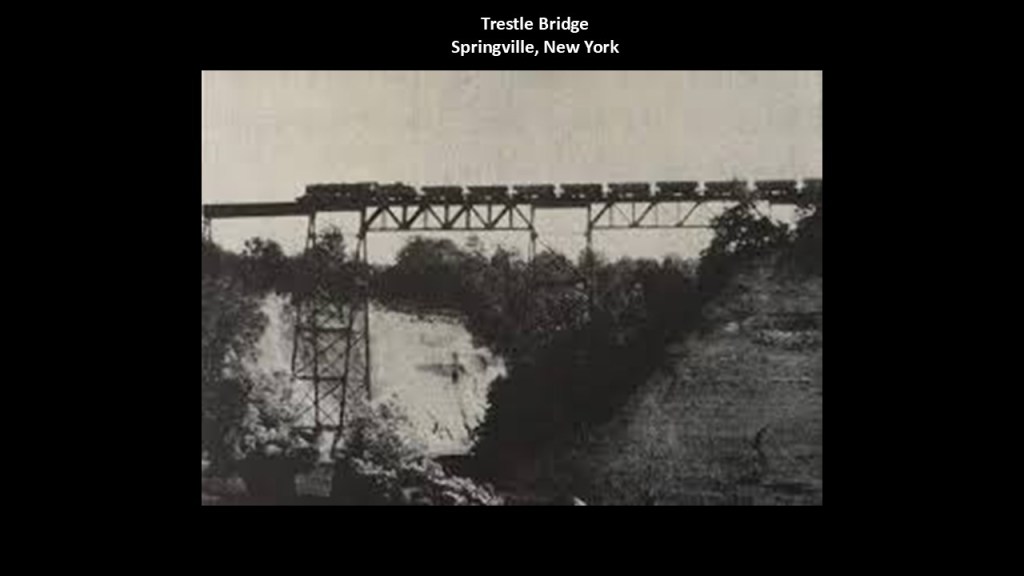
The historic railroad trestle still stands as the Cascade Bridge, and is currently part of the Erie Cattaraugus Rail-Trail Project, which aims to make it a key feature of a regional rail-trail network.
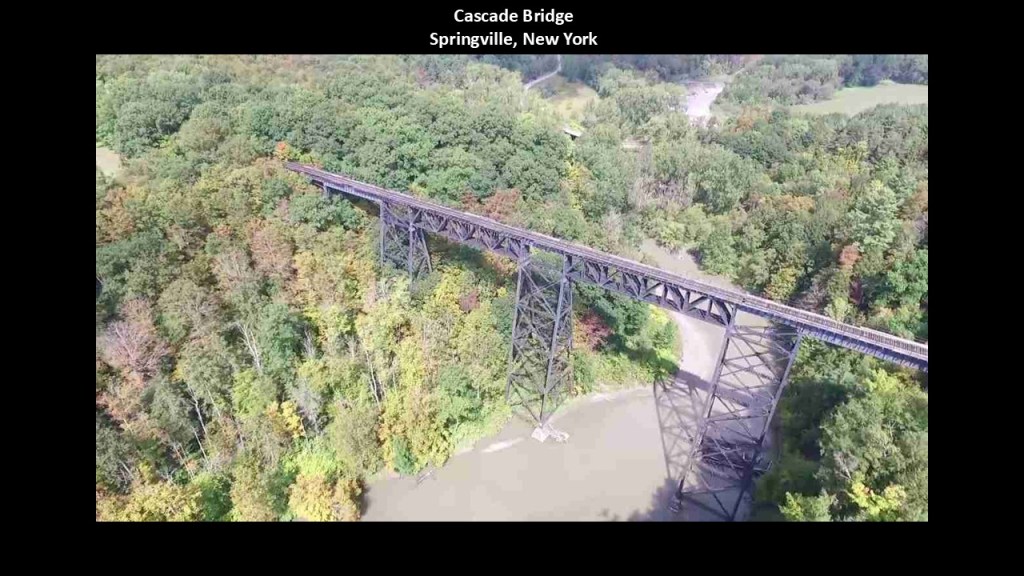
The Erie Cattaraugus Rail-Trail Project is over 27-miles, or 43-miles, of railroad right-of-way connecting Orchard Park, Aurora, West Falls, Colden, East Concord, Springville, and West Valley.
I am sure there is more railroad history to find, and it takes a lot of digging to find it.
But this gives you the idea that there was a connection between these creeks, railroads, gorges, and waterfalls, and that a once-extensive railroad network has been removed and its history obscured and hard-to-find.
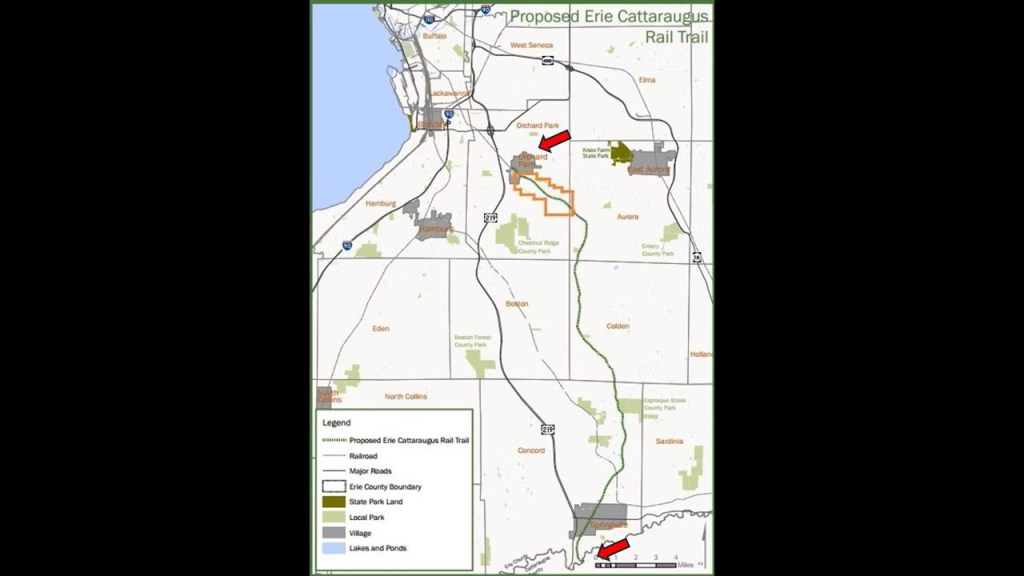
Next, the Stoney Pitcher Falls are in Mansfield, New York, but I can’t find out much about them except that they are on the map.
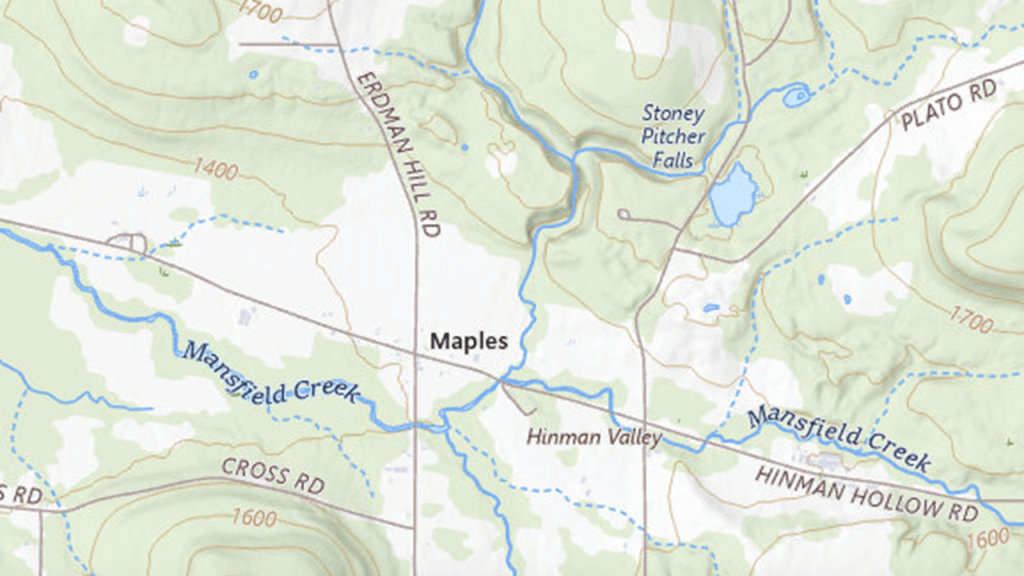
I did, however, find some interesting things nearby, in particular Rock City State Park and US-219.
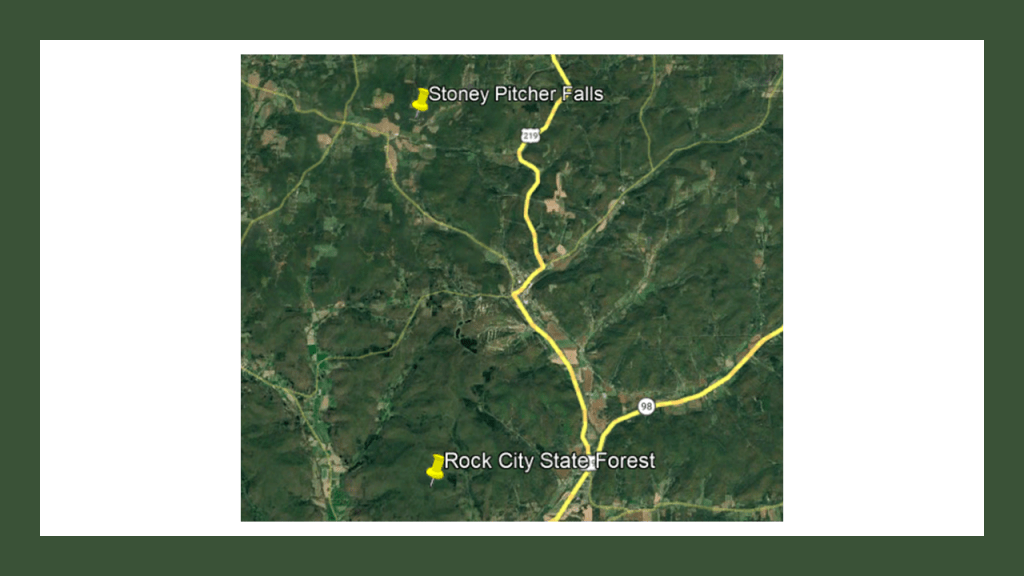
Rock City State Park is noteworthy because it is named for its “Little Rock City” rock formations.
Here huge rock formations form passages that look like a city of rocks, with massive conglomerate formations that look like houses and others creating narrow streets and corridors.
The reason given for its existence is that over thousands of years, erosion and soil movement created the giant blocks and maze-like passageways.
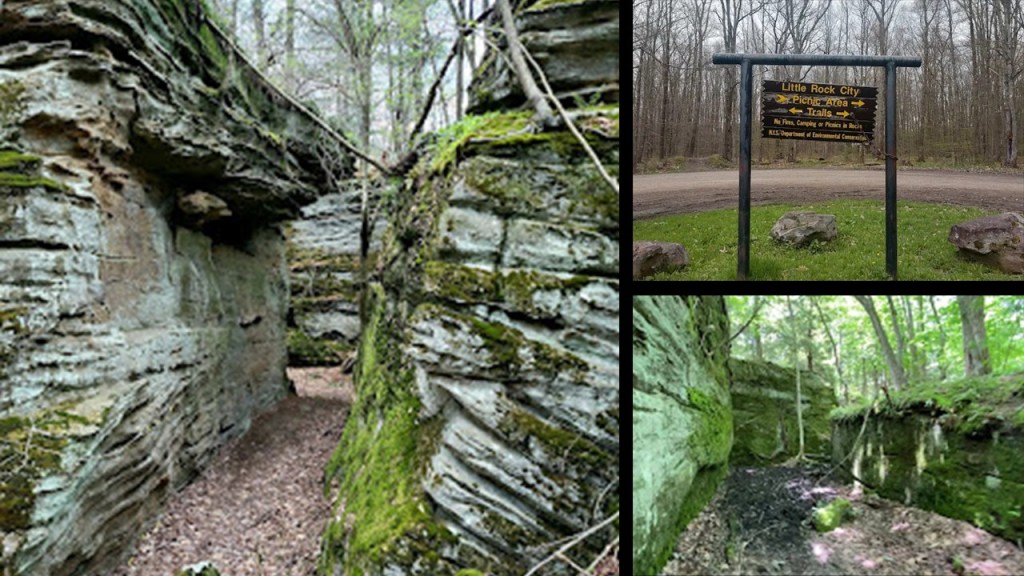
These rock cities in state parks figured prominently in the research I did a couple of years back for “On the Trail of Giants in Appalachia and Beyond,” and US-219 figured prominently in this same post.
So I am going to feature a rock city in Beartown State Park on US-219 in West Virginia, but there are many, many examples to choose from of exactly the same thing found in state parks across the region and the country.
The rock formations at Beartown State Park in West Virginia are described as having “unusual rocky formations, massive boulders, overhanging cliffs, and deep crevices,” with the deep crevices having a regular criss-crossed pattern making them appear like the streets of a town.
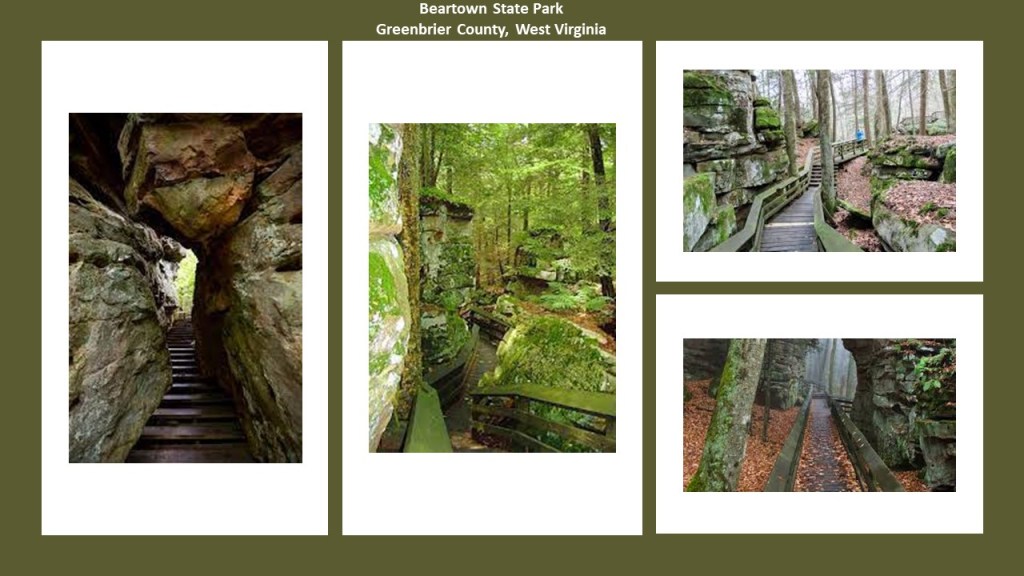
US Route 219 is a spur of US Route 19.
It is 535-miles, or 861-kilometers, -long, and runs from West Seneca, New York, at the eastern end of Lake Erie south of Buffalo, and ends at Bluefield, Virginia, right across the state border from Bluefield, West Virginia
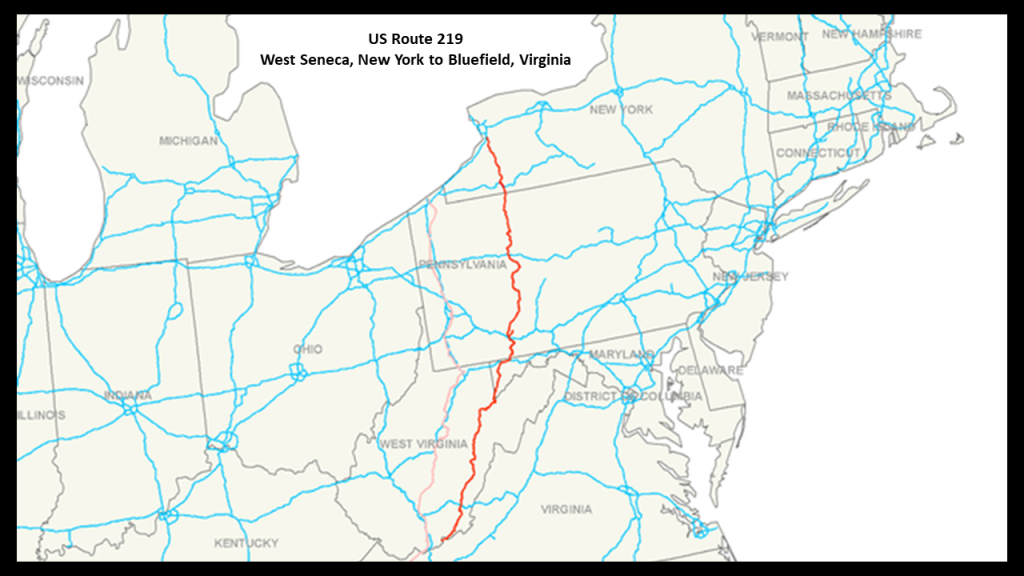
As mentioned, these two highways meet at Bluefield in Virginia, of which there is one city on either side of the West Virginia/Virginia border with that name.
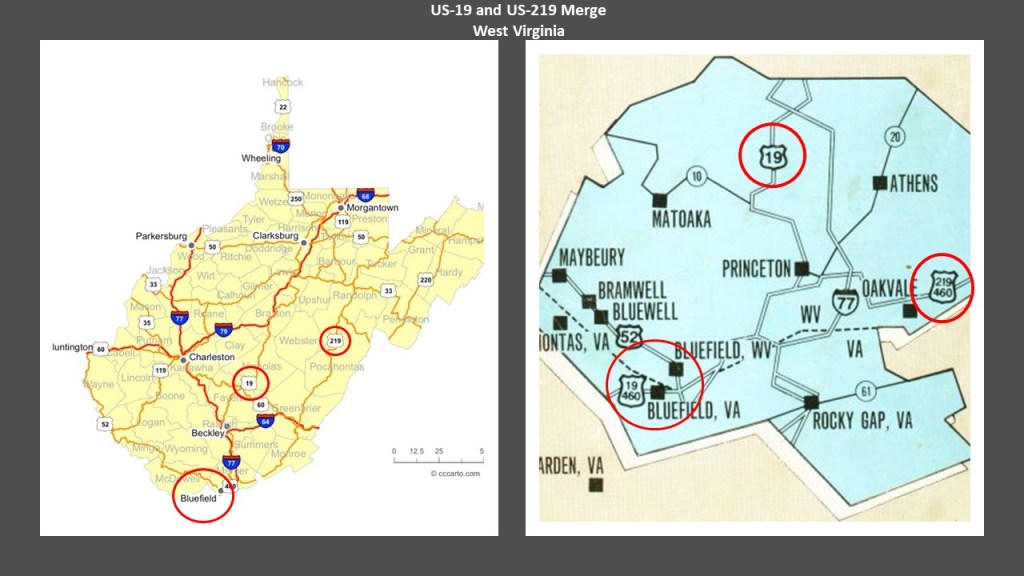
The land beneath the two Bluefields contains the richest deposit of bituminous coal in the world, known as the “Pocahontas Coalfield,” or the “Flat-Top Pocahontas Coalfield,” named after the Flat Top Mountain on US-19 in West Virginia, and Pocahontas, Virginia, where the first coal-seam here was discovered.
The Pocahontas Coalfield started to be mined in 1882.
Bituminous coal is a middle ranking coal that has less carbon than the highly-ranked anthracite coal from Pennsylvania seen earlier, but still widely used for industrial purposes.

In West Virginia, US-219 is said to follow what was known as the “Seneca Trail,” a network of trails of “unknown age” used by indigenous Americans for commerce, trading and communication.
The “Seneca Trail” ran through the Appalachian Valley from what was to become Upper New York State, and went well into Alabama, though they are described to us in our historical narrative strictly as “footpaths.”
What we are told is that by the time the land was settled by Europeans starting in the 18th-century, it was largely abandoned by its previous inhabitants.
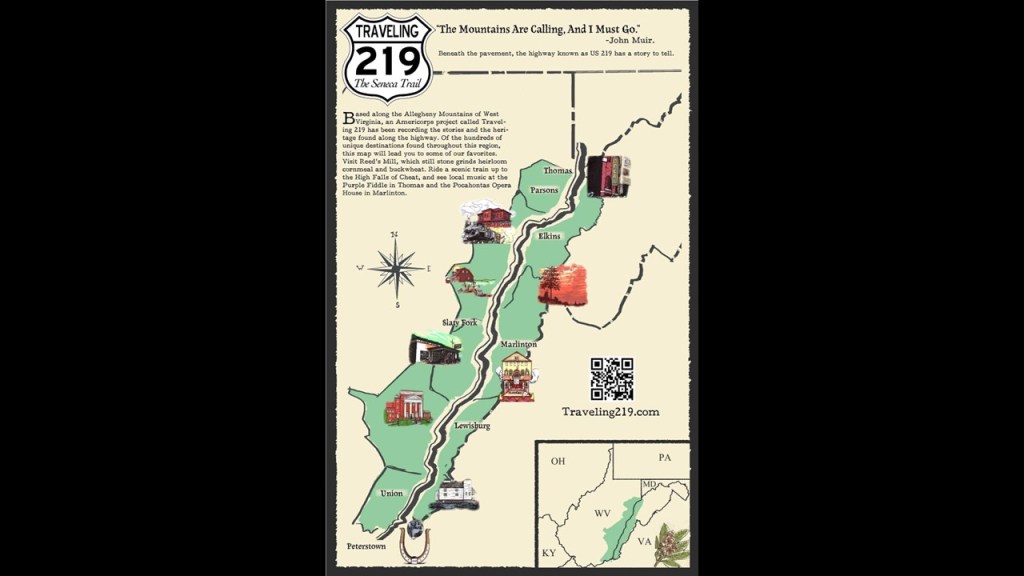
US-219 is a highway corridor that links places like the bogs of Black Moshannon State Park in Pennsylvania near Penn State University and State College and the bogs of Cranberry Glades in West Virginia, near White Sulphur Springs and the Greenbrier Resort.
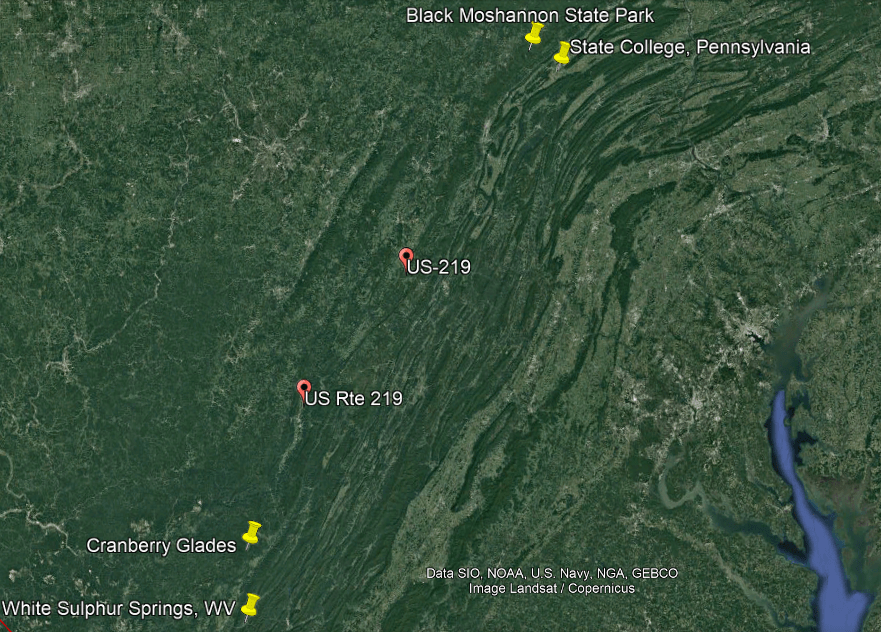
Both of these boggy lands are located in close proximity to former railroad infrastructure, with the Snowshoe Rail-to-Trails at Moshannon Creek , and the Greenbrier Rail-to-Trails running along US-219 and the Greenbrier River near Cranberry Glades.
Like I have been saying, I believe the destruction of the original energy grid destroyed the land around key infrastructure, causing swamps and bogs, deserts and dunes, or causing landmass to shear off and/or become submerged.
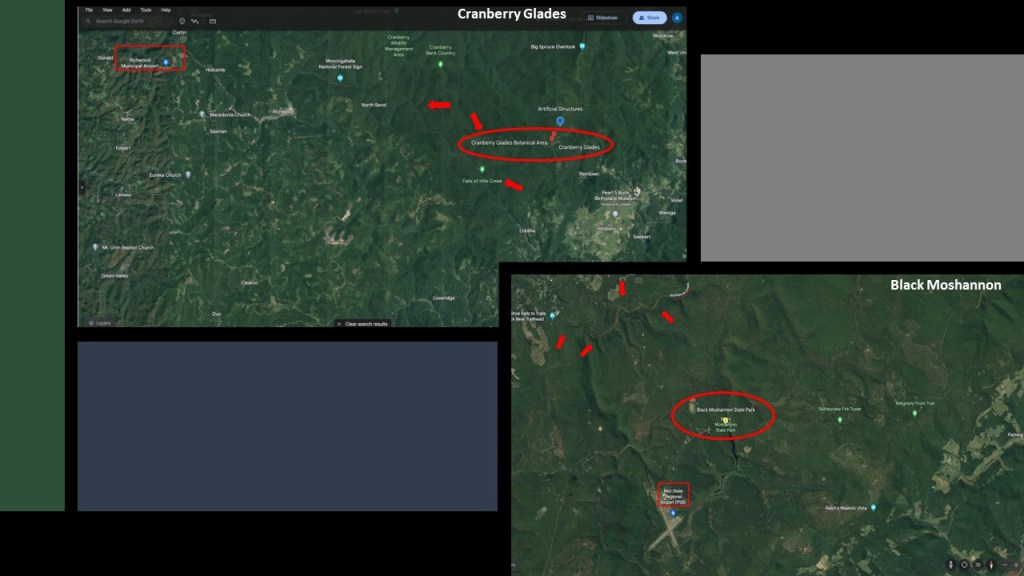
The Greenbrier Resort in White Sulphur Springs, West Virginia, was at one time a Presidential getaway, with President Eisenhower the last President in office to have stayed there, with 27 presidents having stayed at the hotel before him.
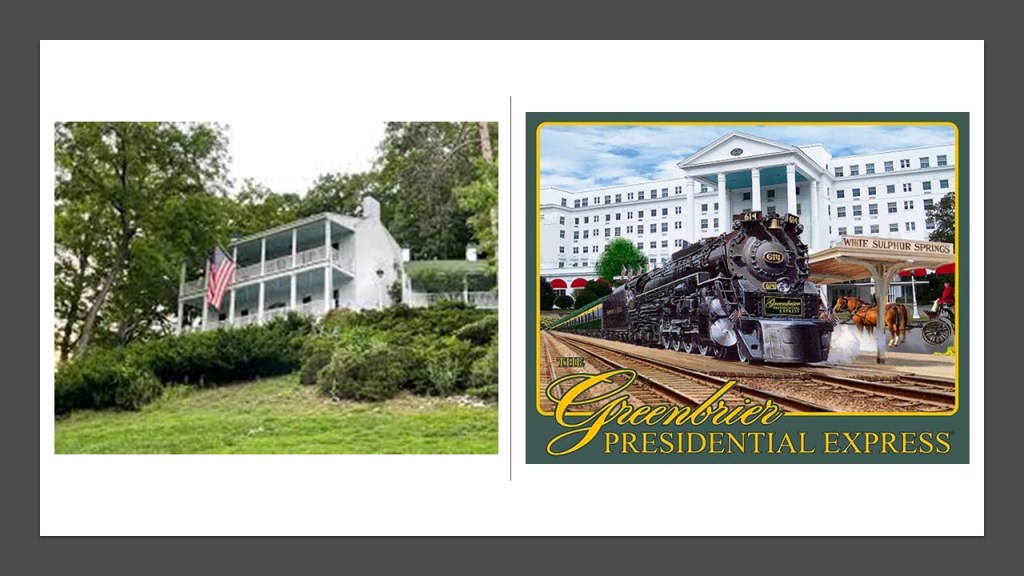
A top-secret, super-sized underground bunker was said to have been constructed there in the 1950s during the Eisenhower Administration to serve as a relocation point for the U. S. Congress in the event of a nuclear war, but when the secret came out in 1992 in a newspaper article, it was decommissioned.
It was kept stocked with supplies for thirty-years but never used as an emergency location.
In 1995, the government ended the lease agreement with the Greenbrier, and it was opened to the public for tours, which it offers to this day.

Salamanca in Cattaraugus County in New York, near Rock City State Park and on US-219, is within the Allegany Indian Reservation, one of two governed by the Seneca Nation of Indians New York, a federally-recognized tribe in western New York.
Almost the entire city of Salamanca is on Seneca Nation land.
The other is the Cattaraugus Reservation which stretches inward from Lake Erie along Cattaraugus Creek.
There is a third, the Oil Springs Reservation, but it is mostly unpopulated.
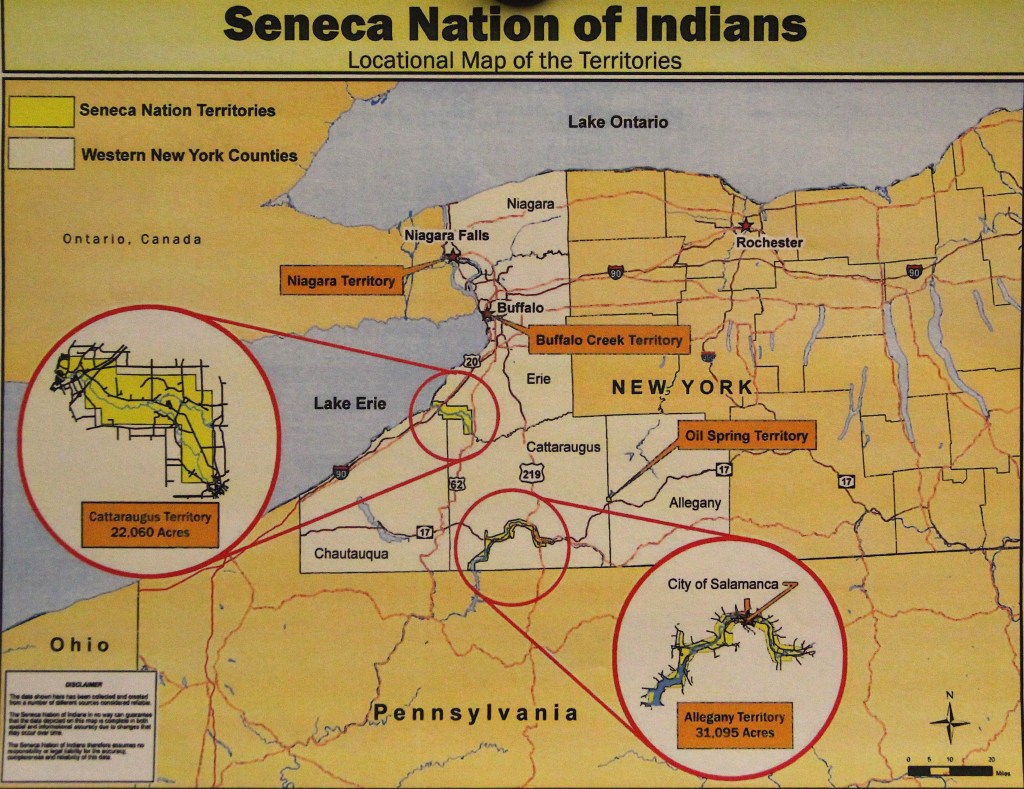
In our historical narrative, the Seneca were the “Keeper of the Western Door” of the Iroquois Confederacy, also known as the Haudenosaunee.
The Seneca were among the first five nations of the Iroquois Confederacy, along with the Mohawk, Oneida, Onondaga, and Cayuga.
The Haudenosaunee are a Confederacy bound by the Great Law of Peace, a constitution that established a representative government and is still in use today.
The Tuscarora were accepted into the Confederacy in 1722, and became known as the “Six Nations.”
In the 21st-century, more than 10,000 Seneca have three federally-recognized tribes, which are the Seneca Nation of New York and the the Tonawanda Seneca Nation in New York, and the Seneca-Cayuga Nation in Oklahoma, where their ancestors were relocated from Ohio during the Indian Removals in our historical narrative in the period of time between 1830 and 1847.
Federally-recognized tribes have a government-to-government relationship with the United States government, including tribal sovereignty and eligibility for federal benefits.
Salamanca was an historic railroad town that was a major hub for the Erie Railroad; the Buffalo, Rochester & Pittsburgh Railway (BR & P); and the Pennsylvania Railroad facilitating passenger and freight service in the late 19th- and early 20th-centuries.
There were two roundhouses here at one time that are long-gone – one for the Erie Railroad and one for the BR & P Railway.
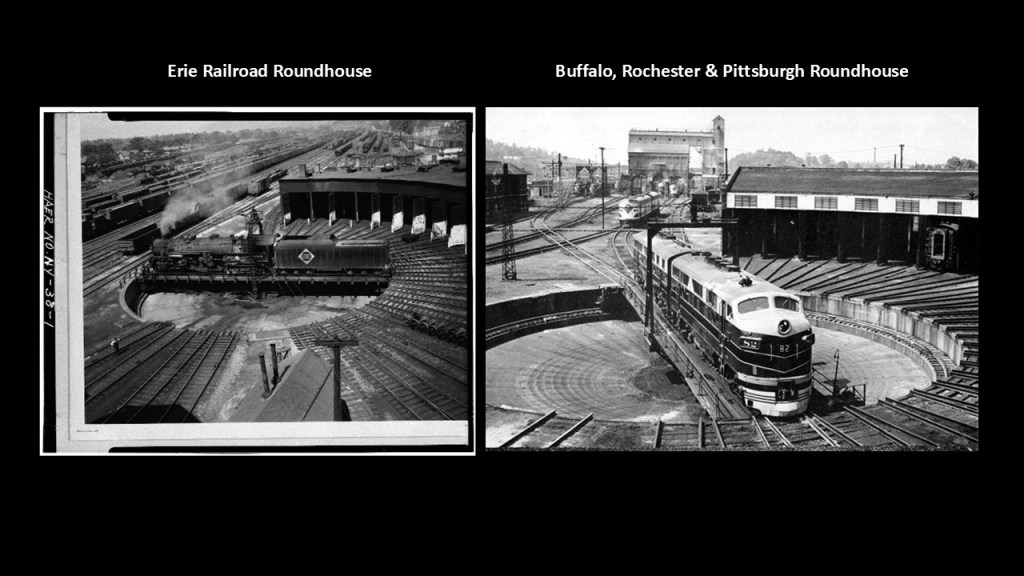
This Salamanca Station was said to have been built in 1851 by the Erie Railroad.
Train service at the station stopped on January 6th of 1970.
It was abandoned and had several fires over the years, and burned down completely in 2014.
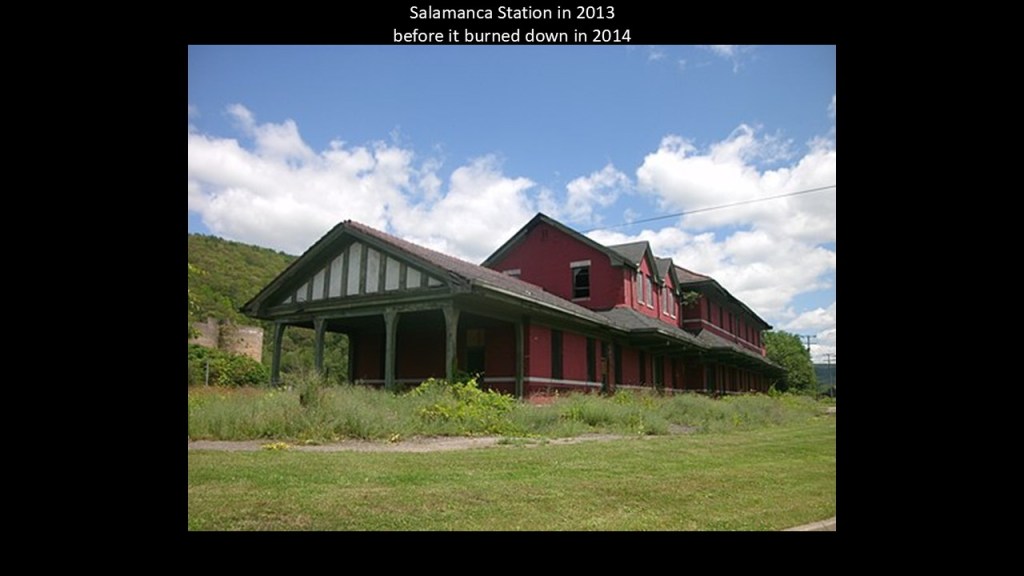
The BR & P Railway Station across the street from the burned-down train station was a railroad museum until it closed last year and is looking for a new home.
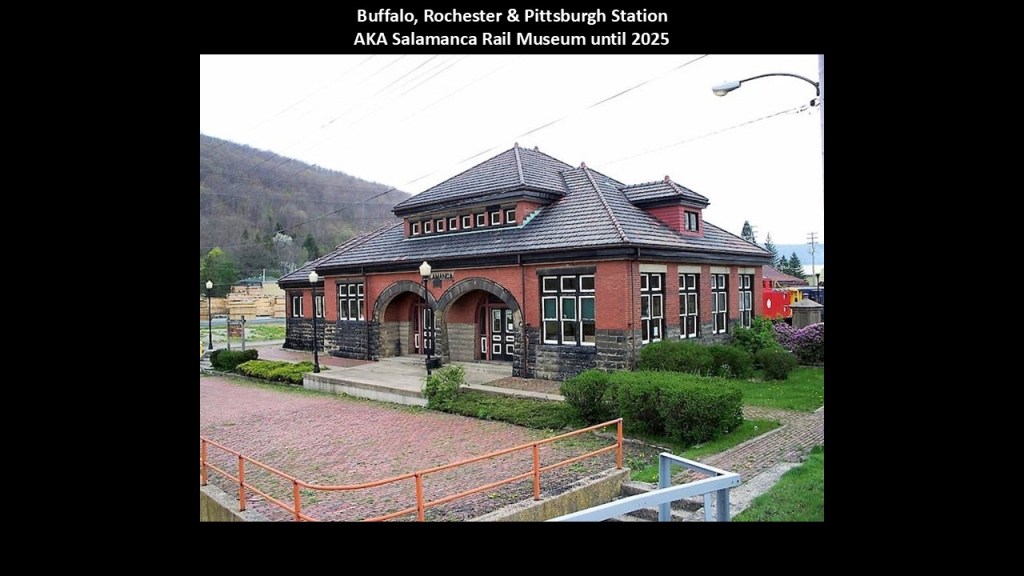
Salamanca is adjacent to Allegany State Park, where the Bridal Falls are located.
Allegany State Park itself is New York’s largest state park, with over 65,000-acres of forests, mountains and lakes.
The park is divided into two sections – the Red House Area and the Quaker Lake Area.
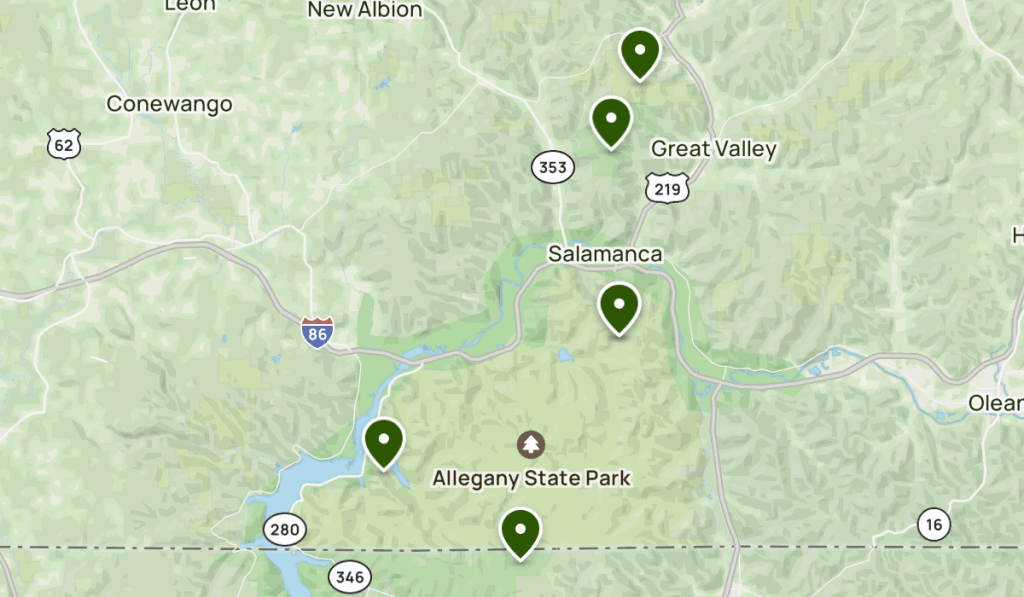
The Red House Area is in the northeastern half of the park, and attractions include the Bridal Falls; and the Stone Tower.
Bridal Falls is located south of Red House Lake, and is easily accessible by road and hiking trail.
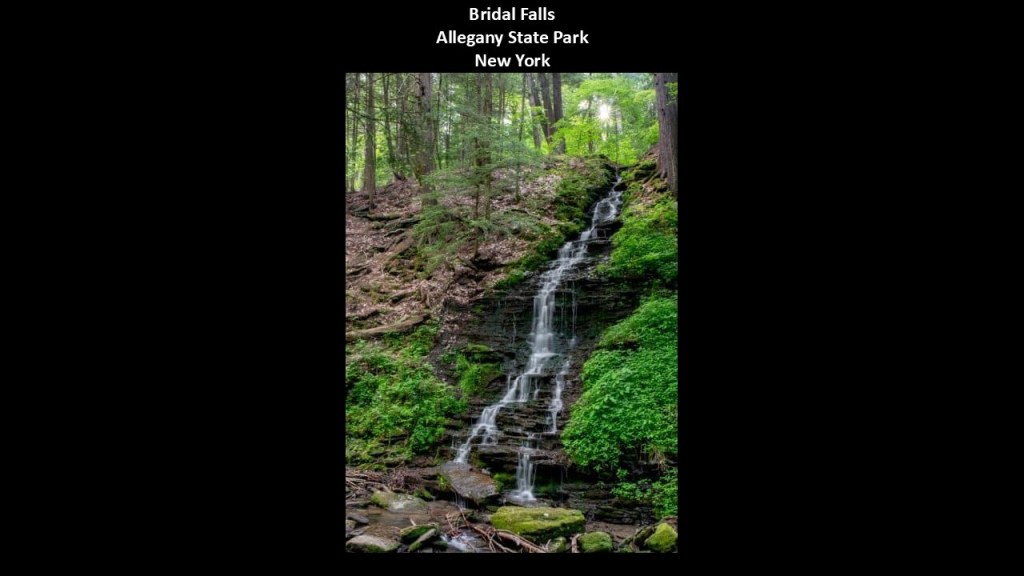
We are told the Stone Tower was constructed as an observation tower in 1934 offering panoramic views of the surrounding area, and is also one of the prime locations for star-gazing in the park.
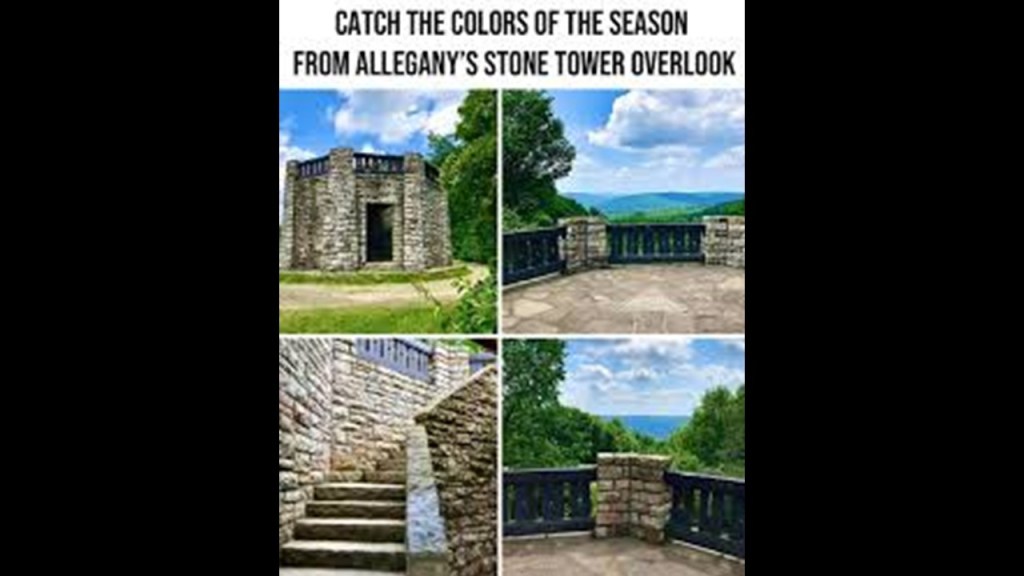
There were several historic rail-lines operating through what is now Allegany State Park from the 1880s to the early 20th-century before the park was established in 1921.
Like the Allegheny & Kinzua (A & K) Railroad that operated between 1889 and 1898 in Pennsylvania and New York, specifically within areas that became Allegany State Park.
It was a logging railroad to move vast quantities of timber to meet high-demand before the land was repurposed.
Remains of the track and a stone culvert can still be found near the Blacksnake Mountain Trail in Allegany State Park.
Linda’s Falls is to the northwest of the Salamanca-area that I have been looking at in this part of Cattaraugus County.
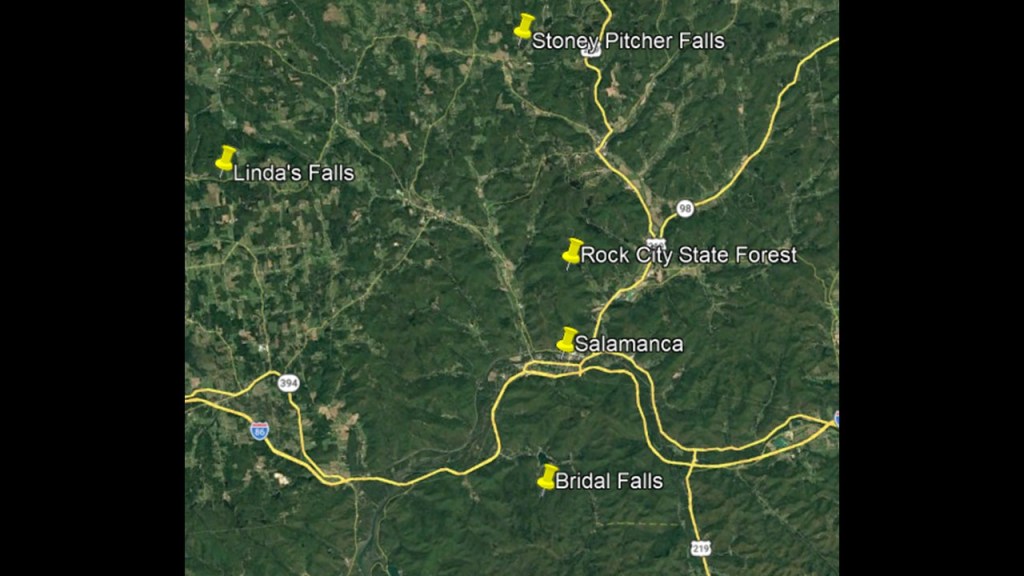
Linda’s Falls are just off of County High 6 in Cattaraugus, New York.
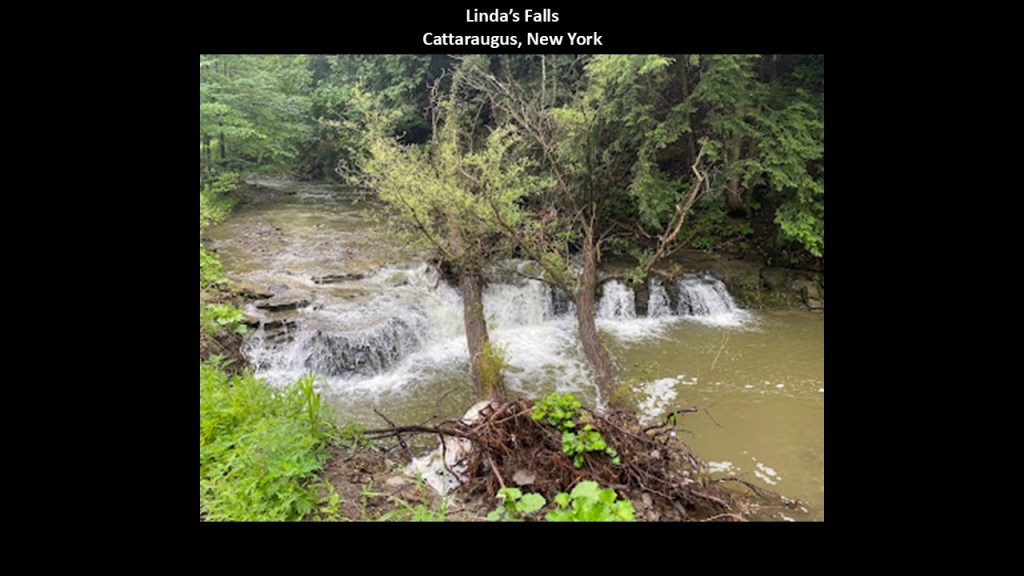
They are a short distance from the ShineOn Valley, a 75-acre campground on the Amish Trail in Leon, New York,
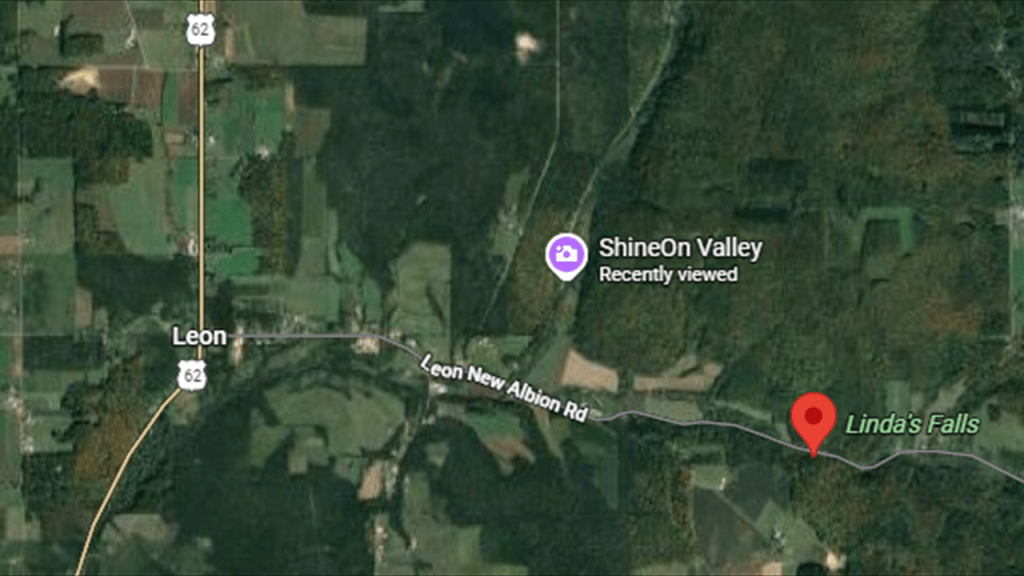
Leon is the largest Old Order Amish community in the United States, where the Amish live without things like electricity, phones, and cars, instead travelling by horse-drawn buggies and known for their quilts, furniture, and self-reliant, farm-based lifestyle.
Next, I am going to take a look at the next section of the shore of Lake Erie just south of Dunkirk and Fredonia, and take a look at the Barcelona Lighthouse and Barcelona Harbor Beach; the Glen Mills Falls; Fitch’s Falls; the Chautauqua Gorge State Forest, and on Lake Chautauqua, the Chautauqua Institution; Miller Bell Tower and the Midway Amusement Park.
We are still in Chautauqua County, the westernmost county in New York State.
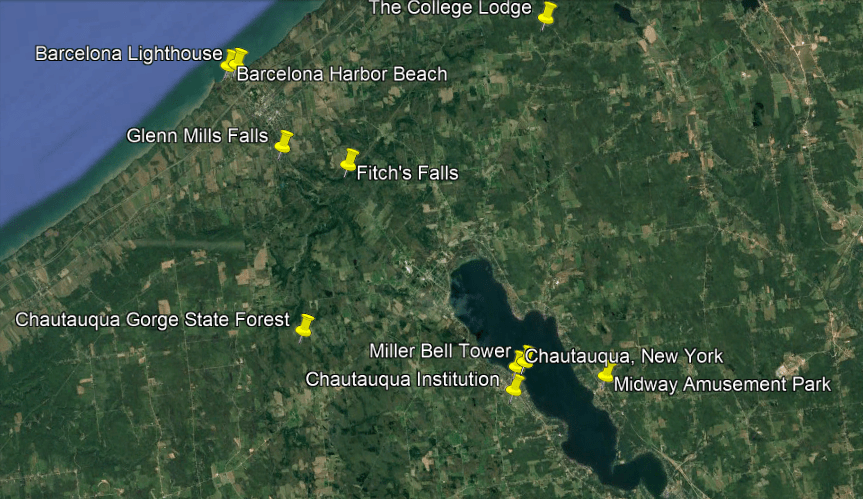
First, the Barcelona Lighthouse in Westfield, New York.
It is 40-feet, or 12-meters, tall, and was said to have been finished in 1829.
We are told it was the first natural gas lighthouse in the world, and in the Federal Lighthouse Service until 1859, so for only 30-years.
It was privately held through various owners until 2007, at which time it was acquired by the New York State Office of Parks, Recreation, and Historical Preservation, and is open to the public.
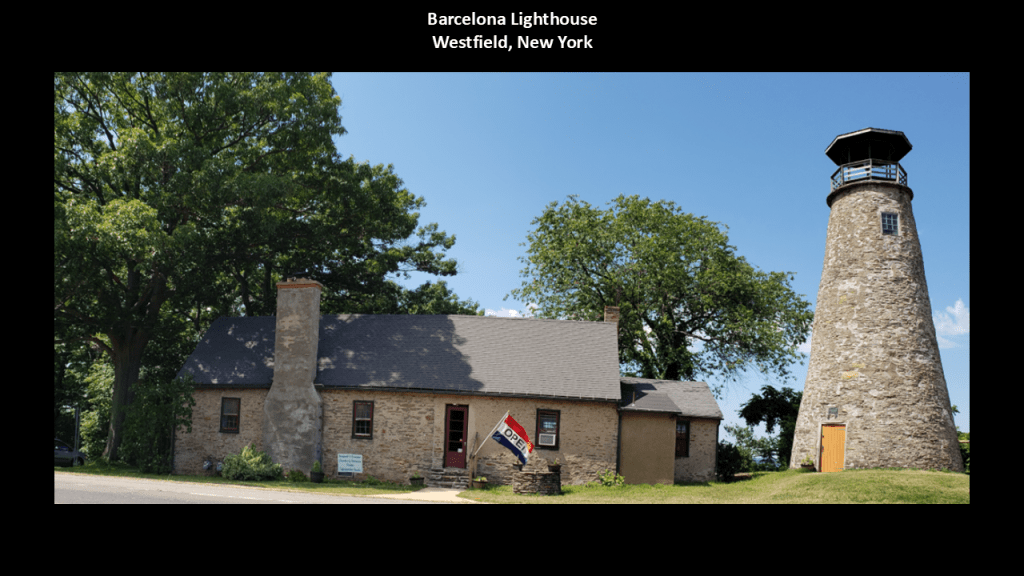
The Barcelona Harbor Beach and lighthouse are located on the Seaway Trail.
The beach is known for its sunsets and beach glass, and the harbor provides access to deep water fishing, and the Barcelona-area was a hub for commercial fishing in its history, which at its height, often took in 140-million pounds, or almost 6.5-million kilograms, of fish in a year.
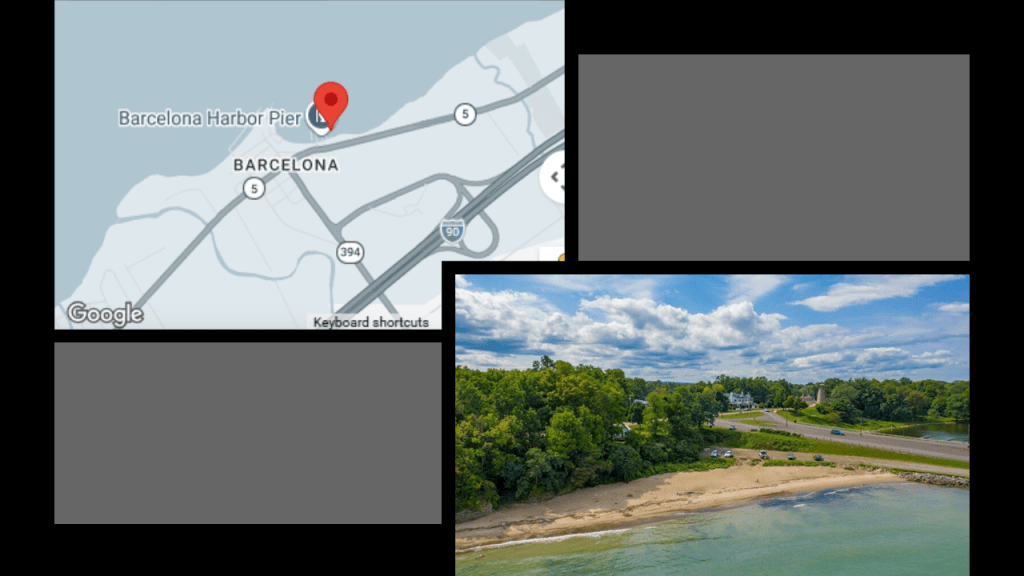
There’s about 1/4-mile, or almost .5-kilometers, of the beach back by a rocky cliff, and there several waterfalls collectively known as “Barcelona Falls” that pour off the cliff onto the beach depending on the season.
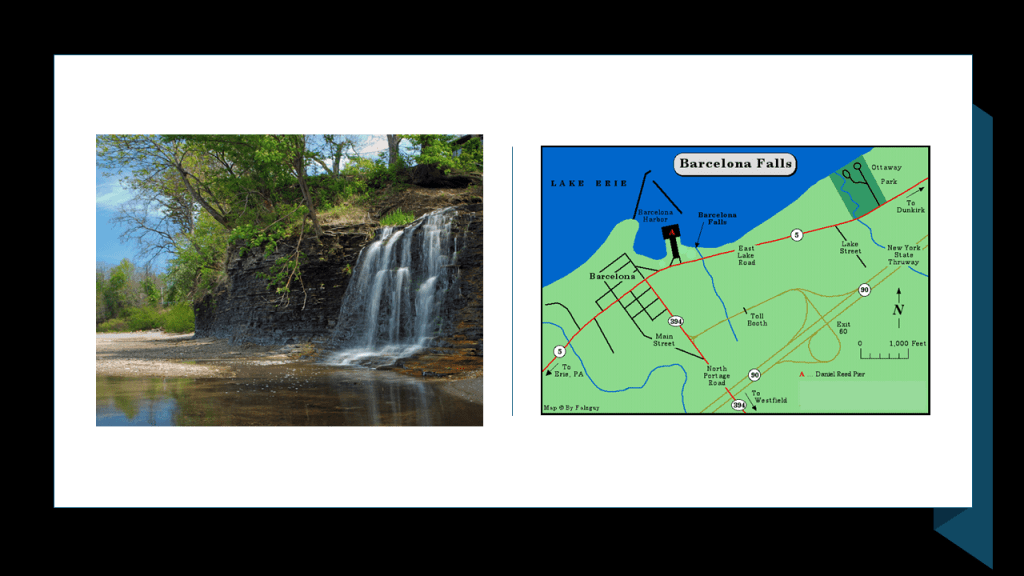
Westfield was a hub for trains in the area, and its station, an art gallery today, was a connection for both the New York Central Railroad and the Jamestown, Westfield, and Northwestern Railroad.
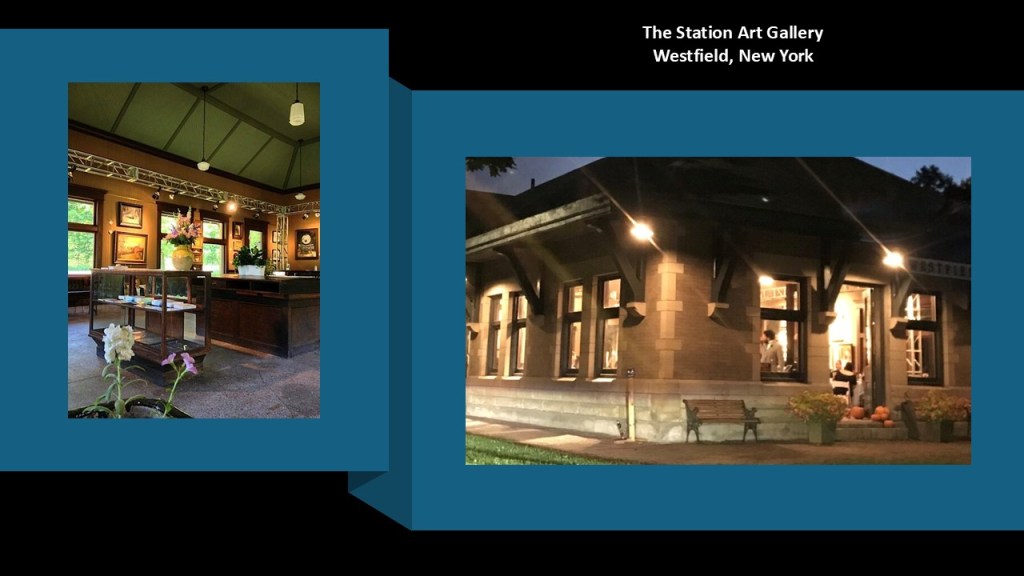
In 1903, Westfield became the end destination of a trolley line that was said to have been built by the Jamestown, Westfield, and Northwestern Railroad.
The residents of Westfield could take a trolley to Jamestown, with stops in-between at places like Mayville, Hartfield and Lakewood, and would arrive in Jamestown in about an hour, with the trolley reaching speeds of 50-to-60-miles/hour, or 80-to-97-kilometers/hour, in the early 1900s.
In 1909, the line was extended to Barcelona, and 18-round trips per day were made between Westfield and Jamestown.
The interurban trolley lasted until the end of Novemeber in 1947, and the New York Central Railroad stopped major passenger service along Lake Erie through here in 1967, before it merged with the Pennsylvania Railroad to form the Penn Central Transportation Company in 1968.
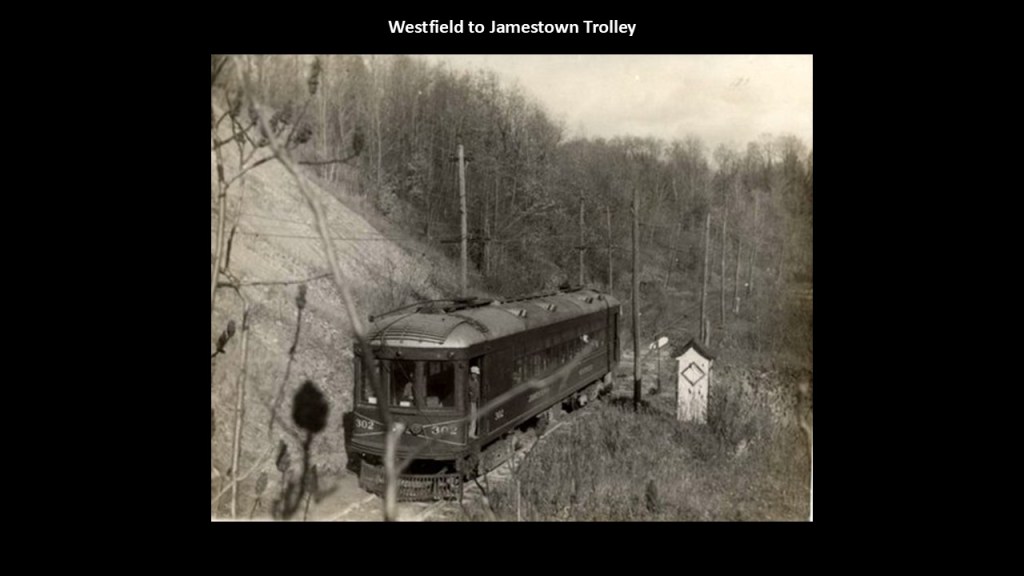
Passenger service at smaller stations like Westfield was discontinued as part of a massive reduction in passenger rail, paving the way for Amtrak to take over national passenger operations in 1971.
The Glen Mills Falls, Fitch’s Falls, and the Chautauqua Gorge State Forest are just to the south of Westfield.
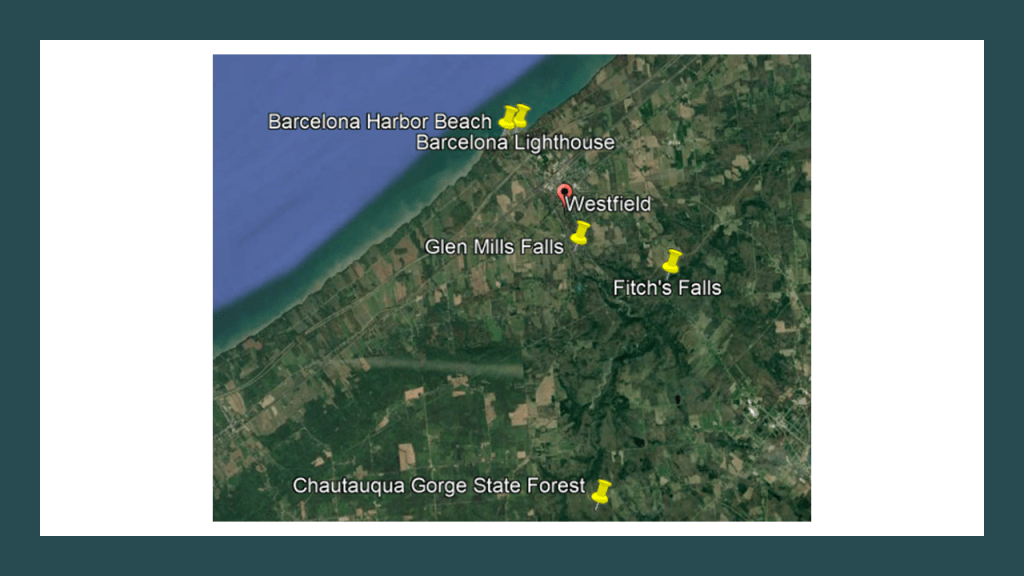
The Glen Mills Falls is located on Little Chautauqua Creek in Westfield, New York.
From what I could find out, there is an old trolley bridge at this location.
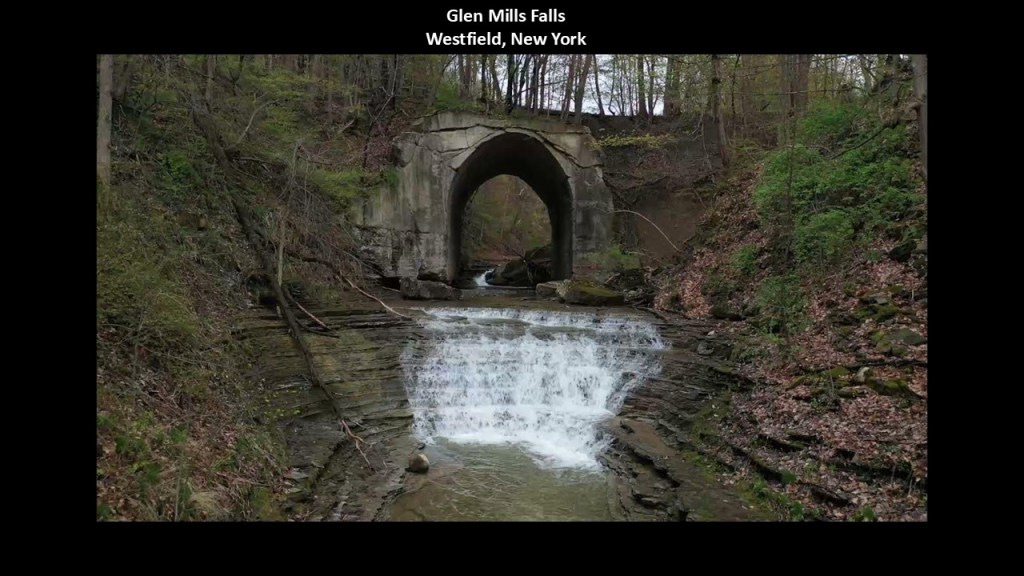
It was also the historic location of Glen Mills, a 19th-century mill site and small industrial area.
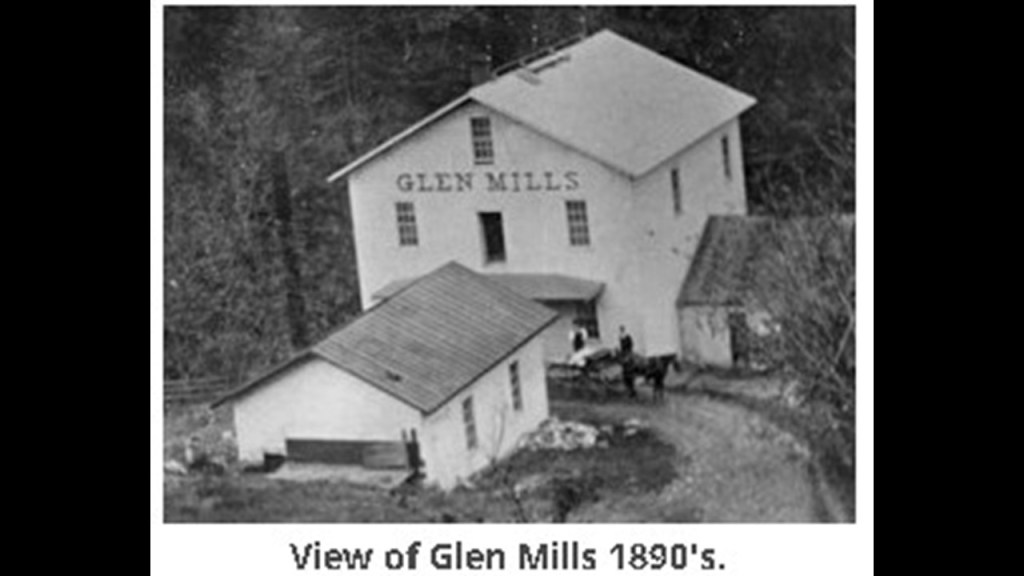
The nearby Fitch’s Falls are also on Little Chautauqua Creek in Westfield, New York, and within hiking distance of the Glen Mills Falls.
Fitch’s Falls are in the Chautauqua Creek Gorge and that it’s name likely came from an early family or landowner in the area.
There is also old rail infrastructure at this location, as well as remnants of an industrial past as the falls along here were used to power mills in the area.
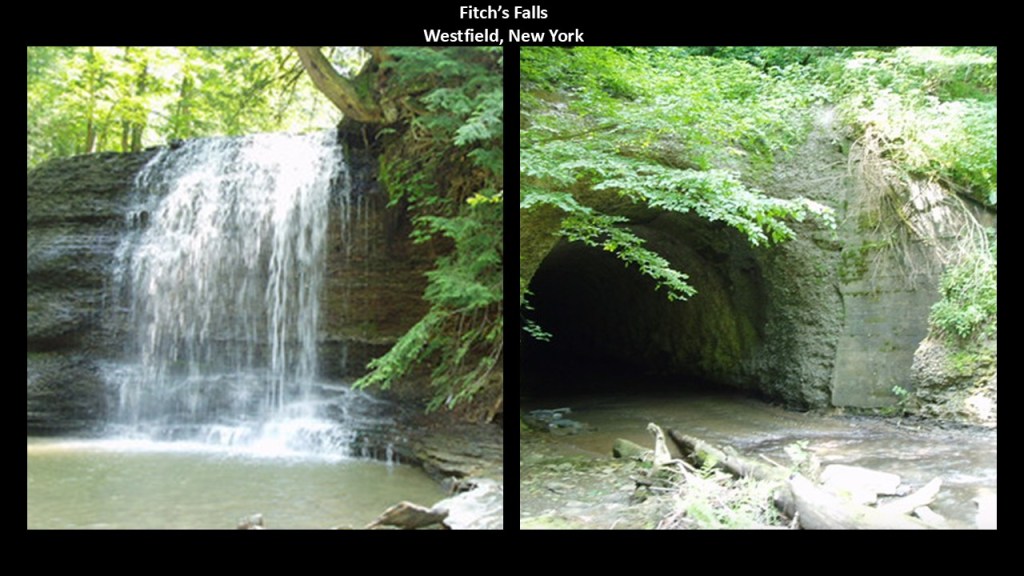
The Chautauqua Gorge State Forest is a multi-use recreational area located between Mayville and Westfield in Chautauqua County.
The forest borders the steep gorges of Chautauqua Creek.
The Fred J. Cusimano Overland Trail runs through the forest, which is a 24-mile, or 7-kilometer, -long hiking trail that connects the southside of Chautauqua Gorge with the Town of Harmony on the New York-Pennsylvania border.
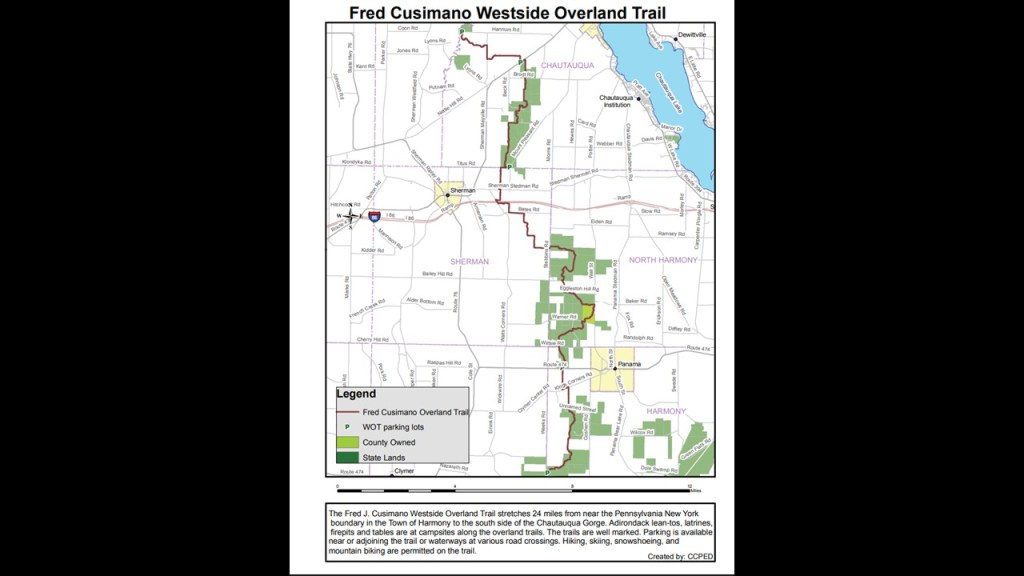
This trail connects to the Chautauqua County Rails-to-Trails System.
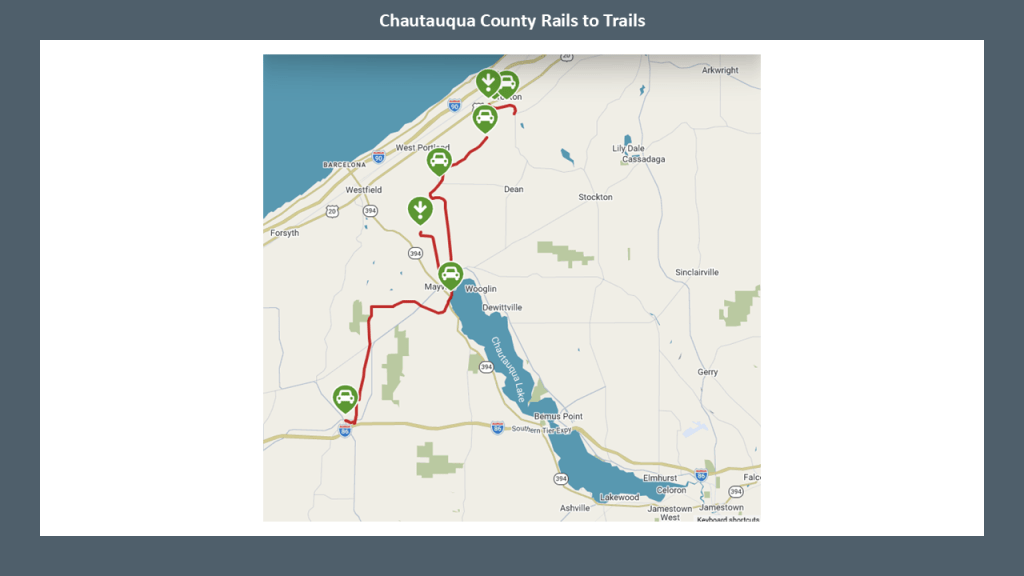
Over on Lake Chautauqua, I am going to take a look at the Chautauqua Institution; the Miller Bell Tower and the Midway Amusement Park.
The City of Jamestown is on the southern end of Lake Chautauqua.
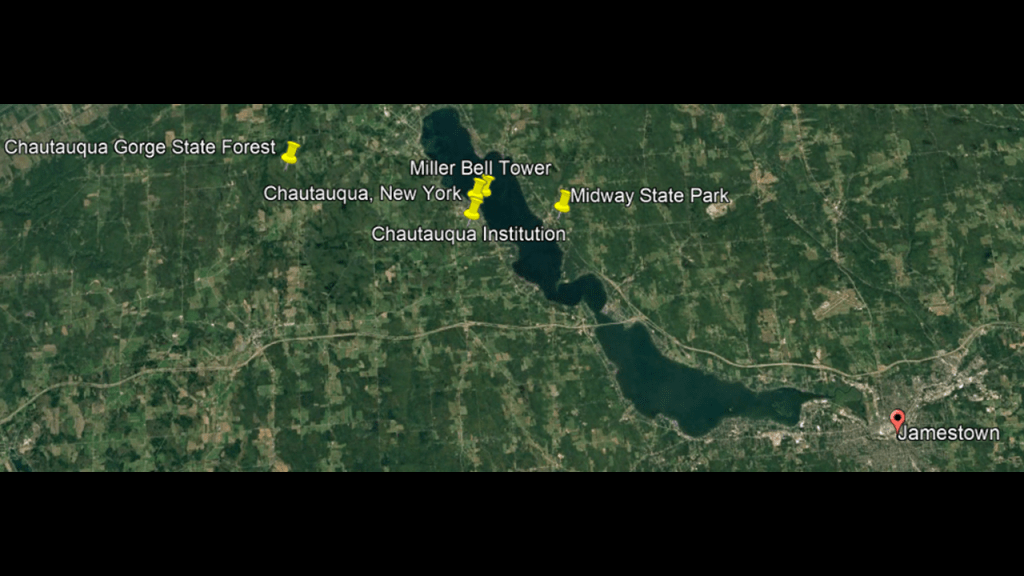
The Chautauqua Institution was established in 1874, and still operates today as an education and summer resort for adults and youth.
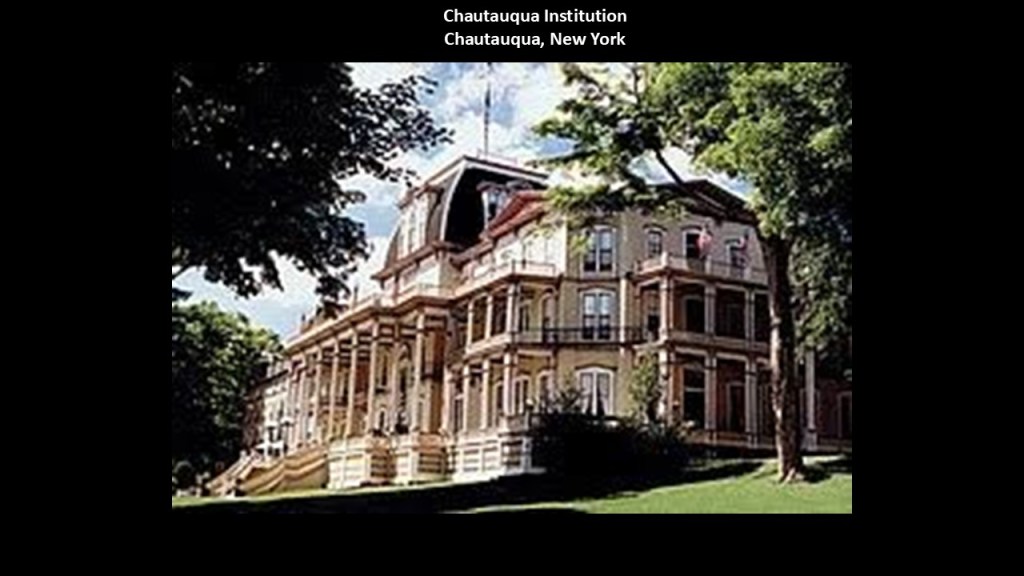
The Chautauqua Institution was founded in 1874 to teach Sunday School teachers.
The teachers would arrive via steamboat on Chautauqua Lake and disembark at Palestine Park, and begin a course of bible study that used the park to teach the geography of the Holy Land.
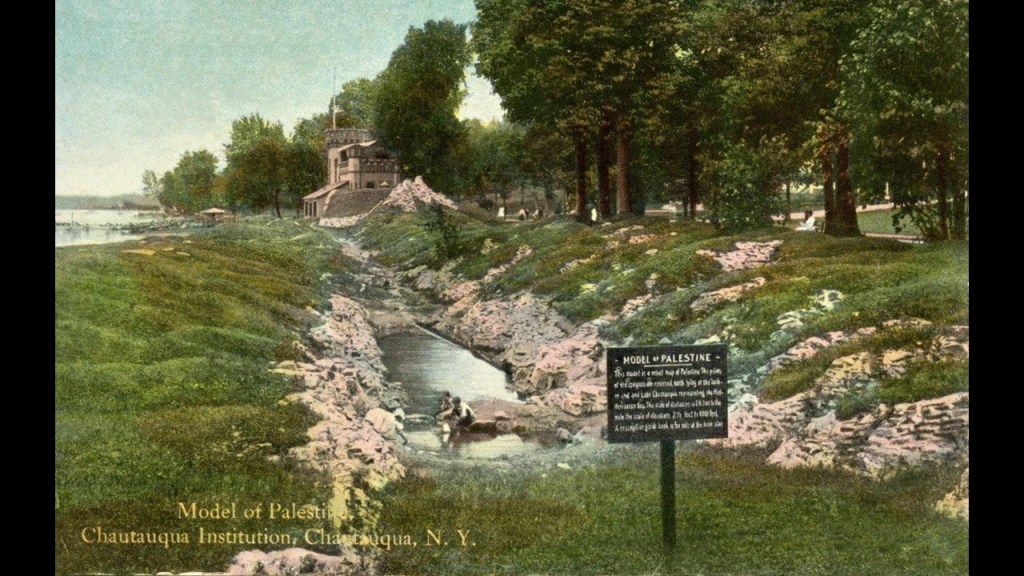
The Chautauqua Institution has expanded its season length over the years and offers programs in education, religion, and the arts, including dance and music.
The Miller Bell Tower at the Chautauqua Institution was dedicated in August of 1911 as a memorial to one of the Chautauqua Institution’s founders, Lewis Miller.
It is 18-feet square and 75-feet tall, or 5.5-meters square and 23-meters tall, and said to be a campanile constructed in the north Italianate-style.
The Westminster Chimes play every quarter-hour between 8 am and 10 pm daily.
Same idea with the Ames Campanile at Iowa State University in Ames, Iowa.
The Ames Campanile is a major symbol of Iowa State University.
As a matter of fact, the Ames Campanile is represented on what is described as the mace, that is probably as tall as, or taller, than the Chief Faculty Marshal that carries it at the head of academic processions, and on the presidential chain symbolizing the authority of the Univerity’s President.
The Ames Campanile was said to have been constructed in 1897 as a memorial to the first Dean of Women, Margaret MacDonald Stanton.
The Campanile houses the Stanton Memorial Carillon, which also plays “Westminster Quarters” every quarter-hour.
Just like what we are seeing with lighthouses and the railroads, what we are told about when these things came into existence…and in so many cases left existence…just doesn’t make sense.
I believe the purpose of these massive bell-towers reaching up to the clouds for the original civilization was that they were musical generators of healing and harmonious frequencies for the benefit and balance of all of Creation.
The current musical scale is not tuned into the solfeggio frequencies, and the results of this are believed to negatively affect our thinking skills and emotional states, thereby lowering our consciounsess in yet another way.

Next, the Midway State Park is directly across Chautauqua Lake from the Chautauqua Institution and its campanile.
In our historical narrative, the Midway State Park in Maple Springs was established in 1898 by the Jamestown and Lake Erie Railway as a picnic ground.
It is recognized as the 15th-oldest continually operating amusement park in the United States and the fifth-oldest remaining trolley park of thirteen still operating in the United States.
These days, park-goers can do things like ride on the vintage carousel; play a game of miniature golf; ride the tilt-a-whirl and go-karts; and there are kiddie rides for the children.
Jamestown at the southern end of Chautauqua Lake was, among other things a railroad hub in the 19th and 20th-centuries, served primarily by the Erie Railroad.
The Erie Railroad’s main-line ran through Jamestown, and connected New York City to Chicago.
The railroad carried passengers, mail and industrial freight, helping Jamestown grow into a regional manufacturing center, in particular furniture manufacturing.
We are told the historic Jamestown Station, the most recent of several previous train stations, was built by the Erie Railroad between 1931 and 1932, in the middle of the Great Depression, as a replacement for the previous one.
It stopped being used for passenger service in January of 1970.
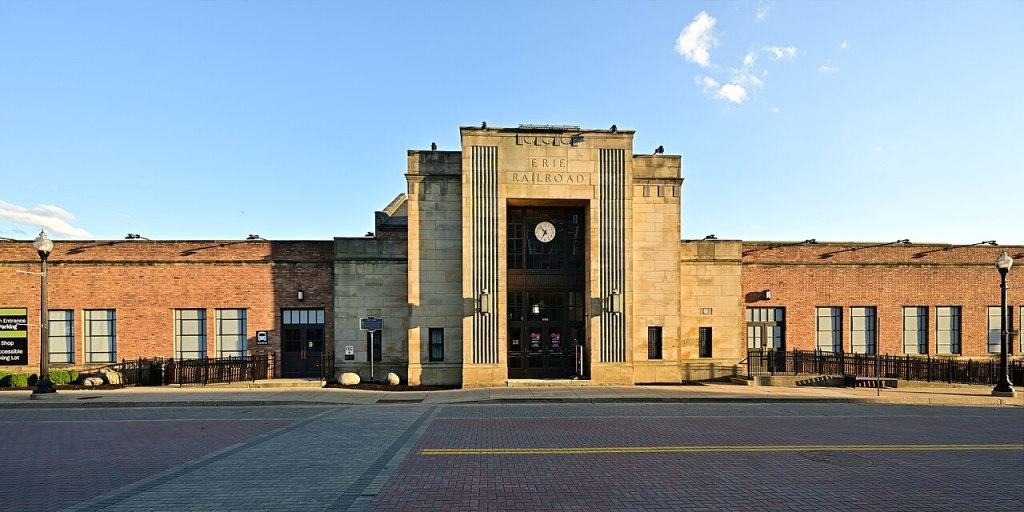
These days it is part of the National Comedy Center, an American museum dedicated to comedy as Jamestown was Lucille Ball’s hometown.
There was also the Buffalo-Jamestown Railroad, which was said to have been built between 1872 and 1875 between the two cities.
It became part of the Buffalo and South Western Railroad, and eventually absorbed into the Erie Railroad system.
It was important for shipping furniture and other manufactured goods, and bringing workers and travellers between Jamestown and the Greater Buffalo region.
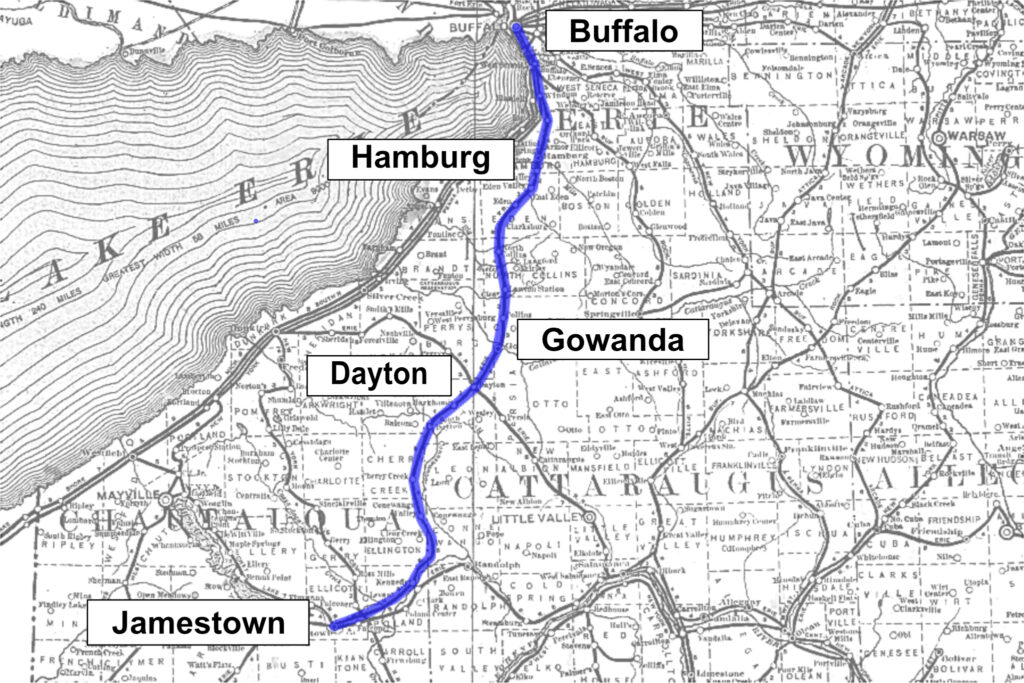
Railroads still exist in the area, but primarily for freight, with the Western New York and Pennsylvania Short-Line Railroad operating freight transport on former Erie Railroad lines, and there is no Amtrak service in Jamestown, though bus links the city to Buffalo’s rail station.
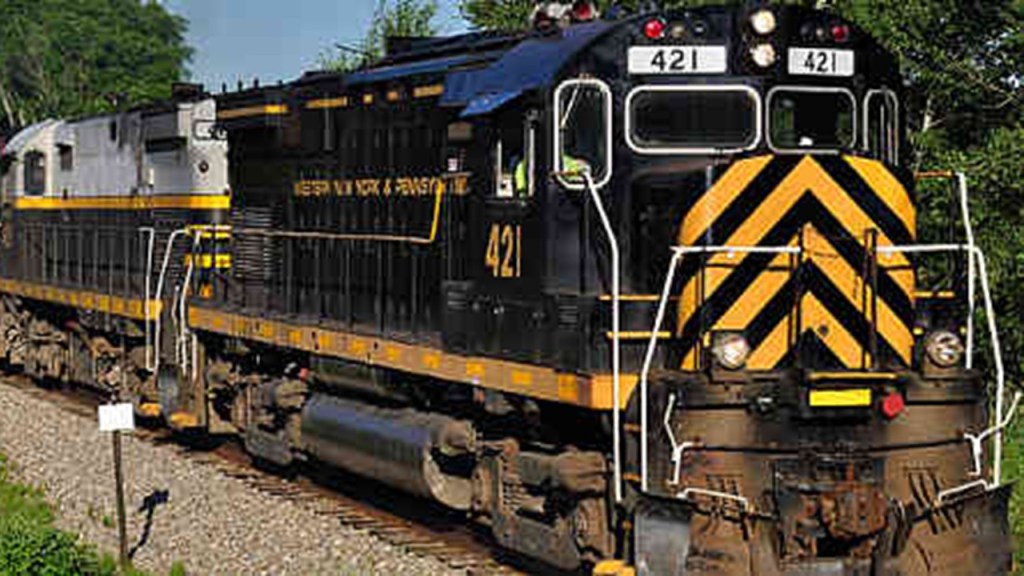
As mentioned previously, Jamestown had an electrified interurban railway, among several in the area.
The Jamestown, Westfield and Northwestern Railroad operated between 1914 and 1950, and was nicknamed the “Chautauqua Lake Route.”
It was used for passenger service, freight transfer to the Erie and New York Central Railroads, and service for factories in Jamestown.
Passenger service ended in 1947, and the line closed completely in 1950.
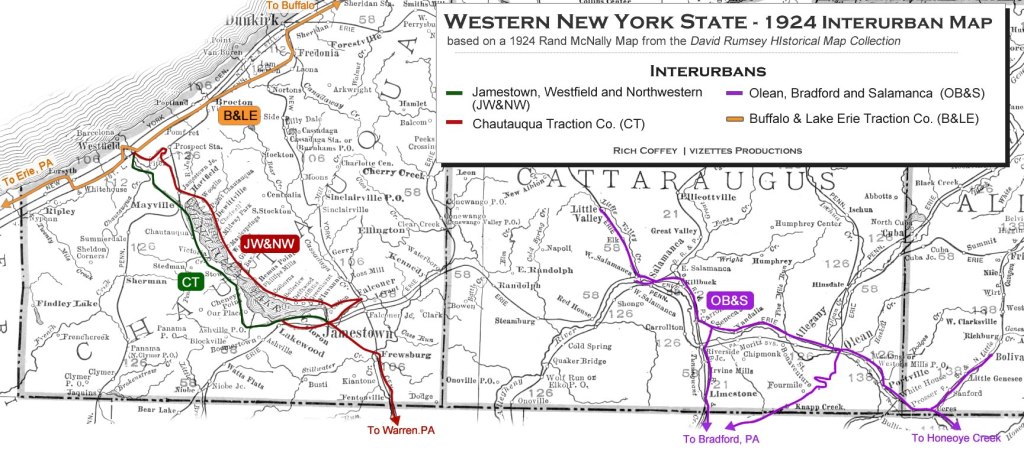
Jamestown also had streetcars, with horse-drawn streetcars appearing in 1884.
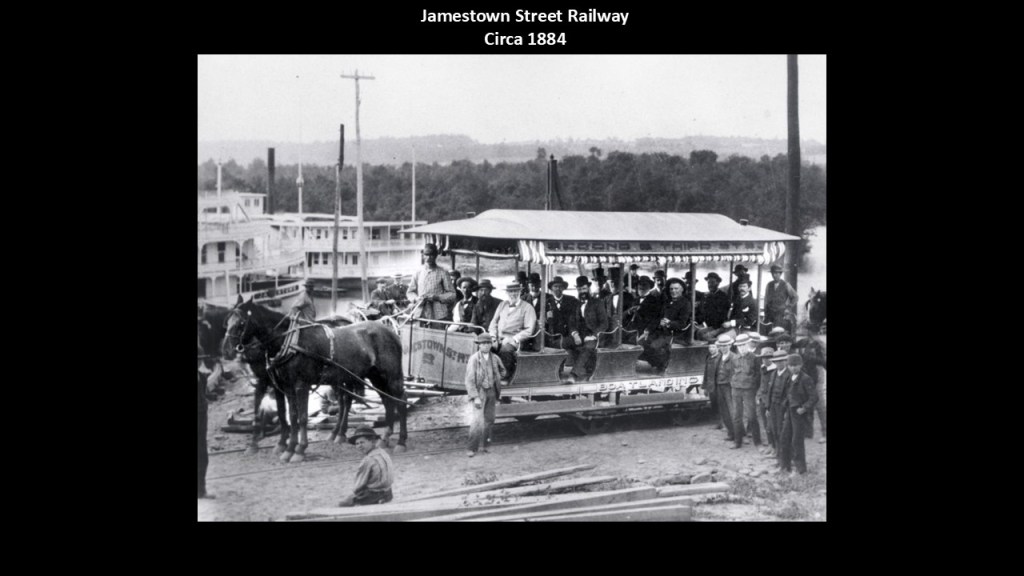
Electric streetcar service began in 1891, making Jamestown one of the earlier cities to electrify its streetcar system.
The Jamestown Street Railway service officially ended during the month of January in 1938, when the last streetcar routes were discontinued and replaced by buses, with interurban passenger service from Westfield continuing until 1947.
Jamestown’s rail history reflects the broader story of American railroading that we have been seeing of rapid-growth in the 19th-century; peak influence in the early 20th-century, and decline in the years preceding and following World War II, in the 1930s and 1940s, again for given reasons like increased automobile ownership; expansion of bus service; and better roads and highways.
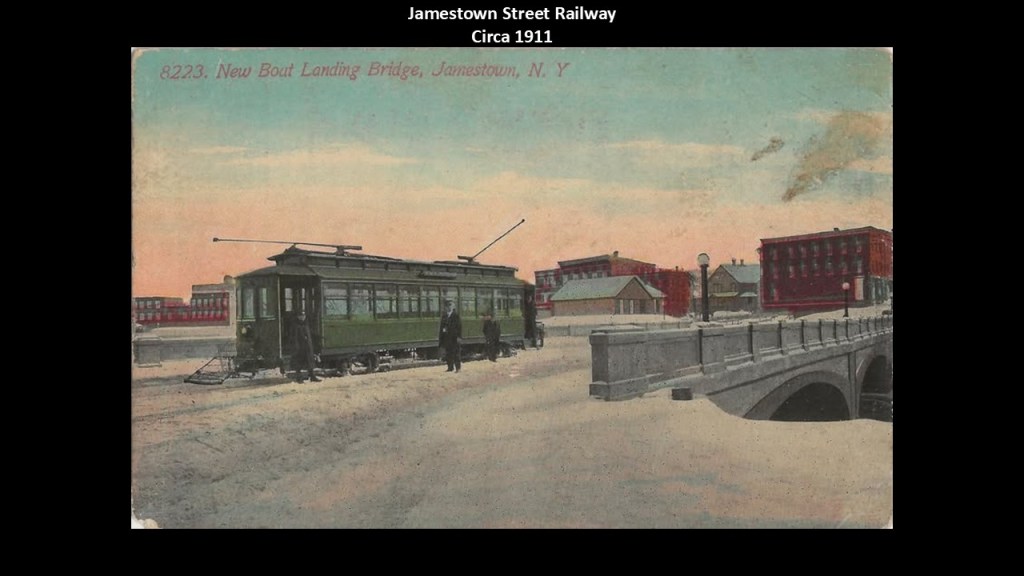
Panama Rocks Scenic Park is to the south of the Chautauqua-area, and to the southwest of Jamestown.
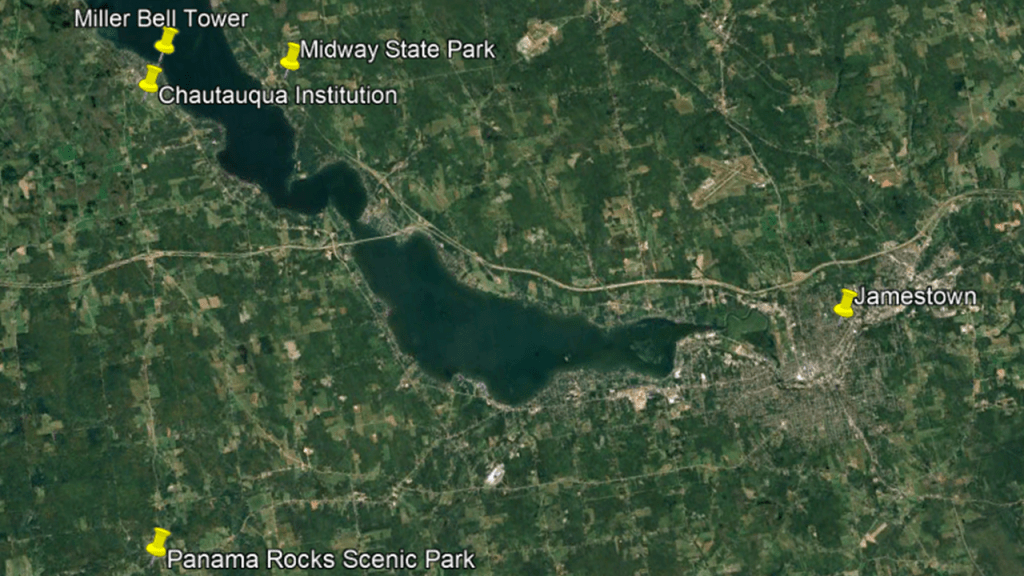
The Panama Rocks Scenic Park, like the previously-seen Rock City State Park, looks like a city of rocks, with massive conglomerate formations that look like houses and others creating narrow streets and corridors.
Described as extending about a half-mile, or almost a kilometer through an ancient forest, rhe rock formations are upwards of 60-feet, or almost 20-meters, in height.
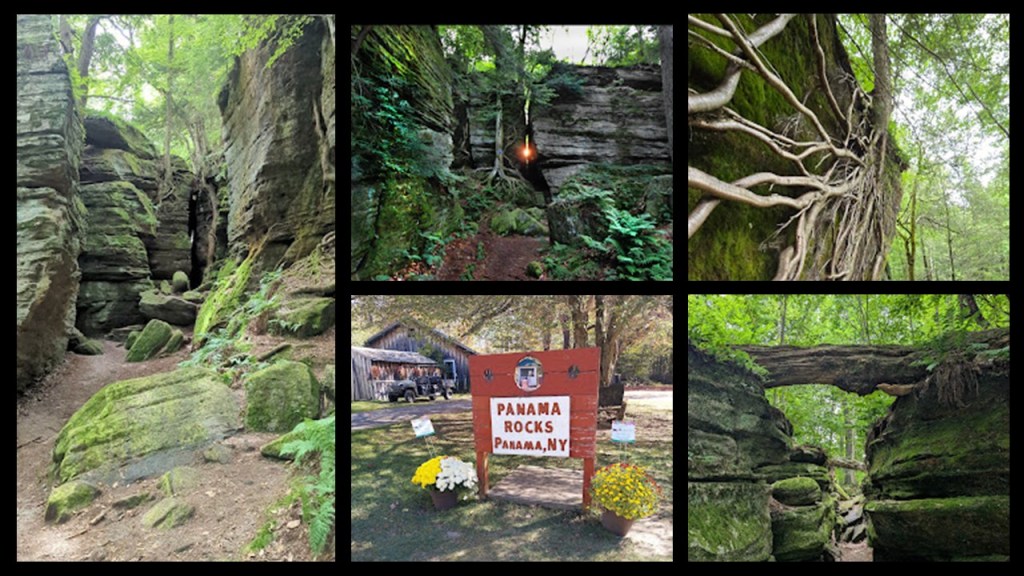
Next we enter Pennsylvania from New York, and first come to what is known as the North East Winery region, which is centered around the town of North East, Pennsylvania, and then come to what is found around Erie, the largest city in northwestern Pennsylvania near the state’s border with Ohio.
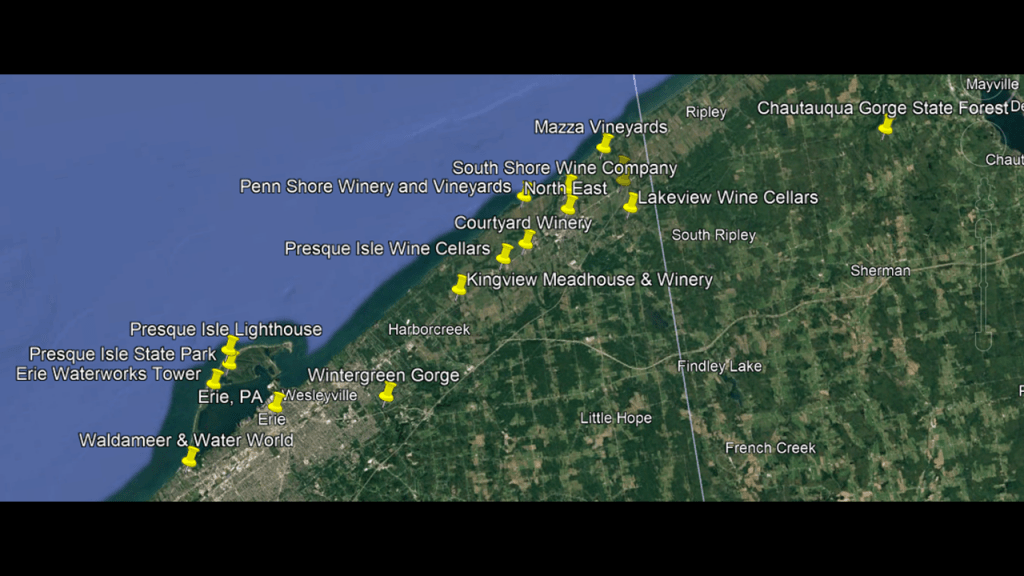
First, North East, Pennsylvania, is in the heart of the Lake Erie American Viticultural Area mentioned previously at The Vineyards Golf Course in Fredonia.
It is in the northeastern part of Erie County, and is one of the most concentrated wine regions in the eastern United States.
The wine country around North East has over 30,000 acres, or 12,141-hectares, of vineyards and over 20 wineries.
At one time having grown primarily concord grapes for juice companies like Welch’s, many have switched to wine grapes, and today the region produces everything from dry European-style wines, to sweet native grape wines and ice wines.
North East and the surrounding vineyards and wine cellars shown here are located between the Seaway Trail running along the shore of Lake Erie; US-20; the still-operating railroad tracks running through the area; and I-90.
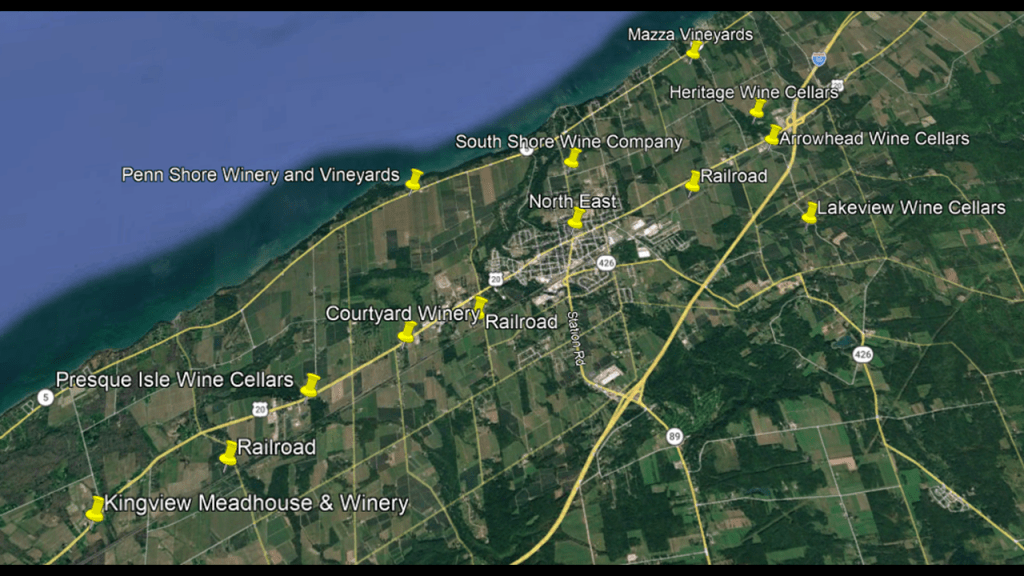
North East has a rich railroad history because it is situated directly on one of the most important rail corridors in the United States, which is the main route along the south shore of Lake Erie between Chicago, Cleveland, Buffalo and New York City.
The railroad arrived in North East in the early 1850s when a line was completed that connected Buffalo with Cleveland, with one of the key companies being the Cleveland, Painesville and Ashtabula Railroad (CP & A), also known by the corporate name of the Cleveland and Erie Railroad, which first opened in 1852 and operated until 1869.
It completed the rail-link between Buffalo and Chicago with connection to the Buffalo and State Line Railroad, and one of the first continuous rail routes across the region.
This was notated as a timetable for the Cleveland and Erie Railroad in 1853.
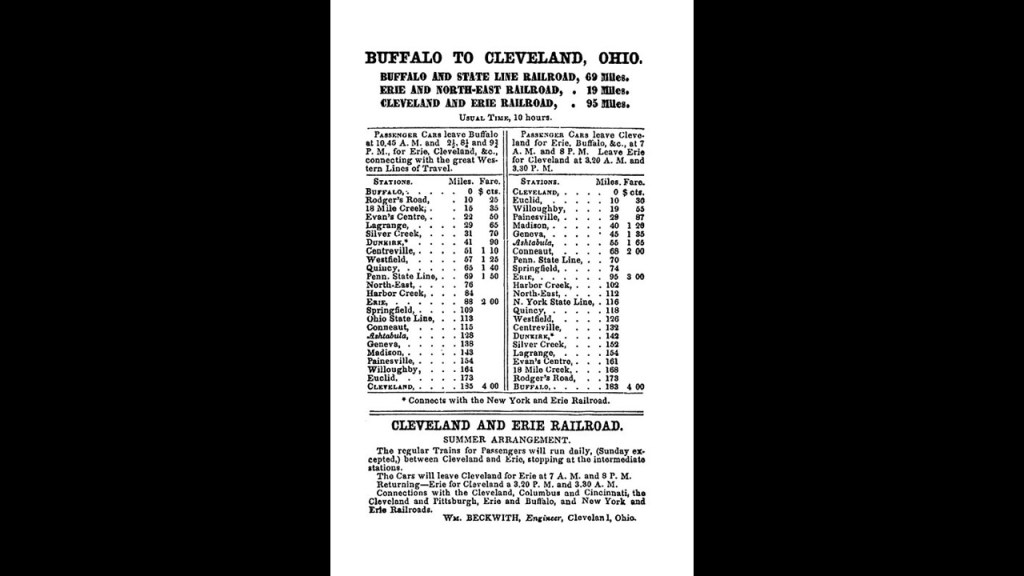
In 1869, these lines were consolidated into the Lakeshore and Michigan Southern Railway, and this railroad ran directly through North East as part of its main east-west trunk line.
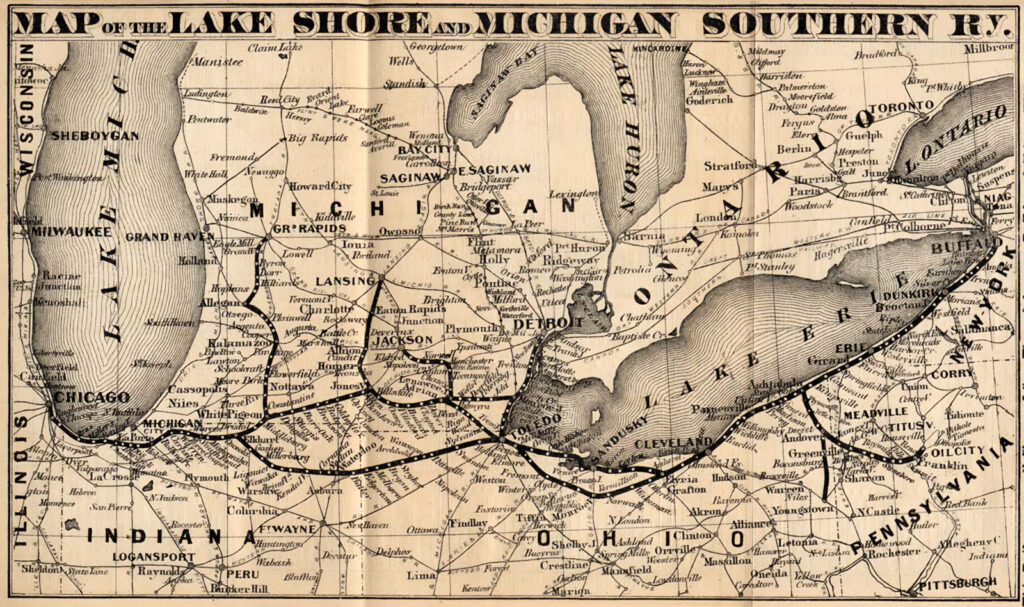
When the railroad consolidated in the early 20th-century, the line through North East became part of the New York Central Railroad on the line called the “Water Level Route” because it ran mostly flat along Lake Erie, making for faster passenger and freight trains, and because of this, the small town of North East saw constant heavy rail traffic, which helped make it a major grape-growing region as refrigerated rail-cars were used to ship its grapes to large eastern cities.
Today, the former Railroad Depot for the New York Central line is a museum and preserves locomotives, rail-cars and artifacts from the regional railroads.
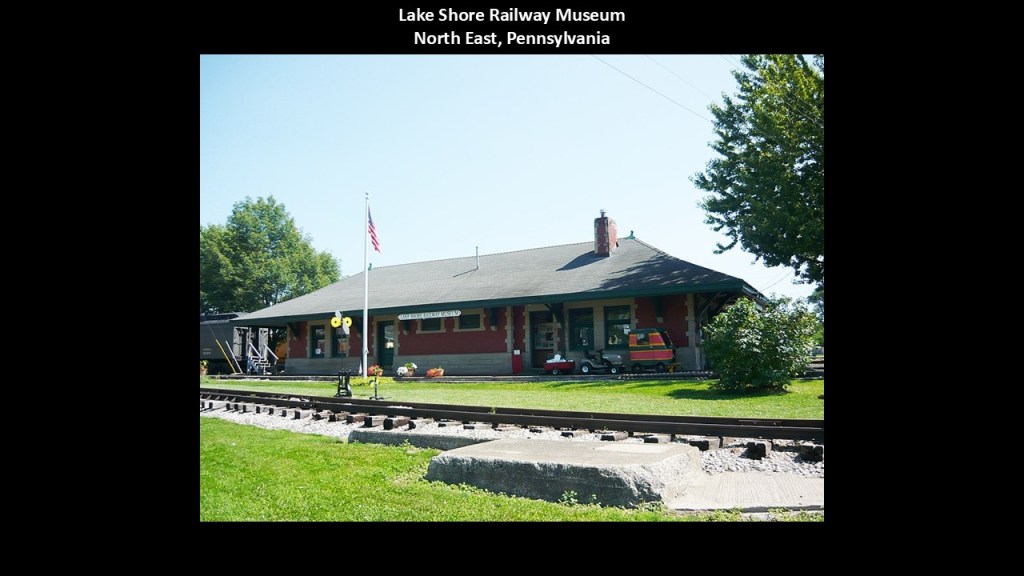
It is located beside the modern main-line, which is operated mainly by CSX for freight transportation on one of the busiest freight corridors in the eastern United States.
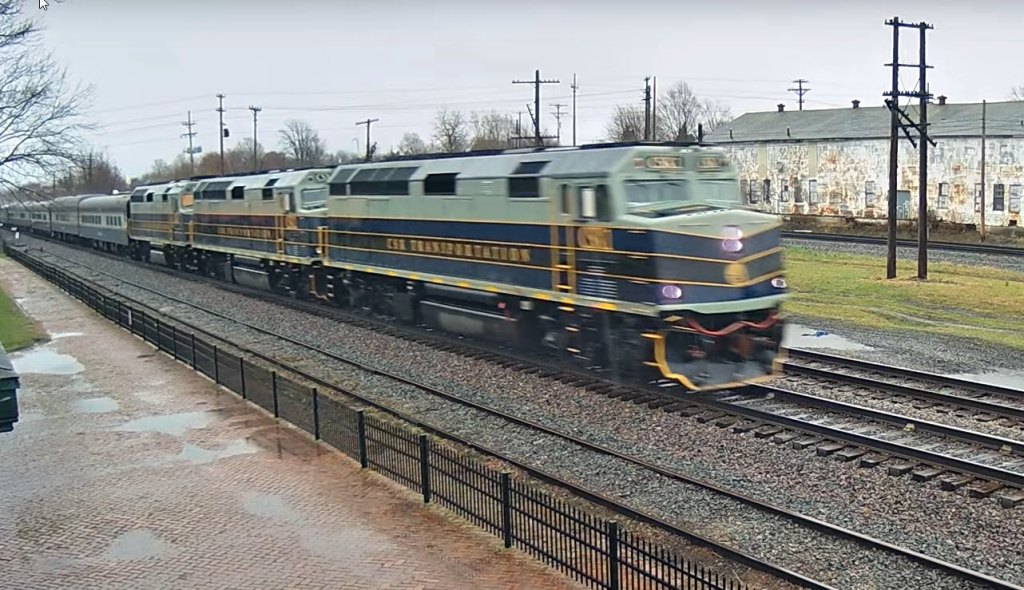
Like I mentioned previously, Amtrak’s Lake Shore Limited runs overnight passenger service along the southern shore of Lake Erie, and it uses the “Water Level Route” main-line.
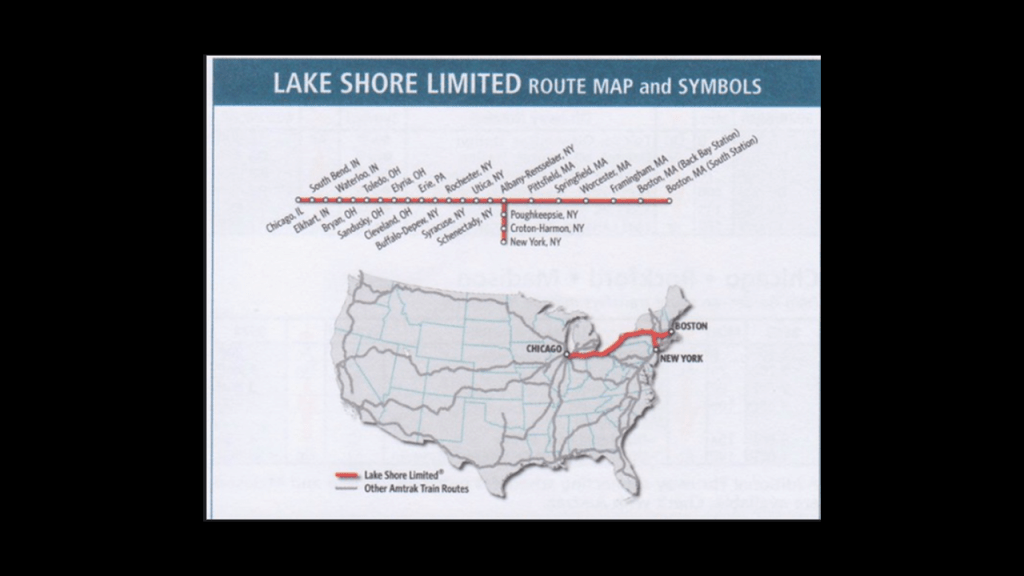
Next, we are heading into the area around Erie, Pennsylvania,
Erie is located just about right in-between Cleveland, Ohio, which is 90-miles, or 140-kilometers, southwest of Erie, and Buffalo, New York, 80-miles, or 130-kilometers, northeast, on the southern shore of Lake Erie.
The first places I am going to take a look at in Erie are the Wintergreen Gorge; Presque Isle State Park and Lighthouses; the former Erie Waterworks area; Waldameer Park and Water World; and Union Station.
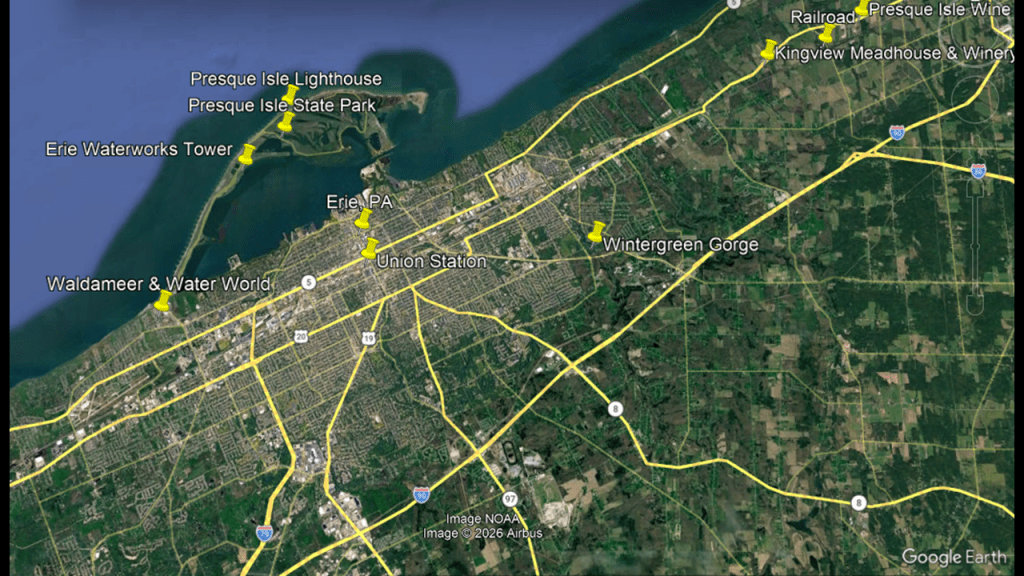
First, the Wintergreen Gorge.
The Wintergreen Gorge is a 6-mile, or almost 10-kilometer, -long canyon on Fourmile Creek.
It is 250-feet, or 23-meters, deep at its highest point.
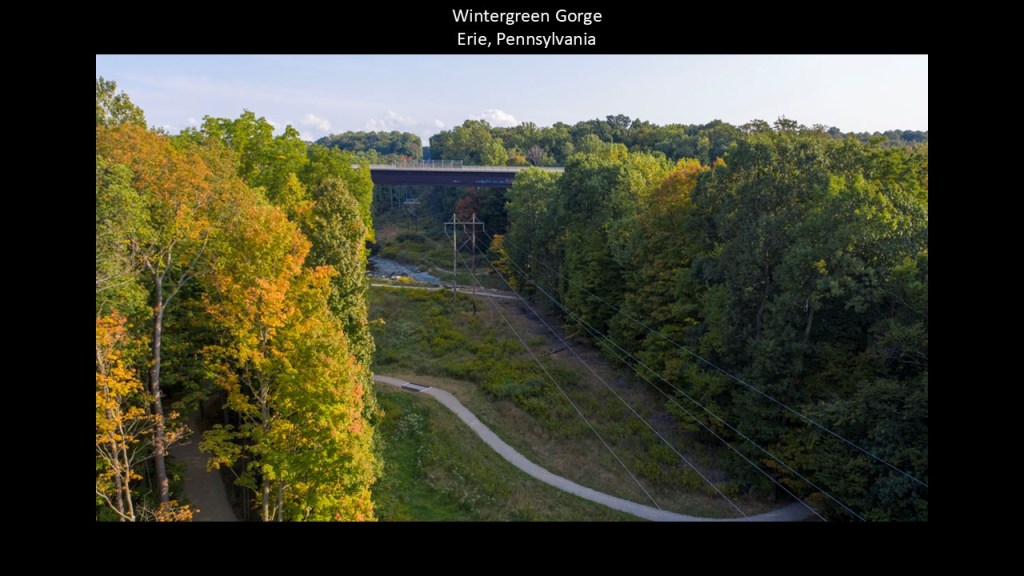
There are six waterfalls through 3/4-mile, or a little over a kilometer, -long Wintergreen Gorge.
Most of the waterfalls range from 10- to 20-feet, or 3- to 6-meter, drops or stepped cascades.
We are told that while there was a railroad associated with Wintergreen Gorge, it did not run directly through the bottom of the gorge, but rather was connected to small industrial and logging railroad spurs in the surrounding area in the late 19th- and early 20th-centuries, tied to the region’s lumber and quarry activity.
Local historians and hikers have reported seeing old rail-beds, stone retaining walls, and unusual straight embankments in the woods.
Next, Presque Isle State Park is an arching peninsula that juts into Lake Erie, 4-miles, or 6-kilometers, west of the city of Erie.
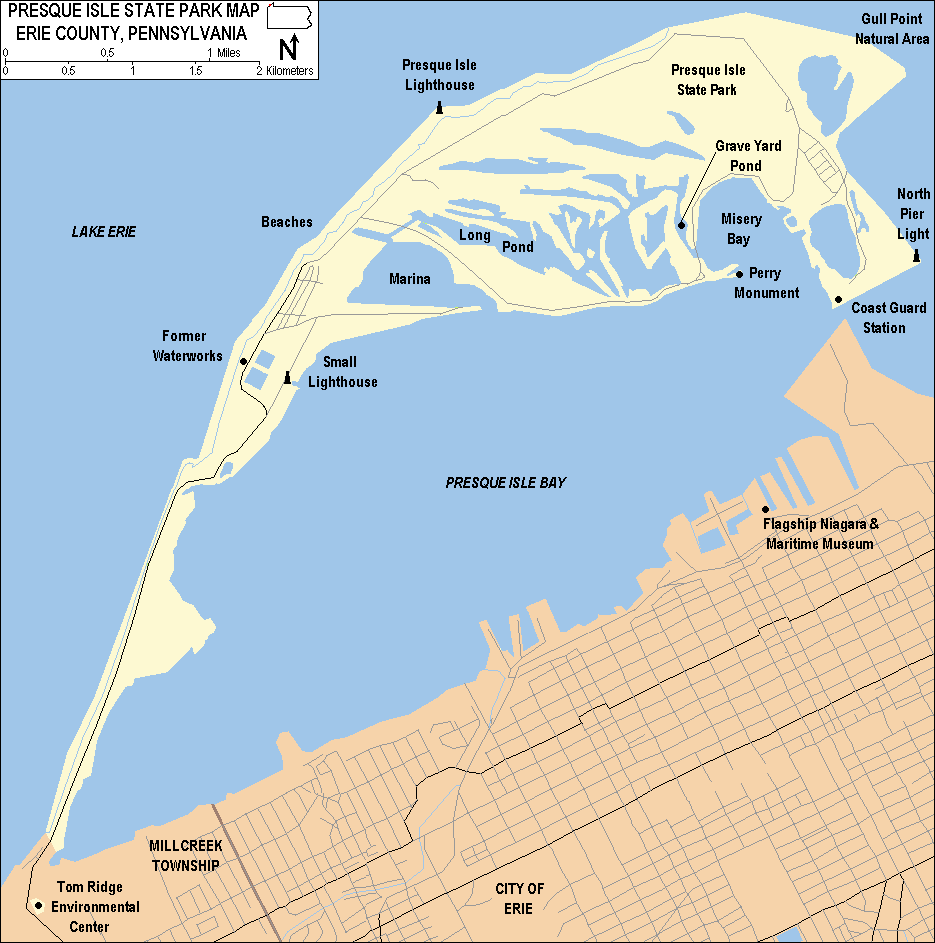
We are told the French were the first Europeans to arrive in the area, which had been inhabited historically by the indigenous Erie people, and that the French were the ones to construct Fort Presque Isle near Erie in 1753 to protect the northern terminus of the Venango Path, the year before the beginning of the French and Indian Wars in 1754, which lasted until 1763.
It was abandoned only six-years later in our narrative.
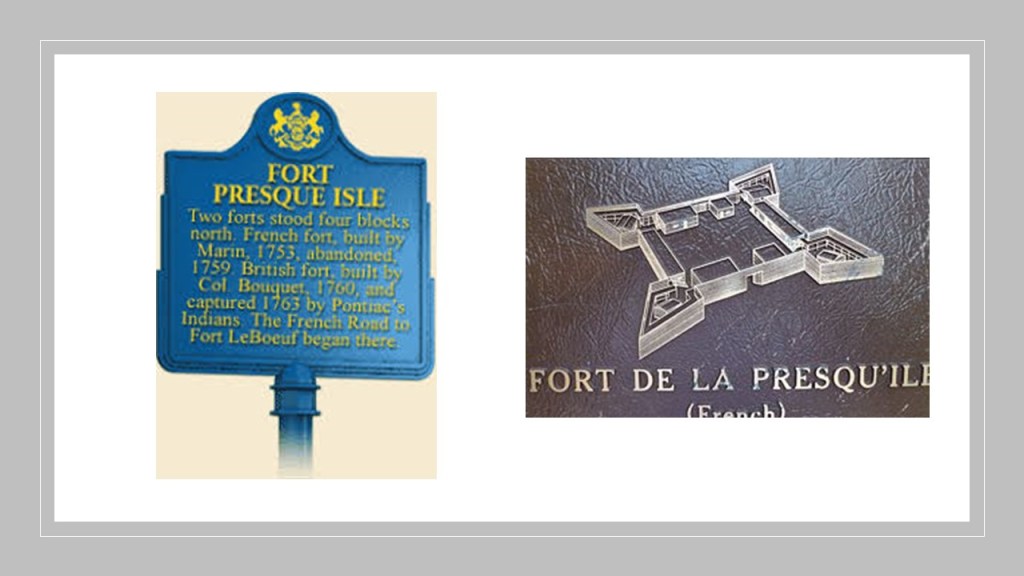
Also in our narrative, the Venango Path was a Native American trail between Presque Isle at present-day Erie, Pennsylvania and present-day Pittsburgh.
The French were also said to have built Fort Le Boeuf that same year, in 1754, with the reason given to guard the road into the Ohio Valley, and it was also abandoned at the same time as Fort Presque Isle.
Historical markers and a museum are all that’s left to remember it by.
Fort LeBoeuf was in today’s Waterford, Pennsylvania, 15-miles, or 24-kilometers, south of Erie on US-19.
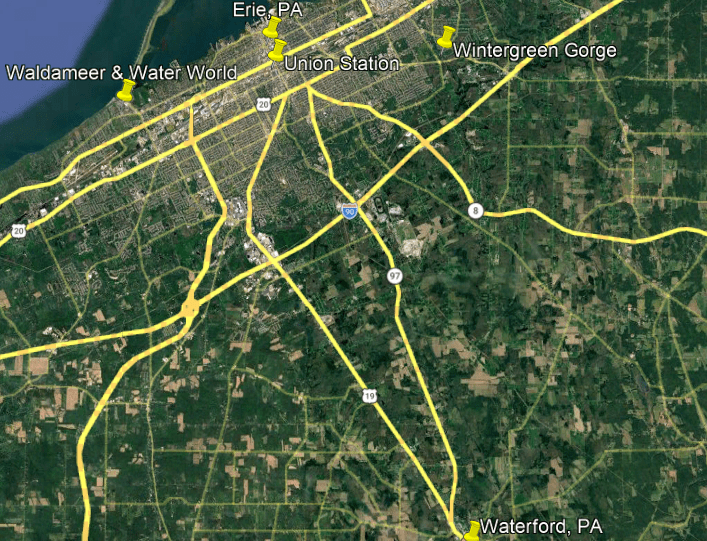
Fort Machault was also included in this line of fortifications the French were said to have built around the same time-period, and also abandoned by the French in 1759.
It was located in present-day Franklin, Pennsylvania on the Allegheny River.
The last fort said to have been built by the French in 1754 in this line of so-called fortifications was Fort Duquesne, situated between the Forks of the Ohio in present-day Pittsburgh, where the Allegheny meets the Monongahela to form the Ohio River.
Fort Duquesne was considered strategically important for controlling the Ohio Country for both settlement and trade.
The French were said to have destroyed the fort later in the French and Indian Wars, and the site was taken over by the British, who were said to have built Fort Pitt, eventually taken over by the Americans and the area became known as Pittsburgh.
I believe these so-called fortifications were actually batteries on the original energy grid, which are found all over the surface of the Earth, and found close together, paired together, or even clusters of them found in the same location.
One definition is a device that produces electricity that may have several primary or secondary cells arranged in parallel or series, as well as a battery source of energy which provides a push, or a voltage, of energy to get the current flowing in a circuit.
Another meaning of the word battery is the heavy fire of artillery to saturate an area rather than hit a specific target.
I believe they were repurposed as forts for them to appear to have a strictly military function as the explanation for why they were built, and in countless cases, why they were destroyed.
Back in Erie, Pennsylvania, in our historical narrative, Presque Isle served as a base for Commodore Oliver Perry’s fleet during the War of 1812, and we are told played a part in the victory over the British in the Battle of Lake Erie.
The Perry Monument on one of Presque Isle’s southern tips was so-named to commemorate this victory.
This monument is an obelisk situated on a circular area and what appears to be artificially-shaped land-form.
I typically find obelisks as commemorative monuments, like the Bunker Hill Monument in Boston, Massachusetts…
…the Sergeant Floyd Monument in Sioux City, Iowa, said to have been erected to commemorate the only death that was said to have occurred during the Lewis and Clark Expedition in 1804…
…Speke’s Monument, located in the Kensington Gardens in London, a red granite obelisk dedicated to John Hanning Speke, the explorer who “discovered” Lake Victoria and led expeditions to the source of the Nile…
…and the obelisk at Jefferson Davis State Park in Kentucky at the birthplace of Jefferson Davis, the President of the Confederate States of America during the American Civil War.
This obelisk is the fourth-tallest monument in the United States; the tallest, unreinforced concrete structure in the world, and the world’s tallest concrete obelisk.
Presque Isle State Park has an interesting and distinct shape.
It is described as a sandy peninsula, with six distinct ecological zones: Lake Erie, the Bay, and the shoreline; sand plain and new ponds; dunes and ridges; old ponds and marshes; thicket and sub-climax forest; and climax forest.
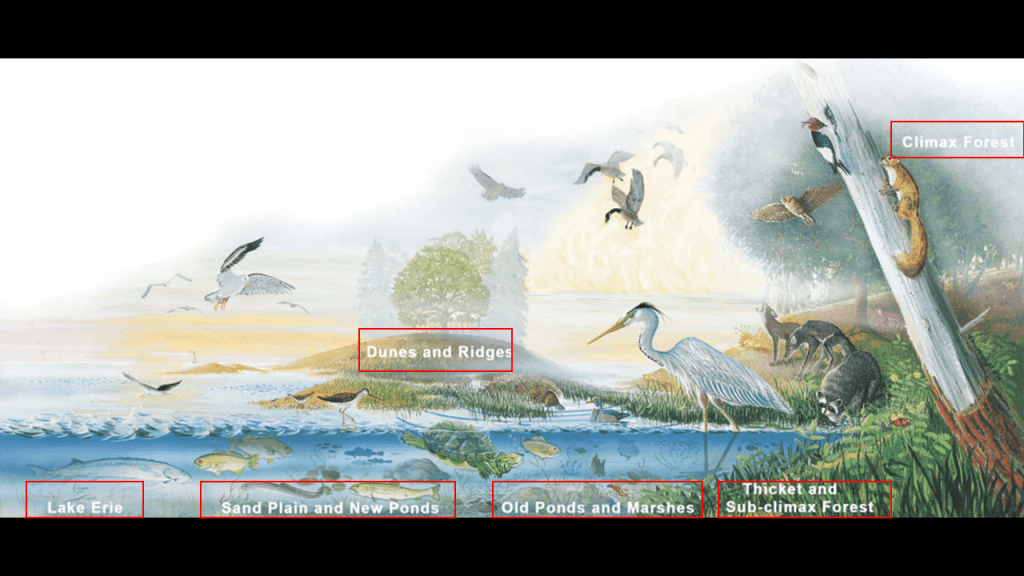
There are three lighthouses in the Presque Isle State Park – the Presque Isle Lighthouse on the north-side; the North Pier Lighthouse on the east-side; and a small lighthouse across from the former Erie Waterworks Area on the west-side.
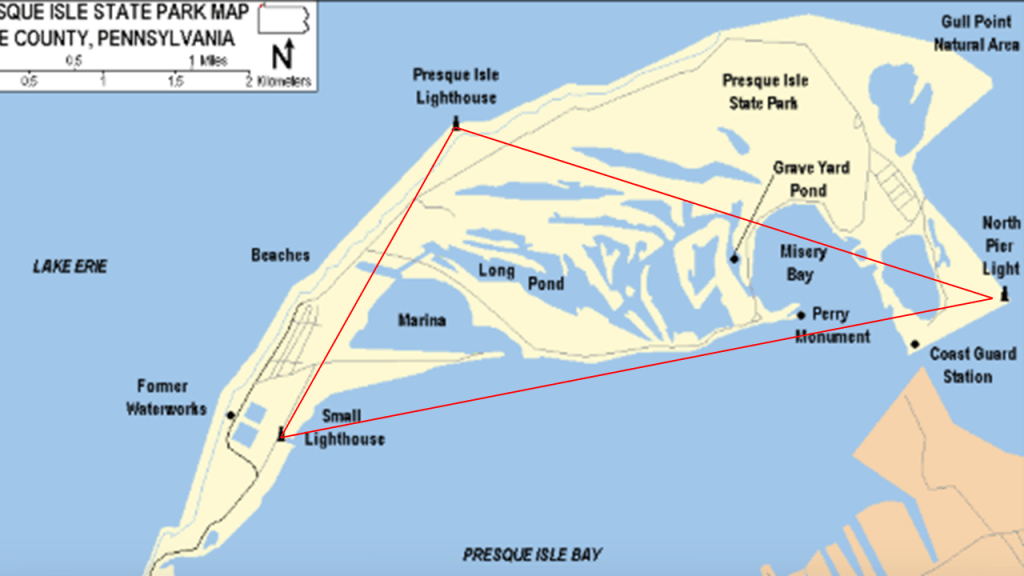
We are told that the Presque Isle Lighthouse on the north-side we see today was constructed between 1872 and 1873, and is five courses of bricks thick.
The tower is square on the outside, and circular on the inside, with a spiral staircase.
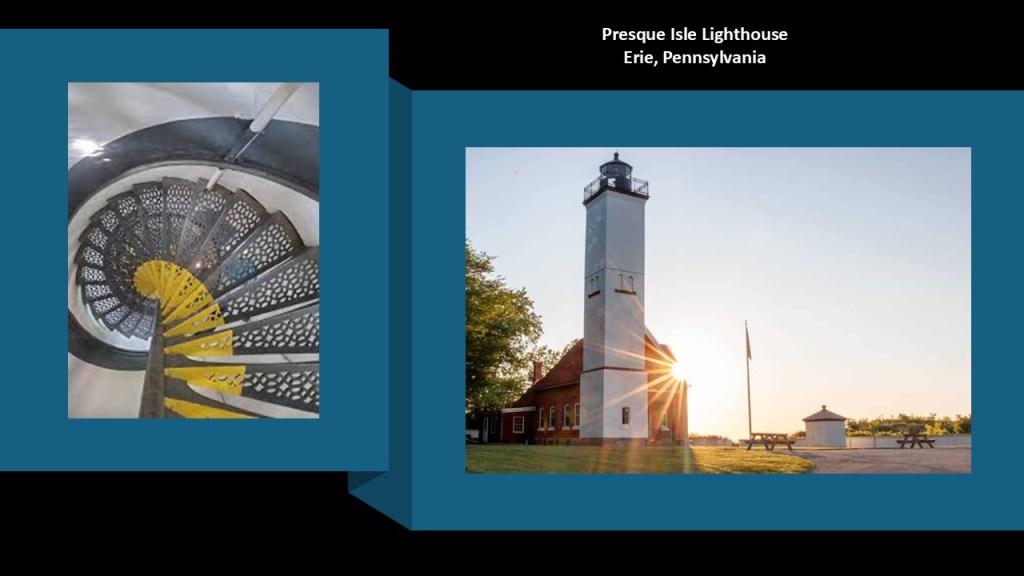
The North Pier Lighthouse was said to have been built in 1858, and guides vessels into Presque Isle Bay from Lake Erie.
It is the only surviving example of this wrought-iron square design in the United States.
It was said to have been forged in France and assembled on site in Erie.
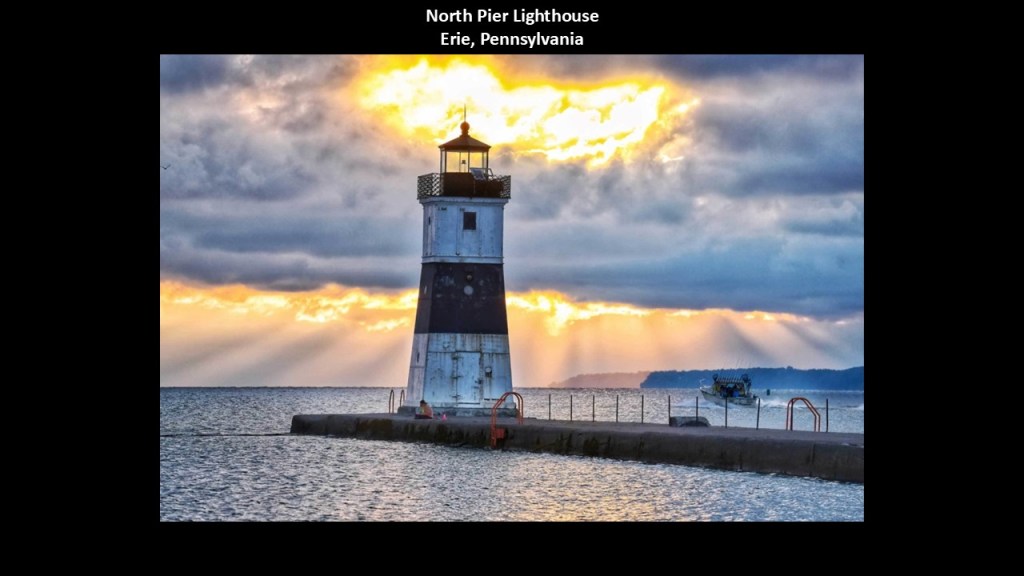
The lighthouse on the grounds of the former Erie Waterworks on the west-side was known officially as the “Waterworks Steel Intake Tower.”
It was said to have been built in 1906 to manage the municipal water intake pipe for the City of Erie.
It was restored in 2018, and the former waterworks has become a recreational area with water taxi service, picnic pavilions and playground equipment.
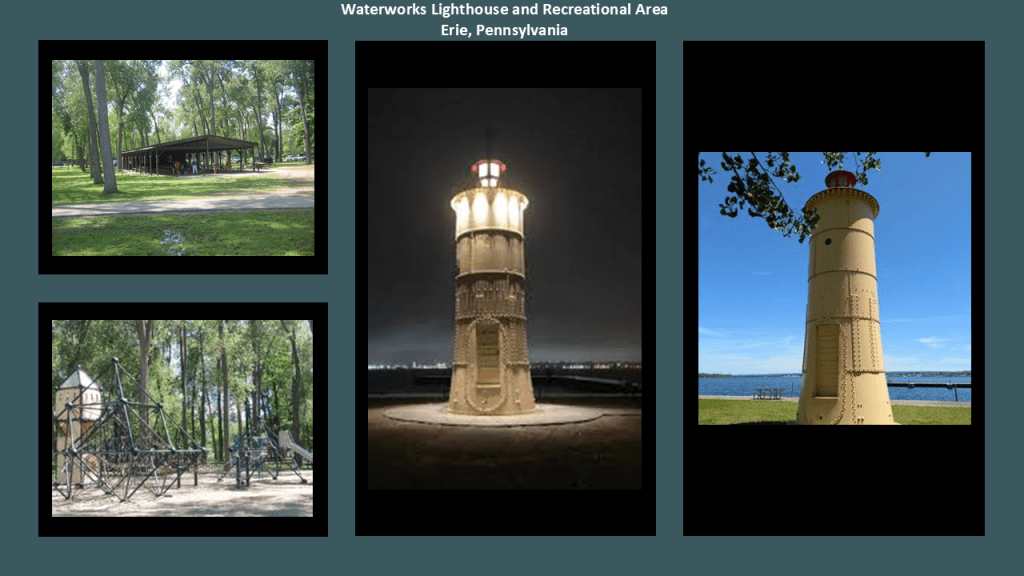
There’s a fourth lighthouse, the Erie Land Lighthouse, just to the southeast of Presque Isle State Park, and a few blocks north of the Seaway Trail, and east of the downtown area.
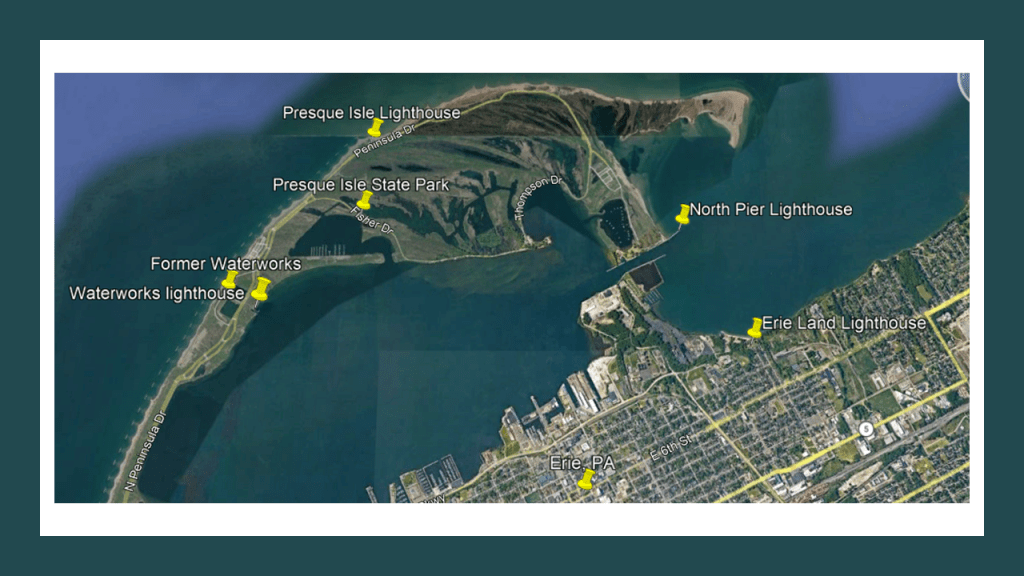
The Erie Land Lighthouse, also known as the Old Presque Isle Lighthouse, is located in Lighthouse Park on the bluffs overlooking Lake Erie.
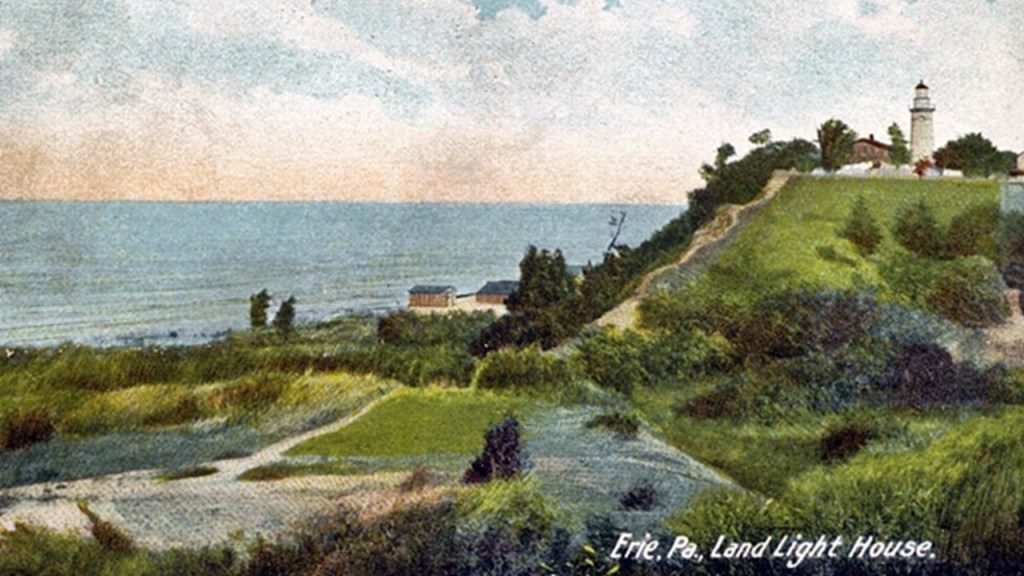
The lighthouse there today was said to have been built in 1867, and permanently decommissioned in 1899.
It is owned by the State of Pennsylvania and open to the public for seasonal tours.
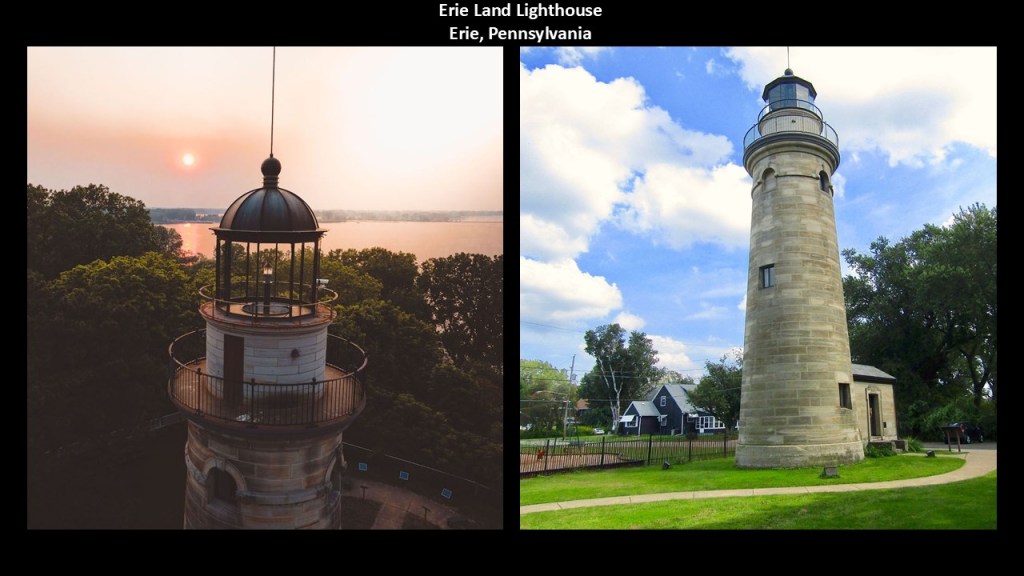
Waldemeer Park & Water World is in Erie, at the entrance to Presque Isle State park and located on the Seaway Trail.
It is billed, like Midway State Park on Chautauqua Lake, as one of only thirteen of the original trolley parks still operating as an amusement park in the United States, though what we see today is not what it used to be!
Waldemeer Park was first leased as a trolley park in 1896 by the Erie Electric Motor Company, and is the fourth-oldest amusement park in Pennsylvania, and the tenth-oldest in the United States.
Waldemeer has operated continuously since then under different owners, but the trolleys of the park are long-gone.
Trolley parks were said to have started in the United States in the 19th-century as picnic and recreation areas at the ends of streetcar lines, and were precursors to today’s amusement parks.
They were said to have been created by streetcar companies for reasons like giving people a reason to use their services on weekends.
By 1919, there were estimated to be between 1,500 and 2,000 such parks.
But like what we have already seen, these magnificent trolley parks went the way of the dinosaur too, along with countless electric streetcar lines, interurbans and railroad lines
I have come to believe that they were somehow involved with recharging the Earth’s energy grid for the original civilization in a really fun way, as they were located at the end terminals of streetcar lines, and were just utilized by the bringers-in of the world’s new system for a short time until they were no longer needed, or just plain inconvenient to the new narrative.
And there were lots of them throughout the Great Lakes region as we have already seen in this series, and will continue to see.
Erie was also an important railroad hub during the mid-19th-century.
We are told the first railroad station in Erie was established in 1851, and replaced in 1866 by the Romanesque Revival Union Depot seen on the left, which was demolished in 1925.
The current Art Deco Union Station in Erie on the right was said to have opened in 1927, and designed by Fellheimer and Wagner, an architectural firm credited with a bunch of railroad stations between 1923 and 1940.
Still in use as part of Amtrak’s Lake Shore Limited route, Erie is the only passenger stop in Pennsylvania.
The station’s ground floor is commercial space today, including a brew pub.
The Pittsburgh & Lake Erie Railroad was said to have been incorporated on April 1st of 1858, with operations starting in March of 1860.
Then on April 1st of 1870, the Pennsylvania Railroad took-over operations.
It was an 83-mile, or 134-kilometer, -long railroad between Girard just west of Erie, and points south around the Pittsburgh area.
This is an except from a book on the “History of Erie County.”
It makes reference to the following finds in “Chapter 5:”
“When the link of the Erie & Pittsburgh Railroad from the dock at Erie was in the process of construction, the laborers dug into a great mass of bones at the cross of the public road which runs by the rolling mill. From the promiscuous way in which they were thrown together, it is surmised that a terrible battle must of have taken place in the vicinity on some day so far distant that not even a tradition of the event has been preserved…” and that “…at a later date, when the roadway of the Philadelphia & Erie Road…was being widened, another deposit of bones was dug up and summarily disposed of as before. Among the skeletons was one of a giant….”

This newspaper article references Beaver Falls at the beginning about two skeletons of gigantic size that were found while workmen were “digging a ditch from the new shovel works to the river at Aliquippa.”
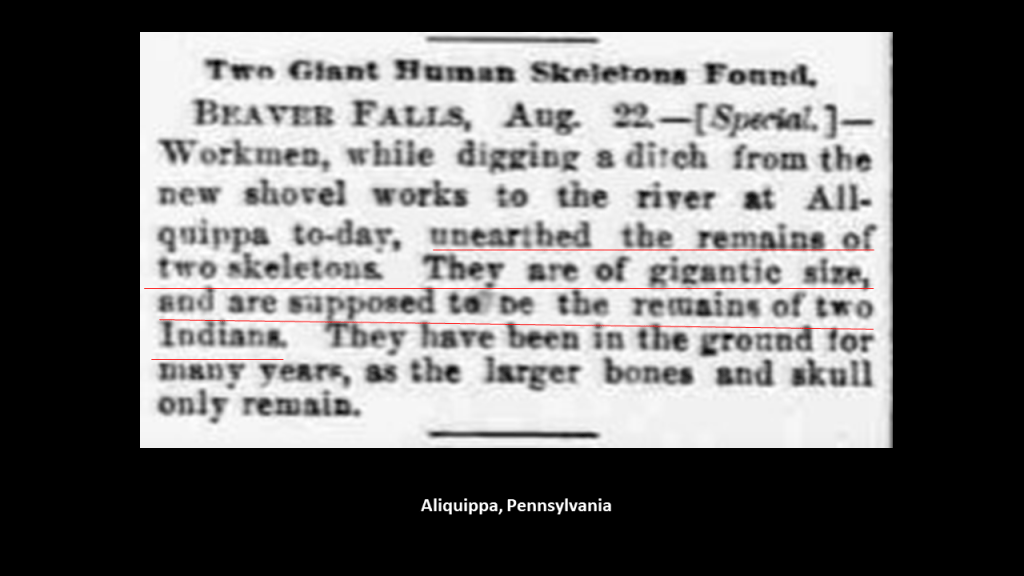
The area around Beaver Falls and Aliquippa were also on the Pittsburgh & Lake Erie Railroad line.
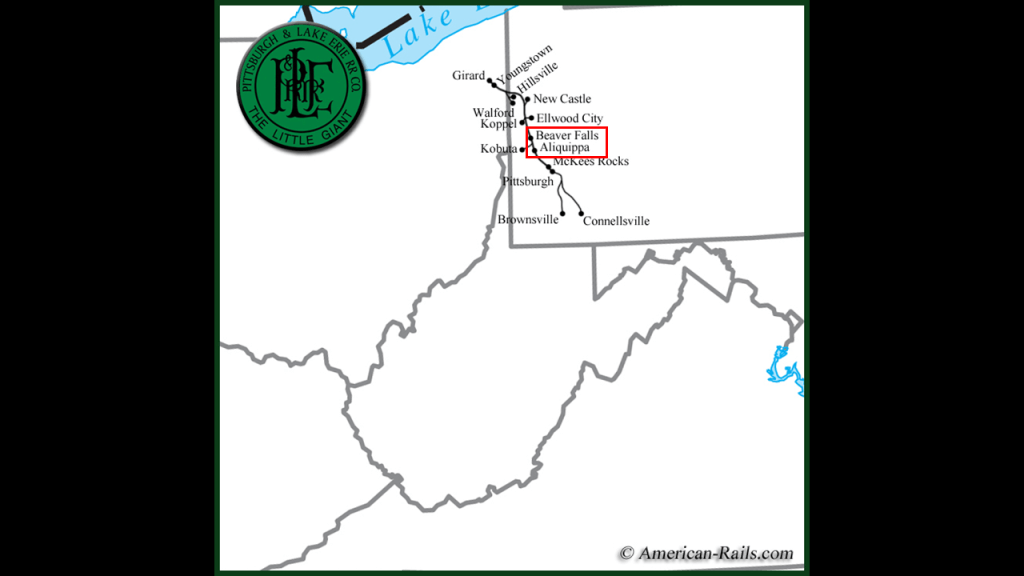
There was also an historic trolley park at Aliquippa, where giant skeletons were found.
One of Pittsburgh’s first amusement parks, it was said to have been established sometime in the 1880s by the Pittsburgh & Lake Erie Railroad as a way to bolster ridership, but by 1905 had fallen into disrepair, and the land was purchased by the “Jones and Laughlin Steel Corporation” that year to construct the “Aliquippa Works.”
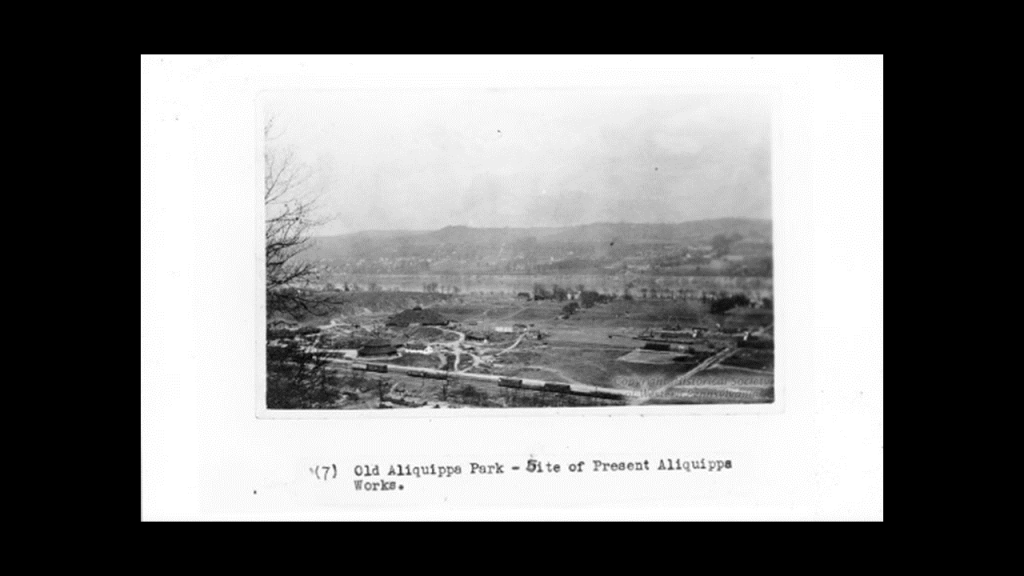
Today, it looks like what was the Pittsburgh and Lake Erie line followed what is now Pennsylvania State Route 18 going south out of Girard, through these same two towns of Beaver Falls and Aliquippa on its way to Pittsburgh; US-19 is just east of there, going south from Erie on its way to Pittsburgh; and Pennsylvania State Route 8 leaves Erie and heads south through Titusville on its way to the greater Pittsburgh area, which is 128-miles, or 206-kilometers, south of Erie.

Titusville was where the petroleum industry in the United States began in earnest in 1859 when Edwin Drake found oil on a piece of leased-land near Titusville, Pennsylvania, in what is now called Oil Creek State Park.
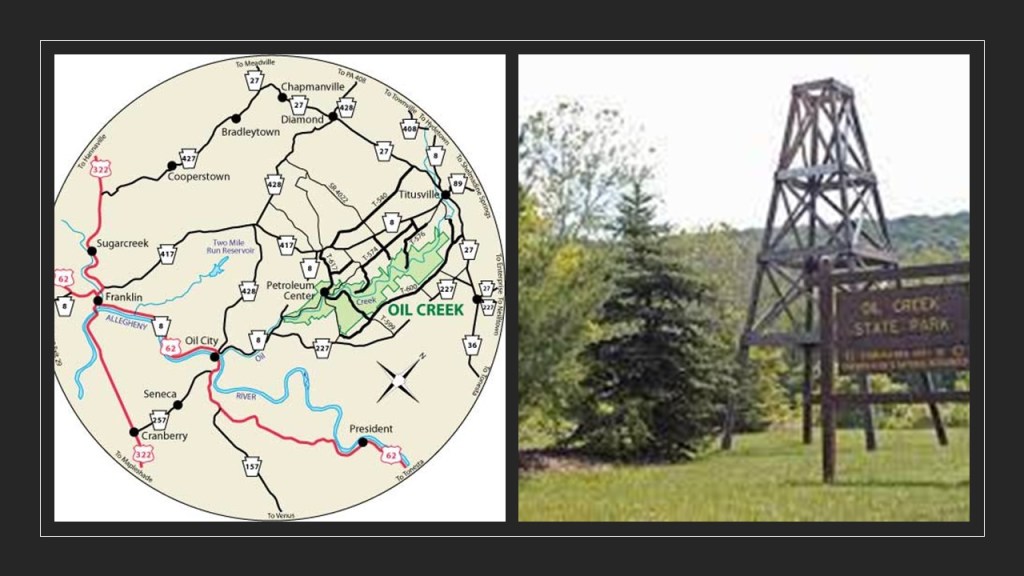
For this reason, Titusville is called the Birthplace of the Oil Industry, and for a number of years this part of Pennsylvania was the leading oil-producing region in the world.
Today, not surprisingly, the Oil Creek State Park Trail runs on the bed of the first railroad line to reach Titusville, the Oil Creek Railroad.
Samuel Kier had established America’s first oil refinery in Pittsburgh in 1854 for making lamp oil, just five-years before oil was “found” in Titusville.
So it certainly appears like the petroleum industry was developed in the 1850s in order to provide a replacement energy technology for the free energy technology of the original civilization.
Roughly a decade after the birth of the oil Industry at Titusville, the Standard Oil Company was founded in 1870 by John D. Rockefeller, along with Henry Flagler, an American Industrialist and major developer in the state of Florida, which was an American oil producing, transporting, refining, and marketing company.

Oil was used in the form of kerosene throughout the country as a light source and heat source until the introduction of electricity, and as a fuel source for the automobile, with the first gas-powered automobile having been patented by Karl Benz in 1886.
There are three waterfalls between Titusville and Oil Creek State Park: the Boughton Falls; Plum Dungeon Falls; and the Pioneer Falls.
All three waterfalls are in Oil Creek State Park in Venango County.
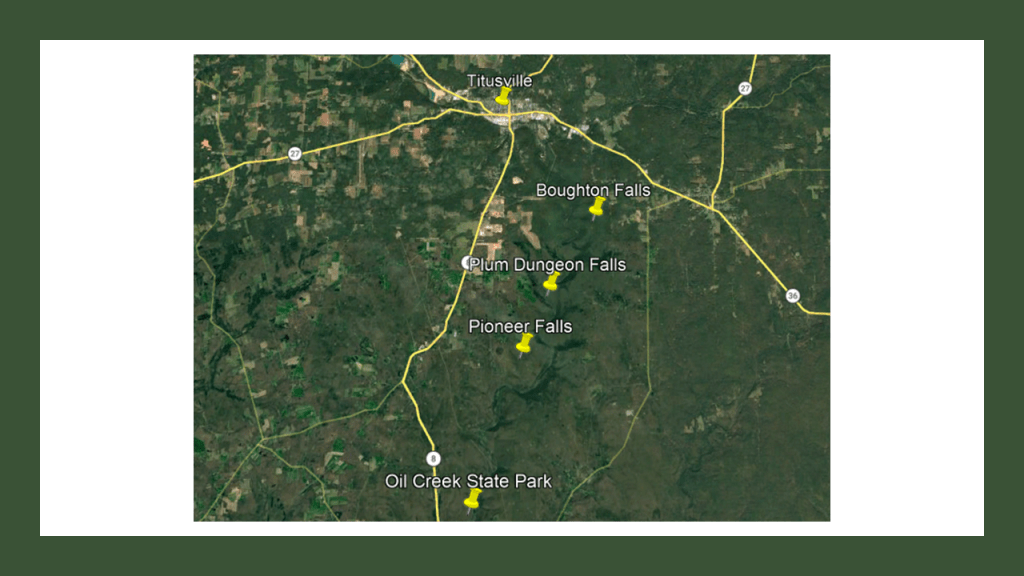
Boughton Falls is located on the northern end of Oil Creek State Park.
It has a 35-foot, or 11-meter, -drop , and accessible from the Oil Creek Trail.
The Boughton Falls are on what is called “Boughton Run,” which empties into Oil Creek, but are not considered to be on Oil Creek itself.
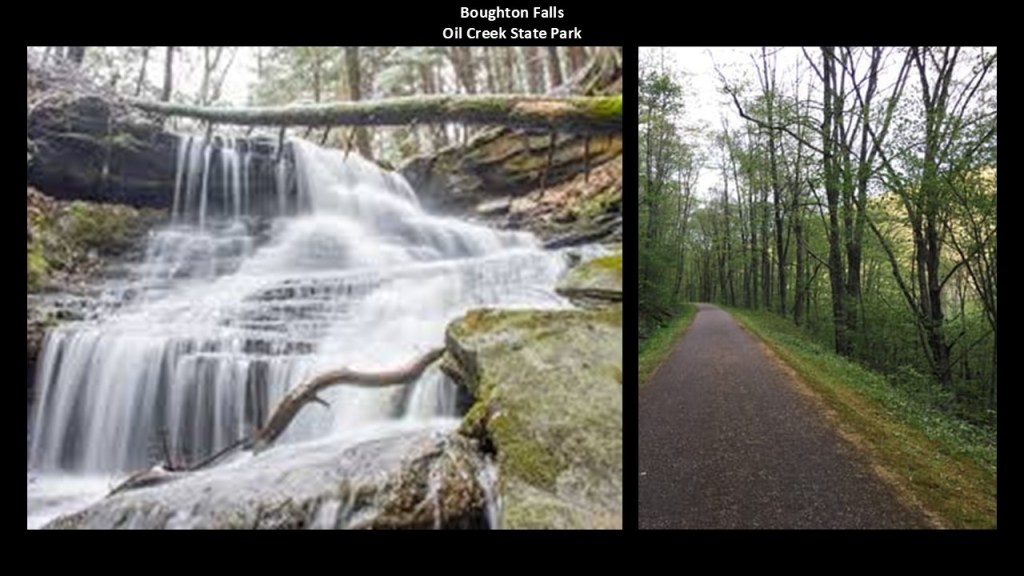
The Plum Dungeon Falls with a height of 60-feet, or 18-meters, are a seasonal waterfall that can really only be seen from a distance.
The Plum Dungeon Falls are located in the northeastern part of Oil Creek State Park on Gerard Trail, a 36-mile or 58-kilometer, – long hiking trail that encircles the park.
The trail from there that leads to the falls is accessed by crossing the Historic Miller Farm Iron Bridge.
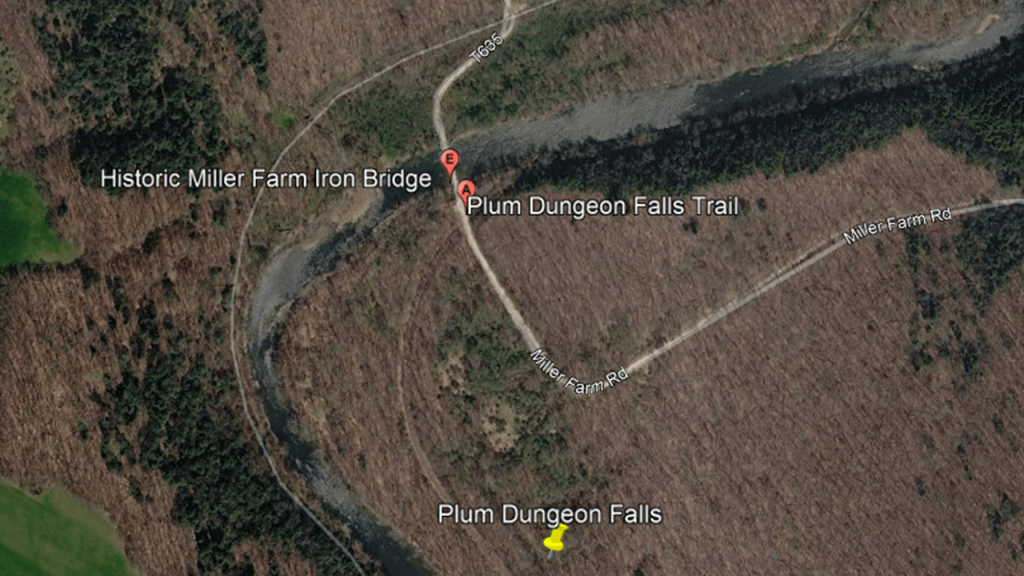
The Miller Falls Road Iron Bridge in Oil Creek State Park was said to have been constructed in 1888 by the Massillon Bridge Company of Massillon, Ohio.
It is considered to be one of the most beautiful bridges in Venango County and an example of a steel truss bridge.
We are told it was set to be demolished but was rehabilitated instead.
The Pioneer Falls are also on the Gerard Trail in Oil Creek State Park and accessed from Pioneer Road.
They are described as a seasonal cascade waterfall on what is called Pioneer Run with a height of 15- to 20-feet, or 5- to 6-meters, that also flows into Oil Creek.
The valley around Pioneer Run was heavily drilled during the first oil boom in the 1860s.
The nearby ghost town of Pioneer is called a short-lived oil boom settlement that was located near the mouth of Pioneer Run.
It was formed after oil was discovered here in 1859 and between 1862 and 1865, major wells were drilled here, reportedly producing 2,500 barrels of oil per day.
In its hey-day, there was even a railroad station here, but by the 1870s, oil production had dropped and the town was abandoned.
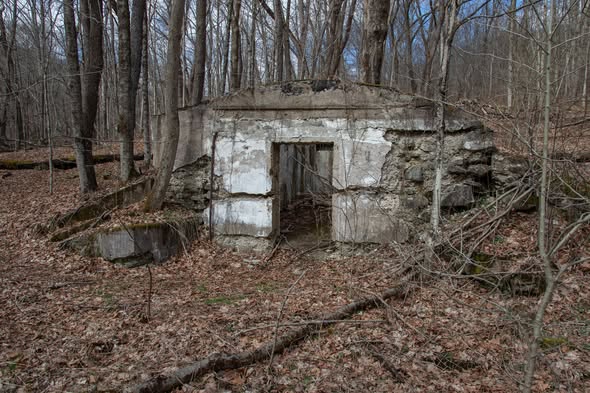
The Oil Creek and Titusville Railroad these days is a 16.5-mile, or 27-kilometer, -long or tourist railroad that runds from Titusville to Rynd Farm north of Oil City at the southern end of Oil Creek State Park on tracks that were originally part of the mainline of the Buffalo, New York, and Philadelphia Railroad in the 1880s.
After mergers over the years, it became Penn Central in 1968, and after Penn Central went bankrupt in 1976, and was absorbed into Conrail.
In 1986, it was acquired from Conrail by the Oil Creek Railway Historical Society and tourist trains started running in July of that year, and freight operations began in September.
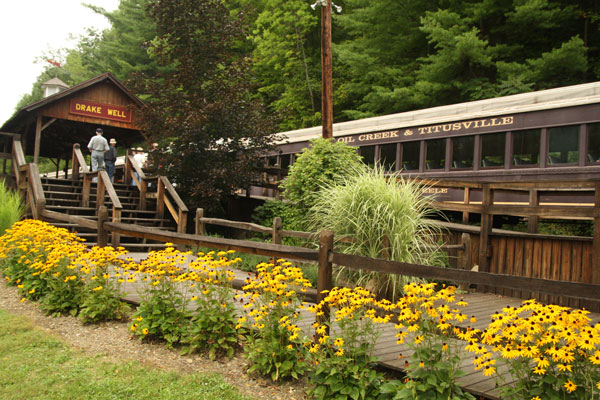
Hector Falls is located northeast of Titusville and West Hickory.
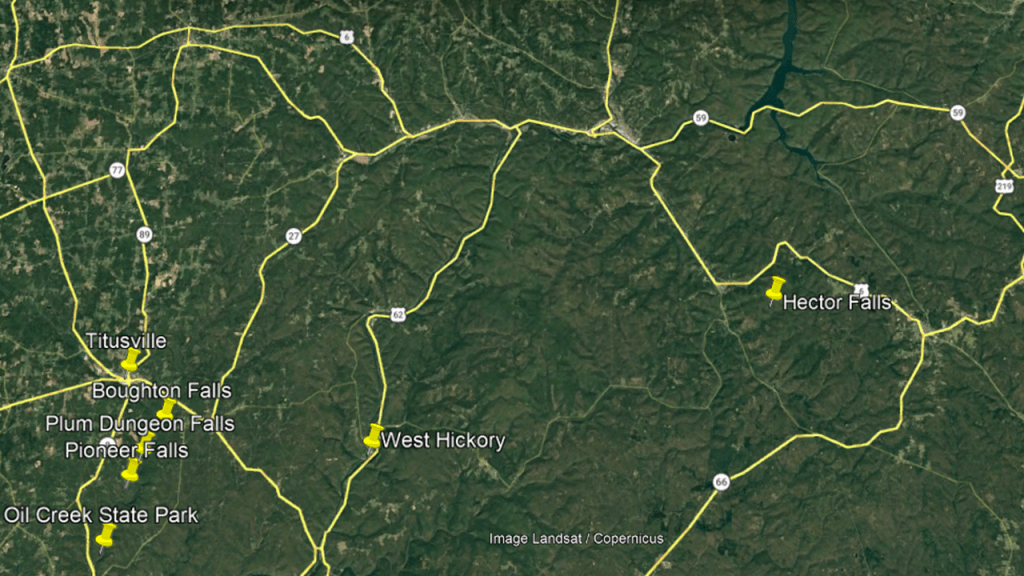
Hector Falls in the Allegheny State Forest in Pennsylvania are described as flowing from a height of 22-feet, or 6.71-meters, from a “rectangular-shaped” rock-face, in the middle of what looks exactly like a wall.
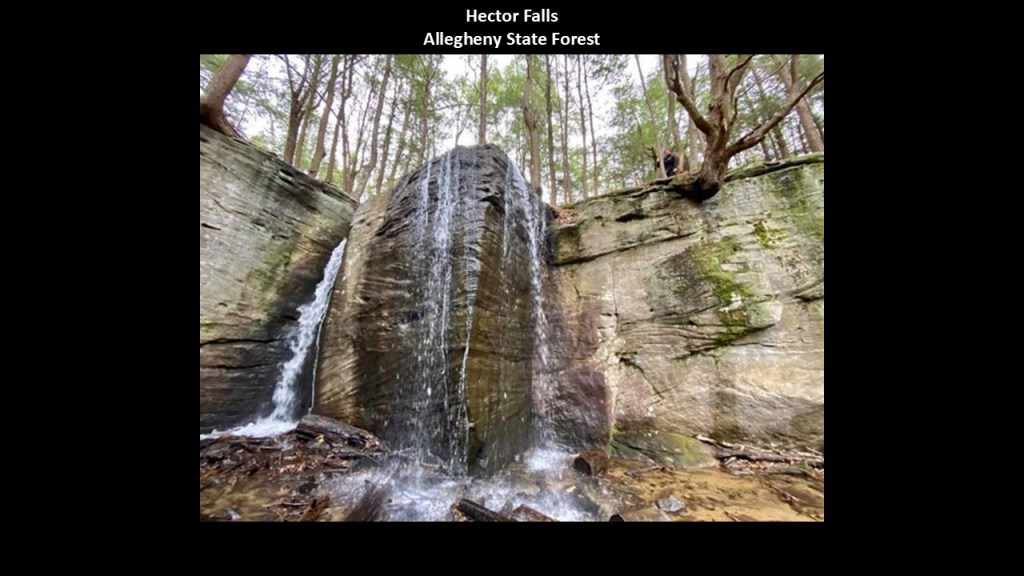
More of the same kind of thing that we saw at the Panama Rocks Scenic Area and Rock City State Park is found throughout the Allegheny National Forest, like what looks like a “rock city” on the popular “Minister Creek Trail.”
The “Minister Creek Trail” is 6.6-miles, or 10.6-kilometers, -long, and is popular for hiking and backpacking.
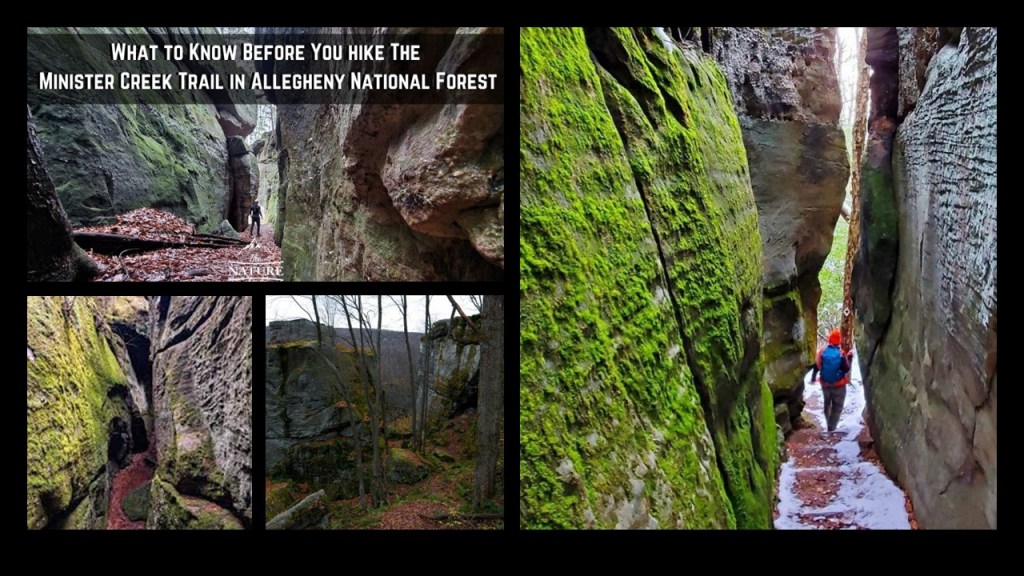
Next, I am going to turn my attention to West Hickory, where the tallest recorded skeleton in North America was found, at 18-feet, 5.5-meters.
West Hickory is 14-miles, or 23-kilometers southeast of Titusville; 12-miles, or 20-kilometers, east of Oil Creek State Park, in Oil City; and 21-miles, or 34-kilometers, from Sheffield, Pennsylvania, where Hector Falls and the Minister Creek Trail are nearby in the Allegheny National Forest.
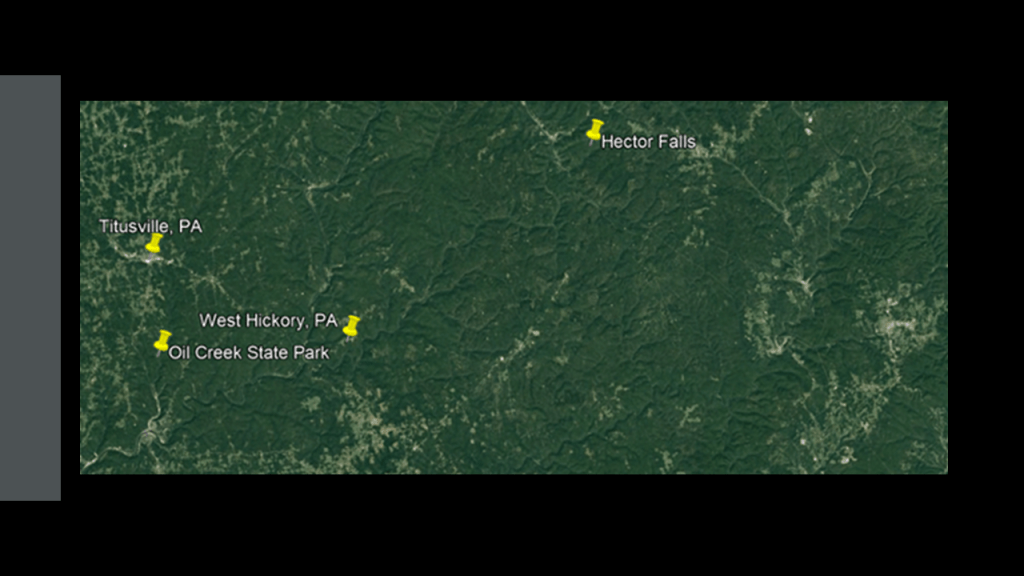
Here is an article from the “Oil City Times” that was in the “Marysville Tribune” of Marysville, Ohio, dated January 26th of 1870.
At the top of the article, it referenced the “Cardiff Giant Outdone” and the alleged discovery of the skeleton of a giant in the oil regions.
So first I looked up the “Cardiff Giant” to find out more about it.
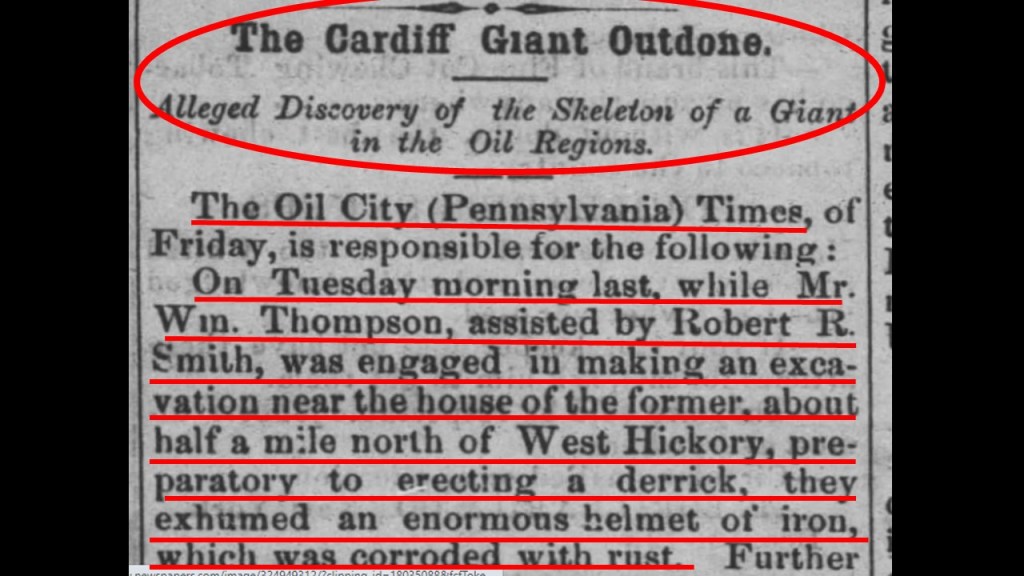
What we are about the “Cardiff Giant” is that it was one of the most famous archaeological hoaxes of all time.
In October of 1869 in Cardiff, New York, workers digging a well behind the barn of William “Stub” Newell, uncovered a 10-foot, or almost 3-meter, -tall, 3,000-pound, or 1,371-kilogram, petrified giant man.
Subsequently, Newell covered the giant with a tent and turned it into a local attraction, drawing a lot of attention from visitors.
The fraud was said to have been perpetrated by a New York tobacconist named George Hull, who wanted to fool people as to how easy it would be to create a giant.
The narrative says that in 1868, only three-years after the end of the American Civil War, Hull hired men to quarry a ginormous block of gypsum from Fort Dodge, Iowa, and had it shipped to Chicago to have it sculpted into a giant.
Then Hull had it shipped to the farm of his cousin William Newell in New York in November of 1868, where it was buried in a hole. Then, after almost a year had passed, Newell hired to men to dig the “well” where they found the giant.
The “Cardiff Giant” in short-time was sold to a syndicate, who moved it to Syracuse, New York, for exhibition.
By December of 1869, the “Cardiff Giant” was said to have been exposed as a fraud.

I found out about the Taughannock Giant when I was looking into the Taughannock Falls State Park in the Finger Lakes region in Part 5 of this series on the New York-side of Lake Ontario.
Workmen widening a carriage road near the Taughannock House Hotel in July of 1879 uncovered of the petrified body of a 7-foot, or over 2-meter, -tall man.
We are told that over 5,000 people paid a small admission fee to see the 800-pound, or 363-kilogram, giant, but that after a short time, it was revealed to be a hoax perpetrated by the hotel’s owner and two of his associates.
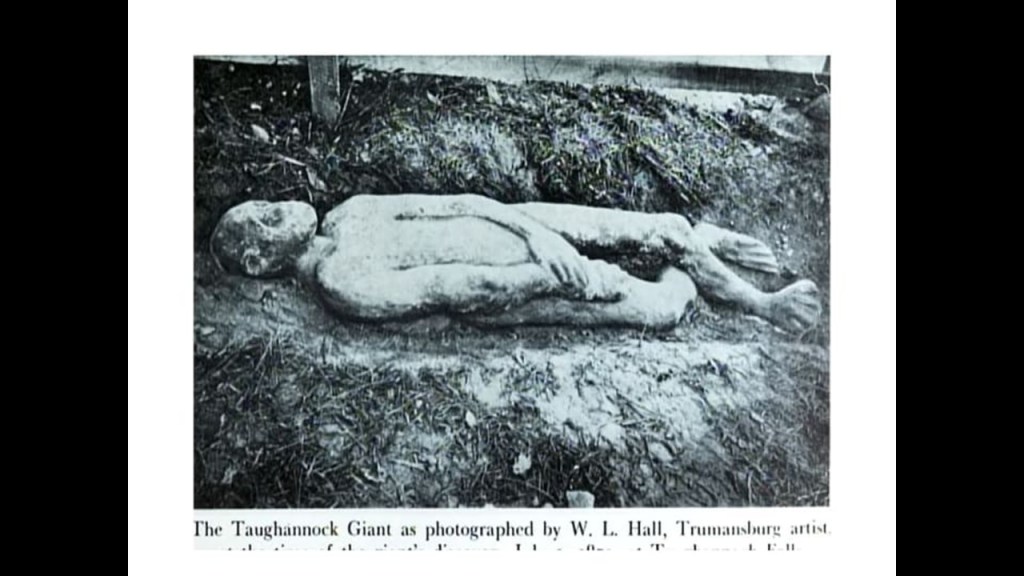
The original giant was said to be damaged and lost, but local artists constructed a replica for the Tompkins Center for History and Culture in 2019.
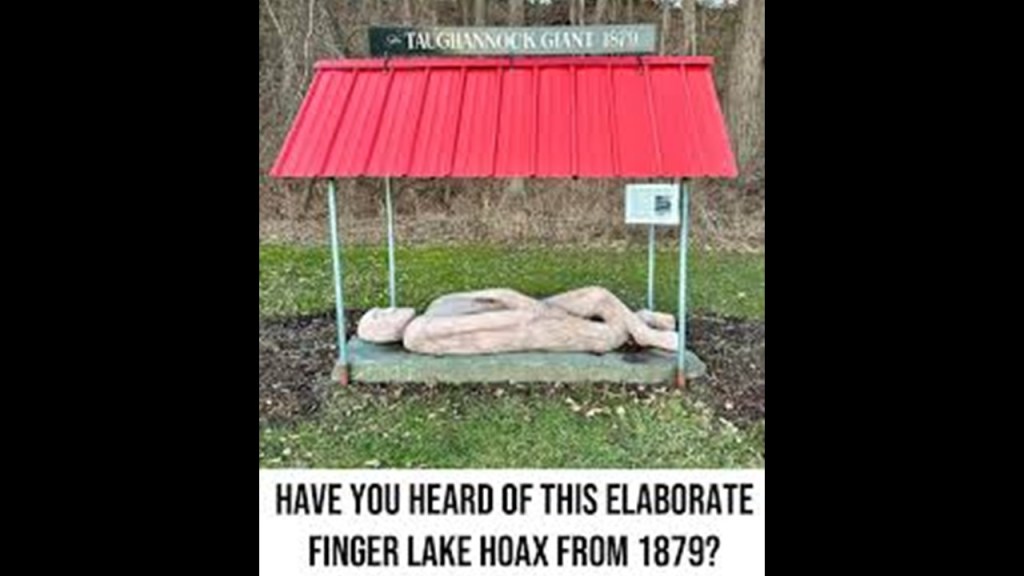
So, now let’s see what the 1870 newspaper article has to say with regards to the giant that was found at West Hickory.
Two men excavating near West Hickory in preparation for erecting a derrick first exhumed an enormous rusty helmet of iron…

…and then they unearthed a 9-foot, or almost 3-meter, – long sword.
So they made the hole bigger, and soon came upon the bones of two enormous feet.
After a few hours, they unearthed the well-preserved skeleton of an enormous human.
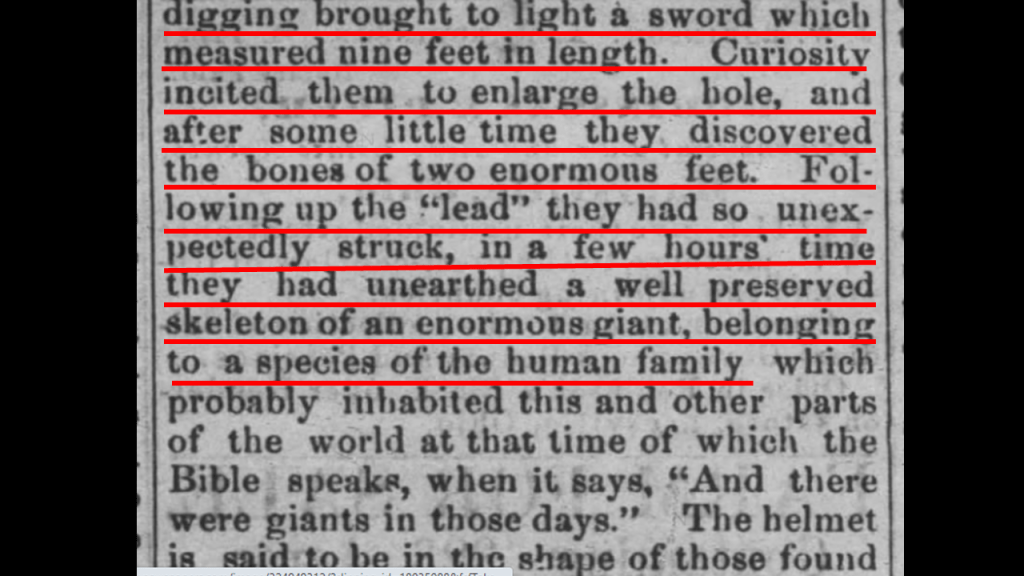
The bones of the skeleton were described as “remarkably white;” the double- teeth all in place, of extraordinary-size; and that when the giant was alive, he must have stood 18-feet, or 5.5-meters, in stockings.
The relics were being viewed in nearby Tionesta before being sent on to New York.
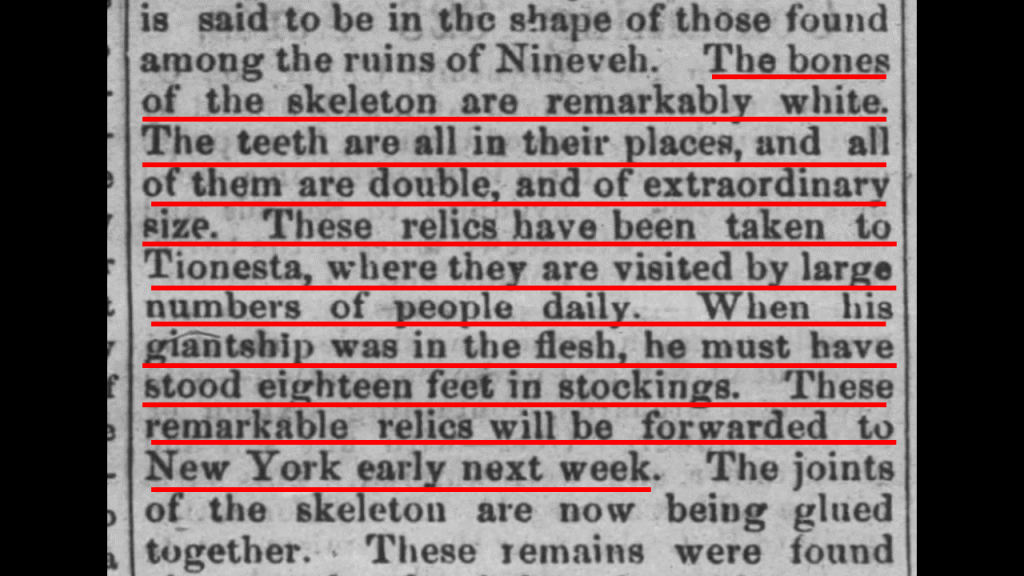
And lastly, the bones were said to have been found about 12-feet, or 3.5-meters, below the surface of a mound, and the mound was not more than 3-feet, or less than a meter, above the level of the ground around it.

So to put that into visual perspective, this garage has 12-foot, or 3.5-meter, – high walls, so the giant’s bones were found that far below the surface of a mound, which was another 3-feet, or almost 1-meter, higher than the ground.
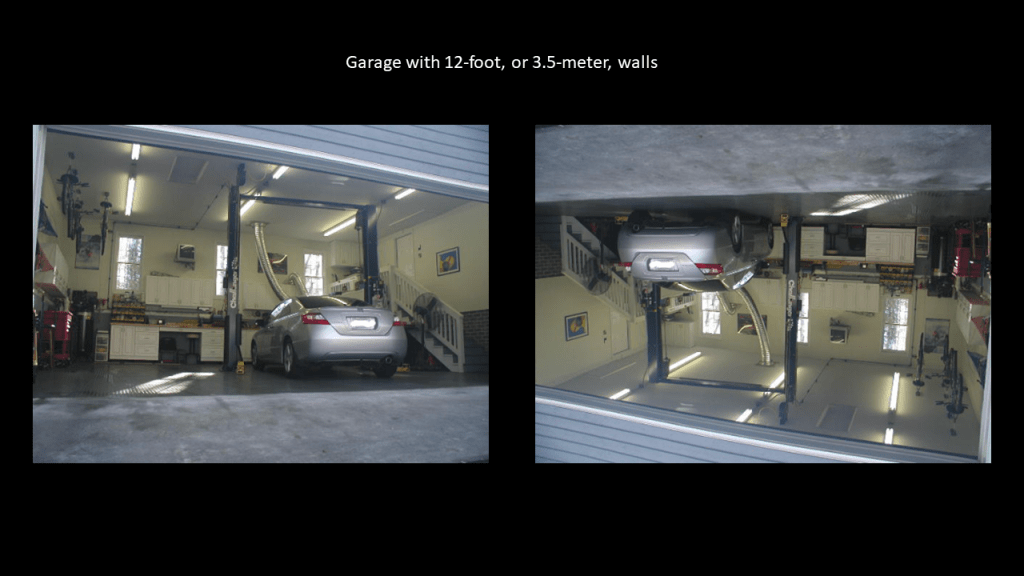
Next I am going to look at the Erie Bluffs State Park and Howard Falls just to the southwest of Erie, Pennsylvania, and then head south to Conneaut Lake, Pennsylvania.
This is all right before we reach the Pennsylvania – Ohio State Line.
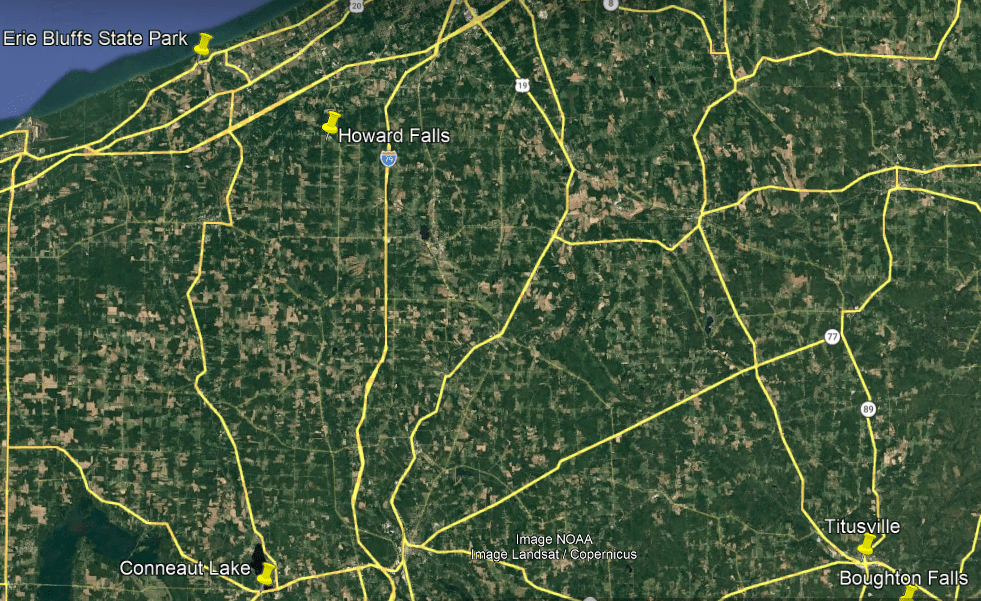
The Erie Bluffs State Park is the largest stretch of undeveloped land overlooking Lake Erie in Pennsylvania.
It is just west of Lake City, and north of the Seaway Trail and the railroad tracks.
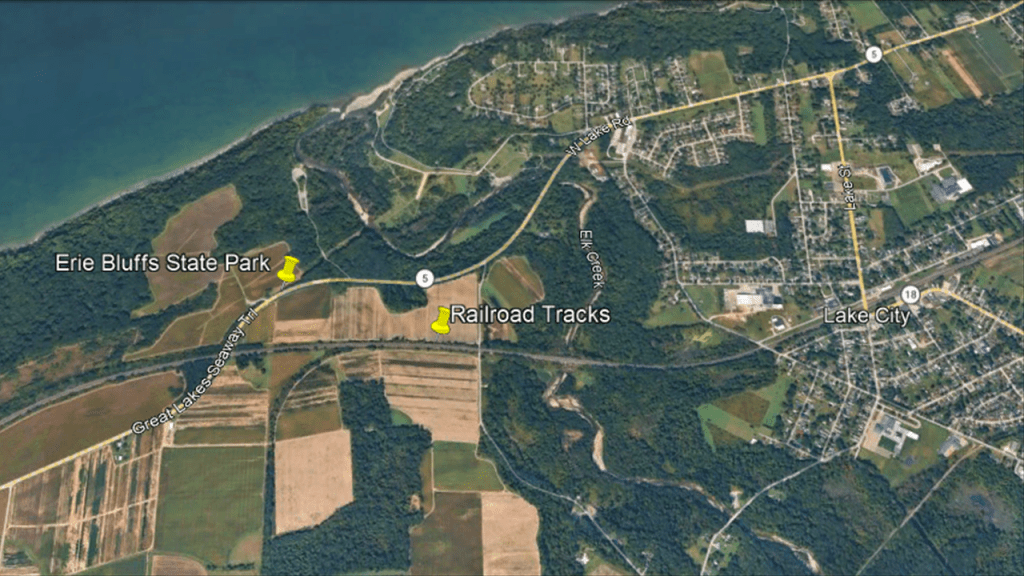
Within the 587-acre, or 238-hectare, state park, there are things like bluffs up to 90-feet, or 27-meters, – tall, and patches of old-growth forest.
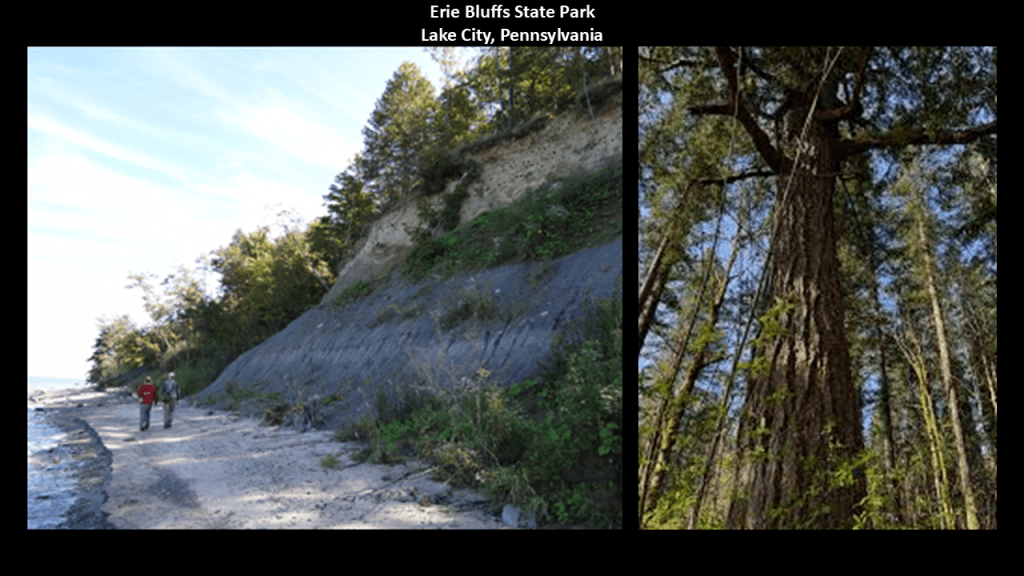
With almost 4-minutes of totality, the Erie Bluffs State Park was one of four state parks in Pennsylvania that were in the Path of Totality for the Annular Solar Eclipse of April 8th of 2024, the other three state parks being Presque Isle; Pymatuning; and Maurice K. Goddard.
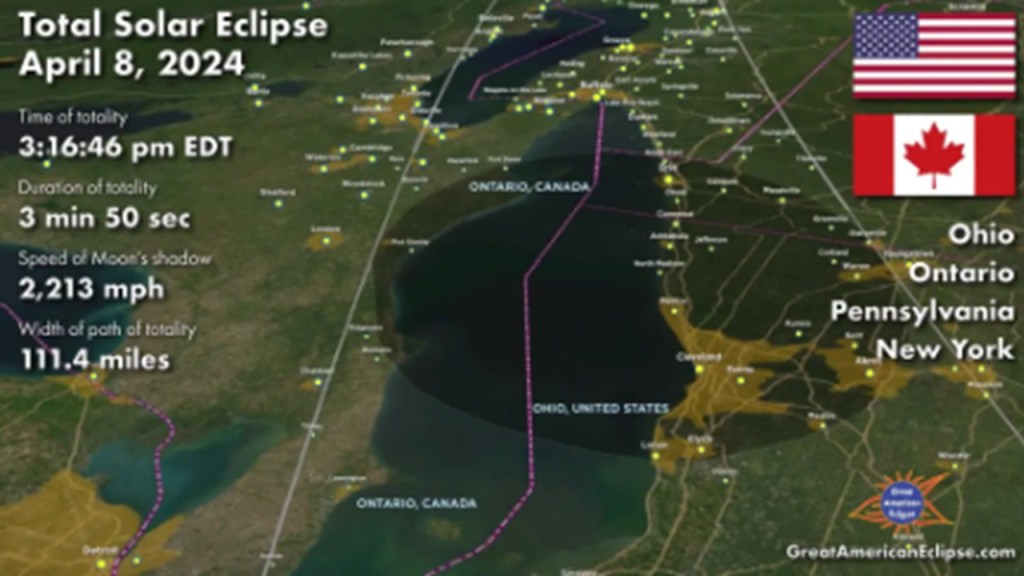
Total solar eclipses occur when the moon completely blocks the view of the sun, and are only visible along a narrow track of the Earth’s surface.
For a few moments during totality, when the moon completely covers the sun, the day becomes night, the horizon displays the colors of sunset, and the heavenly bodies usually seen only at night appear.
There were two total solar eclipses occuring in the United States in a seven year time-frame, with the first one occurring on August 21st of 2017.
The 2017 eclipse traveled from northwest to southeast and the 2024 eclipse travelled from southwest to northeast, and their paths crossed each other in Carbondale, Illinois.
The 2024 Eclipse passed through or near nine cities named Salem.
The 2017 Eclipse passed through seven cities named Salem.
Just a coincidence…or did the builders of this ancient advanced civilization know exactly where they were in place, time and space?

The Giant City State Park, located just south of Carbondale in Makanda, Illinois, and another massive “rock city,” experienced the longest period of totality during the 2017 eclipse, at 2-minutes, and 40-seconds, and was also in the path of totality in 2024 for almost 4-minutes, though did not have the longest period, which was in Nazas, Mexico.
Here is another clipping from a publication on the subject of giants.
Talking about the Great Lake Region, it says “Long Before the Indians…it is believed to have been inhabited by a superior people – of whom not even a tradition remans – whose only monuments are earthworks and tumuli (another word for burial mounds), scattered here and there, in some places containing bones from men of gigantic size.”
It goes on to say further “Mounds and relics from these “Mound Builders” were formerly abundant throughout the Ohio and Mississippi Valleys, especially in this section. If a separate race from the Indians, when and by what agency they were destroyed will probably remain a mystery as deep as that of the lost island “Atlantis.”
So this acknowledges the presence of giants here who were Mound Builders, but shrouds what happened to them in mystery, just like the lost Atlantis, saying we don’t know who they were, or really anything about them, except that they were a superior people.
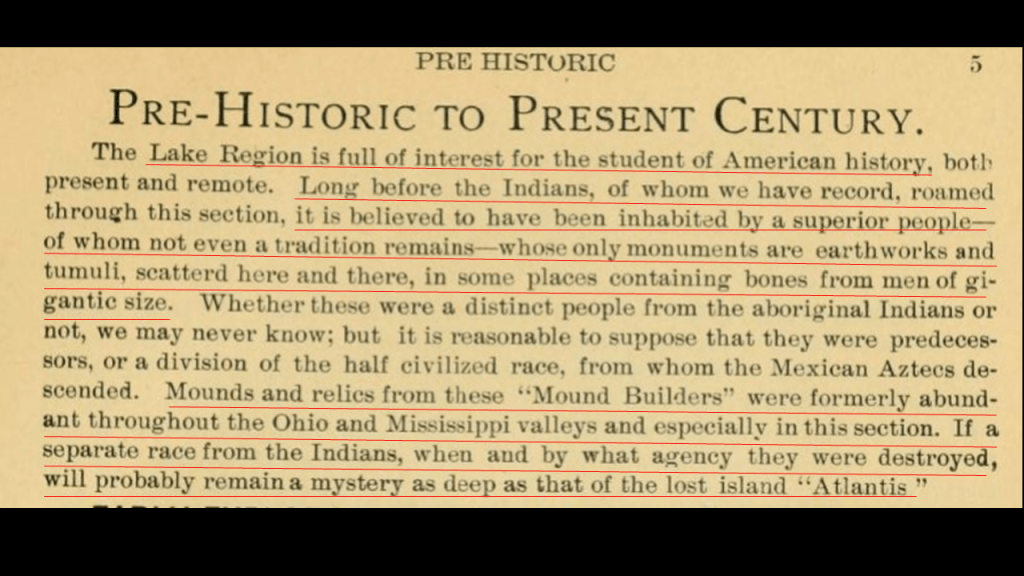
It is interesting to note that researchers have long suspected the Smithsonian to have played a role in the cover-up of giants.
Back in the day, giant skeletons were displayed in public places and mentioned in newspaper articles, but all that went away

On the one-hand, there are reports that the Smithsonian admitted to the destruction of thousands of giant human skeletons in the early 1900 as the result of a U. S. Supreme Court ruling, and on the other hand, there are fact-checkers vigorously debunking this as a satirical claim and false.
Why is there such a contradiction of information, and vehement denial on the subject of giant skeletons, when there were historical records of their existence?

The existence of giants are pushed way back in time in our historical narrative, with what happened to them being a mystery.
I think the giants were buried right where they stood when whatever destroyed the energy grid took place.
Yes, they were reported to be found at mounds, but they were also randomly uncovered when people were digging.
A sudden cataclysmic event, creating swamps, deserts, and even submerging entire landmasses around the Earth, would account for how a highly advanced worldwide civilization of giants could be wiped from the face of the Earth and erased from our collective memory.
The next place I want to take a look at is the Howard Falls in Girard, the largest falls in Erie County, Pennsylvania.
It is in the Falls Run Gorge, and is described as cascading over a large, rock outcropping, approximately 33-feet, or 10-meters, -wide and 40-feet, or 12-meters, -high.
The land that the falls occupy has been privately-owned by the Howard family for 180-years, and while not open to the public to see close-up, they are viewable from the public Falls Road.
The Falls are close to the Howard Quarry in Girard, an inactive stone quarry operated by the Howard family starting in 1839.
The Howard Quarry was said to have provided the local hard sandstone for the Erie County Courthouse in Erie, the west wing of which was said to have been constructed between 1852 and 1853.
The matching east wing was said to have been constructed in 1930, during the Great Depression.
Next, I am heading down to Conneaut Lake, Pennsylvania, because I know there was an historical trolley park there.

The historic Exposition Park was founded there in 1892 by Colonel Frank Mantor, owner of the Conneaut Lake Exposition Company, with a stated purpose of being a permanent fairground and exposition for livestock, machinery, and industrial products.
Ownership of the park transferred to the railroad in 1901, and in 1907 trolley service was said to have been extended to the park.
Then the following year, in 1908, Many of the park’s original buildings were lost in a fire.
We are told that while arson was suspected as a cause of the fire at the time, it was never proven.

An amusement park at Conneaut Lake has existed under various ownership over the years, but as of the 2020s it is no longer a full-scale amusement park, but instead a partial event venue with remnants of the park.

Now I am going to head back to the Lake Erie shore where we cross the state-line and go into Ohio from Pennsylvania.
The first cities we come to are Conneaut and Ashtabula, both of which have lighthouses.
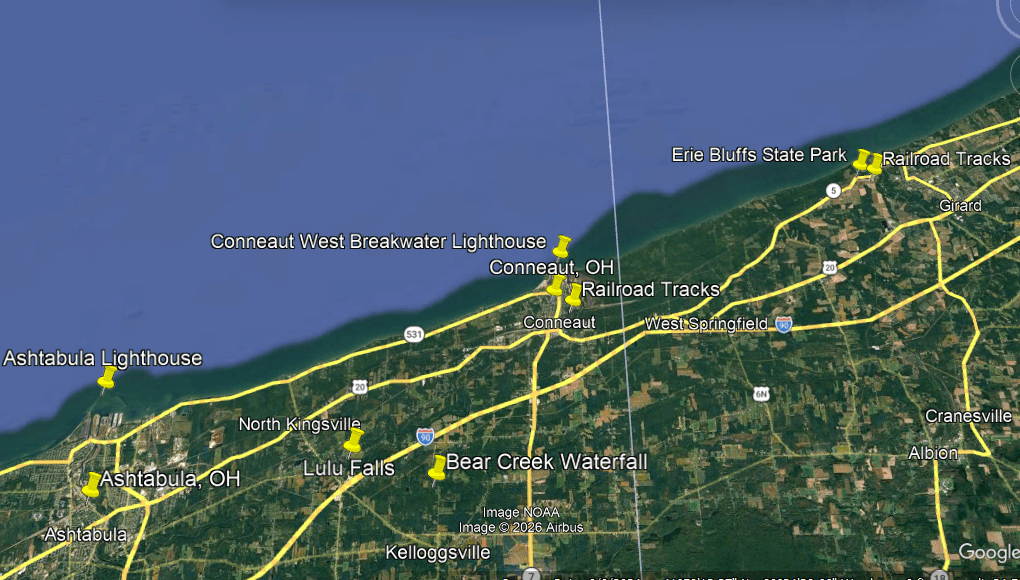
First, Conneaut.
Conneaut is the northernmost city in Ohio at the entrance on Lake Erie of Conneaut Creek.
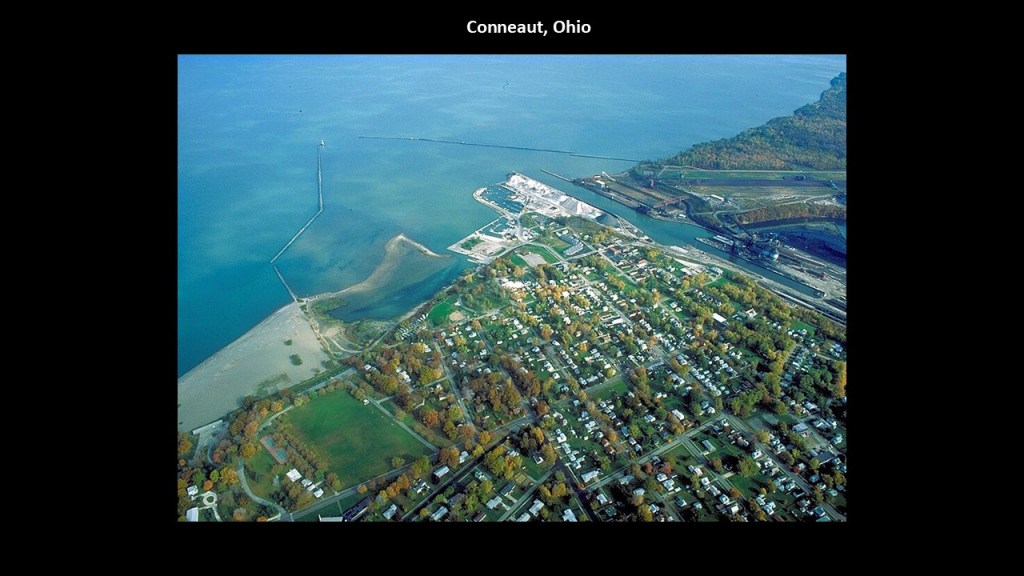
We are told the land was first surveyed by the Connecticut Land Company in 1796, and the first permanent settlement was in 1798.
The Connecticut Land Company was a land speculation company that formed in the late 18th-century to survey and encourage settlement in the eastern parts of the newly chartered “Connecticut Western Reserve” of the former “Ohio Country,” which was part of the highly-prized “Northwest Territory.”
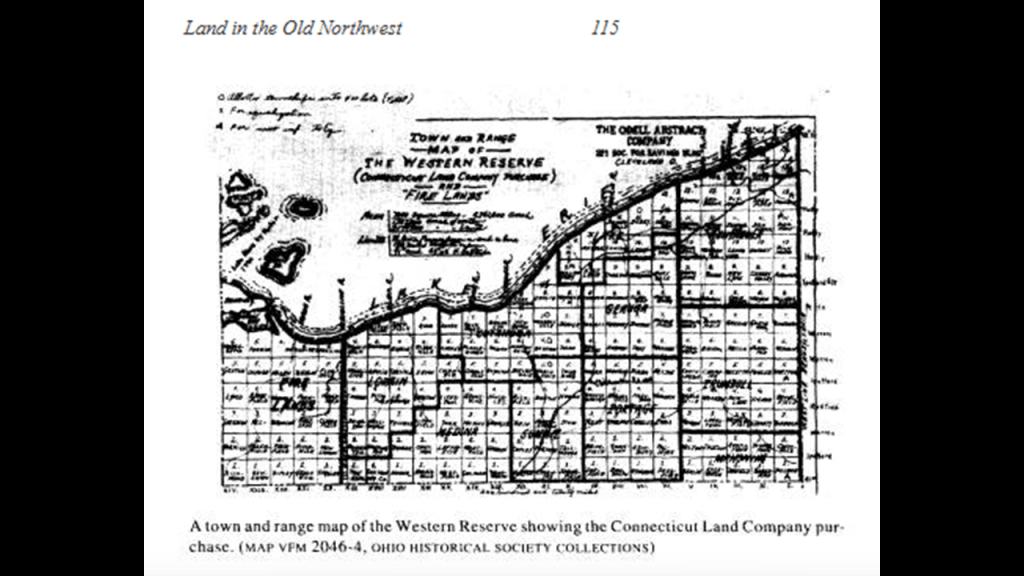
The Connecticut Land Company purchased 3-million-acres, or 12,000-kilometers-squared, of the western reserve in Northeast Ohio, in 1795, and settlers demanded that the land be surveyed prior to settlement per the Land Ordinance of 1785, in which was a standardized system by which settlers could purchase title to farmland in the West.
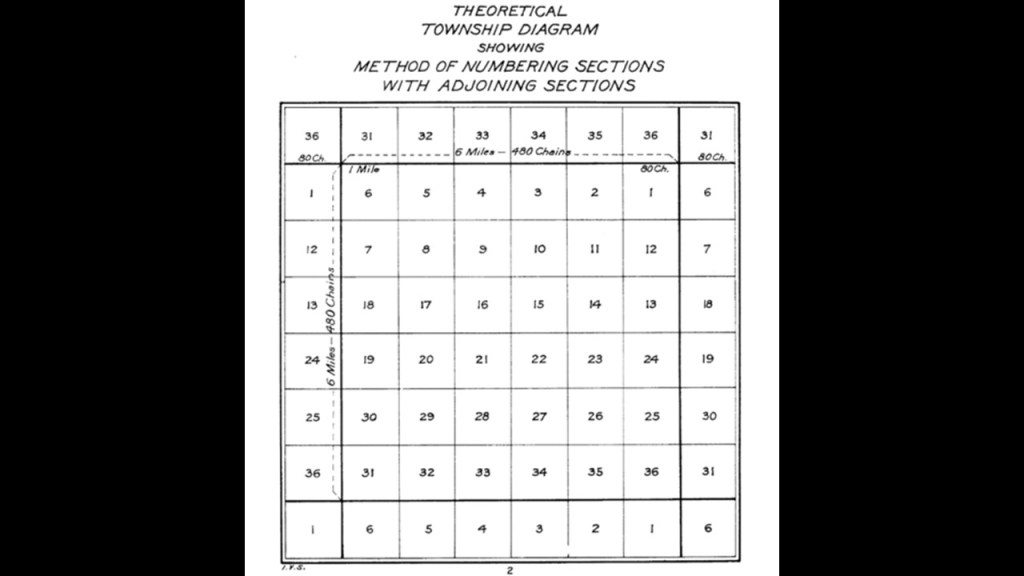
This is what we are told in our historical narrative.
The Northwest Indian War took place in this region between 1786 and 1795 between the United States and the Northwestern Confederacy, consisting of Native Americans of the Great Lakes area.
The Territory had been granted to the United States by Great Britain as part of the 1783 Treaty of Paris at the end of the Revolutionary War.
The area had previously been prohibited to new settlements, and was inhabited by numerous Native American peoples.
The British maintained a military presence and supported the Native American military campaign.
While the Northwestern Confederacy had some early victories, they were ultimately defeated, with the final battle being the “Battle of Fallen Timbers” in August of 1794 in Maumee, Ohio, which took place after General Anthony Wayne’s Army had destroyed every Native American settlement on its way to the battle.
Outcomes were the 1794 Jay Treaty, named for Supreme Court Chief Justice John Jay, the main negotiator with Great Britain.
As a result, the British withdrew from the Northwest Territory, but it laid the groundwork for later conflicts.

The 1795 Greenville Treaty that followed forced the displacement of Native Americans from most of Ohio, in return for cash and promises of fair treatment, and the land was opened for settlement.
The Conneaut West Breakwater Lighthouse is the only lighthouse here now.
It was said to have been completed in 1936 to replace one that had been built on the breakwater in 1920, which had to be demolished because of major changes to the breakwater.
It is a 60-feet, or 18-meters, -tall steel tower said to have been constructed in the Art Moderne-style, a design-style of the 1930s and 1940s said to have evolved from Art Deco of the 1920s.
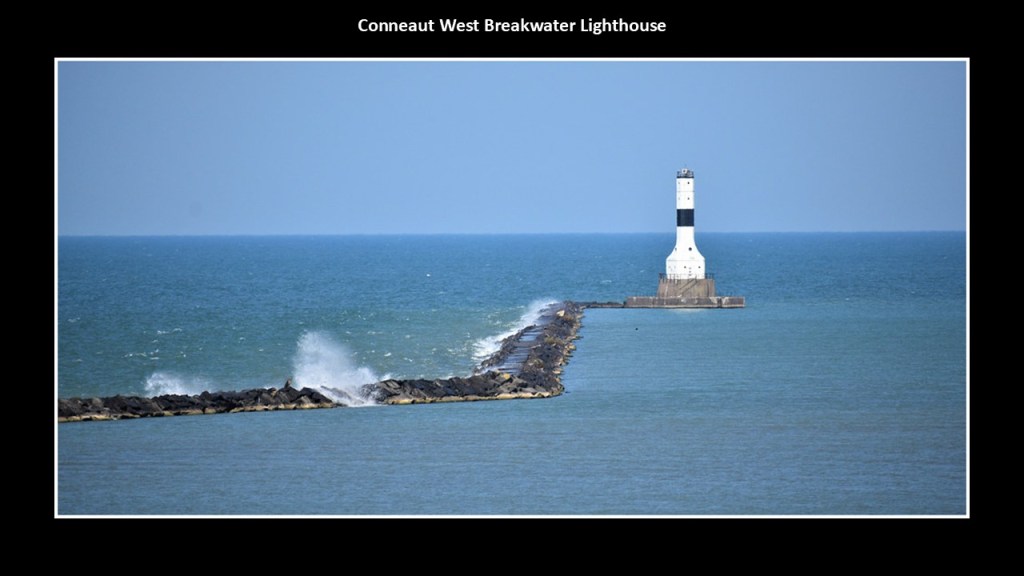
We are told that the first lighthouse was built in Conneaut in 1835 and that as its importance as a shipping port grew, it had multiple lighthouses and pierhead beacons.
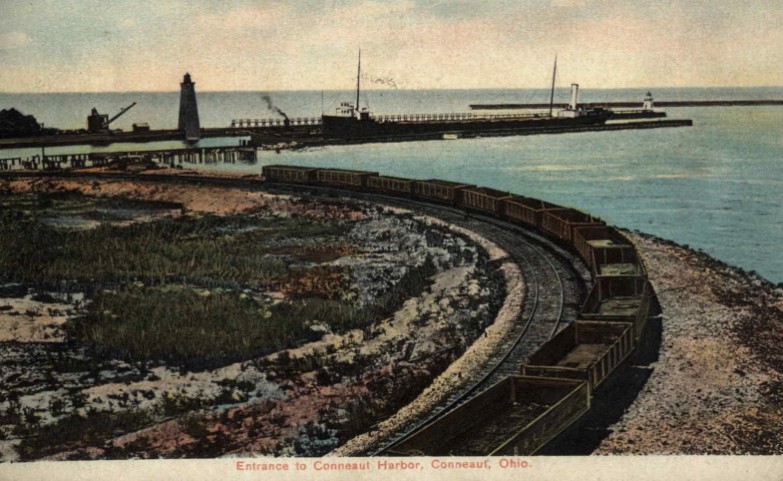
Starting in 1869, what became the Bessemer and Lake Erie Railroad (BLE) ran from Conneaut, Ohio, to the Pittsburgh suburb of Penn Hills, and in 2004, it came under the ownership of the Canadian National Railway as part of their purchase of the Great Lakes Transportation” holding company.
Today the former railroad runs as their “Bessemer Subdivision,” though it still does business as BLE.
Iron ore that comes from the Iron Ranges in northeastern Minnesota on the western-side of Lake Superior is still shipped via BLE trains to steel mills in the Pittsburgh region, mainly US Steel’s Edgar Thomson Plant in Braddock, Pennsylvania, one of the last still operating from the earliest days of the American Steel Industry.
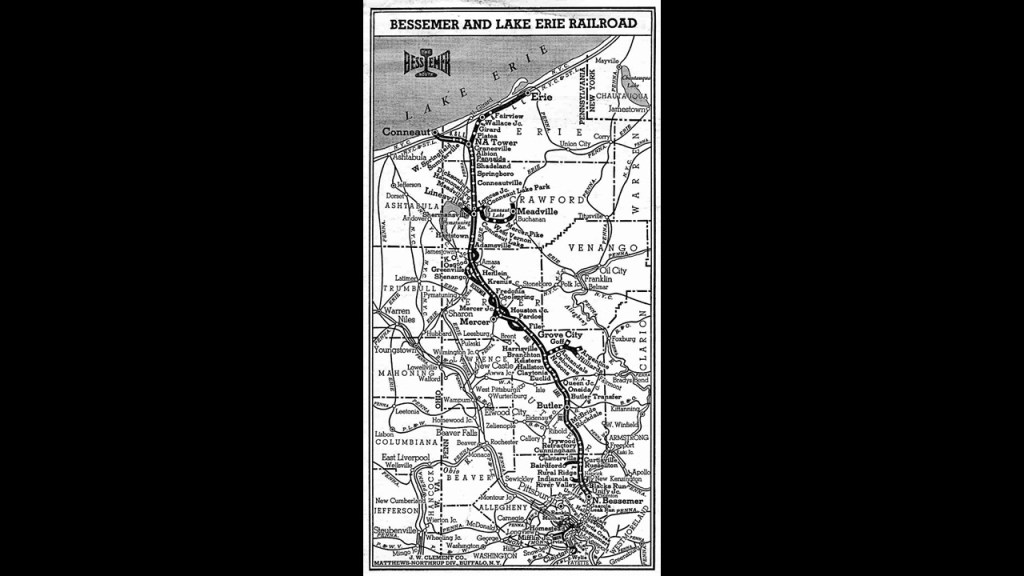
The BLE was formed out of a series of small predecessor railroad companies operating in the area.
The Pittsburgh, Bessemer and Lake Erie Railroad Company was founded in 1897 by Andrew Carnegie to haul iron ore and other products from Conneaut to Carnegie Steel Company plants in Pittsburgh and the surrounding region, which hauled coal north on the return trip.
Andrew Carnegie was a Scottish immigrant to America, who came to Pittsburgh in 1848 with his parents at the age of 12, got his start as a telegrapher, and who by the 1860s, had investments in such things as railroads, bridges and oil derricks, and ultimately worked his way into being a major player in Pittsburgh’s steel industry.
His first steel mill, operational by 1874, was the Edgar Thomson Steel Works, named after the President of the Pennsylvania Railroad.

They subsequently acquired other steel mills, and in 1892, the Carnegie Steel Company was formed, and in 1897, Charles M. Schwab became President of the Carnegie Steel Company.
In 1901, Charles M. Schwab helped negotiate the sale of Carnegie Steel with a merger involving it with Elbert Gary’s Federal Steel Company, and William Henry Moore’s National Steel Company to a group of New York City Financiers led by J. P. Morgan.
After the sale of Carnegie Steel, Andrew Carnegie surpassed John D. Rockefeller as the richest American at the time, and Charles M. Schwab became the first President of the newly minted U. S. Steel Company.

Andrew Carnegie was ranked as the 6th-richest American of all-time by CNN Business, with an adjusted wealth of $101-billion.
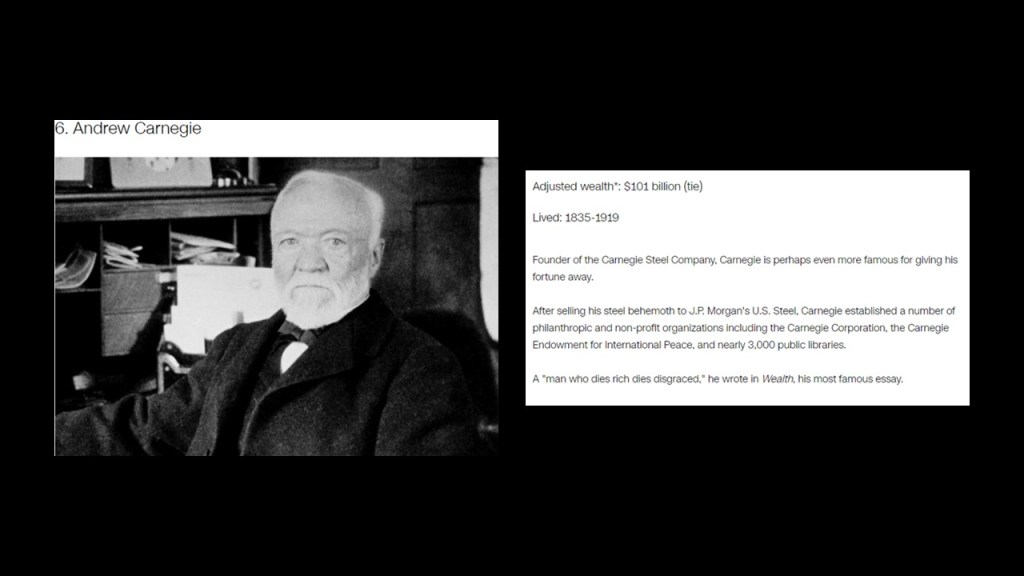
The Bear Creek and Lulu Waterfalls are to the south of, and in-between, Conneaut and Ashtabula on either side of I-90.
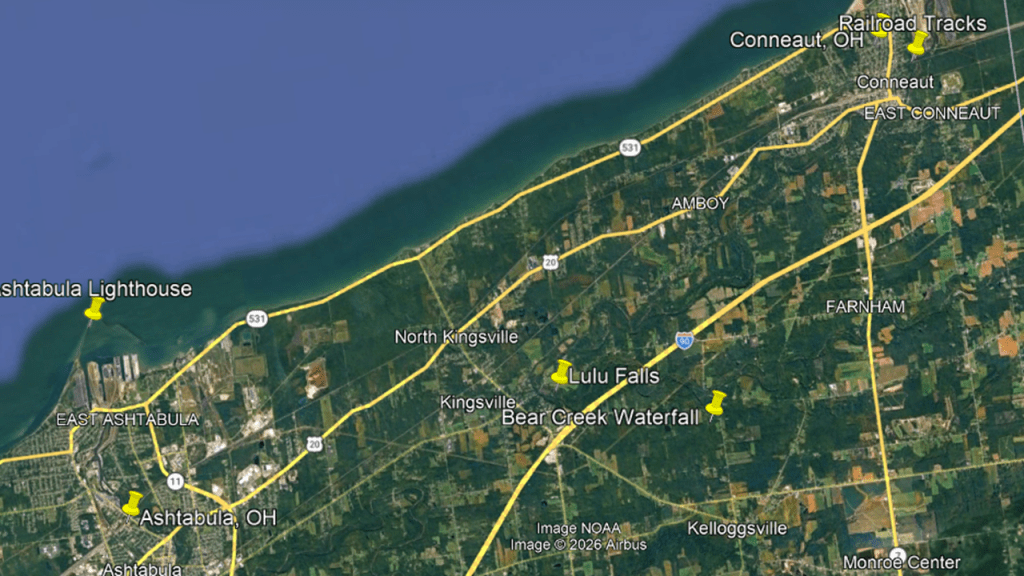
The Bear Creek Waterfall on Bear Creek is in a gorge area near State Road in Kingsville, Ohio, and Bear Creek is a tributary to the Lake Erie watershed.
It is a seasonal waterfall with reported heights varying between 15- and 100-feet, or 4.5- to 30.5-meters, depending on the specific ledge and waterfall.
They are easily visible from the State Road covered bridge.
The State Road covered bridge is one 17 drivable covered bridges in Ashtabula County.
It is called a single-span lattice truss design made from 97,000-feet, or 30,000-meters, of southern pine and oak wood.
This bridge was dedicated in 1983, and was said to have replaced a previous bridge dating from 1831 that stood until 1898.
The Lulu Falls on the other side of I-90 are also in Kingsville.
It is a 25-foot, or 8-meter, -tall waterfall on an unnamed tributary of Conneaut Creek.
It was a popular picnic spot in the 1800s, and supposedly received its name from a young woman who liked the name of a friend.
Like we saw back in Buffalo, where the Scajaquada Creek passes over Serenity Falls in the Forest Lawn Cemetery on its way to Delaware Park, the Victorian-era Lulu Falls Cemetery is near the waterfall here in Kingsville, Ohio.
Now we come to Ashtabula, which is another port city like Conneaut important to iron ore and coal since the late 19th-century, and was integral to the steel-manufacturing that developed around the Great Lakes, with most of the historic steel manufacturing having moved offshore, and with industrial jobs declining since the 1960s, it is considered part of a large historical manufacturing region called the “Rust Belt.”
While the Port of Ashtabula is still a hub for industrial material shipping on Lake Erie, including coal, the historic Ashtabula coal ramp and pier is no longer in use, with its operations handling bituminous coal ending in 2016.
The related coal-fired Ashtabula Generating Station closed in 2015, and the site is abandoned, with portions slated for demolition.
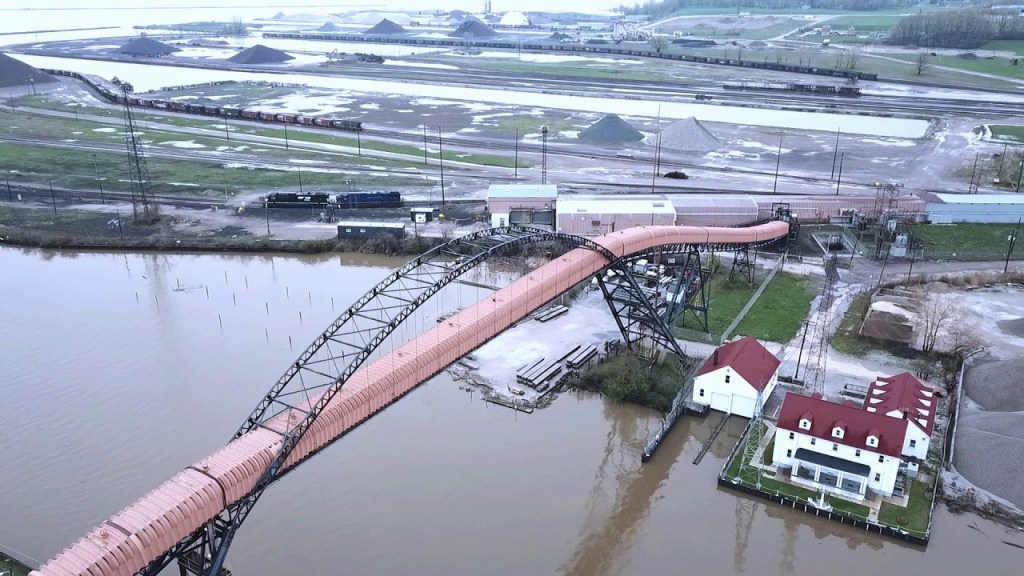
We are told in our historical narrative that railroad construction connected its port to a national network, and Ashtabula is known for the “Ashtabula River Railroad Disaster,” also known as the “Ashtabula Horror,” one of the nation’s most notorious rail accidents that took place on December 29th of 1876.
It involved the collapsing of the Ashtabula River bridge when a Lake Shore and Michigan Southern Railway train was crossing it, dropping a locomotive and eleven passenger cars onto the frozen river 150-feet, or 46-meters, below it, which also started a fire from the railroad car stoves.
Of the 159 people on board, 92 people were killed, and 64 people injured.
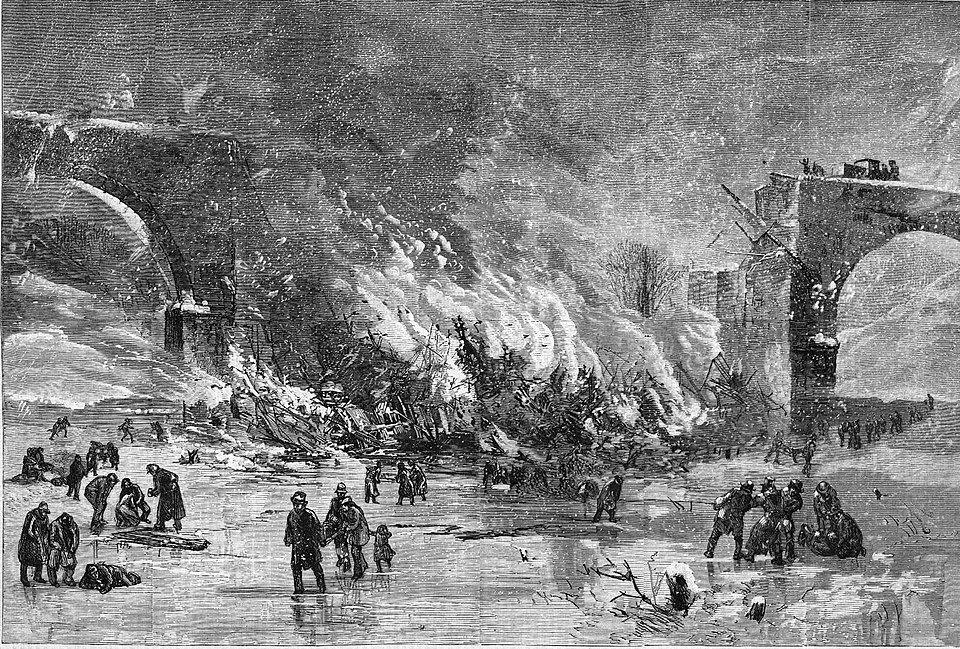
There was also a historical rail ferry that operated carrying coal and iron ore railway cars from Ashtabula to Port Burwell, Ontario, which ran from 1906 until it sank after it collided with a steamer in September of 1959.
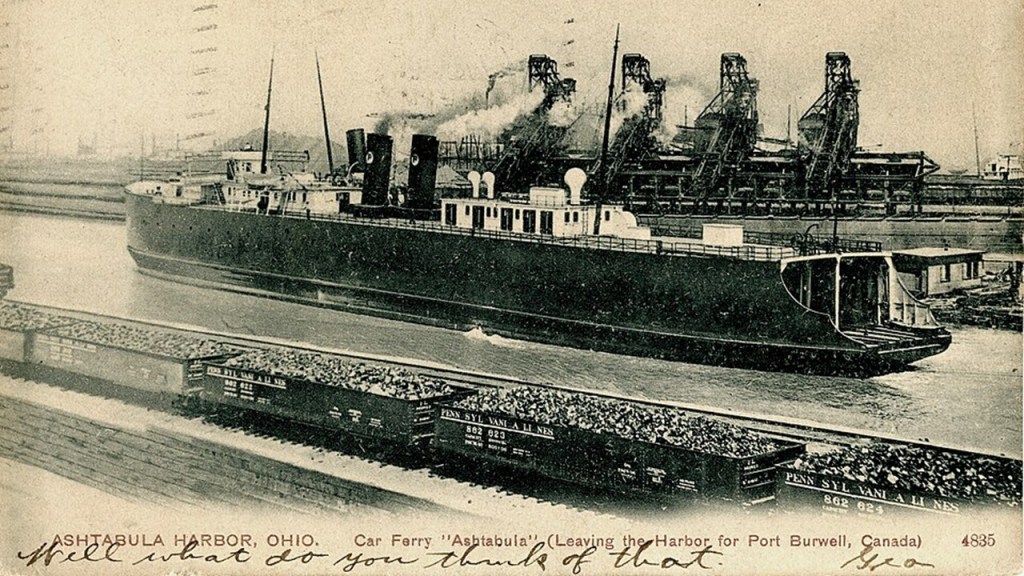
There was an interurban line that was completed in 1901 that connected Ashtabula to Painesville, which connected it to the Cleveland, Painesville, and Eastern interurban system, which stopped operating on May 20th of 1926, for the given reason of competition from cars and buses.
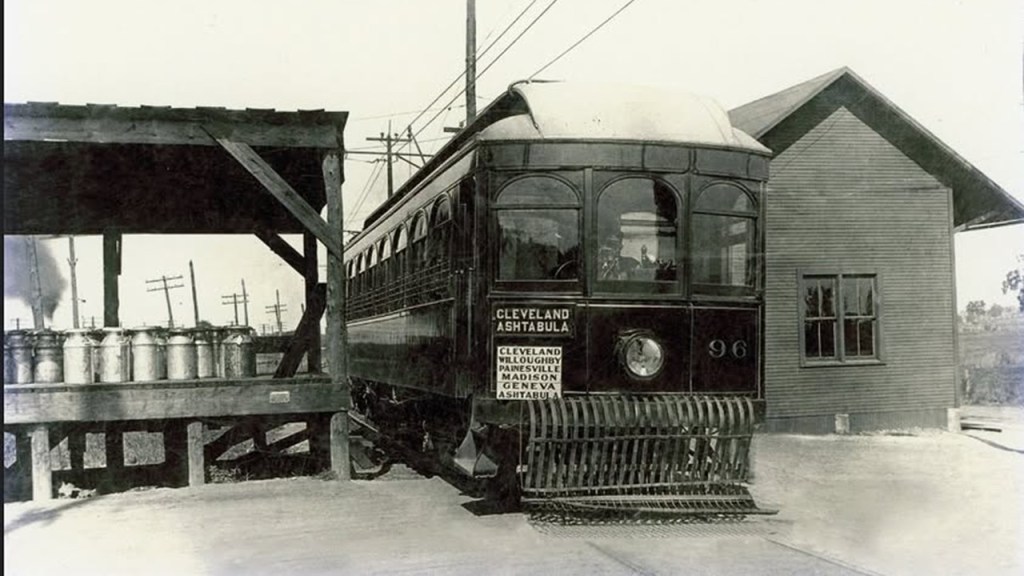
The Ashtabula Lighthouse is located at the end of the west breakwater at the entrance to the busy commercial port of Ashtabula.
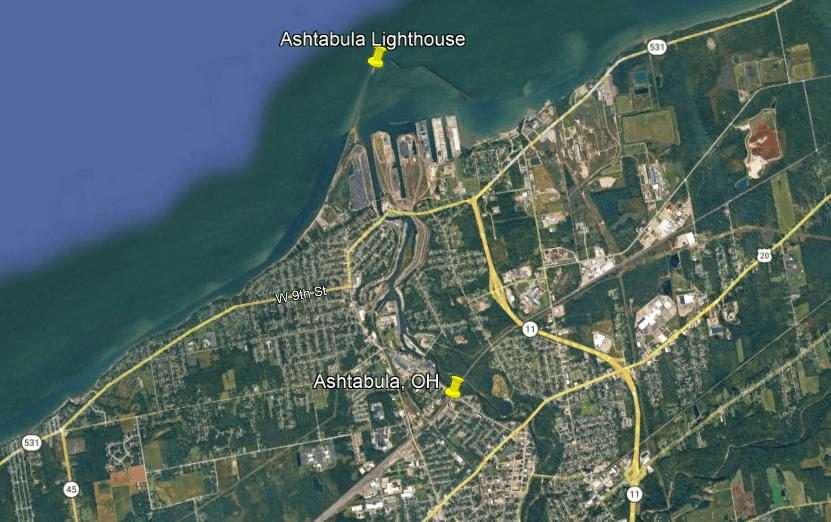
The current lighthouse was said to have been built in 1905, replacing earlier lighthouses that were built from the 1830s to the 1850s.
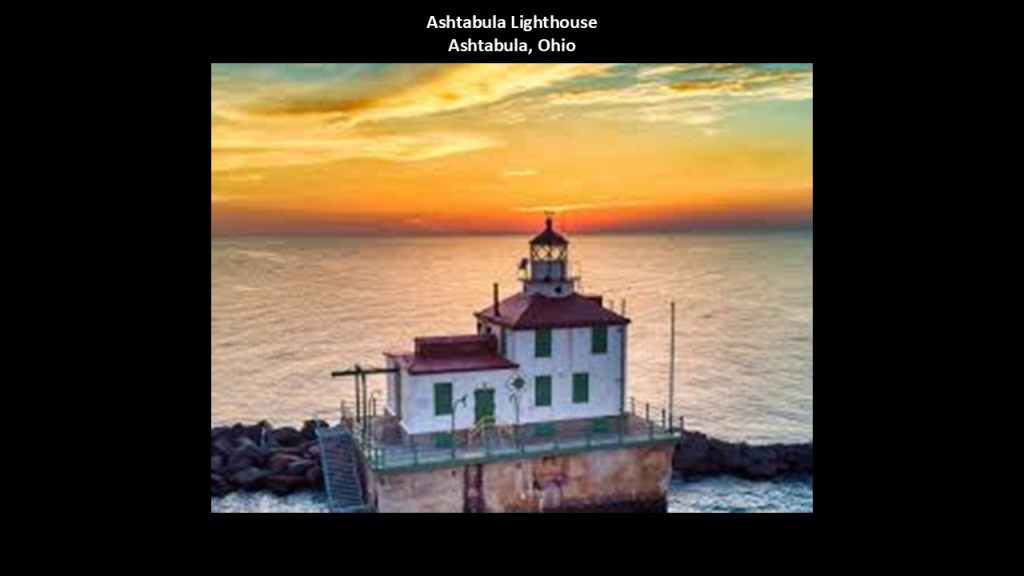
Though still an active lighthouse, in 1982 the lighthouse passed into private hands, and it was opened as a museum in 1984.
The fresnel lens was replaced by a modern beacon, and was given to the museum in 1995.
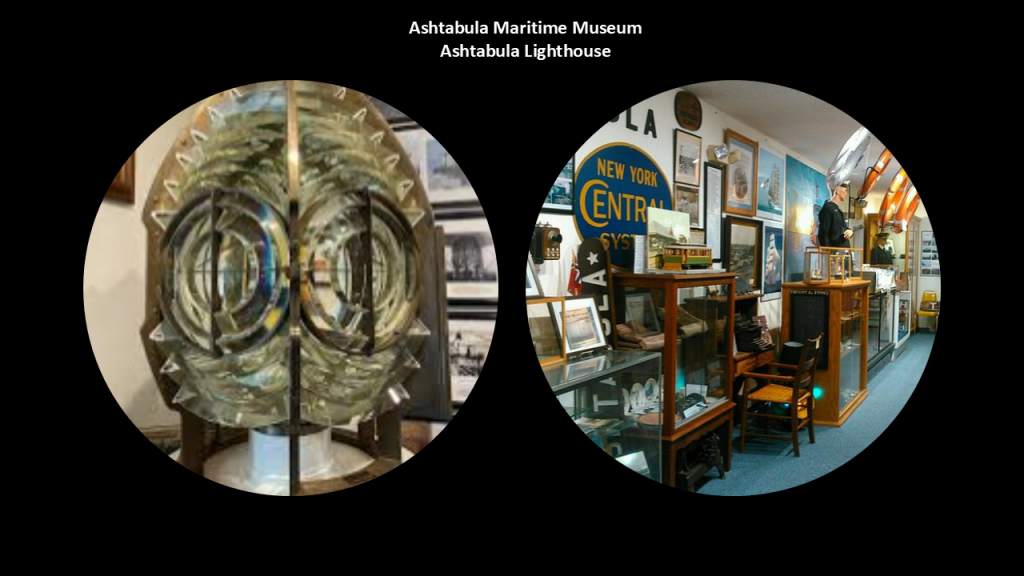
The next places we come to going down the Lake Erie shoreline from Ashtabula are just east of Cleveland.
I am going to look at the Geneva Beacon Lighthouse, the Erie Shores Golf Course and Madison Country Club; the Perry Nuclear Power Plant; Lake Erie Bluffs; Paine Falls; and the Fairport Harbor West Breakwater Light.
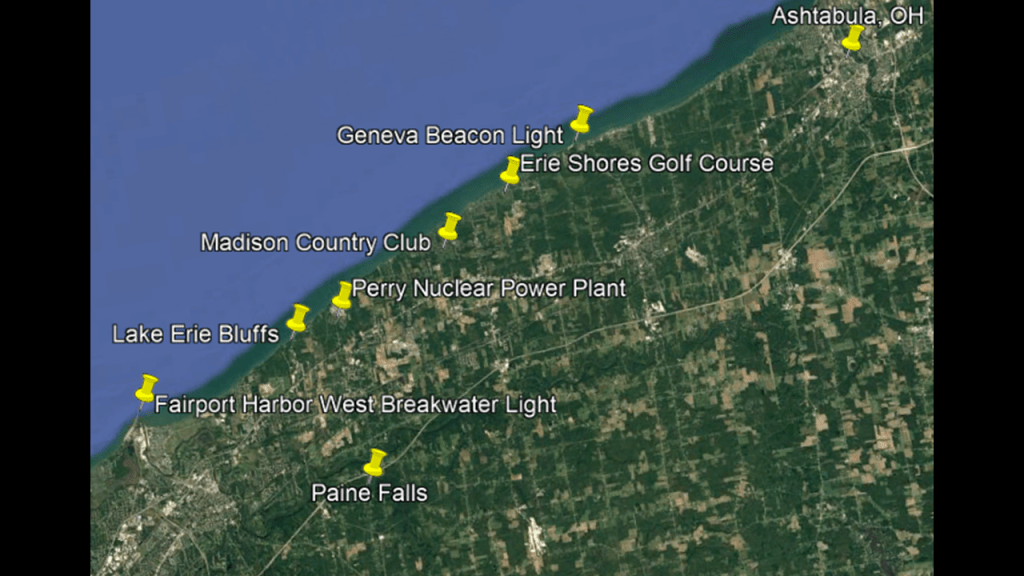
First, the Geneva Beacon Lighthouse.
The Geneva Beacon Lighthouse is located at the Geneva State Park Marina in Geneva in northwestern Ashtabula County.
It serves recreational boat traffic for the marina as opposed to the industrial ports we have just seen in Conneaut and Ashtabula
The date given for its construction is 1980, and it is a 55-foot, or 17-meter, -tall steel structure.
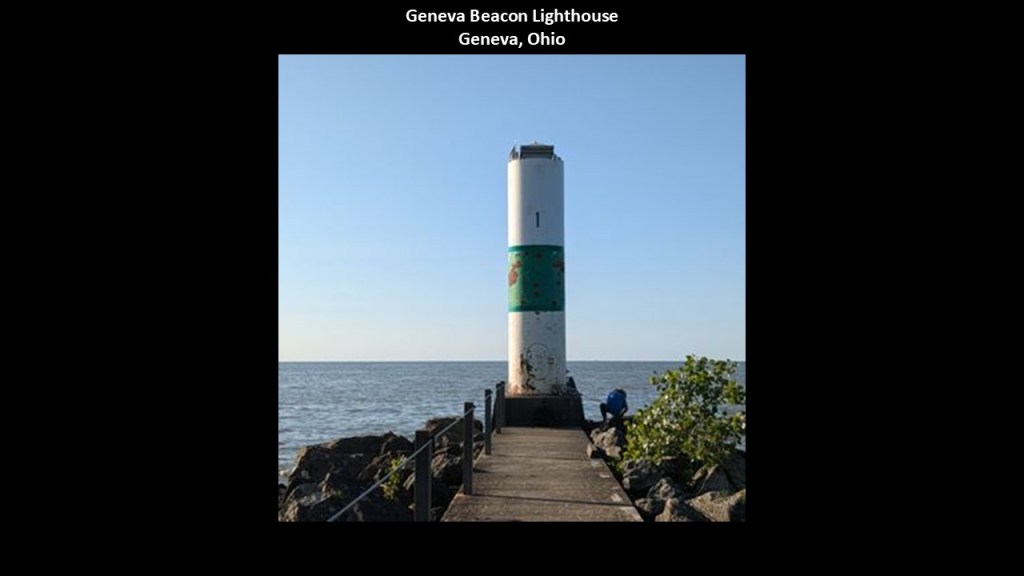
The next places we come to are the Erie Shores Golf Course and the Madison Country Club, which are relatively close together, and in-between the shore of Lake Erie, US-20; I-90; the railroad tracks; and the S-shaped Grand River.
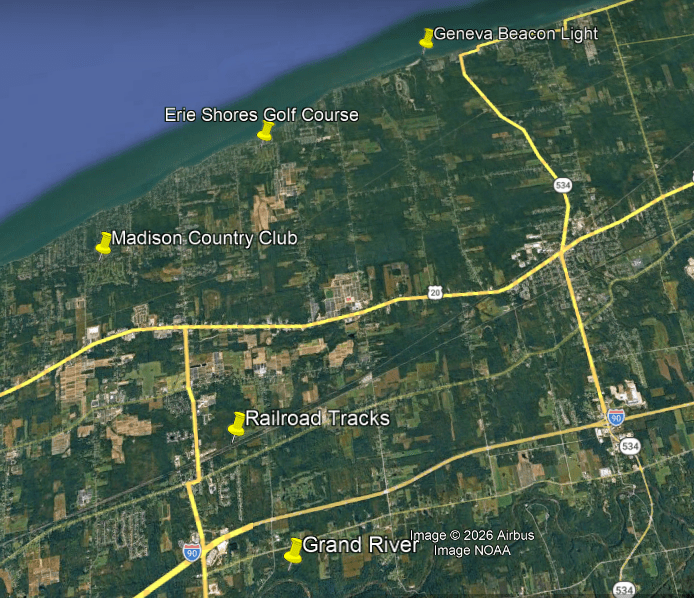
The Grand River is one of the most important waterways in northeastern Ohio, and one of the largest rivers on Ohio that flows directly into Lake Erie.
It was a key route for settlers moving into the Connecticut Western Reserve in the early 1800s.
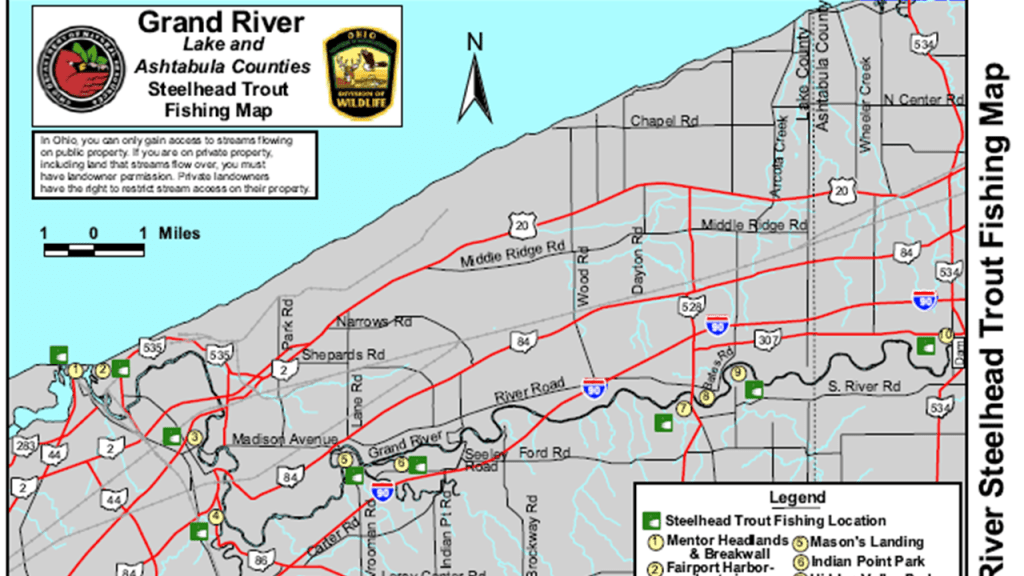
The Perry Nuclear Power Plant and the Lake Erie Bluffs come next.
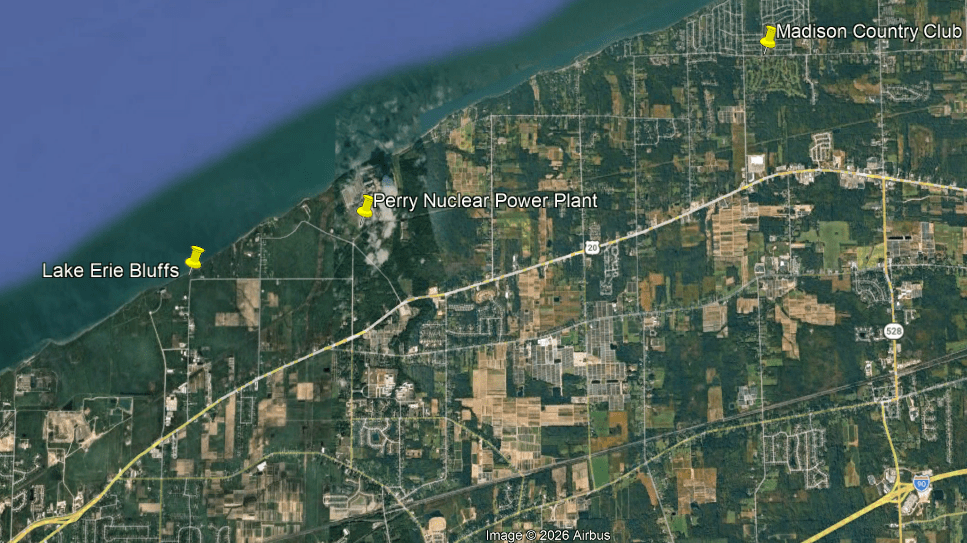
The Perry Nuclear Power Plant is situated on Lake Erie, and is 40-miles, or 64-kilometers, northeast of Cleveland.
There is a land on the grounds of the Perry plant that were designated as an urban wildlife sanctuary in 1993, where there are trees, shrubs, streams, ponds, and wetlands that are habitat for species herons, kingfishers, ducks, geese, and endangered spotted turtles, as well as the rare crane-fly orchid.
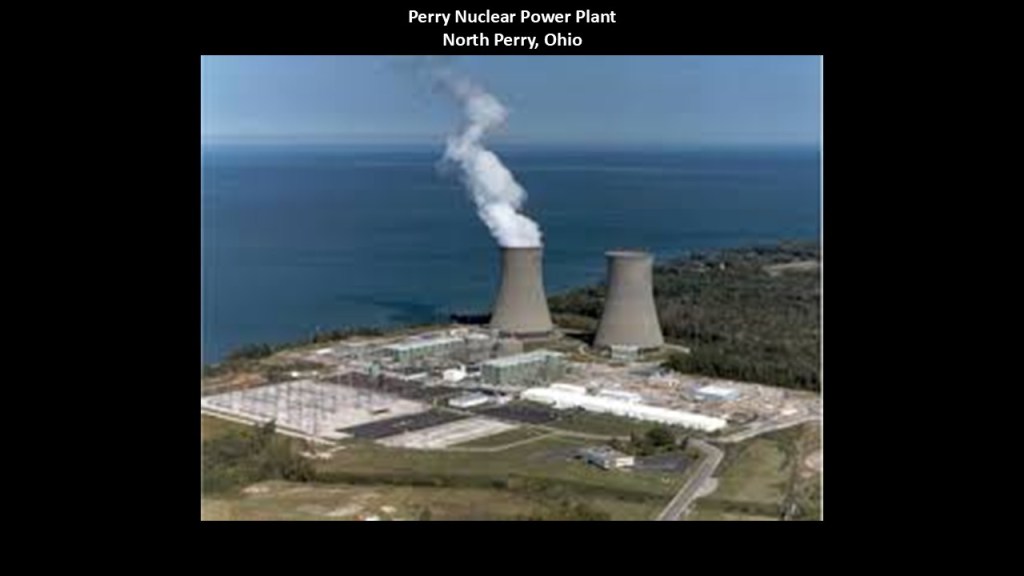
Perry is the fourth nuclear power plant that I have come across while doing this Great Lakes series, and all have been right on the lakeshore of their respective Great Lakes.
They were the Darlington Nuclear Power Station in Bowmanville, Ontario, on Lake Ontario; the Nine-Mile Point Nuclear Power Station in near Oswego, New York, on Lake Ontario; and the Bruce Nuclear Power Plant in Kincardine, Ontario, on Lake Huron.
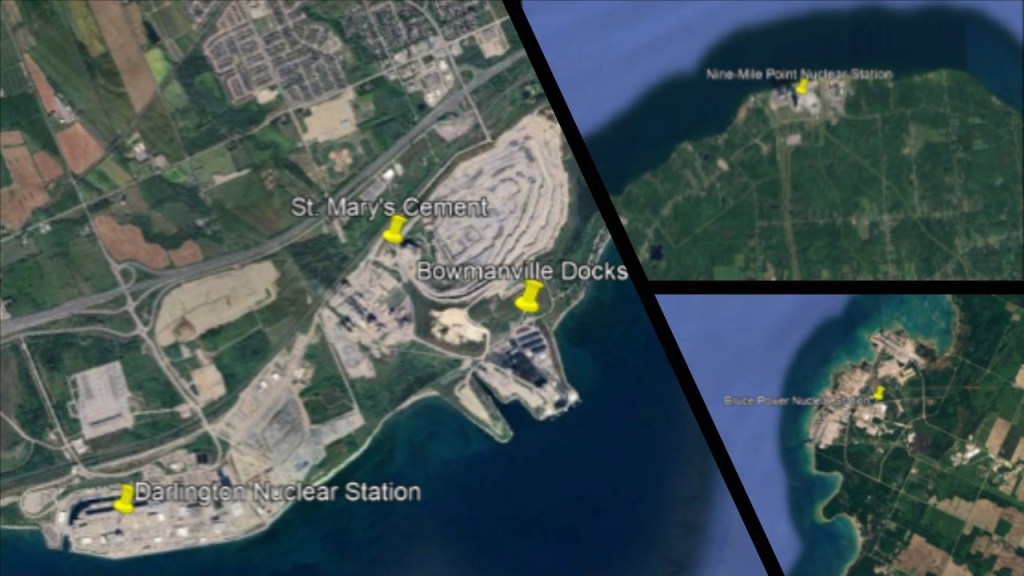
The Lake Erie Bluffs is a 670-acre, or 271-hectare, park managed by Lake Metroparks, a public park system in Lake County, Ohio, that manages a large network of natural areas, parks and recreational facilities.
The Lake Erie Bluffs Park has a mix of up to 40-foot, or 12-meter, -high bluffs on the beach; a significant amount of wetland; and a sandy and cobbled beach along 9,000-feet, or 2,743-meters, of shoreline.
I’ll insert here my belief that all the bluffs and cliffs we are seeing is where land was previously, and it sheared off and is now below the surface of the water.
When the word “sheer” is used to refer to a cliff, it means a high area of land with a very steep side.

One of the meanings of the word “shear” spelled with an “a” is to break off, or be cut off, sharply.

A synonym of the word for “sheer cliff” is “bluff.”
Another meaning of the word “bluff” is a deception, or an attempt to deceive.
There are countless examples to choose from, but here are examples of sheared-off, unstable-eroded-looking landscape seen on this stretch of coastal road beside the Southern California Bight on the left, and the Aquinnah Cliffs on Martha’s Vineyard, which is also where the headquarters of the Wampanoag Tribe of Martha’s Vineyard is located on their historical land.
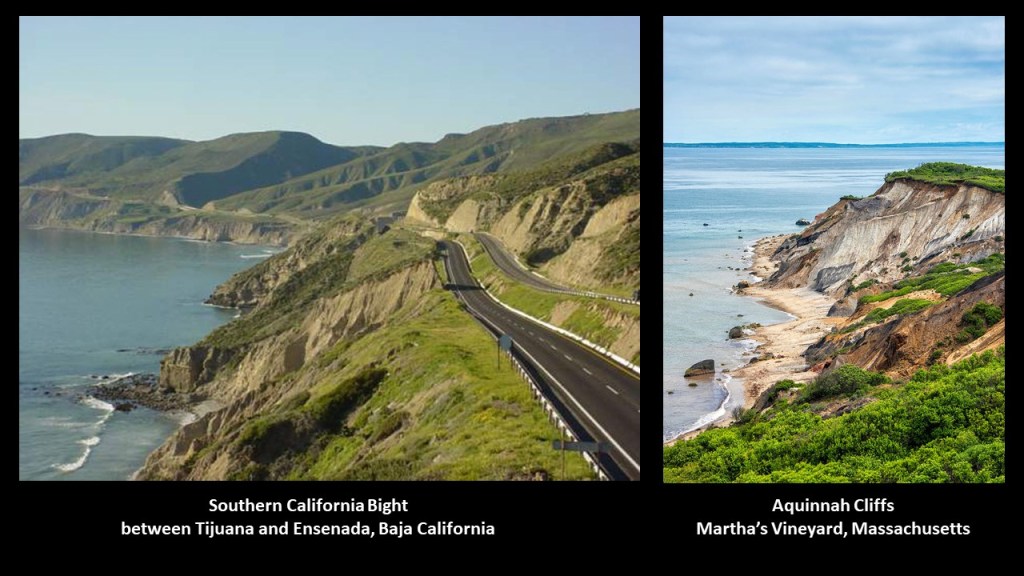
This type of thing is found all over the Earth, like the sheer cliffs of Iran’s Hengam Island’s coastline on the left, compared for similarity of appearance with the sheer white cliffs of Dover on the coast of southern England on the top right, and the cliffs along the southern coast of Australia in Victoria State where the Great Ocean Road runs for a long distance next to a sheer cliff.
Next, the Paine Falls are to the south of the nuclear power plant and the Lake Erie Bluffs Park, right next to I-90.
They are located in Paine Falls Park, which is also managed by Lake Metroparks.
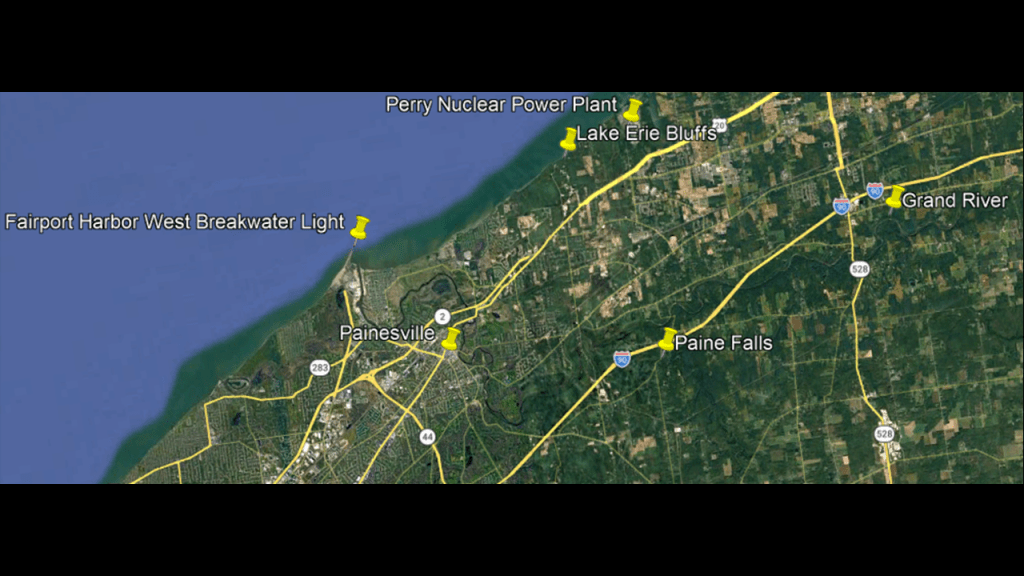
Paine Falls is one of the many waterfalls that can be found in the Cleveland area.
It is a 25-foot, or 8-meter, -tall waterfall on the Grand River where there is a gorge.
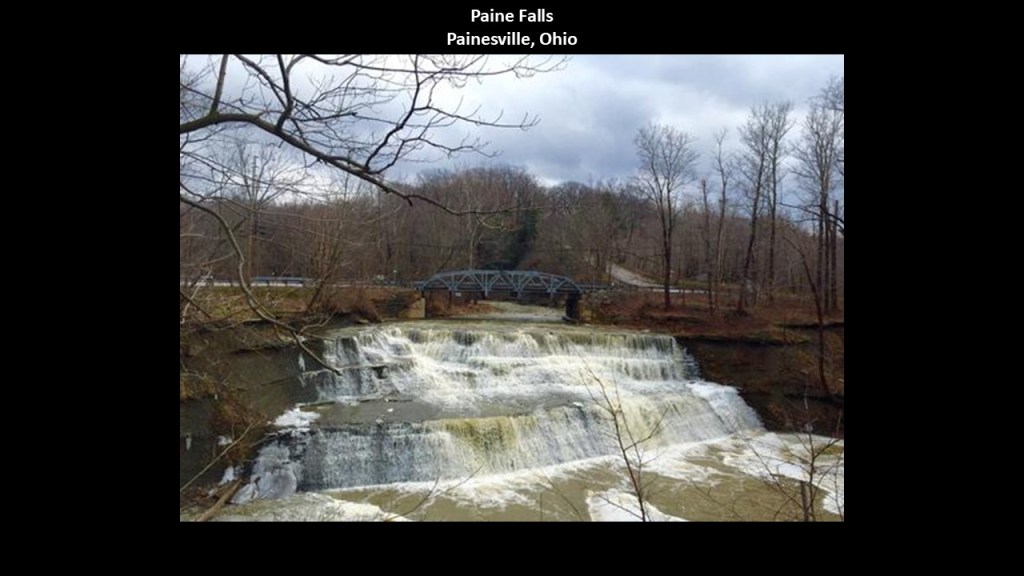
Railroad history on the Grand River was centered around Lake County, and particularly Painesville, where the railroad supported regional industry and shipping.
Key railroad infrastructure included the Baltimore and Ohio (B & O) Railroad lines that were established in the late 1880s, including significant bridge structures.
The Grand River Railway was revived as a short-line in 2016 to support Lake County industry by hauling salt from the Morton Salt Mine to a CSX Interchange after CSX closed the line in 2002.
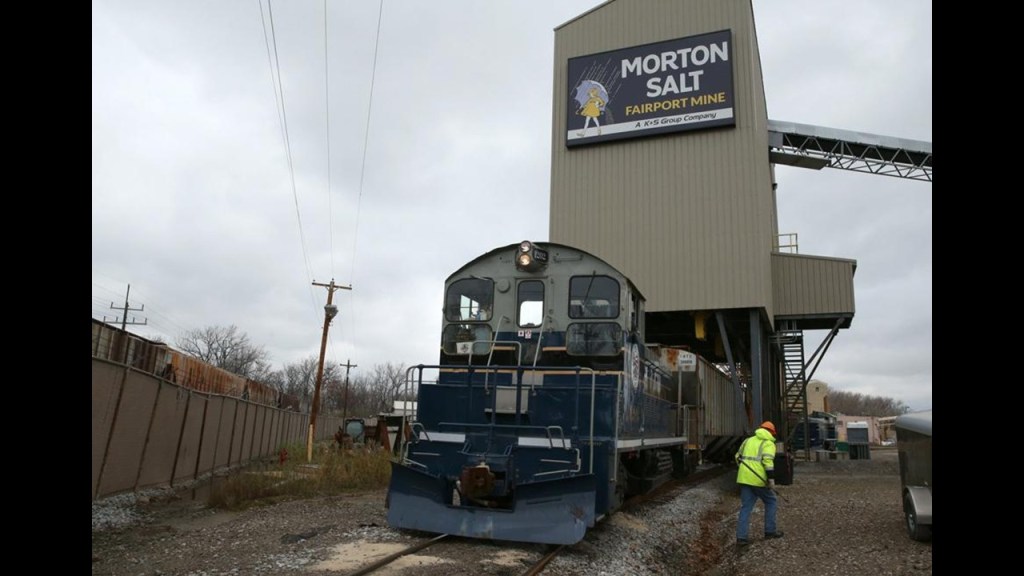
Historically, the railroad along the Grand River was defined by its role as a vital industrial corridor, connecting the inland steel mills of Youngstown, Ohio, with the shipping docks of Fairport Harbor.
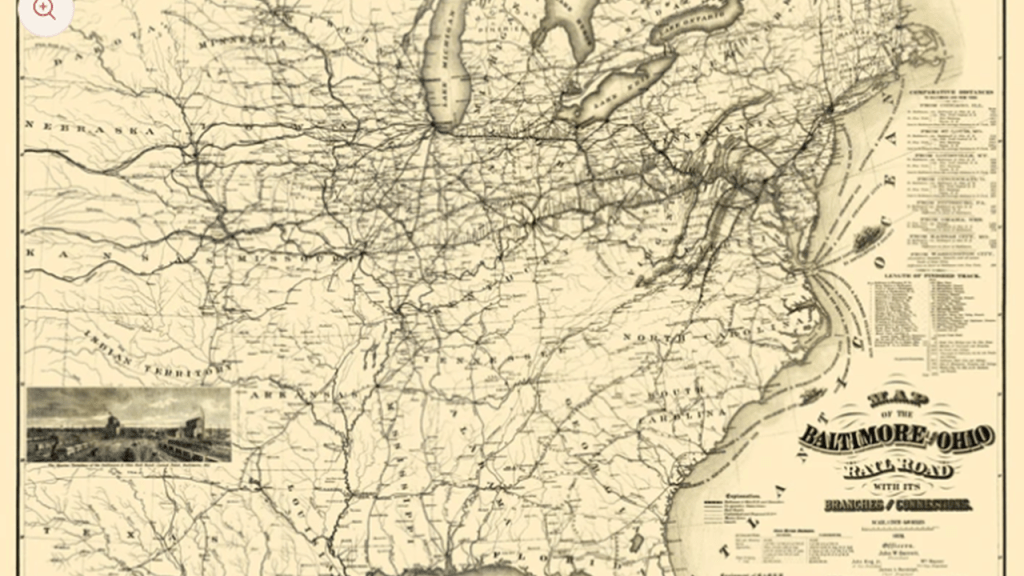
Painesville, the county seat of Lake County, was historically part of the Connecticut Western Reserve.
It was named after General Edward Paine, an officer in the Continental Army during the Revolutionary War, who was one of the first settlers of the Western Reserve.

With its location on key roads and railroads, Painesville became a broader part of the industrial network of northeast Ohio, and became a serious manufacturing center in the late 1800s and early 1900s, with key sectors being metal fabrication and machining; chemical production; electrical components; and plastics and industrial materials.
One of many was the Industrial Rayon Corporation Plant in Painesville.
It was a major employer from 1938 until its closure in 1980, at which time the site was abandoned.
It produced 12.5-million pounds of viscose rayon every year for textiles and tire-cord, clothing, and parachutes, and was known for demanding, high-temperature chemical preocesses.
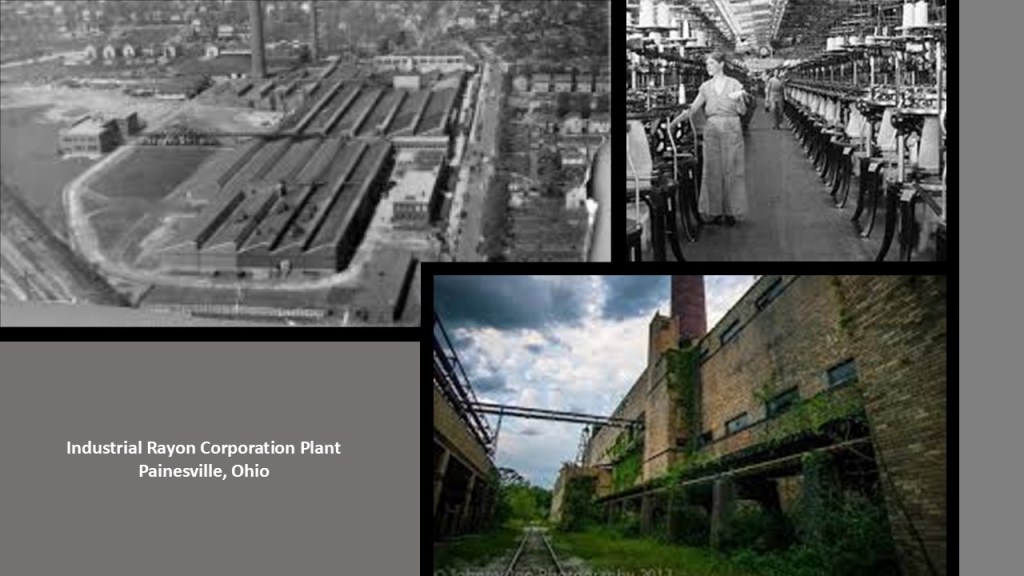
There are two lighthouses in Painesville that I would like to mention – the Fairport Harbor West Breakwater Lighthouse and the Fairport Harbor Lighthouse.
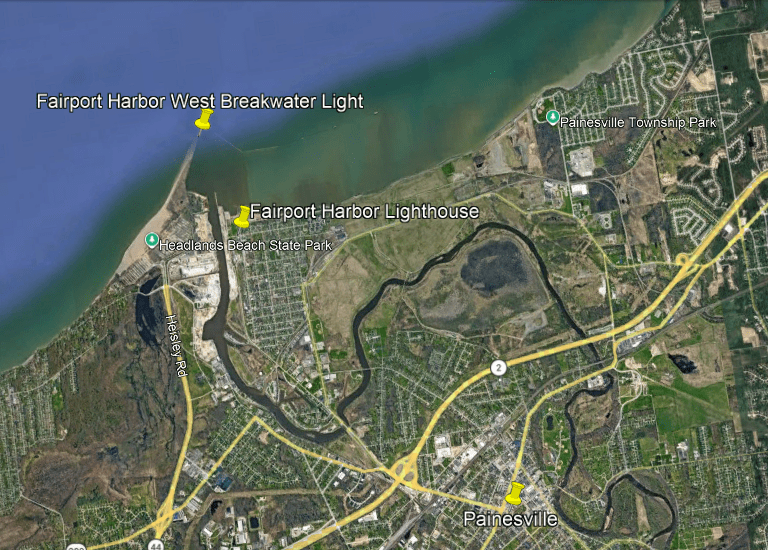
The Fairport Harbor West Breakwater Lighthouse is near the entrance to the Grand River at the end of the breakwater at Headlands Beach State Park.
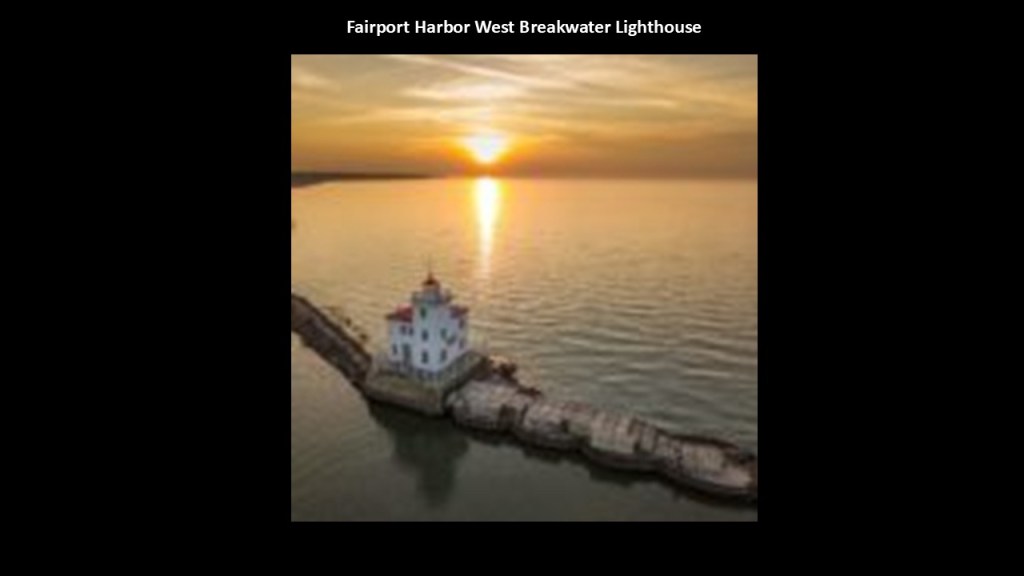
We are told that it was built in 1925 to replace the Fairport Harbor Lighthouse.
It is an automated lighthouse , and while the lighthouse itself is closed to the public, the public can walk up to it on the breakwater from the state park and view it from the outside.
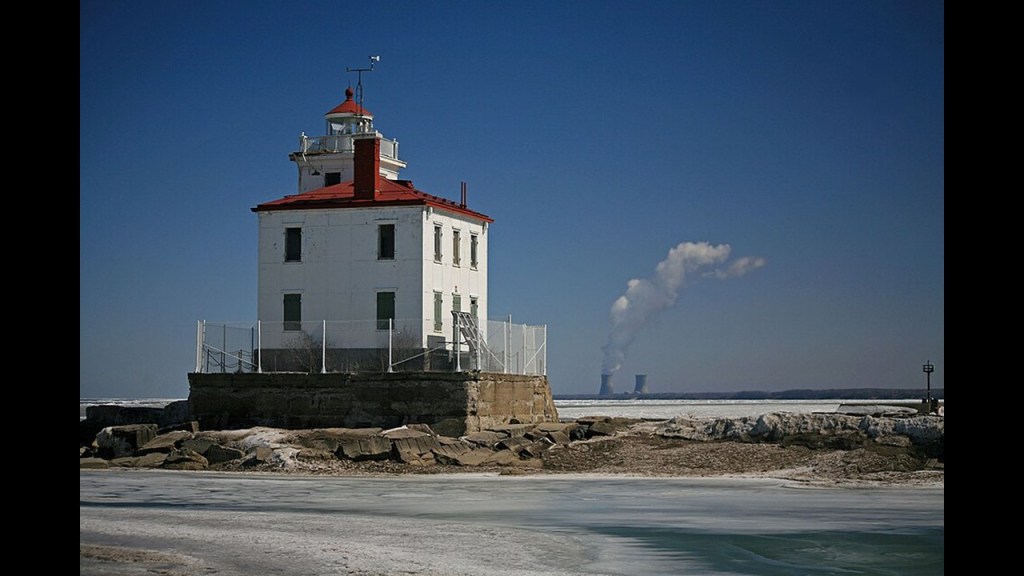
The original Fairport Harbor Lighthouse still stands, but these days is a maritime museum.
It is located at the intersection of Second and High Streets in the village of Fairport Harbor.
It was said to have been constructed in 1871.
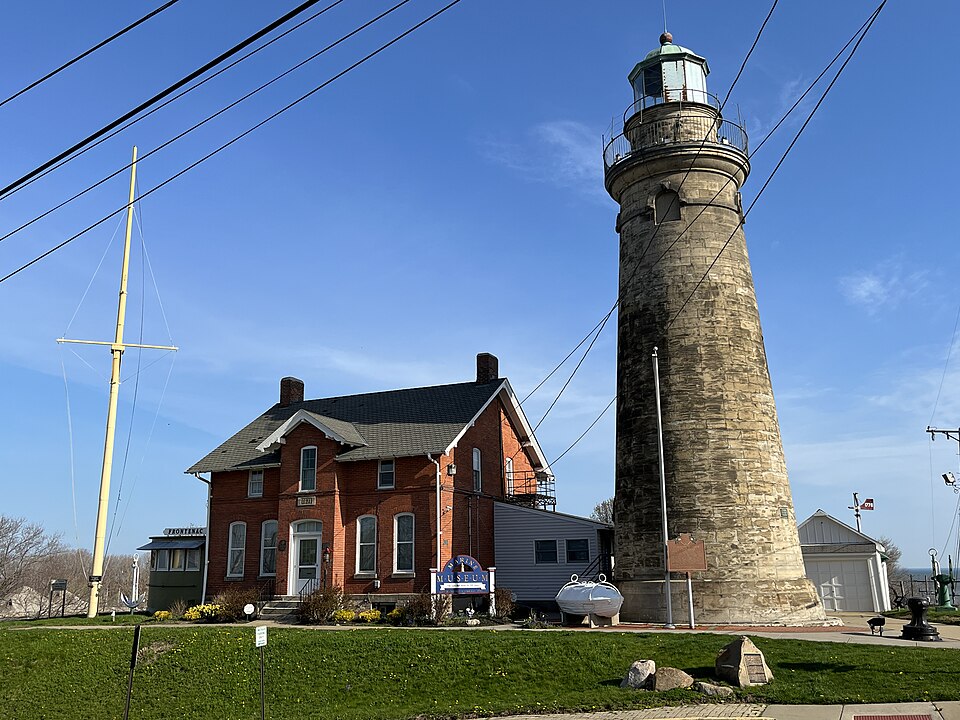
Like what we saw back at the Ashtabula Lighthouse and Maritime Museum, the fresnel lens that was from Fairport Harbor Lighthouse is also on display in the maritime museum here at the same location.
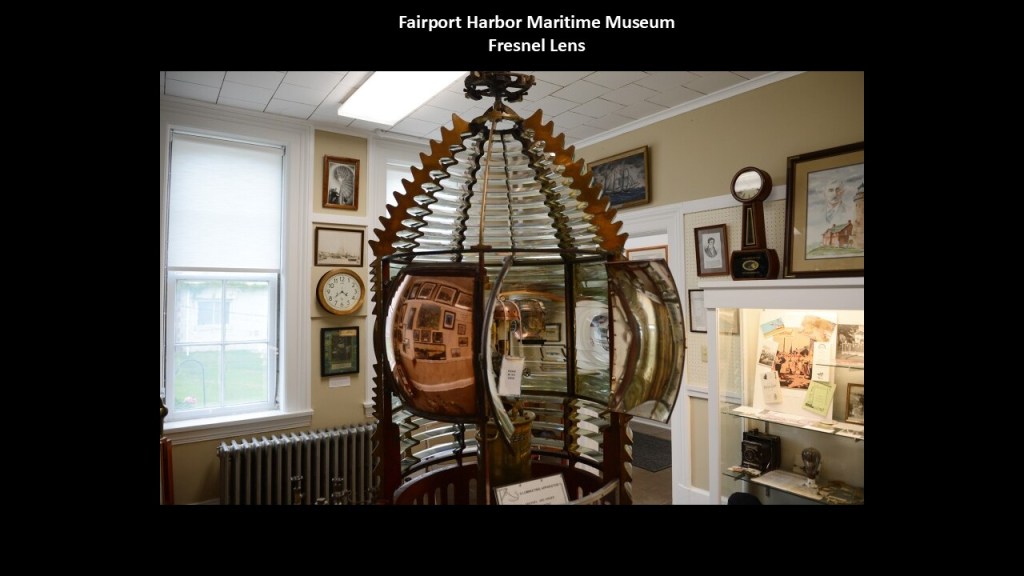
From the Painesville area we are next entering Cleveland, the largest city on Lake Erie, and the second-largest in Ohio after Columbus, the state capital.
The places I am going to take a look at first here are the Coulby Lighthouse; the Beachland Ballroom & Tavern, near the location of the historical Euclid Beach Park; Rockefeller Park; the Cleveland East Entrance Lighthouse; the Cleveland Museum of Art; the Garfield Monument; and the Rockefeller Obelisk.
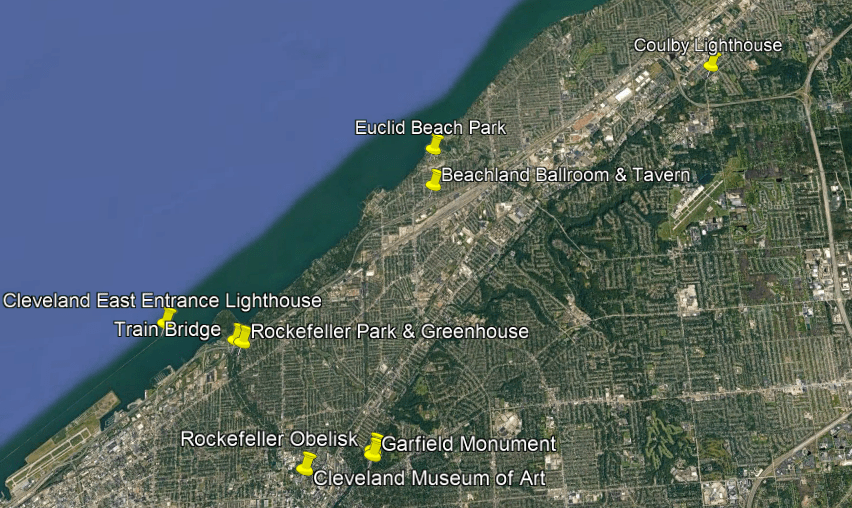
First, the Coulby Lighthouse.
The Coulby Lighthouse is in Wickliffe on the outskirts of Cleveland.
From what I could find out, it was called a folly that is part of Coulby Park.
A folly is defined as a decorative building that doesn’t serve much of a purpose, even if it is meant to look like it does.
British-born Harry C. Coulby was known as the “Czar of the Great Lakes.”
He was partner in Pickland Mathers & Company, a shipping and iron ore mining company with a fleet of boats on Lake Erie that shipped iron ore from Minnesota to steel mills all over the Great Lakes.
Coulby was the first elected mayor of Wickliffe from 1916 to 1921, and his former mansion, known as “Coulallenby,” is the City Hall of Wickliffe these days.
Next stop, the Beachland Ballroom & Tavern.
It is a popular music venue and tavern that got its start in 1950 as the “Croatian Liberty Home,” a center for social activities for the local immigrant community, with the original structure including the ballroom and tavern, with more bar facilities added later.
The ballroom floor is a vintage, well-maintained, hardwood floor.
This location got my attention because I have had occasion to research historic dance halls with amazing hardwood floors that have long been demolished and replaced by housing.
Like the Cloudland Dance Hall in Brisbane, Queensland, Australia.
Cloudland was used as a Ballroom and Dance Hall, and during the 40’s was especially popular in the local scene.
The viewer who told me about it said that the Cloudland hardwood dance floor was naturally-sprung, and when the dancers were pumping, the floor could bounce around nine inches.
The Cloudland Ballroom and Dance Hall itself was demolished by a developer in November of 1982, and the Cloudland Apartments occupy the former location of this iconic landmark.
Another one was the Kings Hall in Aberystwyth, Wales.
It also had a great hardwood floor on which to dance, and said to have been built in the Art Deco Architecture style in 1934 (which would have been between World War I and World War II).
Major band concerts were also held there, like Led Zeppelin in January of 1973 during their Strange Affinity British Tour in 1972 and 1973.
The King’s Hall was demolished in 1989, for the given reason of apparent structural weaknesses and disrepair, and replaced by the King’s Hall residential flats and commercial units.
The Beachland Ballroom and Tavern is located near the location of what was the Euclid Beach Park, another historical trolley park.
The Euclid Beach Park was located on the southern shore of Lake Erie in Cleveland’s Collinwood neighborhood.
It operated as a trolley amusement park until 1963 when daily streetcar service from Public Square ended, and continued as an amusement park until 1969 when it closed for good.
Remnants of the Euclid Beach Park include the arched main gate, which still stands, and having been declared a Cleveland Landmark, it is protected from demolition.
It was moved in January of 2025 from the roadway to an adjacent lot to be made the centerpiece of a park.
Another remnant is a carousel that was sold at auction after the park closed in 1969 and moved to another park in Maine, but efforts were made to get it back, and it finally returned home to Cleveland in 2014 where it is at the Cleveland History Center in University Circle.
Next down the lakeshore from here we come to Rockefeller Park and the Cleveland East Entrance Lighthouse.
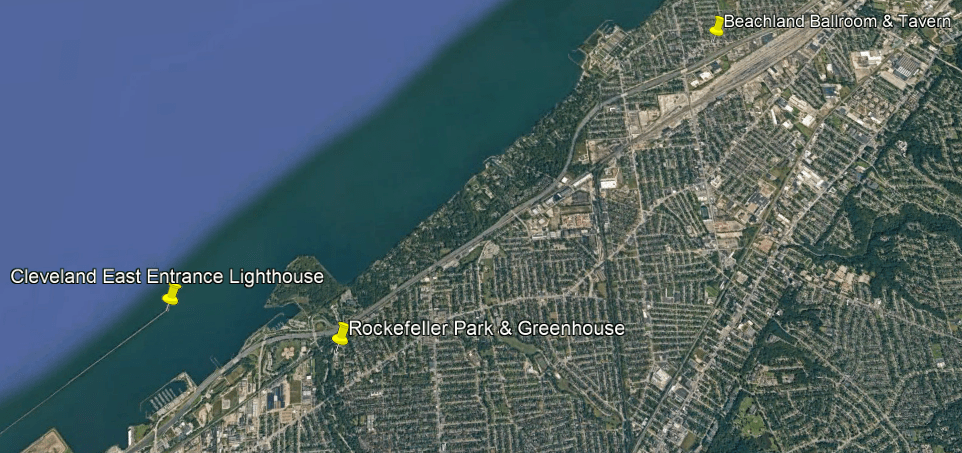
Rockefeller Park was named in honor of Standard Oil magnate John D. Rockefeller, who donated land for the park.
Rockefeller Park stretches for 2-miles, or 3-kilometers, along Doan Brook, and runs a northwesterly path between Shaker Heights and goes in-between the University Circle neighborhood and ends at Gordon Park on the city’s lakefront.
It is immediately adjacent to Wade Park to the southeast; and across Euclid Avenue on its northwest border.
It is the largest park within city limits and was first opened to the public in 1897.
The greenhouse at Rockefeller Park first opened in 1905, and is a city-owned botanical garden and greenhouse, and hosts a diverse selection of indoor and outdoor gardens.
Also, the Cultural Gardens are a collection of gardens at Rockefeller Park that commemorate many of the ethnic groups who have enriched Cleveland and the United States.
The Cleveland East Entrance Lighthouse is located on a breakwaer at the entrance of the Cuyahoga River and Cleveland Harbor, and we are told has existed there since 1915.
It is still active and maintained as a navigational aid by the U. S. Coast Guard.
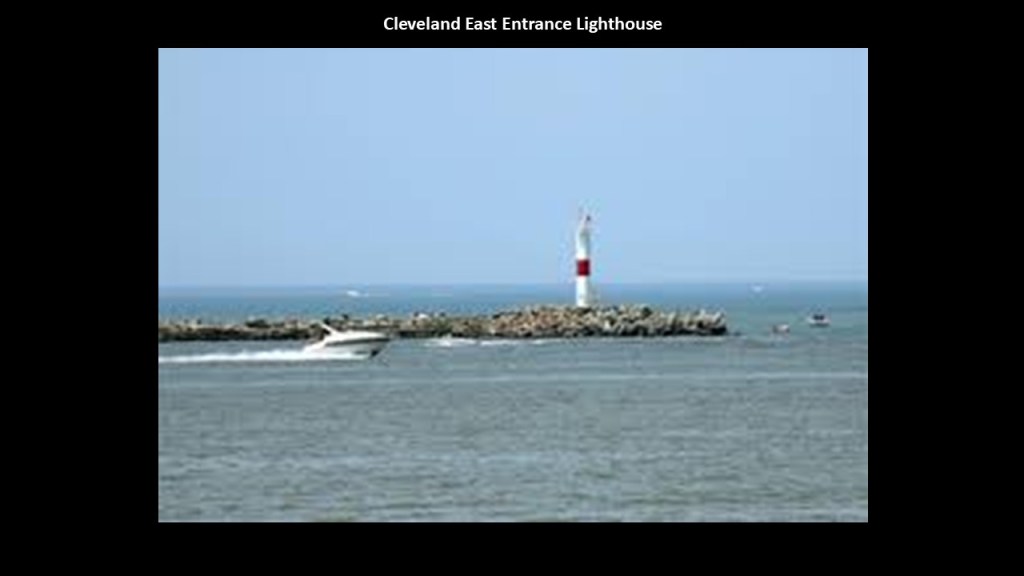
To the southeast of here we come to the Cleveland Museum of Art, the Garfield Monument and the Rockefeller Obelisk.
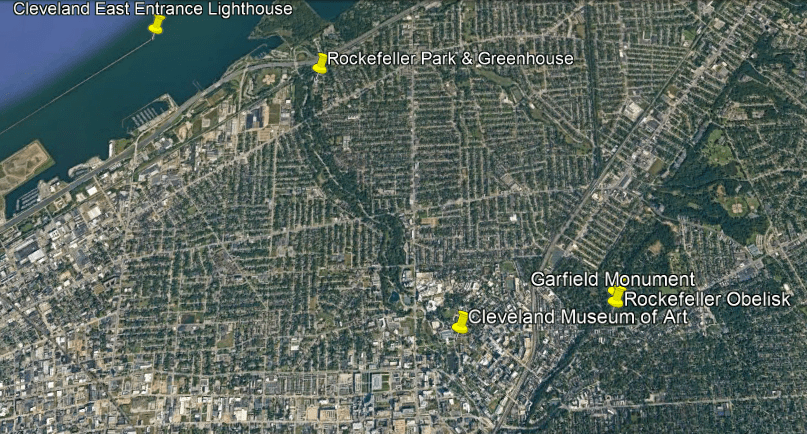
The Cleveland Museum of Art was said to have been established on the southern edge of Wade Park and first opened in 1916.
We are told the original neoclassical building of white Georgian marble was designed by a local architectural firm.
So many buildings like these are proportionally much larger than the people who come to visit them.
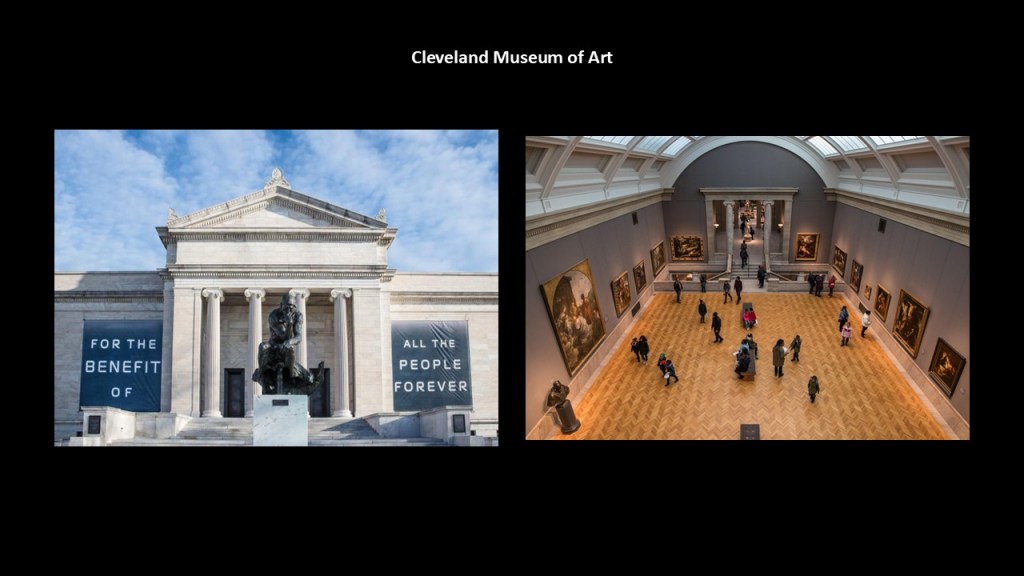
The nearby Garfield Monument is the final resting place of the assassinated American President James A. Garfield, who was shot in Washington, DC, on july 2nd of 1881 and died a couple of months later on September 19th of 1881.
It is a mausoleum in Lake View Cemetery that was said to have been constructed starting in 1885 and dedicated in 1890, and exhibits a combination of Byzantine, Gothic and Romanesque Revival architectural-styles.
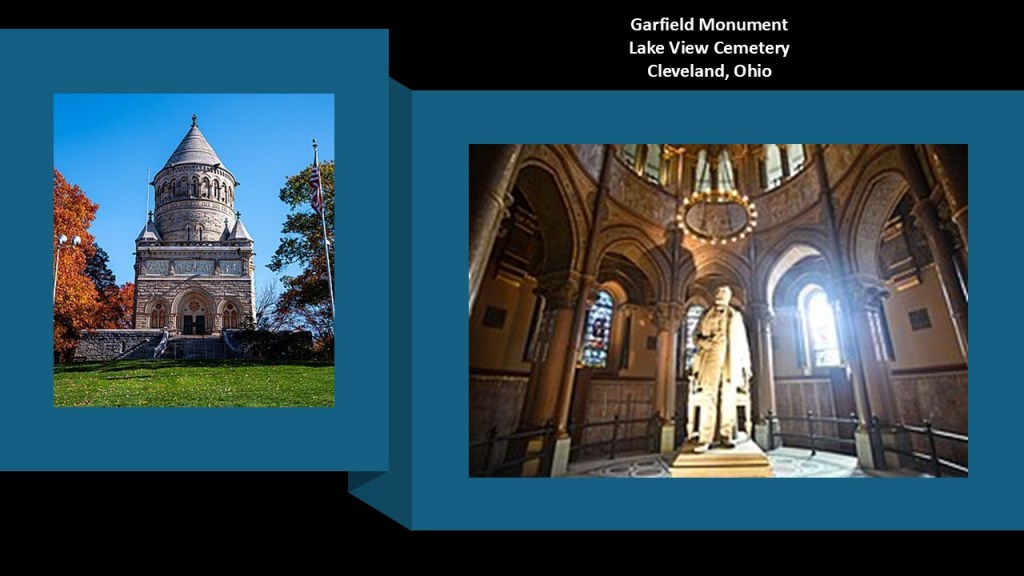
The Rockefeller Obelisk is also in the Lake View Cemetery, which is on Euclid Avenue.
It is almost 70-feet, or 21-meters, -high obelisk and marks the final resting place of John D. Rockefeller, along with his wife and mother.
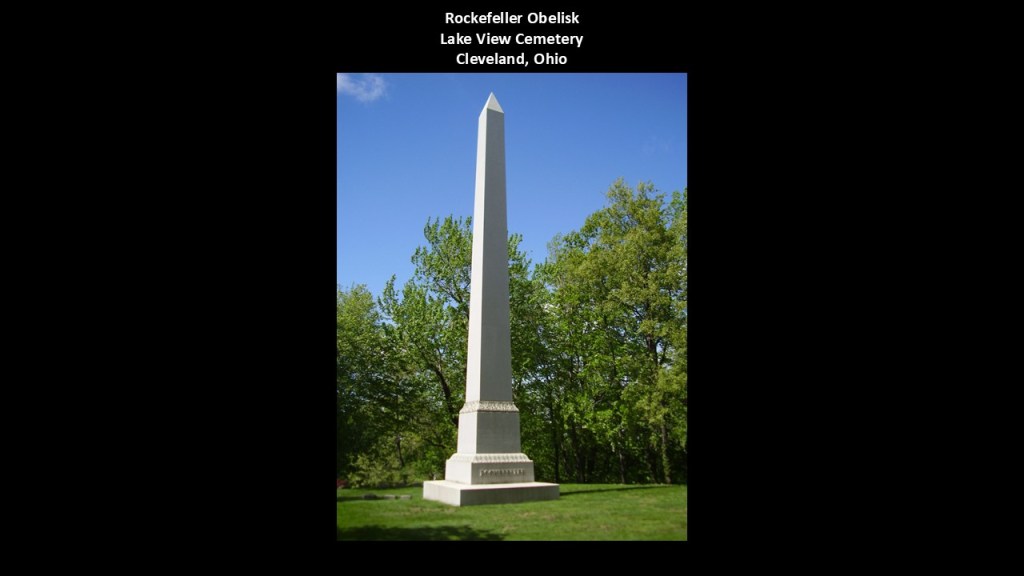
The years between 1873-1930s were known as Cleveland’s Gilded Age, when nearly half of the world’s millionaires lived in Cleveland.
Euclid Avenue was known as Millionaire’s Row, and it was home to some of the nation’s most powerful industrialist’s, including John D. Rockefeller and Samuel Mather, a co-founder of Pickands Mather and Company, the shipping and iron mining company mentioned previously in association with Harry Coulby back in Wickliffe, which was also a popular place for the millionaires to have summer homes.
The Rockefeller Mansion in Cleveland was located at Euclid Avenue and East 40th Street, that he was said to have purchased in 1868 and where his children were born.
This mansion on Euclid Avenue was demolished in 1938, and where it was located is now part of an inter-belt highway.
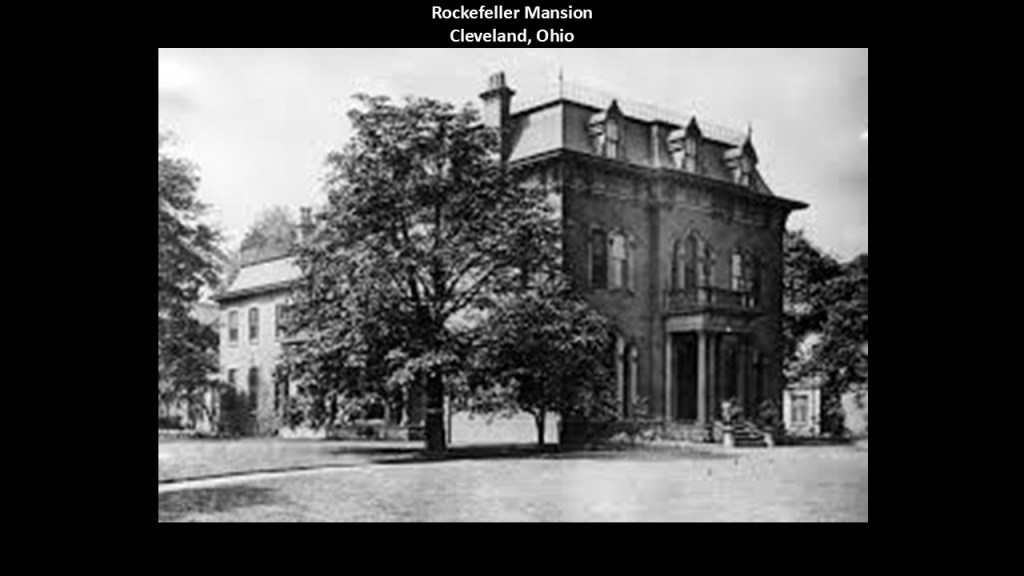
The Rudd-Rockefeller House on Euclid Avenue was purchased by Mary Ann Rockefeller, the sister of John D. Rockefeller, and her husband, William Cullen Rudd, in 1905, and remained in their family until 1966.
It is currently being restored with plans for it to become a museum.
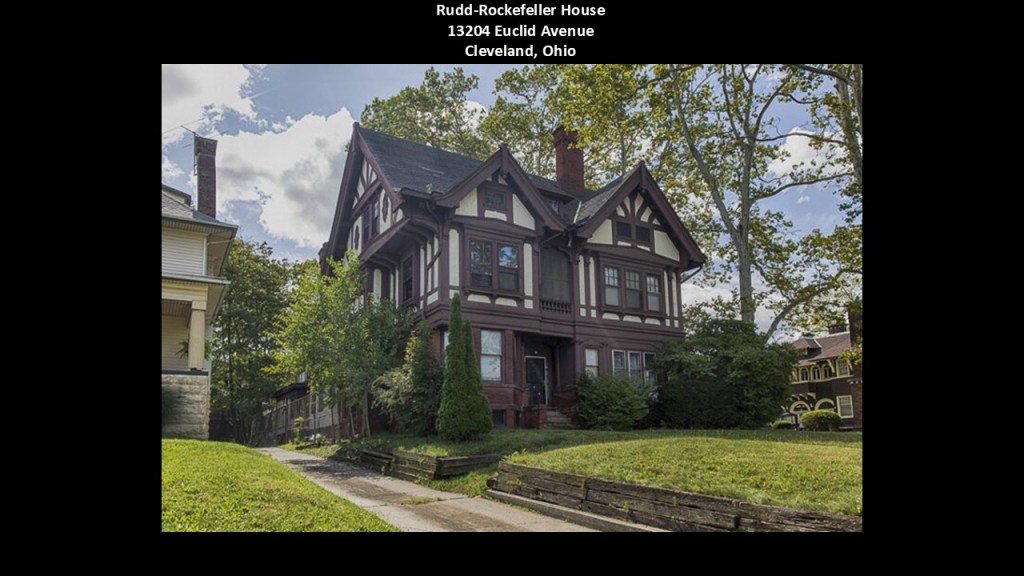
The 45-room Samuel Mather Mansion at 2605 Euclid Avenue was said to have been built between 1906 and 1910, and one of the last surviving mansions on Euclid Avenue.
The home has been owned by Cleveland State University since 1967.
This brings me to the downtown Cleveland area.
The places I am going to highlight here are the Cleveland Burke Lakefront Airport; Huntington Bank Field; the present train station and former Union Depot locations; Lighthouse Park; the Cleveland East Breakwater Lighthouse and Cleveland Harbor West Pierhead lighthouse; the Cargill Salt Mine and C & P Ore Docks on Whiskey Island, and on or near the Cuyahoga River, the Rockefeller Building; the former Cleveland Union Terminal; Rocket Arena & Progressive Field; Westside Market; Cleveland Velodrome; and one of several Ohio & Erie Canal Parks.
First, the Cleveland Burke Lakefront Airport.
Also called the Downtown Airport, it is located directly on Lake Erie.
It is a general aviation airport just north of Cleveland’s Central Business District close to major attractions and hotels in the city.
Interestingly, it is also known as the “Landfill Airport” for the given reason that during the Great Depression in the 1930s, the land it is situated on was used as a dumping site for the city’s waste.
Then we are told after it opened in 1947, the airport’s runways were expanded using dredged material from the Cuyahoga River to create solid land for the runways.
Next up is Huntington Bank Field adjacent to the Downtown Airport.
Huntington Bank Field is currently the home stadium of the National Football League’s Cleveland Browns, as well as serving as a large event venue for the community like other sporting events and concerts.
It also sits on the old landfill and dump site.
The stadium is next to the former Union Depot site and current Cleveland Train Station for Amtrak passenger service, and Lighthouse Park as well.
The former Cleveland Union Depot was said to have been built in 1866.
This picture was notated as having been taken in 1867, which would have been only two years after the end of the American Civil War in our historical narrative.
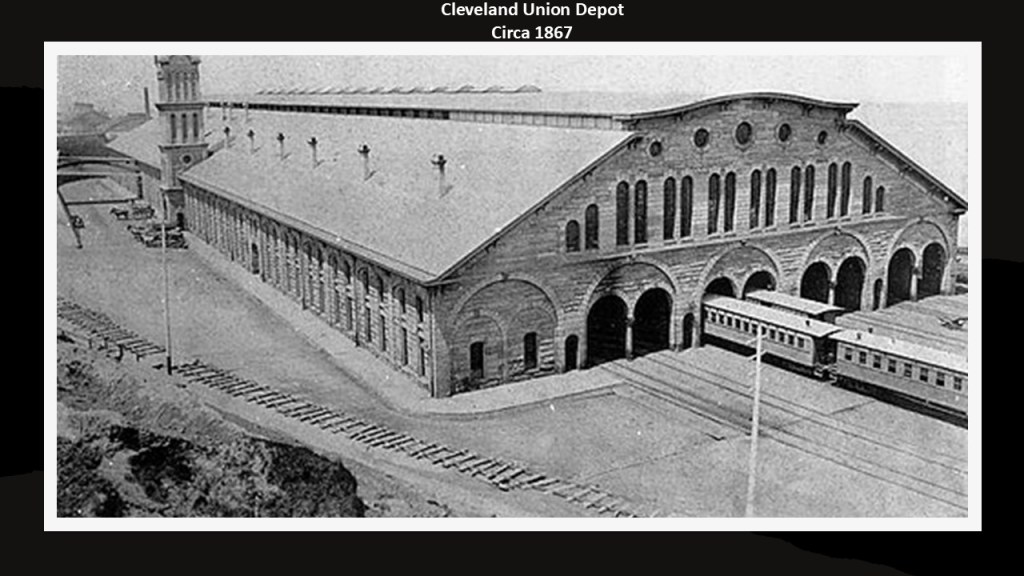
The Cleveland Union Depot was used by multiple railroads over the years.
The Pennsylvania Railroad was the only railroad still using this depot after 1930, when the Cleveland Union Terminal first opened for use in a different location, which we will come to shortly.
The Cleveland Union Depot building was demolished in 1959, six-years after the Pennsylvania Railroad stopped using it in 1953.
The Cleveland Union Depot was located where the parking lot nicknamed “the Pit” at the Huntington Bank Stadium is today, which is frequently used for tailgating during the Browns’ football games.
The nearby Cleveland Train Station, known as the Cleveland Lakefront Station, in front of the stadium not far from the former Union Depot site, has been used by Amtrak since 1977.
It serves Lakeshore Limited passenger train from New York & Boston to Chicago; the Floridian line from Chicago to Miami, and the local Rapid Transit Waterfront Line.
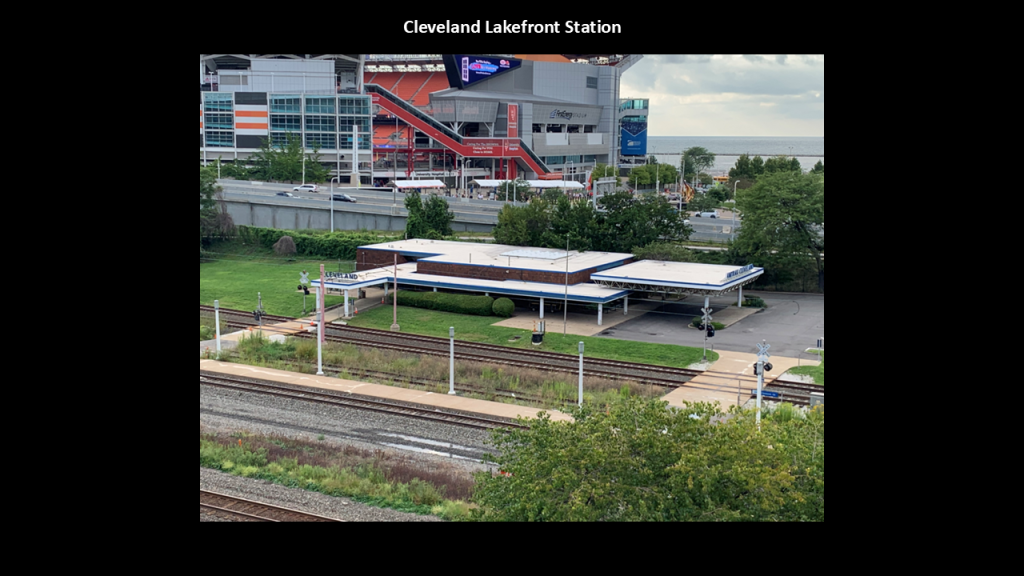
The nearby Lighthouse Park was the former location of the Cleveland Harbor Lighthouse.
The construction of the original Cleveland Harbor Lighthouse was said to have been completed in 1830 on a bluff at the end of what is now West 9th Street.
This area was a significant bluff in the 1820s and 1830s, but it has since been altered by industrial expansion in the Flats and the construction of the Main Avenue Bridge.
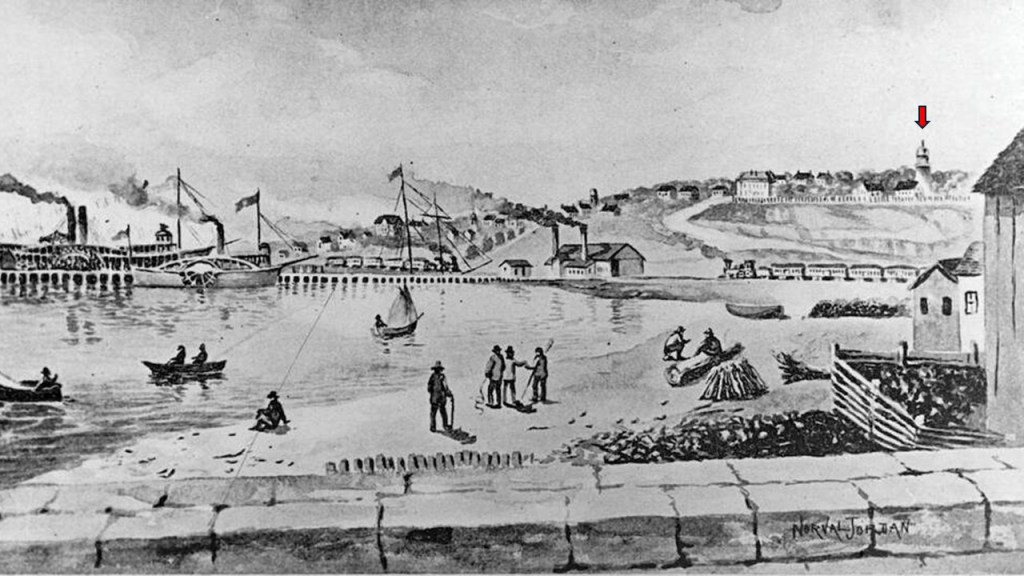
Then we are told the lighthouse tower was rebuilt in 1872, but that by 1894, only 22-years later, this lighthouse was decommissioned.
Then this structure remained until around 1937, when we are told the Main Avenue Bridge was built.
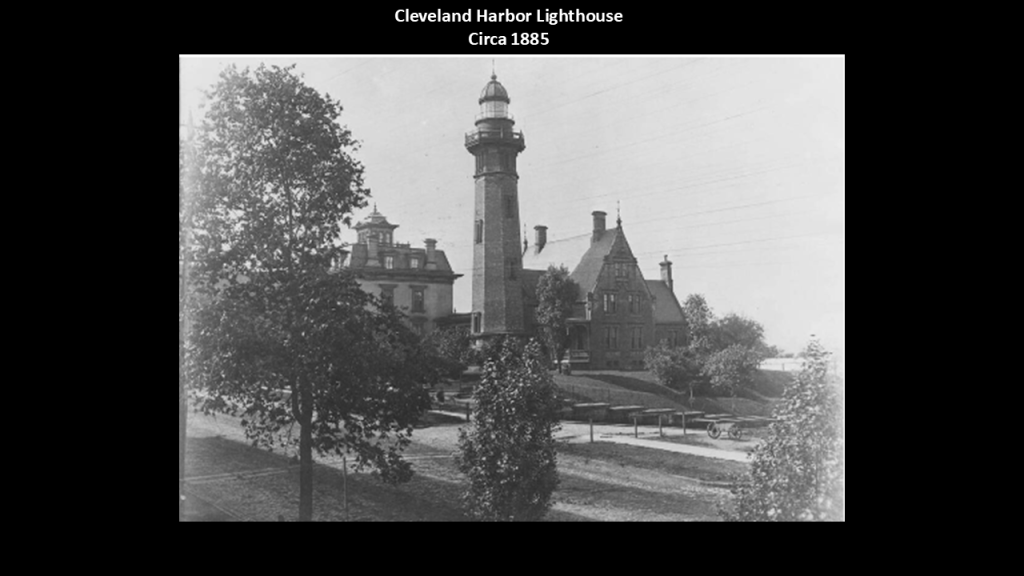
All that remains of this lighthouse are its wall and steps in Lighthouse Park. which features things like built-in seating, bench swings, electrical hook-ups for device charging, and a light-bar feature.
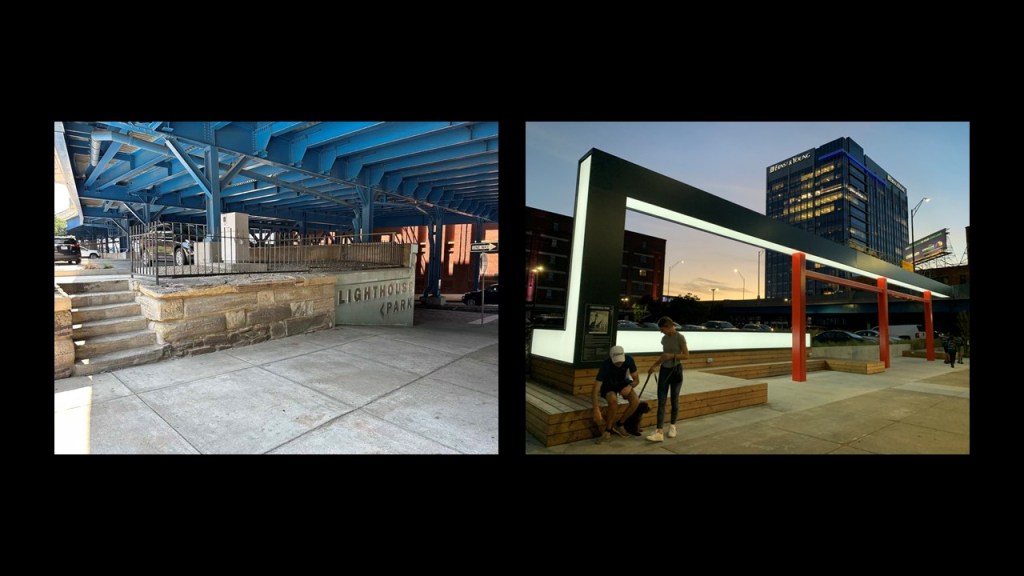
Next, the Cleveland East Breakwater Lighthouse and Cleveland Harbor West Pierhead lighthouses are located close to each other at the main entrance to Cleveland Harbor.
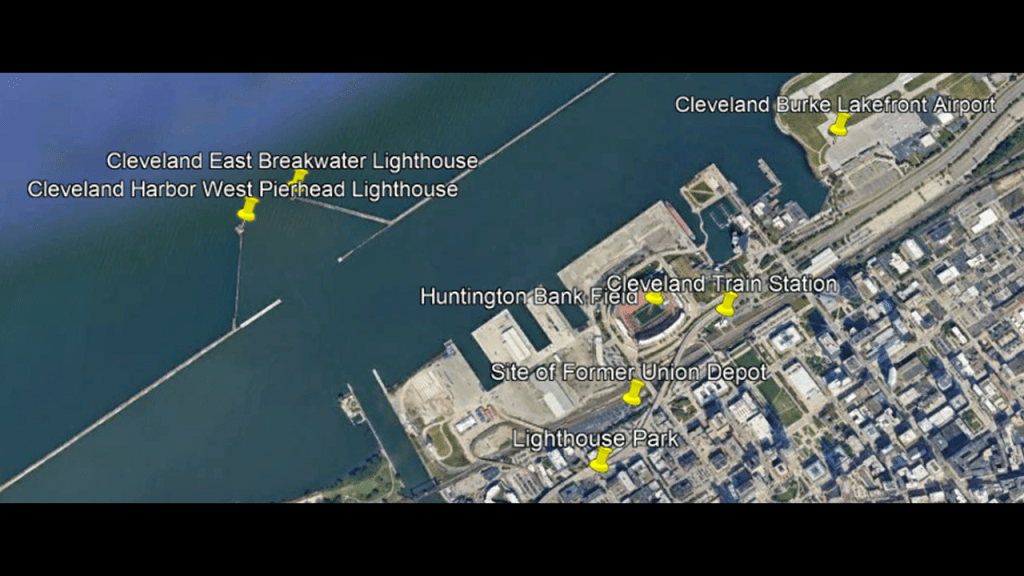
The present Cleveland East Breakwater Lighthouse was said to have been built in 1910, and that it was automated in 1959.
It is still an active navigational aid and not open to the public.
Interesting to note the megalithic stone wall next to the lighthouse.
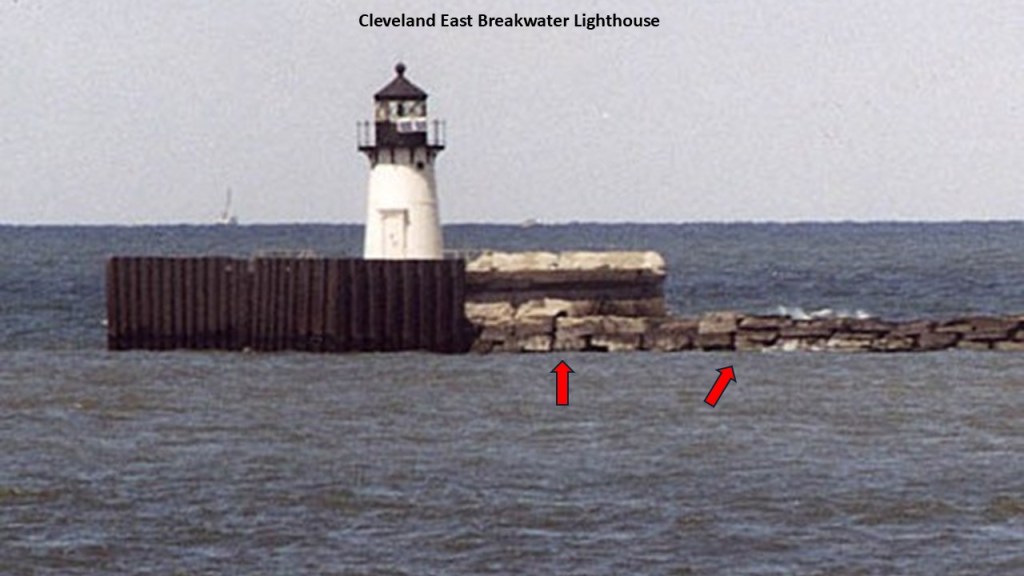
The Cleveland Harbor West Pierhead Lighthouse was said to have been built around the same time as the East Breakwater Lighthouse.
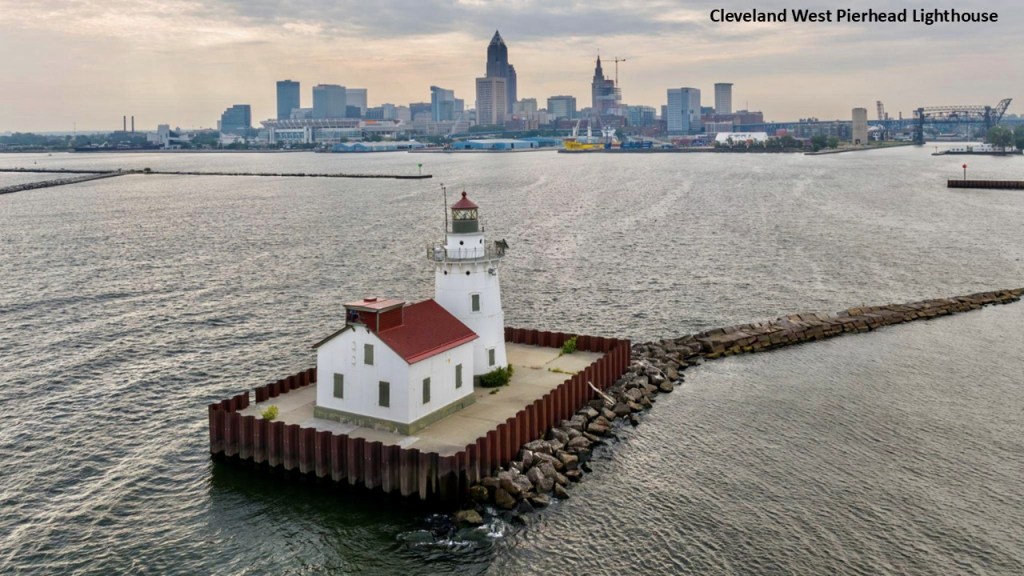
While it still functions as a navigational aid for maritime safety, the Cleveland Harbor West Pierhead Lighthouse was purchased privately for almost $500,000 at a U. S. General Services auction in 2023.
Now I am going to take a look at Whiskey Island situated on the west-side of the entrance to the Cuyahoga River, and in particular, the C & P Ore Docks and the Cargill Salt Mine.
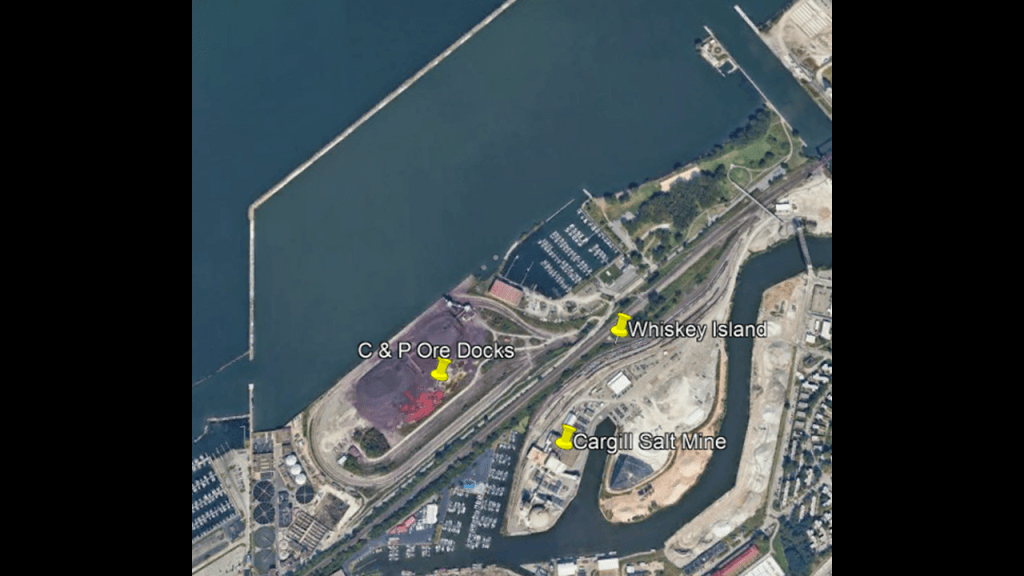
In our historical narrative, Whiskey Island was the first piece of solid land in the swamps that lined the entrance to the Cuyahoga River when Moses Cleaveland surveyed the area in 1796 for the Connecticut Western Reserve.
The first permanent settler of Cleveland, Lorenzo Carter, built his family farm on Whiskey Island, which got its name for a distillery built on the site in the 1830s.
We are told that starting with the construction of the Ohio and Erie Canal in 1825, the area was settled largely by Irish immigrants.
Then in 1831, investors from Buffalo and Brooklyn purchased the Carter farm and divided its 80-acres into allotments along 22 streets, and manufacturing plants and docks were constructed.
We are told the C & P Ore Docks were built by the Cleveland and Pittsburgh Railroad in the late 1800s, and used until they were abandoned in the 1990s.
At their peak, they handled millions of tons of iron ore every year.
The four towering Hulett Iron Ore Unloaders have been removed.
Two were removed and scrapped in 2000, and the remaining two were removed in 2024 and then scrapped.
There are some remnants of ore dock infrastructure that exist and in-use as part of the bulk terminals of the working industrial waterfront.
The Cargill Salt Mine in downtown Cleveland on Whiskey Island is one of the largest salt mines in the world, and one of two salt mines in Ohio, the other being the Morton Salt Mine in Fairport Harbor.
The Cargill Salt Mine is located 1,800-feet, or 549-meters, beneath Lake Erie and is accessed by way of Whiskey Island.
It extends roughly 4-miles under Lake Erie, or around 6-kilometers, and covers about 16-square-miles, or 41-square-kilometers.
It is a massive 24/7 salt-mining operation that produces an estimated 2.6-million to 3.5-million tons of rock salt per year, that we are told is used in large part for de-icing roads in the Great Lakes Region in the winter months.
I found the massive salt mine in Goderich when I was looking at the Ontario-side of Lake Huron in Part 4 of this series.
Goderich has significant salt mining operations at the Goderich Salt Mine, considered the largest underground salt mine in the world, and has been in operation since 1959.
The Goderich Salt Mine has a production capacity of 9-million-tons per year, and produces 7,250,000-tons per year.
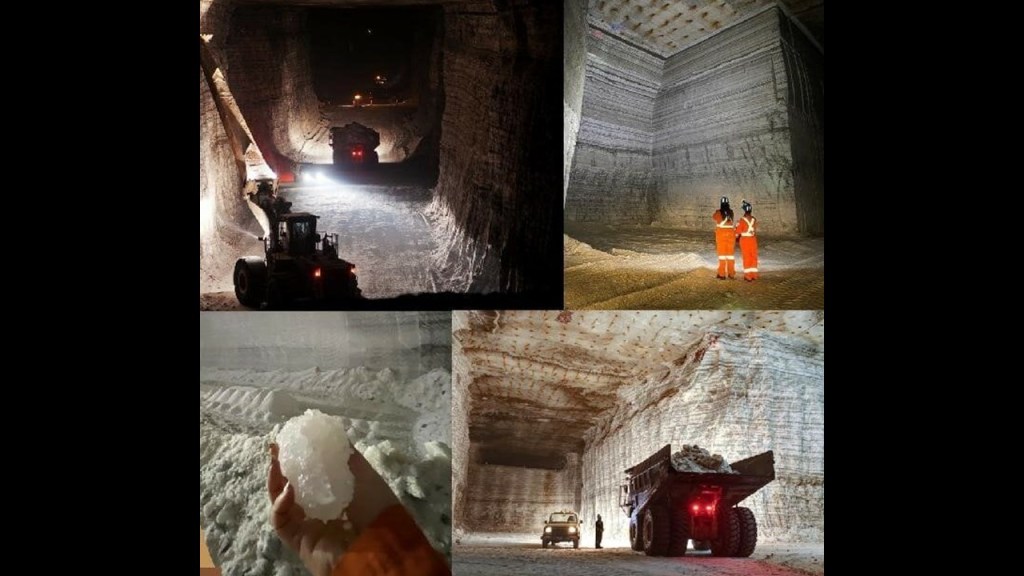
It is 1,800-feet, or 549-meters, under Lake Huron, the same distance that the Cargill Salt Mine is under Lake Erie.
To put this into perspective, these mines are as deep as the 1,815-foot, or 553-meter, CN Tower in Toronto is tall.
As I mentioned, Whiskey Island is situated next to the entrance of the Cuyahoga River.
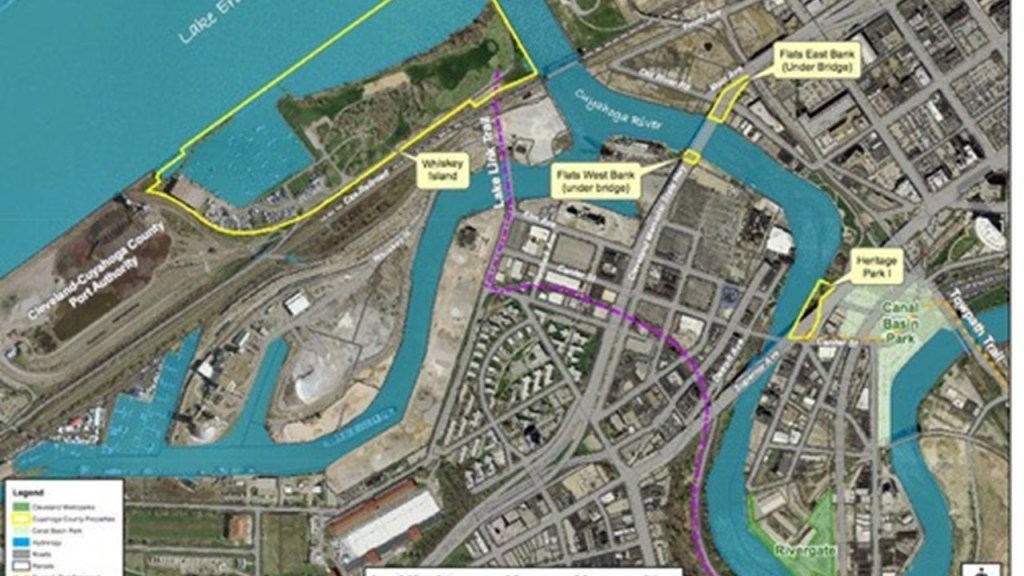
The Cuyahoga River was crucial to the industrial development of northeast Ohio, particularly Cleveland and Akron, by transporting raw materials like iron ore and coal, and powering the growth of steel, rubber, and manufacturing industries.
Cleveland became one of America’s key manufacturing centers in the late 18th- and early 19th-centuries.
Where it was located on Lake Erie made it perfect for shipping raw materials like iron ore and coal, and oil-refining and steel- and machinery-manufacturing boomed here.
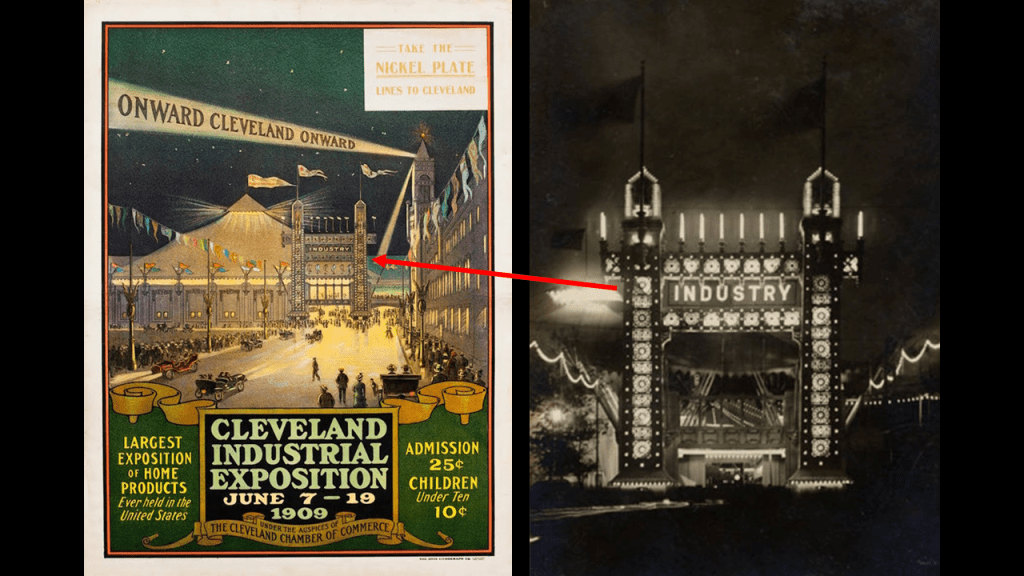
Cleveland was where John D. Rockefeller founded Standard Oil in 1870, which transformed the city into a major oil refining hub.
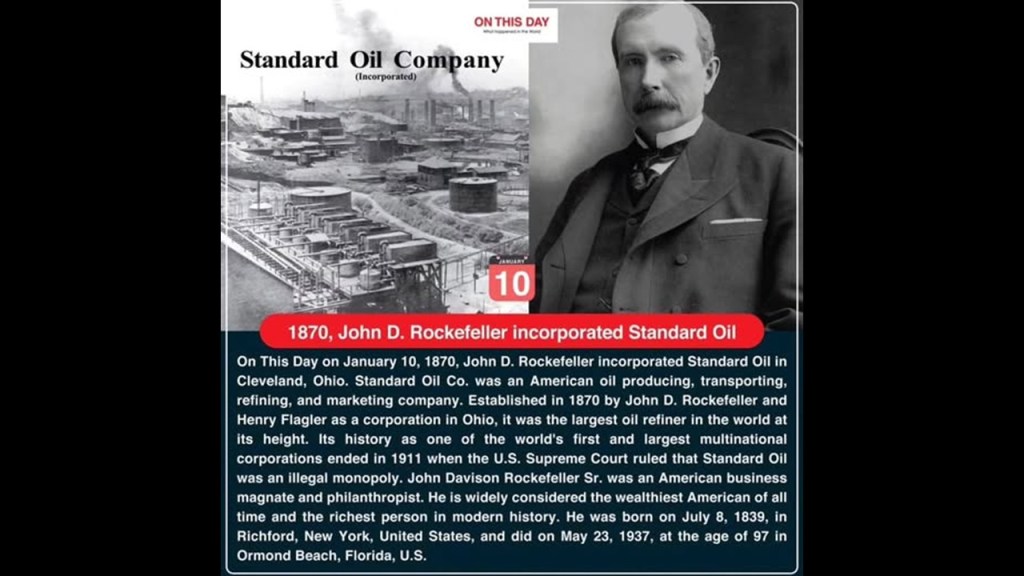
The intense industrial use of the Cuyahoga River caused extreme pollution, and the river caught fire thirteen times in our history between 1868 and 1969.
The 1969 fire on the Cuyahoga River led to the creation of the U. S. Environmental Protection Agency and the passage of the Clean Water Act in 1972 which mandated industrial pollution control and provided investments for modernizing sewage infrastructure.
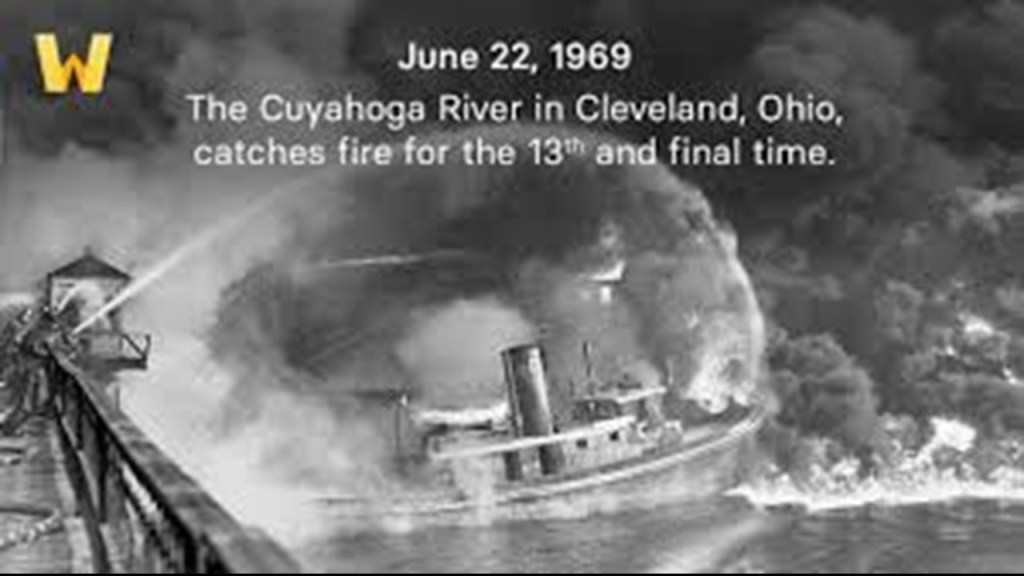
In today’s world, the Cuyahoga River has shifted to a center for recreation and tourism, though it is still a working waterway for large freighters to transport raw materials to the factories that remain.
Next I am going to look at the following places on or near the Cuyahoga River, including the location of the former Cleveland Union Terminal; the Rockefeller Building; Rocket Arena & Progressive Field; the Westside Market; the Cleveland Velodrome; and one of several Ohio & Erie Canal Parks.
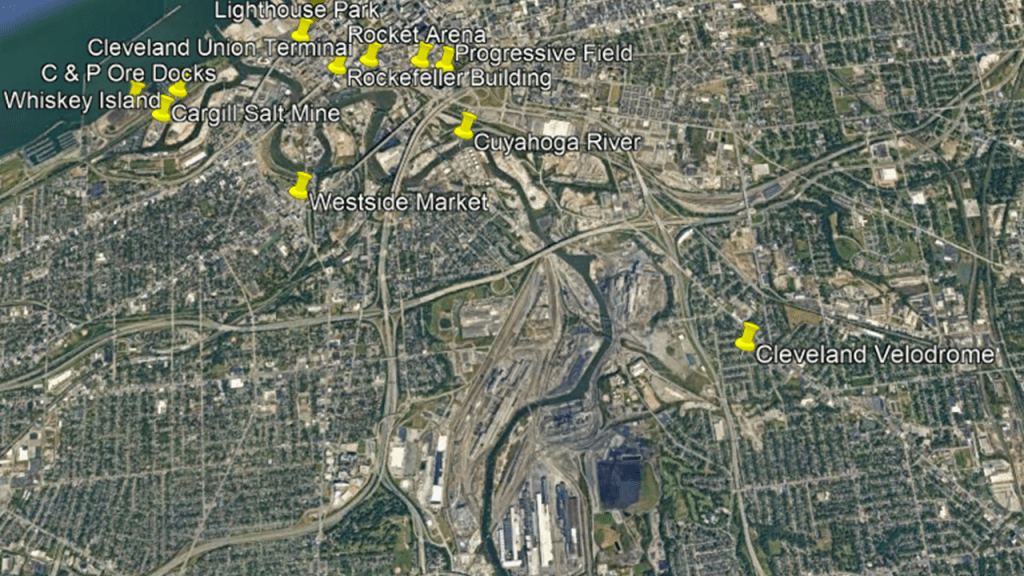
First a few things about the historic Cleveland Union Terminal.
The Cleveland Union Terminal was described as a monumental 1920s project that turned Cleveland’s Public Square into a major transportation and commercial hub anchored by the 52-story Terminal Tower.
It was said to have been constructed between 1923 and 1930.
The Terminal Tower was the tallest building in the world outside New York City, and designed to be a city inside the city, featuring shops, hotels, and a post office in addition to the train station.
When the Cleveland Union Terminal Station opened in 1930, it was one of the busiest rail hubs in the country.
Then we are told that by the 1960s and 1970s, passenger rail travel declined sharply due to cars and air travel.
As previously mentioned, Amtrak took over passenger rail service in 1971 and continued to use the Cleveland Unon Terminal Station for passenger service until 1977, when it moved over to the Cleveland Lakefront Station and that marked the end of rail service here.
Today the Terminal Tower is part of the Tower City Center, and offers shopping, dining, entertainment, office space and local RTA Rapid Transit lines still operate out of this location.
The Rockefeller building is on the other side of the street from the Tower Terminal Complex.
The Rockefeller Building was said to have been built between 1903 and 1905 at the corner of West 6th and Superior Avenue, and displays the Rockefeller name on the side of the building since it was built.
As we have already seen, John D. Rockefeller’s companies were instrumental in turning Cleveland into an industrial powerhouse.
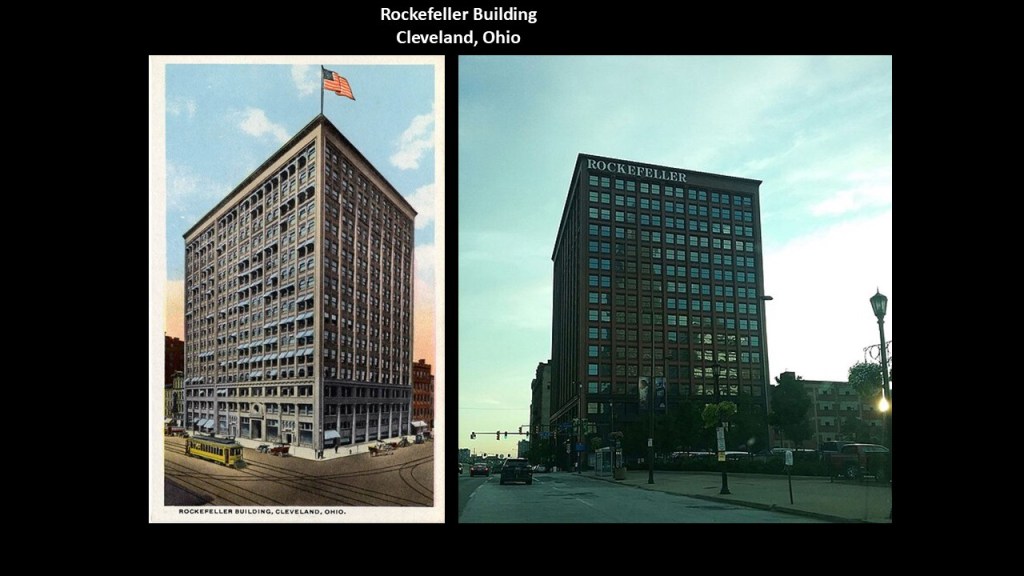
The Rockefeller Building is an entry point into the popular Warehouse District, first a historic residential area, and then the center of Cleveland’s wholesale commercial area.
These days it is a popular hotspot with things like bars, nightclubs, shops, restaurants and apartments.
The Rocket Arena and Progressive Field are directly to the east of Tower Center City and the Rockefeller Building.
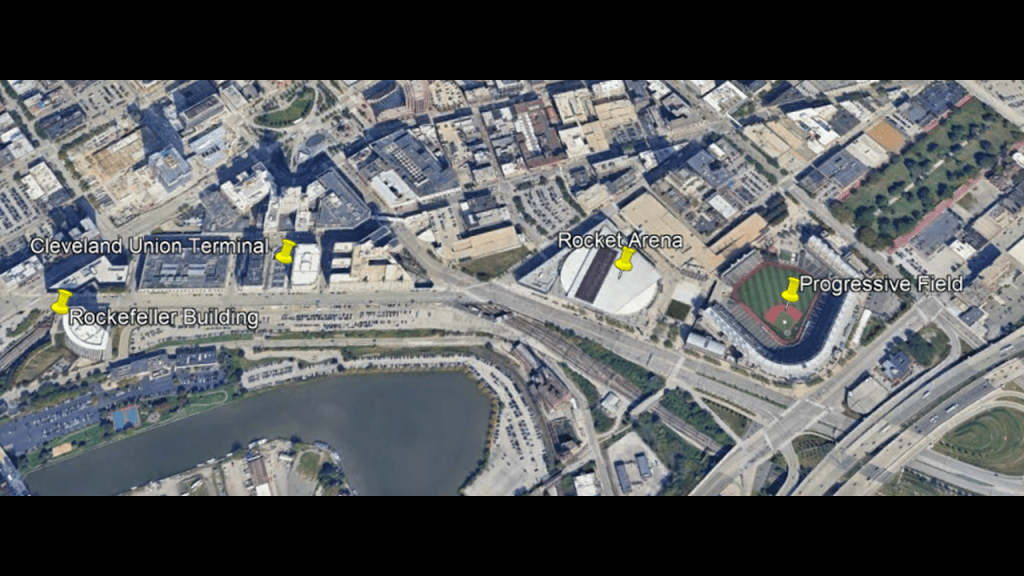
The Rocket Arena is the home venue of the NBA’s Cleveland Cavaliers and the NHL’s Cleveland Monsters, as well as being a multi-purpose venue for other sports’ teams and community events.
Progressive Field is the home venue of the MLB’s Cleveland Guardians, a team that used to be known as the Cleveland Indians.
What I find interesting is that I have found that in city after city, major league sporting venues like the three I’ve looked at in Cleveland -the Huntington Bank Field, Rocket Arena & Progressive Field – are found near railroad yards and tracks or former railroad tracks.
Like Baltimore.
Camden Yards was previously a yard for the Baltimore & Ohio Railroad, and was converted into today’s Oriole Park for the Baltimore Major League Baseball Team, first opening in April of 1992…
…and the M & T Bank Stadium, the home of the National Football League’s Baltimore Ravens, is located next to Oriole Park at Camden Yards, and first opened in September of 1998.
There are still railyards fairly close to this location today.
There are countless examples to choose from, but this gives you the idea.
I think this finding is significant and not random, and believe it’s about energy transference.
From what I am seeing in my research, the railroads were an important component for the transference of free energy on the original grid system, and I think that has been replaced by the harvesting of human energy without our awareness since everything is on or near existing and former railroad tracks, from sporting venues like these to our roadways and highways.

The last three places I want to look at before I end this post are the West Side Market; the Cleveland Velodrome; and one of the Ohio & Erie Canal Reservations on the Cuyahoga River, which are park areas.
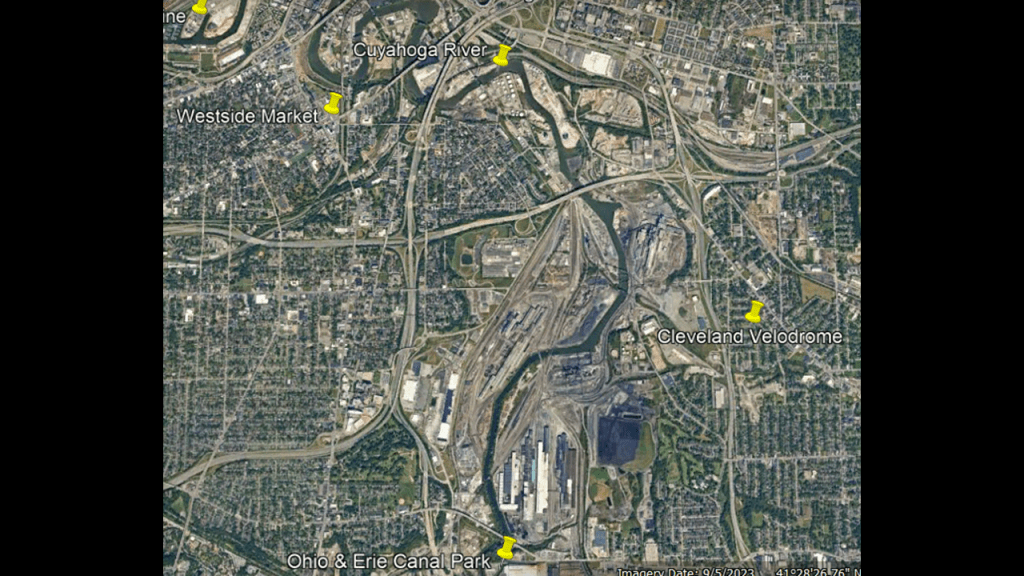
First, the West Side Market.
The West Side Market is an historic public market owned by the City of Cleveland that has been continuously operating since it first opened in 1912, and has hundreds of thousands of visitors annually.
Besides its huge variety of vendors and cultural diversity, the West Side Market building is famous for its vaulted ceiling, and 137-foot, or 42-meter, -tall clocktower.
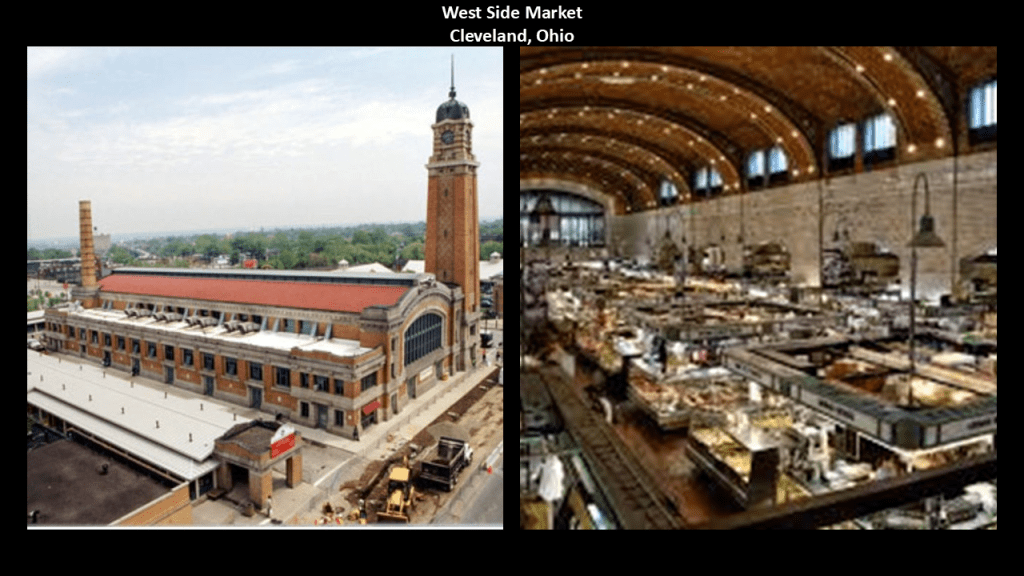
We are told this building was built specifically for the purposes of being a marketplace, but it definitely has features that remind me of a train station, like the previously seen Terminal Tower of the original Cleveland Union Terminal Station that is now Tower City Center.
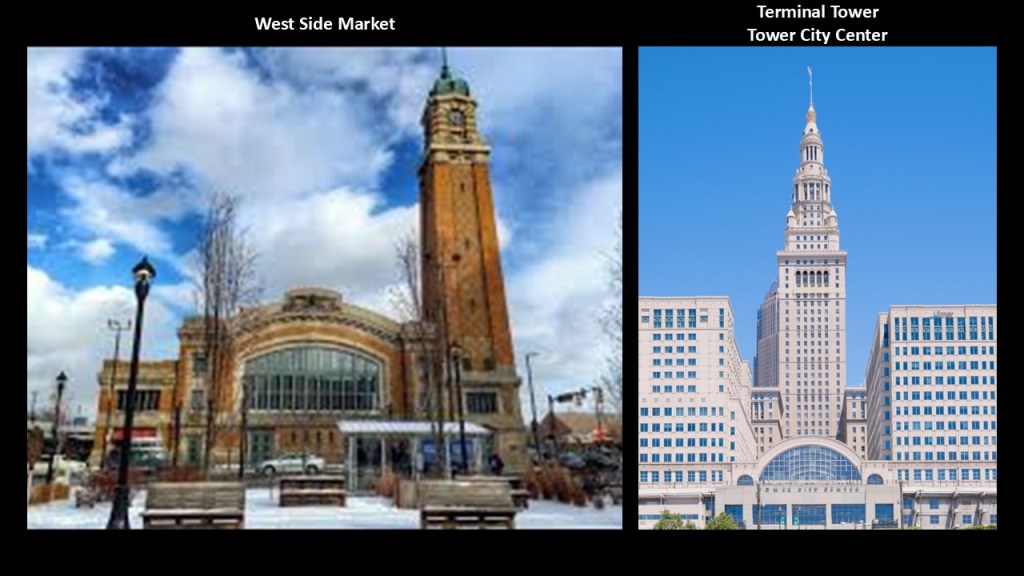
Next up, the Cleveland Velodrome.
Velodromes are arenas for track cycling, so the Cleveland Velodrome is an outdoor bicycle racing track used for track cycling.
It opened in August of 2012 and is the only velodrome in Ohio.
It features a 545-foot, or 166-meter, steep, wooden track with very steep, banked turns.
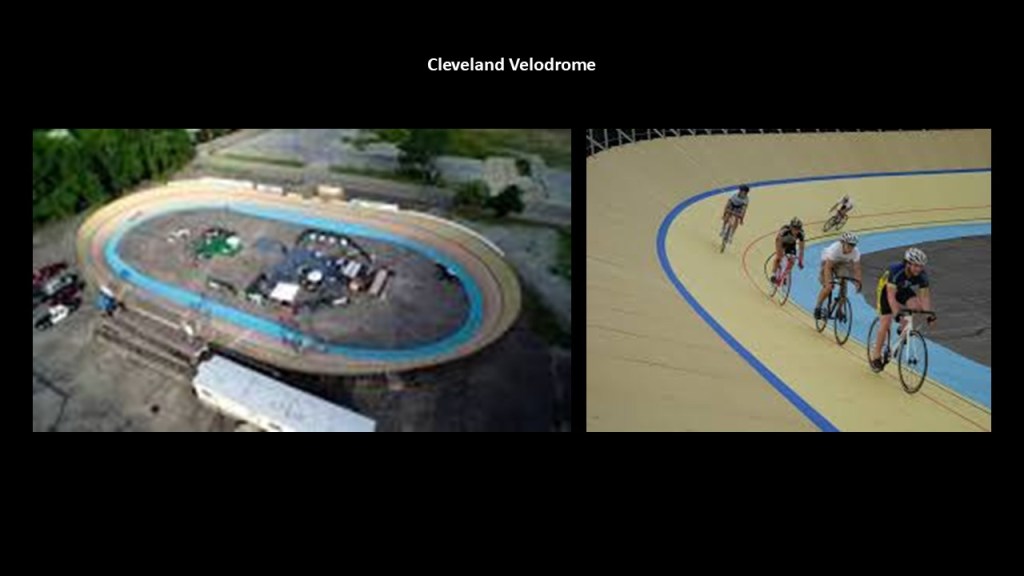
We are told the first velodromes were constructed in the late 1870s, with the oldest being the Preston Park Velodrome in Brighton, England, said to have been built by the British Army in 1877.
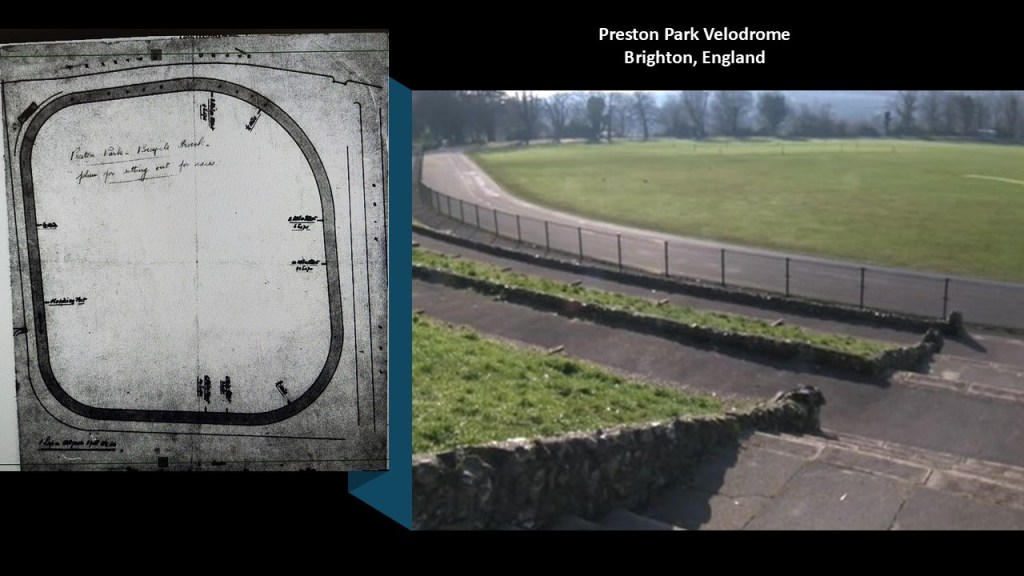
These velodromes bring to mind an historic structure that I found out about when I looked into West Baden Springs in French Lick, Indiana.
The hotel for the resort was said to have been built in 1901 in the Moorish architectural style, and from 1902 to 1913, was said to have the largest dome in the World.

Along with having a trolley system…
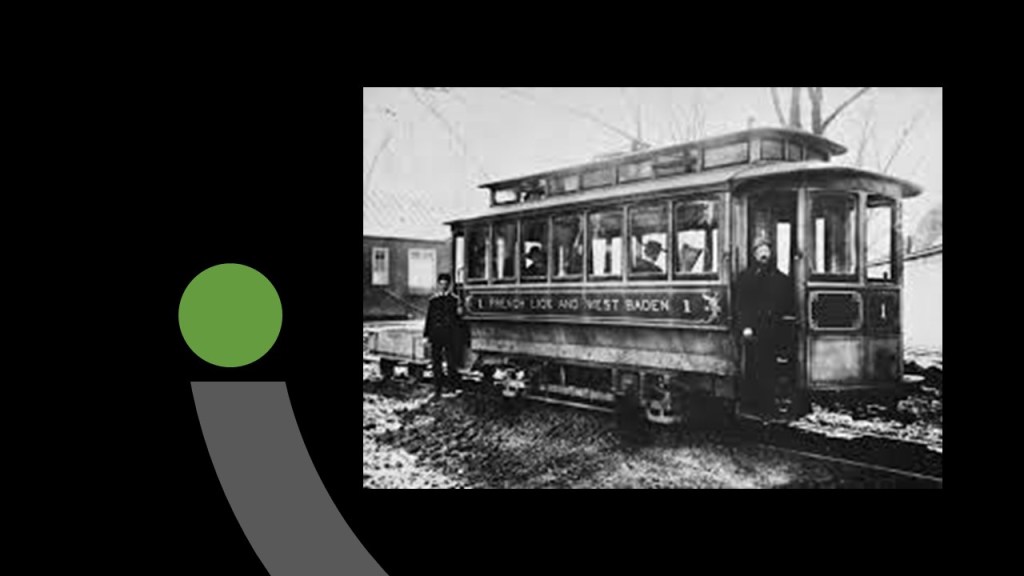
…it had the largest bicycle track in the country, which was a covered double- decker.
The double-decker bicycle track, however, was said to have been nearly demolished by a windstorm that blew through the area on July 25th of 1925…
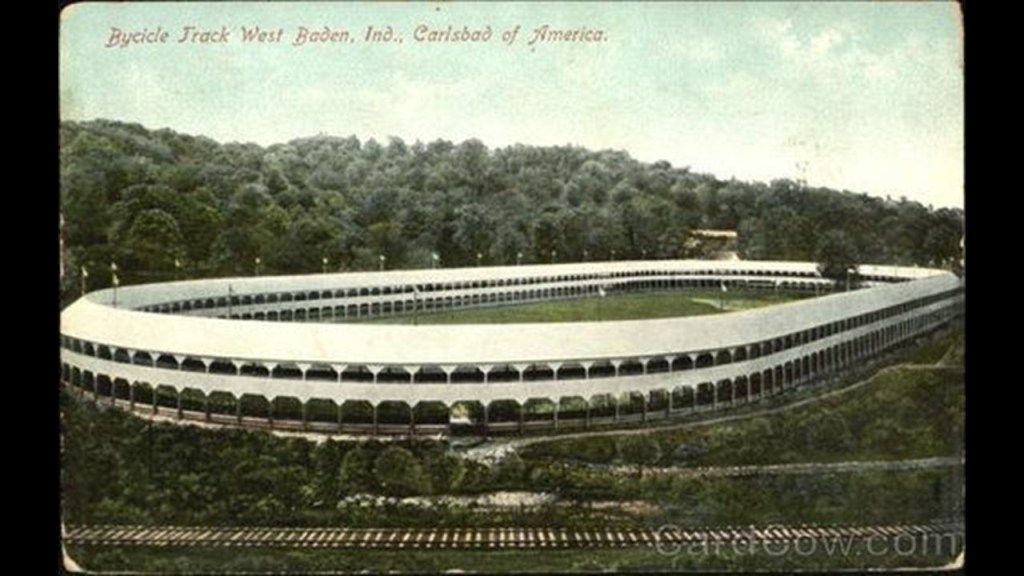
…and when the owner received an insurance check for $100,000, he tore the rest of the structure down, and it was gone by the fall of 1925.

The last place I want to look before I end this post is the Ohio and Erie Canal Reservation, which is a 325-acre, or 132-hectare, park administered by Cleveland Metroparks.
It features a 7.2-mile, or 12-kilometer, trail, on the historic Ohio and Erie Canal, and runs between Harvard Avenue in Cleveland and Rockside Road in Valley View.
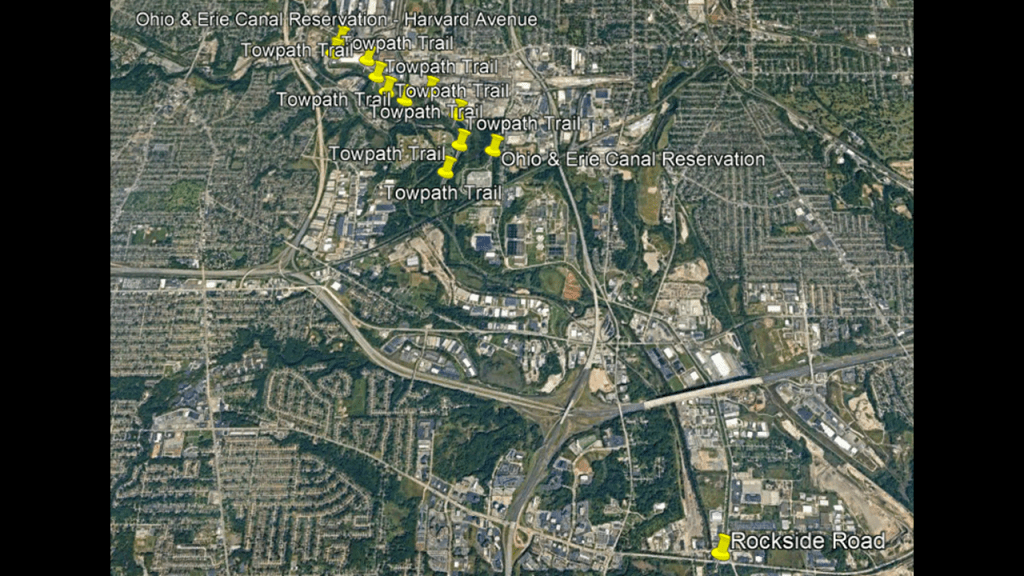
First, some background information on what we are told about the Ohio and Erie Canal.
The 308-mile, or 496-kilometer, -long canal was said to have been constructed, from 1825 to 1832 to connect Lake Erie at Cleveland with Portsmouth on the Ohio River, and that it only carried freight from 1827 to 1861, when the construction of railroads ended demand.
The year of 1861 was also the first year of the American Civil War, which ended in 1865.
Then from 1862 to 1913, the canal served as a water source for industries and towns.
In 1913, much of the canal system was abandoned after important parts of it were badly flooded.
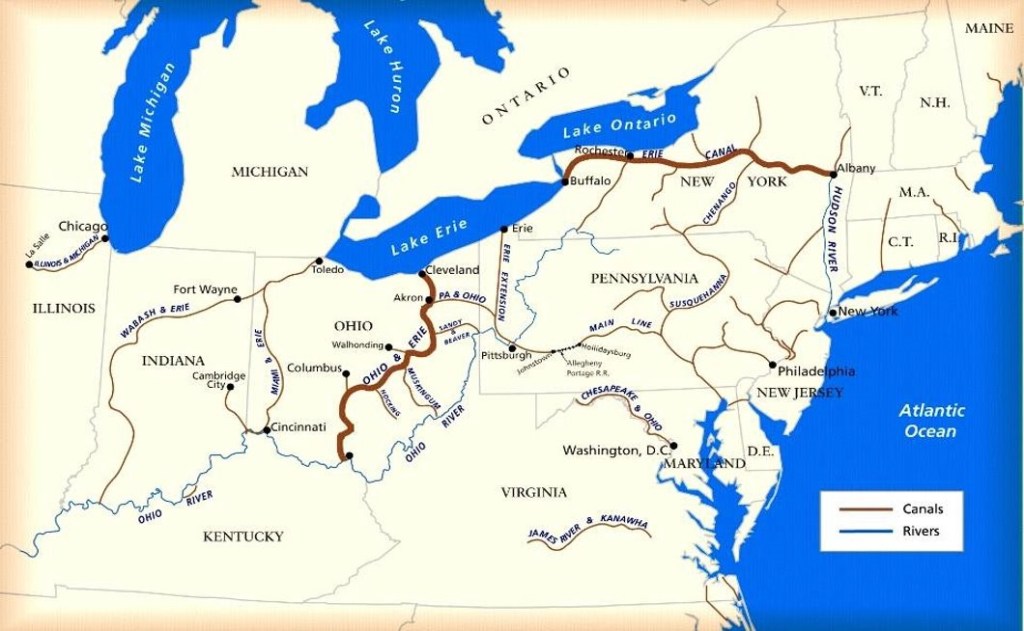
The canal was said to have been dug manually largely by Irish immigrants, who used picks, shovels, and wheelbarrows, and using horses, oxen and dynamite to clear trees and blast through rock.
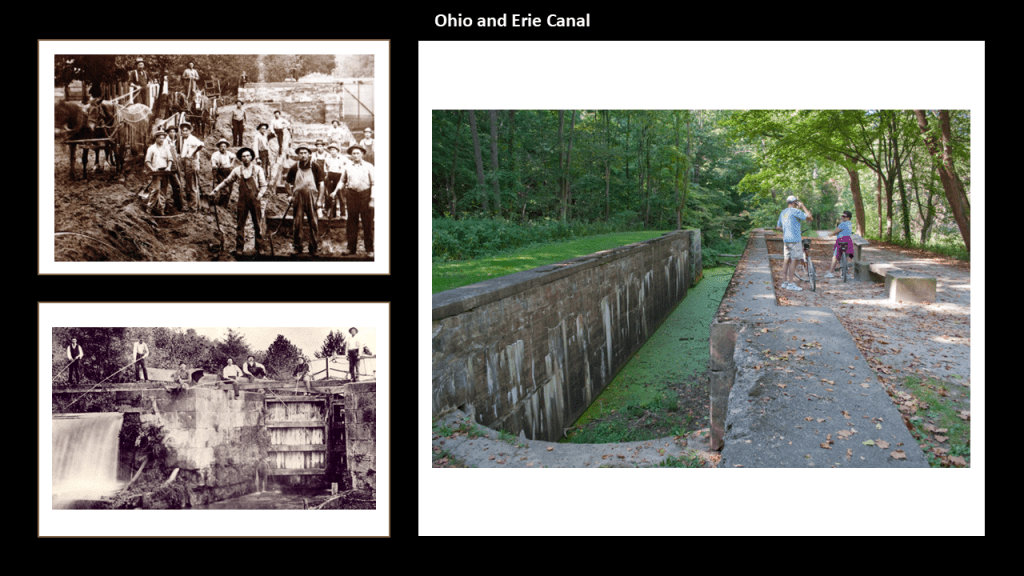
Now I would like to share with you what I found when I took a look around to see what is found on or near this Cleveland Metropark recreational parkland.
In-between the Harvard Avenue Trailhead access to the Ohio & Erie Canal Reservation to the South; the house from the movie “A Christmas Story” to the west; and the Cleveland Velodrome to the East, I found places like, but not limited to, the CSX Clark Avenue railyards; Norfolk Southern Railyards; the Cleveland Cliffs Cleveland Works, a steel manufacturer, and its railway; and Industrial Valley.
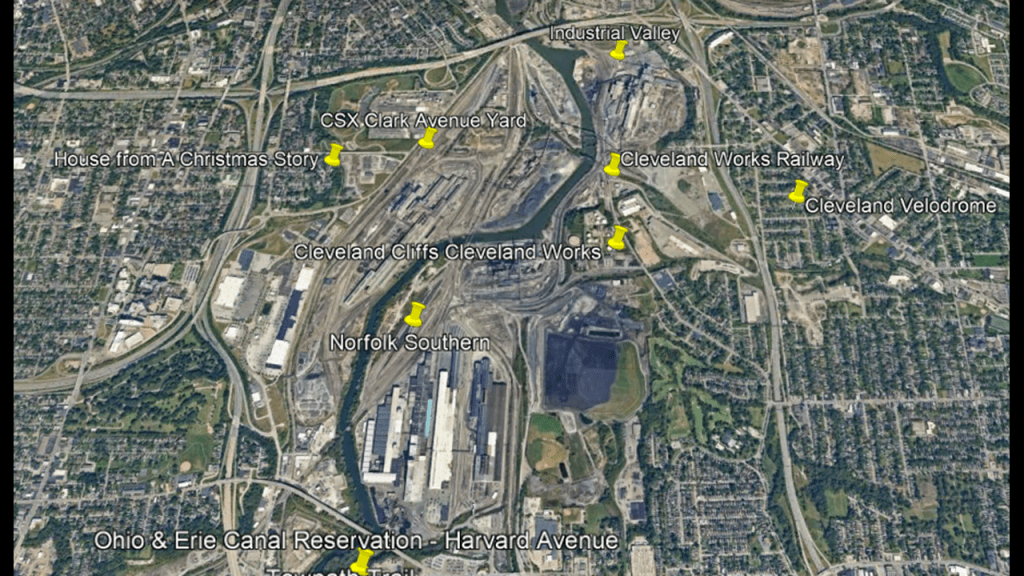
Industrial Valley, often referred to as “The Flats,” or the “Cuyahoga Valley Neighborhood,” is a heavily industrialized district along the banks of the Cuyahoga River south of downtown Cleveland.
It is a hub for heavy industry, which includes, besides the Cleveland Cliffs steel manufacturer, chemical manufacturers, petroleum terminals, and scrap metal recycling centers.
It is also the location where John D. Rockefeller established Standard Oil in 1870, cementing Cleveland’s status as an industrial powerhouse.
As we go down along the Ohio and Erie Reservation towards where it ends at Rockside Road in Valley View, we find more of the same kinds of things, like Charter Steel; storage facilities for BP Pipelines North America, which manages over 3,299-miles, or 6,150-kilometers, of pipelines transporting crude oil, natural gas and refined products; the large Southerly Wastewater Treatment Plant, and countless other industrial and commercial locations in the surrounding area.
There’s loads to unpack here at this location alone, but I would like to leave this thought for your consideration about this industrializing after finding here as well as many other places throughout this series.
Along with rewiring the original free energy grid, which was for the good of all, into what is known as the Matrix, an energy-harvesting system designed to benefit the very few, this industrial rewiring process process has transformed and inverted the original regenerative and free energy grid circuitry into an extractive energy system, and this is being done right in front of our eyes, but without our knowledge or consent as to what is actually taking place here.
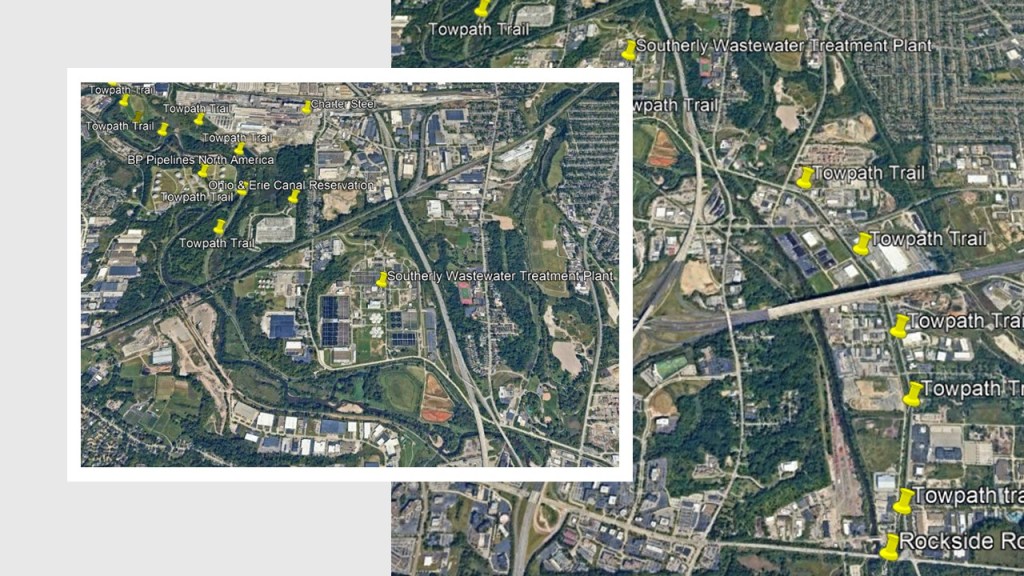
I am going to end this post here, and pick it up in west Cleveland in the next part of the series as I continue to work my way around Lake Erie to the end of this series on the Great Lakes at Fort Erie in Ontario, across the Niagara River from Buffalo, New York.
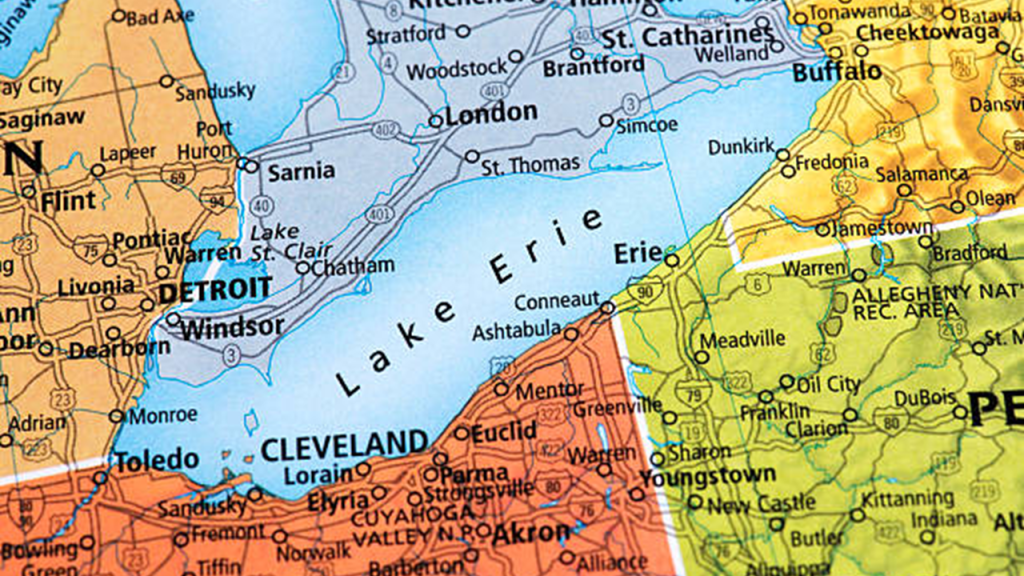

 Revealing What Has Been Hidden in Front of Our Eyes