
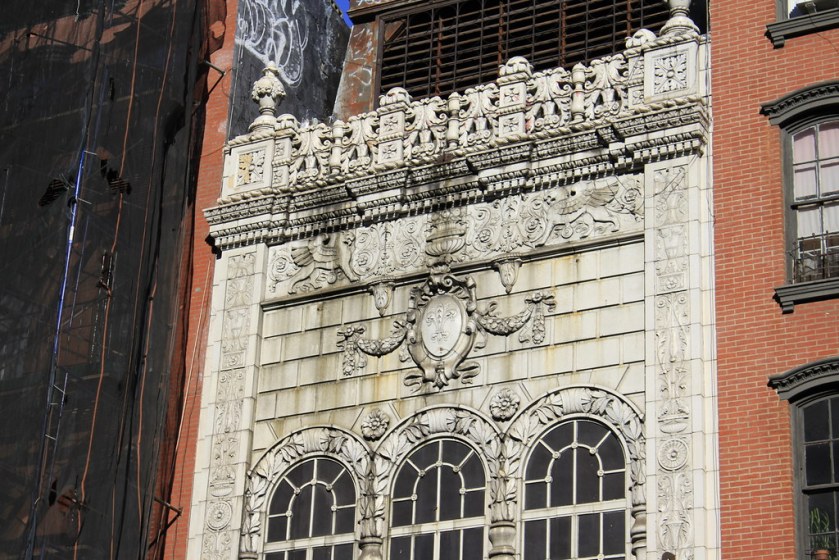
Chinatown, Manhattan, New York City, New York, United StatesThe Loews Canal Street Theatre at 31 Canal Street on Manahattans Lower East Side was constructed as a neighborhood movie house in 1926-27 at the beginning of what is generally regarded as the Golden Age of Cinema. It was commissioned by Loews Inc., which was one of the so-called Big Five within the Hollywood Studio System, and was designed by the nationally-known firm of Thomas W. Lamb, Inc.The emergence of the motion picture industry coincided closely with the growth of the Lower East Side as the citys most prominent immigrant district. The earliest experiments in the medium began in the 1870s and the first commercial exhibitions took place in the 1890s, right as hundreds of thousands of newcomersmany of Jewish faithwere settling in the area. By the early 20th century the neighborhood could claim the nations densest concentration of both human population and movie houses.Marcus Loew, the founder of the theater chain, was born to immigrant parents on the Lower East Side and became involved in film exhibition during its earliest days as a peep-show novelty. He started as an operator of penny arcades and soon moved on to larger nickelodeons and then to small-time vaudeville theaters. In the 1920s he acquired several film production companies and created the Metro-Goldwyn-Mayer, or MGM, studio. The parent company Loews Inc. remained one of the largest and most important film monopolies into the 1950s, when it was broken up following a federal anti-trust case against the Hollywood studios.From the earliest days of cinema the Lower East Side contained one of the highest concentrations of motion picture theaters in the country. The Loews Canal Street Theatre was one of several large movie houses constructed in the neighborhood during the 1920s as the national chain competed against the smaller M. & S. Circuit for control of the local market. Of these theaters, the Loews Canal Street
 Revealing What Has Been Hidden in Front of Our Eyes